Walk into any Indian grocery store on a rainy evening and notice what starts leaving the shelves. Tea, biscuits, and quite often, a packet of besan. From pakoras and kadhi to dhokla, laddoos, cheela, and bread-roll batter, gram flour quietly plays a major role in everyday Indian cooking.
That regular demand makes besan an important product for retailers, but it also brings responsibility. Customers notice quickly when a batch smells stale, feels unusually coarse, or develops a bitter taste while cooking. One poor-quality lot can affect trust and may push repeat buyers toward another store.
If you run a kirana store, supermarket, sweet shop, hotel supply business, or regional distribution network, choosing the right wholesale besan supplier for retailers can directly influence customer satisfaction and repeat sales. This guide explains what to check before buying, what questions to ask suppliers, how pricing should be compared, and how to stock gram flour more effectively.
By the end, you will know how to identify best quality besan, compare suppliers more fairly, and place your first wholesale order with greater confidence.
Why Besan Is a High-Rotation Product for Retailers
Most shops carry some version of besan, but few treat it as a strategic category. They should. Here is why:
- Year-round demand. Pakoras in monsoon, kadhi through the week, dhokla on weekends, besan laddoos during festivals.
- Frequent repurchase. Households finish a 500 g pack quickly, so the same customer returns every few weeks.
- Wide buyer base. Home cooks, tiffin services, halwais, caterers, dhabas and small snack makers all use it.
- Brand sensitivity. Customers who find a besan they trust tend to ask for it by name.
In short, besan is a staple that builds footfall. When your gram flour is dependable, customers also pick up oil, spices, rice and pulses from you in the same trip.
What Besan Is and How It Is Made
Besan, also called gram flour, chana flour or chickpea flour, is made by milling dehusked, split Bengal gram (chana dal). Some producers roast the dal lightly before grinding to deepen the nutty aroma; others mill it raw for a milder, fresher taste.
A typical production flow looks like this:
- Raw material selection: chana dal is sourced and checked for size, colour and foreign matter.
- Cleaning and grading: stones, husk and broken pieces are removed.
- Milling: the dal is ground in controlled mills to the target fineness.
- Sieving: flour passes through sieves to remove oversized particles.
- Cooling: freshly ground flour is cooled, since heat retained from milling can shorten shelf life.
- Packing: the flour is sealed in food-grade packs to guard against moisture and odours.
Every stage affects what ends up in your customer’s kadhai. A good supplier will happily explain these steps; a vague one will not.
Types of Besan and Where Each One Sells
Not all gram flour is the same grind. Knowing the grades helps you stock the right mix for your neighbourhood.
| Type | Texture | Best for | Typical buyers |
| Regular / powder besan | Smooth, fine | Pakora, kadhi, cheela, dhokla batter, everyday cooking | Households, tiffin services |
| Bareek (extra-fine) besan | Very fine, silky | Smooth batters, bread pakora, sweets needing a delicate finish | Home cooks, snack sellers |
| Motichur / mota besan | Coarse, granular | Motichur laddoo, boondi, traditional sweets | Halwais, festive buyers |
The Health Mark range covers these formats: standard Besan, Bareek Besan, Motichur / Mota Besan and Powder Besan. Having more than one grind lets a single supplier serve your home-cook customers and your sweet-making customers together, which also simplifies billing and delivery.
How to Recognise Best Quality Besan (5 Hands-On Checks)
You do not need a laboratory. A shopkeeper’s senses and a kitchen are enough to separate best quality besan from average stock.
Check 1: Smell
Fresh gram flour smells mildly sweet and nutty. A sour, musty or oily smell signals old stock, damp storage or poor packing. Reject it immediately.
Check 2: Colour
Good besan has a uniform, creamy-yellow tone. Greyish, dull or patchy colour often points to mixed raw material or ageing.
Check 3: Texture
Rub a pinch between your fingers. Quality flour feels soft and silky, not gritty. Press a handful in your palm: it should hold a loose shape briefly and then crumble, without feeling damp.
Check 4: The water-lump test
Mix two spoons of besan with water. A good flour forms a smooth batter without stubborn lumps and holds together when whisked. Poor flour stays gritty or separates.
Check 5: The pakora test
Fry a few pakoras. They should puff up, turn evenly golden and stay crisp for a while. Bitterness or a raw aftertaste means trouble with raw material or storage.
What Makes Premium High Quality Besan Different
When a supplier says premium quality besan, ask what it actually means. In practice, the difference comes down to five factors:
| Factor | What to look for |
| Raw material | Carefully selected chana dal, uniform in size and colour, free from foreign matter |
| Milling precision | Consistent fineness from batch to batch |
| Hygiene | Clean, controlled processing and packing environment |
| Moisture control | Low moisture at packing, since dampness invites lumps, odour and pests |
| Packaging | Sealed, food-grade, clearly labelled packs with batch and date details |
Health Mark describes its besan as made from carefully selected chana dal, finely ground for a smooth texture and rich nutty flavour, and hygienically processed and packed to keep it fresh and pure. For a retailer, consistency across batches matters even more than a single impressive sample.
How to Choose a Wholesale Besan Supplier (9-Point Checklist)
Finding a dependable top Besan supplier is less about the loudest advertising and more about reliability. Use this checklist when comparing options.
- Valid FSSAI licence. Ask for the licence number and verify it on the official FSSAI portal (fssai.gov.in). This is a legal requirement for food businesses in India.
- Sample before bulk. A confident supplier lets you test first.
- Batch consistency. Ask how fineness, colour and moisture are kept uniform.
- Pack size variety. You should be able to buy small, medium and large formats from one source.
- Clear labelling. Packaging should show manufacturing date, best-before date, batch number and ingredient details.
- Delivery reliability. Missed deliveries during festive peaks hurt more than a slightly higher rate.
- Transparent pricing. Rates should be clear, including taxes and transport terms.
- Responsive communication. A supplier who answers calls and WhatsApp messages promptly will usually solve problems quickly too.
- Return and replacement policy. Ask what happens if a lot arrives damaged or fails your checks.
Manufacturer, distributor or trader: which is better?
| Source type | Advantages | Watch-outs |
| Direct manufacturer | Better control over quality and freshness, often better pricing, clear accountability | May have minimum order requirements |
| Distributor / stockist | Convenient for small quantities, quick local delivery | Extra margin layer, stock age varies |
| Open-market trader | Flexible, easy to start | Inconsistent quality, loose or unbranded stock, weak traceability |
For most retailers who plan to stock besan regularly, a direct manufacturer relationship gives the strongest mix of quality and margin.
Why Sourcing From a Besan Manufacturer in India Saves Margin
When you work with a besan manufacturer in India directly, you remove one or two intermediaries between the mill and your shelf. That affects three things:
- Freshness. Flour reaches you sooner after milling, so shelf life in your store lasts longer.
- Cost. Fewer hands means fewer margins stacked on top of the product.
- Accountability. If something goes wrong, you know exactly who to call.
Health Mark operates from Plot No. 60, Industrial Township, Bhatoli Kalan, Baddi (Himachal Pradesh) 173205, a well-connected industrial hub that serves markets across northern India, including Chandigarh, Panchkula and Ludhiana. If you are a retailer in this belt, proximity can also mean quicker replenishment.
Understanding the Best Besan Price (It Is Not the Cheapest Rate)
Everyone wants the best besan price, but “best” should not mean “lowest”. Here is what actually drives the rate you are quoted:
- Chana dal market price, which moves with harvest, demand and import conditions
- Grade and fineness of the flour
- Packaging type and size (smaller packs cost more per kilo to produce)
- Order volume and delivery distance
- Payment terms
A simple margin example (illustrative numbers only)
Suppose you compare two suppliers for 1 kg packs:
| Supplier A (cheaper) | Supplier B (quality-focused) | |
| Purchase rate | Lower | Slightly higher |
| Return / spoilage rate | High (damp, off-smell lots) | Very low |
| Customer complaints | Frequent | Rare |
| Repeat purchase | Drops | Grows |
The lower rate looks attractive until you add wastage, replacements and lost customers. In real trade, best wholesale besan is the one that gives you the healthiest net margin after all those hidden costs.
How to get a sharper price legitimately:
- Consolidate besan with other staples (atta, pulses, rice, salt) from the same supplier to increase your order value.
- Plan orders ahead of festive peaks instead of last-minute buying.
- Ask about scheme benefits for regular monthly orders.
Pack Sizes: Matching Shelf Space to Shopper Behaviour
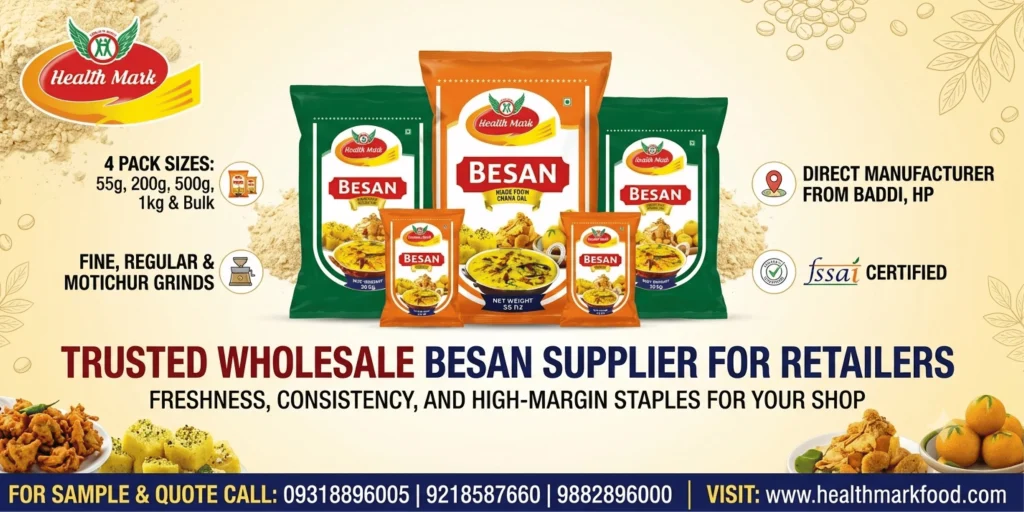
Health Mark Besan is available in four pack sizes: 55 g, 200 g, 500 g and 1 kg. Each serves a different buyer.
| Pack | Who buys it | Retail strategy |
| 55 g | Trial buyers, students, bachelors, impulse shoppers | Keep near the billing counter |
| 200 g | Small families, occasional cooks | Great for first-time brand trial |
| 500 g | Regular households | Your core fast-moving pack |
| 1 kg | Large families, tiffin services, small eateries | Offer a small bulk-buy advantage |
A balanced shelf plan might give roughly half of besan space to 500 g and 1 kg packs, with the rest split between 200 g and 55 g. Adjust after watching your own sales for a month.
Storage and Shelf Management Tips
Even the finest gram flour will disappoint if it is stored badly. Share these habits with your staff:
- Follow FIFO (first in, first out). Older stock moves forward, newer stock goes behind.
- Keep it dry. Store bags on pallets or racks, away from walls and floors.
- Avoid strong smells. Flour absorbs odours, so keep it away from detergents, incense and pungent spices.
- Stay out of direct sunlight and heat.
- Inspect monthly. Check for lumps, insects or musty smell, especially in humid months.
- Do not over-order. Besan is fast moving but not meant to sit for months. Frequent smaller orders beat one huge stock-up.
- Tell customers to reseal. A line on your shelf talker (“store in an airtight container”) builds trust.
Seven Common Mistakes Retailers Make
| # | Mistake | Better approach |
| 1 | Choosing purely on the lowest rate | Compare net margin including returns and complaints |
| 2 | Skipping the sample test | Always test aroma, texture and frying performance |
| 3 | Ignoring manufacturing dates | Check dates on every delivery |
| 4 | Stocking only one pack size | Offer small, medium and large formats |
| 5 | Poor storage during monsoon | Raise stock off the floor and inspect weekly |
| 6 | Buying from unlicensed sources | Verify the FSSAI licence number |
| 7 | Not planning for festivals | Pre-book coarse and fine stock before peak season |
Nutrition: What Customers Are Asking About
Health-conscious shoppers increasingly ask what is inside their flour. According to USDA FoodData Central, chickpea flour (the same as besan) provides roughly 22 g of protein and around 11 g of dietary fibre per 100 g, with about 387 kcal. Besan is also naturally gluten-free, which is why it features in many gluten-free kitchens.
Those numbers explain besan’s reputation as a protein-rich pantry staple. Still, values vary by product and brand, so always refer to the nutrition panel on the pack, and encourage customers with specific dietary needs to consult a qualified nutritionist.
For retailers: a simple shelf-talker such as “Gram flour: a naturally gluten-free, protein-rich staple” helps health-minded customers choose, without making medical claims.
What Actually Makes a Top Selling Besan in India
Search online and you will find endless lists of the top selling Besan in India or claims about the No 1 besan brand. The honest truth is that rankings differ by city, price band and retail channel, and no single public figure settles it for every market.
What consistently drives sales at the shop level is more practical:
- Reliable fine texture that delivers soft dhokla and crisp pakoras
- Fresh aroma the moment the packet is opened
- Trusted pack sizes that fit household usage
- Clean, readable packaging with dates and batch details
- Steady availability, so customers never find an empty shelf
- Word of mouth from neighbours and cooks
When your customers repeat-buy a brand without asking for discounts, that brand is your personal number one. Choose a supplier who helps you build exactly that kind of loyalty.
Health Mark Besan: Product Overview
If you are searching for a wholesale besan supplier for retailers in northern India, Health Mark is worth adding to your shortlist. The brand offers a focused besan range alongside atta, pulses, rice, spices, oils and other daily staples, so one supplier can fill several shelves.
Health Mark Besan at a glance:
| Feature | Details |
| Raw material | Carefully selected chana dal (Bengal gram) |
| Texture | Smooth, finely ground |
| Flavour | Rich, nutty aroma |
| Best for | Pakora, dhokla, kadhi, cheela, laddoo and other sweet and savoury recipes |
| Processing | Hygienically processed and packed to preserve freshness |
| Pack sizes | 55 g, 200 g, 500 g, 1 kg |
| Other besan formats | Bareek Besan, Motichur / Mota Besan, Powder Besan |
| Location | Baddi, Himachal Pradesh |
Why retailers like this kind of range:
- Four pack sizes cover trial buyers, daily households and bulk cooks.
- Multiple grinds mean one supplier can serve both snack lovers and sweet makers.
- Simple, familiar product positioning that is easy for your staff to explain at the counter.
Whether it becomes your best Besan seller depends on your own taste tests and customer feedback, so request a sample and let your shoppers decide.

How to Place Your First Wholesale Order
Starting is simpler than most retailers expect. Follow these steps:
- Decide your mix. Estimate how many 500 g and 1 kg packs your store sells weekly, and whether you want fine, coarse or both.
- Contact the sales team. Call 09318896005, 9218587660 or 9882896000, or message on WhatsApp through the product page.
- Share your details. Tell them your location, expected monthly volume, preferred pack sizes and whether you also need other staples.
- Ask for a sample and a quote. Request rates, tax details, delivery terms and minimum order quantity in writing.
- Test the sample. Run the five checks from Section 4.
- Place a small trial order. Track sell-through for two to four weeks.
- Scale up. Move to regular scheduled orders once you are satisfied.
Looking for a besan seller near me? If you are in or around Chandigarh, Panchkula, Baddi or Ludhiana, mention your town when you call. Nearby delivery can shorten lead times and keep your stock fresher.
FAQ
1. Who is the best wholesale besan supplier for retailers?
The right supplier is the one that delivers consistent fineness, a fresh nutty aroma, clear labelling and dependable delivery, not just the lowest quote. Compare at least two or three suppliers using the 9-point checklist above, test samples from the same batch you will receive, and verify the FSSAI licence number before ordering in bulk.
2. Where can I buy besan in bulk for my shop?
You can buy besan in bulk directly from manufacturers, authorised distributors or wholesale markets. Direct manufacturers usually offer better freshness and accountability. To buy besan from Health Mark, call 09318896005, 9218587660 or 9882896000, or use the enquiry option on the product page.
3. How do I identify premium quality besan?
Look for a creamy-yellow colour, a mildly sweet and nutty smell, a silky texture with no grittiness, and a smooth batter when mixed with water. Premium flour also fries into evenly golden, crisp pakoras with no bitter aftertaste. Clear manufacturing and best-before dates on the pack are another good sign.
4. What is the difference between fine (bareek), coarse (mota) and regular besan?
Fine or bareek besan is silky and ideal for smooth batters and delicate sweets. Coarse or mota besan is granular and suited to motichur laddoo and boondi. Regular powder besan sits in between and works for everyday dishes such as kadhi, pakora and dhokla.
5. What pack sizes should a retailer stock?
Most shops do well with a mix: 55 g for trial and impulse buyers, 200 g for small families, 500 g as the core fast-moving pack, and 1 kg for large households and small eateries. Health Mark offers all four sizes, so you can adjust the ratio based on your own sales data.
6. What affects besan price in wholesale?
Price depends mainly on the market cost of chana dal, the grade and fineness of the flour, packaging format, order quantity, delivery distance and payment terms. Since raw material prices move through the year, ask for a written quote and compare net margin after wastage, not only the headline rate.
7. How long does besan stay fresh in a store?
Shelf life depends on the manufacturer’s best-before date, moisture and storage conditions. Keep stock dry, cool, off the floor and away from strong odours, follow first-in-first-out, and inspect packs monthly. Always rely on the date printed on the pack rather than a general rule of thumb.
8. Is besan gluten-free and nutritious?
Besan is made from chickpeas, so it is naturally gluten-free, and USDA data shows chickpea flour to be a good source of plant protein and fibre. Individual products differ, so check the nutrition panel. People with allergies or medical conditions should seek advice from a qualified professional.
9. Can I get other kitchen staples from the same supplier?
Yes. Health Mark also supplies atta, pulses, rice, salt, sugar, spices and more, which lets retailers combine products into a single order and simplify delivery and billing. Browse the full range on the Health Mark website.
10. Which certifications or licences should I ask a besan supplier for?
At minimum, ask for the supplier’s FSSAI licence number and confirm it on the official FSSAI portal. Also check that packaging carries mandatory label details such as ingredients, net weight, manufacturing and best-before dates, batch number and manufacturer address.
Conclusion: Build Your Besan Shelf on Trust
Besan may look like a simple product, but it quietly decides whether many shoppers see your store as reliable. The retailers who win are the ones who test before they buy, think about margin beyond the headline rate, store stock properly and choose a supplier who delivers the same quality every time.
To recap:
- Test aroma, colour, texture, batter and frying performance on every new supplier’s sample.
- Choose a wholesale besan supplier for retailers that offers batch consistency, multiple pack sizes and dependable delivery.
- Judge price by net margin, not by the lowest quote.
- Stock a smart mix of fine, coarse and regular grades, and plan for festive peaks.
- Store flour dry, rotate with FIFO and inspect monthly.
Ready to strengthen your gram flour category? Explore Health Mark Besan, browse the full besan category, and speak to the sales team for samples and wholesale rates.