
Open any Indian kitchen cupboard and you will almost certainly find a steel dabba with a yellow-stained lid. Haldi goes into nearly everything: the first tadka of a dal, the sabzi on a weekday evening, the glass of warm milk when someone has a cold. Because we use it so often, we rarely stop to ask whether the packet we bought is actually any good.
That is a mistake worth fixing. Premium turmeric powder is not just a brighter shade of yellow. It is a spice made from well-grown, properly dried roots, ground without scorching, free from added colour or fillers, and sealed so that its aroma survives until you open the pack. A poor one tastes flat, bitter or chalky, and in the worst cases it can carry something that should never be in food.
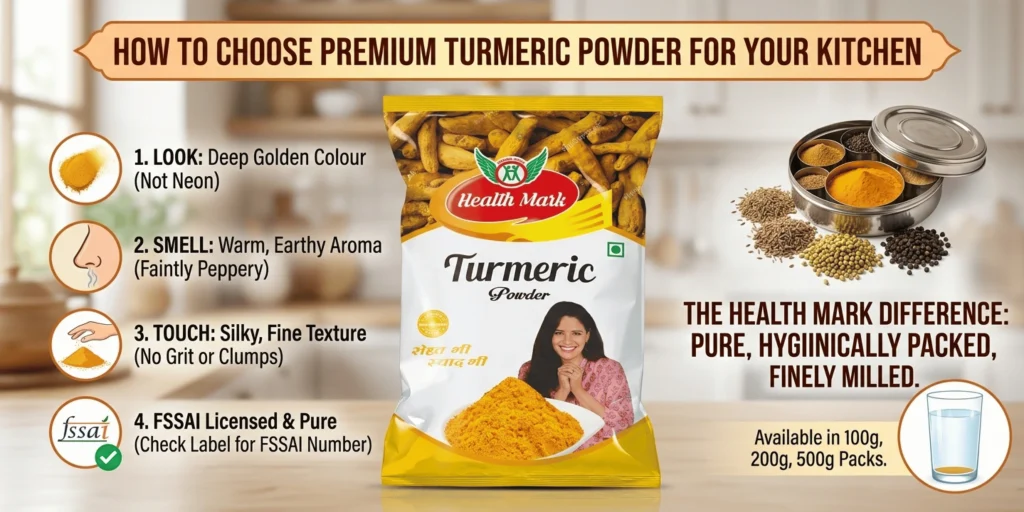
This guide shows you how to tell the difference before you pay. You will learn what to look for in colour, smell, texture and packaging, how to run quick home checks, how to read a label, and how to use turmeric so a good pack gives you its best. Whether you shop for a family of four or buy in bulk for a small kitchen, the same checks apply.
What Makes Turmeric Powder Premium?
Turmeric comes from the dried, boiled and polished rhizomes of Curcuma longa. Everything that separates a premium pack from an average one is decided long before it reaches the shelf: in the field, at the drying yard and in the mill.
1. The quality of the root
Indian turmeric powder has a global reputation because India grows and uses more turmeric than any other country. But the roots are not all alike. Variety, soil, rainfall and harvest timing change the colour, the aroma and the amount of curcumin, the pigment responsible for turmeric’s golden shade.
- Common commercial varieties usually contain roughly 2 to 5 per cent curcumin by weight.
- Lakadong turmeric from Meghalaya is often reported at 7 to 9 per cent, which is why it is sold at a higher price.
- Alleppey and Erode types are widely prized for deep colour and a balanced, earthy flavour.
You do not need the highest curcumin figure to cook well. For daily cooking, what matters is that the root was mature, fully dried and free from mould.
2. Proper curing and drying
Fresh rhizomes are boiled, dried in the sun until they snap cleanly, and then polished. Rushed drying leaves excess moisture, and moist roots grow mould and lose aroma quickly. The FSSAI standard for haldi powder caps moisture at 10 per cent, total ash at 9 per cent and acid-insoluble ash (a sign of dirt and sand) at 1.5 per cent. A responsible turmeric powder manufacturer tests against these limits and does not leave them to chance.
3. Clean milling at a controlled temperature
Grinding generates heat, and heat drives off the volatile oils that carry turmeric’s fragrance. Processing guidance from Practical Action notes that grinding temperature should be kept as low as possible so that aroma compounds are not lost, and that the powder should be sieved until it is uniformly fine. This is why aromatic turmeric powder from a well-run mill smells noticeably livelier than a pack that was ground hot and stored for months.
4. Absolute purity
FSSAI rules require haldi powder to be free from lead chromate, added starch and any foreign colouring. This is the single most important point on the list. A pack can look spectacular and still fail it, which is exactly why colour alone should never decide your purchase.
5. Honest labelling
A premium turmeric spice powder names its single ingredient (turmeric), lists the pack weight, shows a batch number and dates, and prints the FSSAI licence number. You can verify food business licences on the FSSAI website.
How to Identify Pure Haldi Powder: The Five-Sense Checklist
You do not need a laboratory to screen a pack of pure haldi powder. Your eyes, nose and fingers will catch most obvious problems, and a glass of water will catch a few more. Treat these checks as a first filter, not a certificate.
Look: colour should be golden, not glowing
Good turmeric powder is a warm golden-orange with a slightly muted, earthy depth. If the colour is an intense, almost fluorescent lemon yellow, be suspicious. A study of turmeric across Indian cities, reported by Down To Earth, traced high lead levels to lead chromate, a yellow pigment used in paints and plastics that is added to make poor-quality roots look better. The report found loose powder and polished roots among the worst affected, with packaged branded powder also testing positive in some samples.
Smell: warm, earthy and a little peppery
Open the pack, or press the sealed pouch gently and sniff. Real natural turmeric powder smells warm, woody and faintly bitter-peppery. A weak, dusty or musty smell means the spice is old, stale or stored damp. A sharp chemical or oddly sweet note is a red flag.
Touch: silky and light, not gritty or heavy
Rub a pinch between your thumb and forefinger. A well-sieved, finely ground turmeric powder feels smooth and almost powdery-soft. Grit suggests sand or coarse husk. Heavy, clumpy powder that clings together suggests moisture or fillers such as starch.
Taste: clean, not harsh
A tiny pinch on the tongue should taste earthy and mildly bitter. Chalky, sour or sharply metallic flavours mean the product is stale or contaminated. Never taste anything that smells chemical.
Test: the water settling check
- Fill a clear glass with room-temperature water.
- Gently drop in half a teaspoon of turmeric powder without stirring.
- Watch for a minute or two. Pure powder tends to sink slowly and tint the water a pale yellow. Powder with added colour often releases bright streaks or an unnaturally strong yellow almost at once.
This check is indicative only. Water cannot detect every adulterant, and a clean result does not prove safety. For definitive answers, FSSAI-recognised laboratories test for lead chromate, metanil yellow and added starch. FSSAI also publishes its DART (Detect Adulteration with Rapid Test) booklet, which explains simple screening methods for common spices.
Red flags at a glance
- No FSSAI licence number on the label
- A price far below the market rate for comparable packs
- A bright, almost neon colour
- Loose, unlabelled powder sold from an open sack
- No manufacturing or best-before date
- A mouthfeel that is sandy or sticky
Premium vs Ordinary Turmeric: A Side-by-Side Comparison
The table below turns the earlier checks into one quick reference. Screenshot it before your next trip to the shop.
| What to check | Premium haldi powder | Ordinary or low-grade powder |
| Colour | Deep golden-orange, slightly earthy | Pale and dull, or unnaturally bright yellow |
| Aroma | Warm, earthy, faintly peppery | Faint, musty, or sharply chemical |
| Texture | Silky, uniformly fine, free-flowing | Gritty, lumpy or clumping |
| Ingredients | Turmeric only | May contain starch, fillers or added colour |
| Water test | Settles slowly, pale yellow tint | Streaks of strong colour appear fast |
| Packaging | Sealed, airtight, opaque or laminated pouch | Loose, open sack, or thin transparent bag |
| Label | FSSAI number, batch, pack and best-before dates | Missing or vague information |
| Price | Fair market price for the quality | Suspiciously cheap, or priced high with no proof |
| Cooking result | Even golden colour, rounded flavour | Muddy colour, bitter or flat taste |
| Shelf life | Aroma stays for months when stored well | Fades within weeks |
Choosing the Best Haldi for Everyday Cooking
The best haldi for cooking is not the one with the most dramatic marketing. It is the one that behaves well in your pan: it blends smoothly, colours the dish evenly, and adds warmth without a bitter edge. Here is how that plays out in common Indian dishes.
Dal and tadka
A quarter teaspoon per cup of raw dal is a reliable starting point. Add it while the dal boils so the colour spreads through the pot. A good powder gives a clear golden dal; a weak or over-filled one turns it murky.
Everyday sabzi and gravies
For a vegetable dish serving four, half a teaspoon is usually enough. Stir it into the oil after the onions soften and before the tomatoes go in. This brief fry removes the raw, dusty note and deepens the flavour.
Turmeric powder for curry
In restaurant-style gravies, turmeric supplies the golden base that other masalas build on. Use turmeric powder for curry together with coriander, cumin and chilli, and keep the heat moderate. If the pan is smoking, take it off the flame first, because scorched haldi turns bitter within seconds.
Rice, marinades and soups
A pinch in pulao or khichdi gives an appetising colour. In marinades for paneer, chicken or vegetables, it works with yoghurt and salt to colour and gently flavour the surface. Remember that it stains steel, plastic and countertops, so keep a damp cloth ready.
Warm milk and kitchen wellness
Haldi doodh remains a family favourite. Use a small pinch, simmer it in milk and add a little black pepper. Research reviewed in the journal Foods (Hewlings and Kalman, 2017) notes that curcumin on its own is poorly absorbed and that piperine from black pepper can improve absorption. That is encouraging, but turmeric is a food ingredient here, not a medicine, so treat any health benefit as a traditional bonus and speak to your doctor if you have a medical condition or take regular medication.
Three habits that improve any turmeric dish
- Cook it in fat. Curcumin dissolves in oil and ghee, so frying the powder briefly brings out both colour and flavour.
- Never let it burn. Add it to warm, not smoking, oil, and follow quickly with onions or water.
- Pair it. In your everyday cooking masala, turmeric works well with cumin, coriander and black pepper, a combination found across many Indian spices blends.
If you are comparing options, you can see the full masala range on the Health Mark Powder Masale category page and pick complementary spices in the same visit.
Grinding, Packaging and Storage: Where Quality Is Kept or Lost
A superb batch of turmeric can still disappoint if it is handled badly after milling. Three things decide whether the pack you open at home still tastes the way it should.
Fineness of the grind
Processing guidance from Practical Action describes sieving ground turmeric until it is a uniform, fine powder. In practice, fineness matters in the kitchen because a smooth powder disperses in a tadka or marinade without leaving gritty specks, and it releases colour more evenly. Coarse or uneven powder tends to sink and clump in liquids.
Packaging that protects
Ground spices have a large surface area, which means they pick up moisture, light and odours quickly. Turmeric’s colour also fades when left in light for long periods. Good hygienically packed turmeric powder therefore comes in:
A sealed, multi-layer pouch or airtight container, not a loose bag
Opaque or laminated material that blocks light
A clean tamper-evident seal
Clear printing: batch number, date of packing, best-before date, net weight and licence details
Loose powder weighed from an open sack is exposed to humidity, dust and handling at every step, and you cannot trace where it came from.
Pack sizes: buy for your cooking pace
A family that cooks daily may use a 100 g pack in a month or two. Fresh aroma is the aim, so buy a size you will finish within a few months rather than stocking up on a very large pack that sits open for a year. Health Mark offers its turmeric in 100 g, 200 g and 500 g sizes, which lets small households and heavy users each pick what suits them.
How to store turmeric at home
- Transfer the powder to a dry, airtight steel or glass container after opening, or reseal the original pouch tightly.
- Keep it away from the stove, sunlight and the sink.
- Always use a dry spoon. A single wet spoon can start clumping and mould.
- Label the container with the date you opened it.
- Smell it once a month. If the aroma has largely vanished or the powder smells musty, replace it.
Stored this way, a good pack keeps its character far longer than one left in a warm, humid cupboard.
A Step-by-Step Guide to Buying with Confidence
Use this routine whether you are picking up a pack at a store, ordering online, or sourcing for a café, tiffin service or small food business.
Decide how you will use it
For daily home cooking, a well-milled, 100 g to 500 g retail pack from a trusted brand is enough. For food businesses, think about monthly volume and consistency from batch to batch.
Read the front and back of the pack
Look for the single ingredient “turmeric”, the FSSAI licence number, batch number, packing and best-before dates, net weight and the manufacturer’s address. Missing details are a reason to put the pack back.
Judge the packaging
Sealed, airtight and light-blocking is the standard. Torn corners, soft pouches that look as if they have absorbed damp, or faded print suggest poor storage.
Run the quick checks
If you can open a sample, check the colour, aroma and feel as described earlier. At home, repeat the water settling test with a pinch from your new pack before using it in bulk cooking.
Check the credibility of the seller
The name on the pack matters less than what stands behind it. A dependable turmeric powder supplier or turmeric powder manufacturer will be open about:
- Food safety certifications such as ISO 22000, ISO 9001, GMP, GHP and HACCP
- Where and how the spice is cleaned, milled and packed
- Willingness to share test reports when you ask, especially for bulk orders
- Clear contact details and a real address you can verify
For businesses buying in volume, ask for a certificate of analysis showing moisture, ash, curcumin and the absence of lead chromate.
Compare value, not just price
The best turmeric powder for you is the one that gives consistent colour and flavour per spoon. A slightly higher price for a pure, finely milled pack often works out cheaper in the kitchen, because you can use less of it and avoid wasting a ruined dish.
Buy fresh and buy right-sized
Pick the pack with the most recent packing date, and choose a quantity you will use within a few months. If you are buying premium haldi powder online, check that the listing shows weight options, ingredients and a way to contact the seller before you order.
Common Mistakes and Expert Tips
Mistakes that cost you flavour (and sometimes safety)
- Choosing by colour alone. The brightest pack is not the best pack. Colour can be faked; aroma and labelling are harder to fake.
- Buying loose powder from an open sack. You cannot trace its origin, age or handling.
- Picking the cheapest option every time. Very low prices usually mean weak roots, filler or both.
- Buying far more than you need. Ground spices lose aroma gradually, so an oversized pack wastes money.
- Storing it next to the stove. Heat and steam shorten the life of the spice.
- Dipping a wet spoon into the jar. One drop of moisture can cause clumping and spoilage.
- Adding turmeric to smoking-hot oil. It scorches within seconds and turns the dish bitter.
- Ignoring the date. Check the packing and best-before dates, not just the brand name.
Expert tips from the spice shelf
Bloom, then build. Fry the powder briefly in warm oil or ghee, then add onions, tomatoes or water. This one habit lifts almost every dish.
Use less of a better product. A pure, fresh pack goes further than a diluted one, so you often need a smaller pinch.
Keep a small “working jar”. Fill a small container for daily use and keep the main pack sealed. This protects the bulk of your spice from repeated opening.
Test every new brand once. Run the water test and cook a simple dal. If the colour and aroma are right, you have a keeper.
Note the batch. If something ever seems off, a batch number lets you contact the seller with details.
Think beyond one spice. Pair your turmeric with fresh coriander, cumin and chilli powders so the whole masala box is consistent.
Why Families Choose Health Mark Turmeric
Health Mark is a food company based in Baddi, Himachal Pradesh, known for staples such as chakki-fresh atta, besan, pulses and a full range of powder masale. Its turmeric is built around the same checks you have just read.
| Buying check | How Health Mark Turmeric Powder responds |
| Colour | Made from high-quality turmeric roots for a rich golden shade |
| Aroma | Strong, warm turmeric aroma, kept fresh through careful packing |
| Texture | Finely milled for a smooth, even texture in tadka, gravies and marinades |
| Packaging | Hygienically packed to retain freshness |
| Pack sizes | 100 g, 200 g and 500 g |
| Food safety systems | The brand lists ISO 22000, ISO 9001, GHP, GMP and HACCP accreditations on its website |
| Everyday use | Suited to dal, sabzi, curry, soups, marinades and more |
You can see the full details, pack sizes and enquiry options on the Health Mark Turmeric Powder product page. To pair it with other staples, browse the Powder Masale category, which includes coriander, red chilli, garam masala and other everyday blends.

Talk to the team
Whether you want a household pack or you are a retailer or food business looking for a dependable partner for turmeric powder India supply, you can speak to the Health Mark sales team directly:
- Phone: 09318896005, 9218587660 or 9882896000
- Address: Plot No. 60, Industrial Township, Bhatoli Kalan, Baddi, India 173205
- Enquiry: Use the product enquiry options on the Health Mark website
Ask for the pack sizes you need, current availability and any quality documents relevant to your order.
FAQ
1. How do I know if turmeric powder is pure?
Check that the label lists only turmeric and carries an FSSAI licence number, then look at colour (golden, not neon), smell (earthy and warm) and texture (smooth, not gritty). A water settling test adds a quick signal. For certainty, only an accredited laboratory can confirm the absence of lead chromate, metanil yellow and added starch.
2. What colour should premium turmeric powder be?
A deep golden-orange with a slightly earthy undertone. Very pale powder may be old or diluted, while an electric lemon-yellow shade can point to added colour. Natural colour varies a little between varieties and batches, so use aroma and labelling alongside what you see.
3. Which turmeric powder is best for curry?
Choose a finely ground powder with a strong aroma and a smooth texture, since it will disperse evenly in gravies. Fry it briefly in warm oil before adding other ingredients. Pure, fresh turmeric gives an even golden base and a rounded flavour that supports coriander, cumin and chilli.
4. Does higher curcumin content mean better turmeric for cooking?
Not necessarily. Curcumin drives colour and is often cited for health interest, but cooking quality also depends on aroma, purity, moisture and freshness. A high-curcumin variety such as Lakadong is excellent but costs more. For everyday dal and sabzi, a pure, fresh, properly milled powder works beautifully.
5. How can I test turmeric powder at home?
Try the water settling test: drop half a teaspoon into still water and watch. Pure powder tends to sink gradually and tint the water pale yellow, while coloured powder often leaves bright streaks quickly. Also check smell and texture. These are screening tools only and do not replace laboratory testing.
6. How long does turmeric powder stay fresh?
Properly sealed and stored, ground turmeric stays usable for many months, but its aroma and colour slowly fade. Follow the best-before date on the pack, keep it dry and away from light and heat, and replace it if the smell turns weak or musty.
7. Is loose turmeric powder safe to buy?
It is harder to verify. Loose powder is exposed to moisture and handling, and you cannot see the batch, date or licence details. A study reported by Down To Earth found loose powder among the forms with high lead contamination in some Indian cities. Sealed, labelled packs from a licensed brand are the safer choice.
8. How should I store turmeric powder at home?
Use an airtight, dry steel or glass container, keep it away from the stove and sunlight, and always scoop with a dry spoon. Buy sizes you can finish within a few months so that the aroma stays fresh.
9. What does FSSAI require for turmeric powder?
FSSAI standards require haldi powder to be made from ground Curcuma longa rhizomes, with moisture up to 10 per cent, total ash up to 9 per cent and acid-insoluble ash up to 1.5 per cent, and to be free from lead chromate, added starch and foreign colouring. Always confirm the current regulation on the FSSAI website.
10. Where can I buy Health Mark turmeric powder?
You can view the product and send an enquiry on the Health Mark Turmeric Powder page, or call 09318896005, 9218587660 or 9882896000. Packs are available in 100 g, 200 g and 500 g sizes.
Conclusion
Choosing good haldi is a small habit with a big payoff. Look for a deep golden colour rather than a glowing one, a warm earthy aroma, a silky texture, honest single-ingredient labelling, airtight packaging and a seller who is open about how the spice is processed. Add a quick water test and a simple dal trial, and you will quickly separate the reliable packs from the risky ones.
When you apply these checks consistently, premium turmeric powder stops being a vague promise on a label and becomes something you can recognise in your own kitchen.
If you would like to start with a pack that is finely milled, hygienically packed and available in 100 g, 200 g and 500 g sizes, explore Health Mark Turmeric Powder or browse the wider Powder Masale range. For bulk requirements or product questions, call 09318896005, 9218587660 or 9882896000 and the Health Mark team will be glad to help.