
If you have ever bitten into a pakora that fell apart in the oil, or dhokla that came out dense instead of spongy, the problem probably wasn’t your recipe. It was your besan. Gram flour looks like a commodity on the shelf, but the difference between a mediocre batch and a genuinely good one shows up the moment it hits hot oil or steam. That difference comes down to one thing: who milled it, and how.
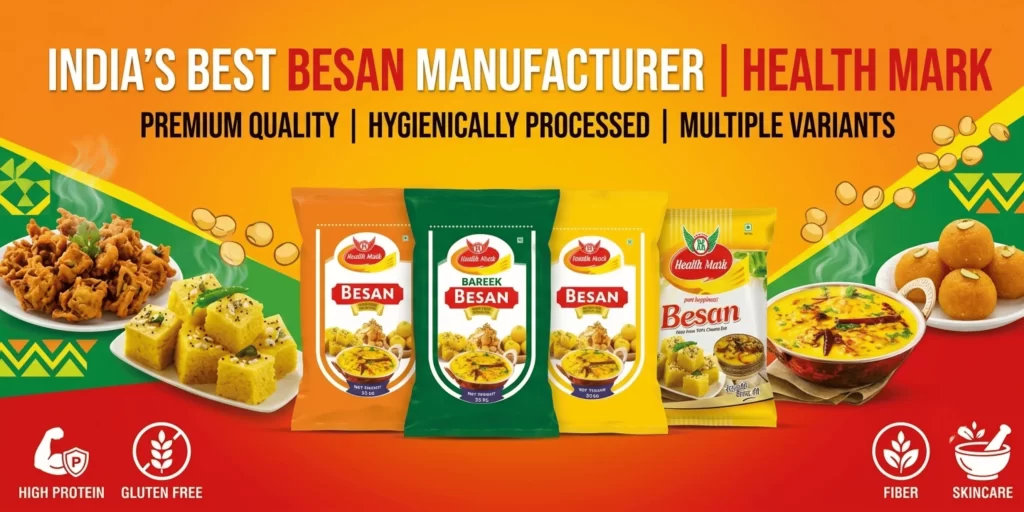
This guide is built for home cooks who are tired of inconsistent results, and for restaurant owners, sweet shops, and bulk buyers who need a dependable, food-safe supply chain. We’ll walk through what actually separates the best besan manufacturer in India from the rest, how to read a besan pack like a professional, what drives besan price, and where a brand like Health Mark fits into all of this. No fluff, no recycled listicle advice just what actually matters when chana dal becomes the flour in your kitchen.
What Is Besan and Why the Source Matters
Besan is simply gram flour, milled from chana dal (split Bengal gram). It sounds basic, but besan is one of the most quietly essential ingredients in Indian cooking. It binds, it thickens, it fries, it sweetens, and it does all of this differently depending on how finely it’s ground and how fresh the dal was when it went into the mill.
Here’s what most people don’t realize: besan isn’t a single standardized product. There are at least four commonly sold variants fine besan, bareek (extra-fine) besan, coarse or motichur besan, and powdered besan and each behaves differently in a recipe. A manufacturer that only sells one generic “besan” is usually not milling with intention; they’re grinding whatever chana dal comes in and packing it under one label.
This is why the source matters more than the price tag. Two packs can look identical and cost the same, yet one will make a dhokla that rises evenly and one won’t.
The Real Health Benefits of Besan
Besan earns its reputation as one of India’s healthiest flours, and it’s not marketing spin the nutrition profile genuinely holds up.
- High in plant protein: Besan is one of the more protein-dense flours available in an Indian kitchen, making it a favorite for vegetarian and vegan diets.
- Naturally gluten-free: It’s a safe, versatile substitute for wheat flour in recipes for people avoiding gluten.
- Good source of fiber: The fiber content supports digestion and contributes to a longer feeling of fullness.
- Low glycemic impact: Besan releases energy more slowly than refined wheat flour, which is one reason it’s popular in diabetic-friendly recipes.
- Rich in folate and minerals: Chana dal naturally carries folate, iron, and magnesium, much of which is retained through milling.
- Skin-care staple: Besan’s use in ubtans and face packs isn’t just tradition its mild exfoliating texture and protein content make it genuinely useful for skincare, not just cooking.
None of these benefits mean much if the besan itself is adulterated, stale, or milled from poor-quality dal. Nutrition and quality are inseparable which is exactly why the manufacturer behind the pack matters as much as the ingredient itself.
How Besan Is Actually Made The Manufacturing Process
Understanding the production process is the fastest way to evaluate a besan brand, because most quality problems trace back to a shortcut somewhere in these steps.
- Sourcing chana dal: Quality manufacturers select clean, mature, uniformly sized chana dal, free from moisture damage, insect activity, or excess broken grains.
- Cleaning and sorting: Dal is passed through sieves and destoners to remove husk, dust, stones, and foreign matter before it ever touches a grinder.
- Milling: Dal is ground using stone or roller mills. The fineness here determines whether the final product is bareek besan, standard besan, or a coarser motichur-style grind.
- Sieving for consistency: The ground flour is sifted to ensure uniform particle size, which directly affects how evenly it cooks or fries.
- Quality checks: Reputable manufacturing units test for moisture content, color, aroma, and purity before the flour is cleared for packing.
- Hygienic packing: The final step and often the most overlooked by budget brands is packing in a controlled, hygienic environment that protects the flour from humidity and contamination.
A manufacturer that skips or rushes any of these steps produces besan that smells raw, cooks unevenly, or spoils faster than it should. This is the exact process Health Mark follows at its Baddi, Himachal Pradesh facility, where besan is milled from carefully selected chana dal and packed to preserve freshness before it reaches your kitchen.
What Makes a Manufacturer the “Best Besan Manufacturer in India”
There’s no single certificate that stamps a company as “the best.” Instead, it’s a combination of operational choices that consistently show up in the final product. When you’re evaluating any besan seller not just Health Mark check for these markers:
a) Raw Material Selection
The best manufacturers don’t buy chana dal on price alone. They select for grain maturity, low moisture, and minimal breakage, because inferior dal produces bitter or gritty besan no matter how good the mill is.
b) Hygiene Standards
Look for FSSAI licensing at minimum, and ideally additional food-safety certifications. Ask (or check the website) whether the manufacturing unit follows documented hygiene protocols dust control, pest management, and trained staff handling.
c) Consistency Across Batches
A one-off good batch doesn’t make a brand reliable. The best Besan brand in India is the one where your dhokla turns out the same way every single time you buy a fresh pack that consistency is a direct signal of process control.
d) Packaging That Protects Freshness
Besan absorbs moisture and odors easily. Manufacturers who invest in proper multi-layer or resealable packaging are protecting a product that’s otherwise vulnerable to humidity, especially in Indian climates.
e) Transparent Sourcing and Communication
Manufacturers who are upfront about where their chana dal comes from, how it’s processed, and who can be contacted for bulk or B2B orders tend to have less to hide. A visible contact number and enquiry option (rather than a faceless storefront) is a small but telling signal of accountability.
f) Range of Product Variants
A manufacturer that offers besan, bareek besan, motichur/mota besan, and powder besan is signaling that they understand how cooks actually use gram flour rather than pushing one generic SKU to every customer.
Types of Besan You Can Buy (And When to Use Each)
Not all besan is interchangeable in the kitchen. Choosing the wrong grind is one of the most common reasons home cooks get inconsistent results.
| Besan Type | Texture | Best Used For |
|---|---|---|
| Besan (Standard) | Fine, smooth | Everyday cooking kadhi, curries, general batter |
| Bareek Besan | Extra-fine | Delicate sweets, smooth batters, dhokla |
| Motichur / Mota Besan | Coarser grind | Motichur laddu, boondi, textured sweets |
| Powder Besan | Ultra-fine, powdery | Skincare packs, fine confectionery, quick-mixing batters |
If you’re buying for a sweet shop that makes motichur laddu, standard besan will give you the wrong bead texture. If you’re making dhokla, a coarse grind will leave you with a dense, uneven sponge. Buying from a manufacturer who stocks all four variants like Health Mark’s besan product range means you’re not forced to compromise on texture just because your usual seller only carries one type.
Health Mark: A Case Study in Quality-First Besan Manufacturing
Health Mark’s Besan is milled from carefully selected chana dal and finely ground to deliver a smooth texture with a rich, nutty flavor the kind of flour that performs consistently whether you’re making crispy pakoras, soft dhokla, or a well-balanced kadhi.
A few things stand out about how Health Mark approaches this product:
- Premium Bengal gram sourcing: The besan is prepared from good-quality chana dal rather than mixed or lower-grade lots.
- Hygienic processing and packing: The flour is processed and packed under controlled conditions to protect freshness and purity from the mill to your kitchen shelf.
- Multiple pack sizes: Available in 55gm, 200gm, 500gm, and 1kg formats, so both a single household and a small commercial kitchen can buy exactly what they need.
- A genuine product range: Alongside standard besan, Health Mark also manufactures Bareek Besan, Motichur / Mota Besan, and Powder Besan covering nearly every use case a cook or a food business could need.
- Direct accessibility: Unlike many manufacturers who hide behind distributors, Health Mark lists direct sales contact numbers for bulk, retail, and B2B enquiries, making it easier to actually speak to someone about your order.
This combination sourcing discipline, hygienic manufacturing, and a full product range is exactly the pattern to look for when you’re trying to identify the best Besan manufacturing operation for your needs, whether that’s home cooking or supplying a restaurant kitchen.
Loose Besan vs Branded Besan vs Premium Besan A Comparison
Many buyers default to loose besan from a local grinder because it feels cheaper. The comparison below shows where that assumption holds up and where it doesn’t.
| Factor | Loose / Open Besan | Generic Branded Besan | Premium Besan (Health Mark) |
|---|---|---|---|
| Hygiene during processing | Often unverifiable | Usually FSSAI compliant | Hygienically processed & packed |
| Consistency across batches | Low varies by grinder | Moderate | High controlled milling process |
| Shelf life & freshness | Short, exposed to air/moisture | Moderate | Longer, protected packaging |
| Variant availability | Rarely more than one grind | Sometimes 1–2 variants | Besan, Bareek, Motichur, Powder |
| Traceability of sourcing | Minimal | Limited | Transparent, direct contact available |
| Best suited for | Occasional, small home use | Regular home cooking | Home cooking, sweet shops, bulk/B2B |
The takeaway isn’t that loose besan is always bad it’s that you’re trading traceability and consistency for a marginally lower price, and for anything beyond occasional home use, that trade-off tends to cost more in wasted batches than it saves.
Besan Price in India: What You’re Really Paying For
Besan price varies based on a handful of concrete factors, and understanding them helps you evaluate whether a price is fair or a red flag.
- Quality of chana dal used: Premium, well-sorted dal costs the manufacturer more upfront, which is reflected in the final price but it also directly reduces the chance of bitter or gritty flour.
- Grind type: Bareek and powder besan typically involve additional processing steps, which can slightly affect pricing compared to standard besan.
- Pack size: Smaller packs (like 55gm trial packs) usually carry a marginally higher per-kg cost than bulk formats like 1kg, which is standard across the packaged food industry.
- Packaging quality: Moisture-resistant, resealable packaging costs more to produce but significantly extends shelf life a cost worth paying if you buy in bulk.
- Certifications and hygiene compliance: Manufacturers who invest in food-safety compliance and hygienic facilities generally price slightly above uncertified, unbranded sellers.
- Bulk/B2B ordering: Buying directly from a manufacturer for bulk or business needs often works out more economical than routing through multiple middlemen, especially when you contact the manufacturer directly for a quote.
If you want current pricing across pack sizes, the fastest way to get an accurate number is to check the Besan product page directly or reach out via the contact numbers listed at the end of this guide pricing on raw agricultural commodities like chana dal shifts with the season, so a number quoted today may not hold three months from now.
Best Uses of Besan in Indian Cooking
Good besan earns its keep across an enormous range of dishes. Here’s where it shows up most:
- Pakoras and bhajis: Besan is the classic binding and crisping agent for onion, potato, and paneer pakoras.
- Dhokla and khaman: A fine, fresh besan is essential for that light, spongy texture stale or coarse besan is the top reason dhokla turns dense.
- Kadhi: Besan thickens the yogurt-based gravy and gives kadhi its characteristic tang and body.
- Besan chilla: A savory, protein-rich pancake made almost entirely from besan, popular as a quick breakfast.
- Laddus and mithai: Motichur laddu, besan laddu, and several regional sweets rely on a specific grind of besan for the right texture and mouthfeel.
- Batters and coatings: Besan is widely used to coat vegetables and paneer before frying, giving a crisp exterior without needing egg.
- Thickening agent: In some regional gravies, a spoon of roasted besan is used to thicken and add nutty depth to the dish.
- Face packs and skincare: Powdered besan mixed with turmeric, curd, or rosewater remains one of India’s most common natural skincare routines.
Common Mistakes People Make When Buying Besan
- Buying based on price alone: The cheapest pack on the shelf is often cheap because a step in cleaning, sorting, or hygienic packing was skipped.
- Ignoring the grind type: Using standard besan for laddus, or coarse besan for dhokla, is one of the most common reasons for disappointing results match the grind to the recipe.
- Not checking the manufacturing date: Besan doesn’t have an infinite shelf life; older stock develops a stale, slightly bitter smell that ruins delicate dishes.
- Buying loose besan without checking storage conditions: Open besan exposed to humidity or sunlight in a shop absorbs moisture and can develop a musty smell before you even get it home.
- Overlooking the smell test: Fresh besan should smell mildly nutty. A raw, “beany,” or sour smell is a clear sign the batch isn’t fresh.
- Assuming all branded besan is equal: Brand recognition doesn’t always equal manufacturing quality check for FSSAI details, sourcing transparency, and product variants before assuming.
How to Store Besan So It Stays Fresh for Months
- Store besan in an airtight container, not the original paper or thin plastic pouch, once opened.
- Keep it in a cool, dry place away from direct sunlight and stovetop heat.
- In humid climates or during monsoon, refrigeration extends shelf life significantly and prevents clumping.
- Never use a wet spoon or wet hands to scoop besan even small amounts of moisture can trigger mold growth over time.
- Buy pack sizes that match your usage rate. A 1kg pack sitting half-used for months will lose freshness faster than buying smaller packs more frequently if your usage is occasional.
How to Buy Besan (Retail and Bulk)
Buying besan online has become the more reliable route for both households and businesses, largely because it removes the guesswork of buying loose flour from an unknown source.
For retail or trial quantities, you can browse and order directly from Health Mark Besan product page, which lists 55gm, 200gm, 500gm, and 1kg pack options.
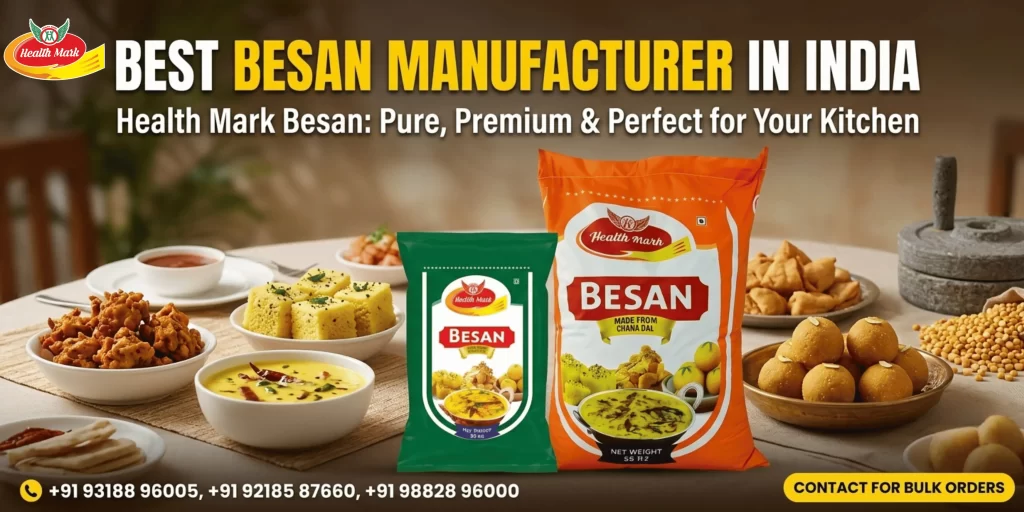
For bulk, wholesale, or B2B requirements restaurants, sweet shops, caterers, or distributors it’s usually faster to speak directly with the manufacturer rather than negotiate through a middleman. You can reach Health Mark’s sales team directly at:
Expert Tips for Choosing Top-Selling Besan
- Match the grind to your recipe before you shop decide if you need standard, bareek, motichur, or powder besan rather than grabbing whatever’s in front of you.
- Buy from manufacturers who publish their process sourcing transparency is one of the strongest indicators of consistent quality.
- Prefer sellers who offer direct contact for bulk orders this usually signals a manufacturer confident enough in their product to stand behind it directly.
- Check pack sizes against your actual usage buying the right size reduces waste and keeps every batch fresher.
- Don’t ignore smaller trial packs a 55gm or 200gm pack is a low-risk way to judge a new manufacturer’s quality before committing to bulk.
- Re-evaluate your source seasonally chana dal quality can shift with harvest cycles, so the “best” batch this month may not automatically repeat next month unless the manufacturer has strong quality control.
FAQ
Q1. Who is considered the best Besan manufacturer in India?
There’s no single official ranking, but the strongest manufacturers share common traits: careful chana dal sourcing, hygienic processing and packing, consistent batch quality, and a full range of besan variants. Health Mark is one such manufacturer, producing besan, bareek besan, motichur besan, and powder besan from its Baddi, Himachal Pradesh facility.
Q2. What is the difference between besan and bareek besan?
Besan is milled to a standard fine texture suitable for everyday cooking, while bareek besan is ground even finer, making it better suited for delicate preparations like dhokla and smooth batters.
Q3. Is besan good for daily consumption?
Yes, in moderation. Besan is naturally gluten-free, high in plant protein, and a good source of fiber, which makes it a healthy addition to a balanced diet, though portion and preparation method (fried vs. steamed) still matter.
Q4. How can I tell if besan is fresh or stale?
Fresh besan has a mild, nutty smell and a smooth, uniform color. Stale besan often smells slightly sour or “raw,” may feel clumpy, and can taste bitter once cooked.
Q5. What affects besan price in India?
Chana dal quality, grind type, pack size, packaging standard, and hygiene certifications all influence besan pricing. Bulk or direct-from-manufacturer purchases are often more economical than buying through multiple middlemen.
Q6. Which besan is best for making dhokla?
A fine or bareek besan is generally best for dhokla, since a finer grind helps create the light, spongy texture that dhokla is known for.
Q7. Can besan be used for skincare?
Yes, powdered besan is a traditional skincare ingredient in India, commonly mixed with turmeric, curd, or rosewater as a natural face pack, though it should be patch-tested for sensitive skin.
Q8. Where can I buy premium quality besan online in India?
You can order premium besan directly from manufacturers with an online presence, such as Health Mark’s Besan product page, which also offers Bareek Besan, Motichur/Mota Besan, and Powder Besan in multiple pack sizes.
Q9. What is motichur besan used for?
Motichur or mota besan has a coarser grind and is primarily used for making motichur laddu and other boondi-based sweets, where a specific bead texture is essential.
Q10. How do I find a reliable besan seller near me?
Look for sellers or manufacturers who disclose their sourcing and manufacturing process, hold proper food-safety compliance, and offer direct contact for queries or bulk orders this is usually a stronger signal of reliability than proximity alone.
Final Word
Besan seems like a small ingredient until you taste the difference a good batch makes. The manufacturer behind the pack how they source their chana dal, how carefully they mill and sieve it, and how hygienically they pack it shapes almost everything about how your pakoras, dhokla, kadhi, or laddus turn out.
If you’re ready to cook with besan that’s milled from carefully selected chana dal and packed to preserve freshness, explore Health Mark’s full besan range including standard Besan, Bareek Besan, Motichur/Mota Besan, and Powder Besan on the Besan category page. For bulk orders, wholesale pricing, or B2B enquiries, you can speak directly with the Health Mark sales team at +91 93188 96005, +91 92185 87660, or +91 98828 96000.