If you run a kirana store, a grocery chain, a hostel mess, or a food-processing business anywhere in North India, you have probably typed some version of “Poha supplier in Punjab” into Google at least once usually right after a shipment from an unreliable vendor left you with broken flakes, musty odour, or inconsistent grades. You are not alone. Poha (flattened rice) is one of India’s fastest-moving breakfast staples, and the gap between a mediocre supplier and a genuinely dependable one shows up fast: in customer complaints, wasted stock, and margins that quietly shrink.
This guide walks through everything a serious buyer needs before placing a bulk order what separates premium Poha from the rest, how Punjab became a serious sourcing hub for it, the red flags to watch for in wholesale deals, and why Health Mark Food has earned a reputation as one of the best Poha sellers in Chandigarh and across Punjab. Whether you are comparing Poha wholesalers in India for the first time or looking to switch from an underperforming supplier, you will find a practical, no-fluff buyer’s roadmap here.
What Is Poha? A Quick Introduction for Buyers and Brands
Poha is parboiled rice that has been flattened into thin, dry flakes. The process generally involves soaking paddy, parboiling it, flattening the grains, and then drying them. The result is a light, convenient rice flake that softens quickly when washed or soaked, making it a popular breakfast and snack ingredient across many parts of India.
For retailers, distributors, and food brands, Poha can be an attractive product category because it offers convenient storage, regular consumer demand, and relatively easy handling when packed and stored correctly. However, not every Poha product is the same. Thickness, moisture level, colour, flake uniformity, cleanliness, and processing quality can vary from one manufacturer to another.
These differences matter because they can directly affect cooking performance, texture, appearance, and customer satisfaction. A consistent product can help retailers build repeat sales, while uneven quality may lead to complaints or reduced customer trust.
Individual consumers may simply look for Poha for everyday cooking, but business buyers usually evaluate suppliers more carefully. Retailers, wholesalers, distributors, and private-label brands often compare product quality, pricing, packaging options, supply capacity, and delivery reliability before choosing a vendor.
This guide is designed especially for those buyers who want to understand Poha quality, compare suppliers more effectively, and make better sourcing decisions.
Why Punjab Is Emerging as a Hub for Premium Poha Sourcing
Punjab has a strong food-processing and distribution ecosystem, making it an increasingly practical sourcing location for buyers serving North India. Its established wholesale markets, road connectivity, warehousing infrastructure, and access to nearby commercial centres such as Chandigarh, Mohali, Panchkula, Ludhiana, and Delhi NCR can help food businesses manage regional supply more efficiently.
This is one reason more buyers are considering a Poha supplier in Punjab when comparing sourcing options for North Indian markets.
Key advantages can include:
- Shorter delivery routes for buyers across Punjab, Haryana, Himachal Pradesh, Chandigarh, and nearby regions
- Faster replenishment cycles, helping retailers and distributors maintain fresher inventory
- Lower dependence on long-distance freight, which may reduce handling and transit-related breakage
- Access to established food-processing and packaging businesses serving regional FMCG markets
- Better coordination for repeat and bulk orders, especially for buyers located in North India
For businesses in Chandigarh, Ludhiana, Amritsar, Mohali, Panchkula, and surrounding markets, working with a Punjab-based Poha supplier can offer practical advantages in delivery speed, stock planning, and regular order fulfilment.
When choosing a supplier, buyers should still compare product thickness, moisture level, packaging quality, consistency, pricing, minimum order quantity, and delivery reliability before placing a bulk order.
Health Mark Food A Trusted Poha Supplier in Punjab
Health Mark has built its name around a simple promise: consistent, hygienically processed, premium-quality Poha, batch after batch. Rather than treating Poha as a commodity to move in bulk at any cost, the focus stays on clean processing, careful moisture control, and packaging that protects the flakes from the point of production to the point of sale.
The Poha product page lays out the specifics grade, packaging options, and sourcing details while the broader Snacks category shows how Poha fits into a wider portfolio of ready-to-cook and snack staples. For buyers evaluating multiple Poha wholesalers in India, that breadth matters: a supplier with a diversified, well-run product line is usually a safer long-term partner than a single-SKU trader.
Health Benefits of Poha Why It’s a Top Choice for Health-Conscious India
Poha’s popularity isn’t just about taste and convenience it genuinely fits into a health-conscious diet, which is part of why “best health mark Poha” and similar searches are climbing.
- Light and easy to digest: Parboiling partially breaks down the starch, making Poha gentler on the stomach than many other grain-based breakfasts a reason it’s often recommended during recovery from illness.
- Naturally low in fat: Plain Poha carries very little fat before cooking, which makes it a sensible base for a calorie-conscious meal when prepared with minimal oil.
- Iron-friendly when fortified or paired right: Many commercial Poha varieties are iron-fortified, and pairing it with lemon juice (vitamin C) during cooking a traditional practice in most Poha recipes improves iron absorption.
- Gluten-free by nature: Since Poha is made from rice, it suits people avoiding wheat-based gluten, making it a practical staple for gluten-sensitive households.
- Quick energy release: As a carbohydrate-based food, Poha provides a relatively quick, usable source of energy useful for a working breakfast or a pre-activity meal.
- Versatile for diabetic-conscious cooking: When prepared with vegetables, minimal oil, and controlled portions, Poha can be adapted into a lower-glycemic-impact meal, though individuals managing diabetes should always confirm portion sizes with their doctor or dietitian.
For buyers and brands, these health credentials aren’t just nutrition trivia they’re a marketing asset. A supplier offering a genuinely premium, high-quality Poha with clean processing gives retailers a stronger story to tell health-conscious customers.
Types and Grades of Poha We Supply
Not all Poha is interchangeable, and knowing the difference helps buyers order the right grade for their use case whether that’s a restaurant kitchen, a retail shelf, or an institutional mess.
| Poha Type | Flake Thickness | Best Used For |
| Thin Poha | Very fine, delicate flakes | Quick-cooking snacks, chivda, instant preparations |
| Medium Poha | Standard everyday thickness | Classic breakfast Poha, home-style cooking |
| Thick Poha | Sturdier, chunkier flakes | Dishes needing texture retention, layered preparations, kheer |
| Red Poha | Made from red/unpolished rice | Health-focused buyers seeking higher fibre content |
A dependable Poha manufacturing partner offers more than one grade, because retail customers and institutional buyers rarely want the same product. Health Mark Poha product line is built around this flexibility letting distributors and retailers pick the grade that matches their customer base instead of settling for a one-size-fits-all flake.
How to Choose the Best Poha Supplier in India
Most buyers only discover what matters in a Poha supplier after a bad batch arrives. Here’s the checklist to run before that happens.
- Check FSSAI registration and food-safety compliance. A legitimate manufacturer will have this visible on packaging and documentation without you having to ask twice.
- Inspect flake consistency. Premium Poha has an even colour, minimal broken flakes, and a clean, non-musty smell. Ask for a sample before committing to a bulk order.
- Confirm moisture control and packaging quality. Poha is highly sensitive to humidity. Look for moisture-resistant, food-grade packaging designed for your order volume and transit distance.
- Ask about batch traceability. A supplier that can tell you which batch, which date, and which raw material lot a shipment came from is one that takes quality seriously.
- Compare minimum order quantities (MOQs) and lead times. The best Poha seller for a small retailer may not be the best fit for a large institutional buyer, and vice versa.
- Review pricing transparency. The best Poha price isn’t always the lowest one it’s the one that reflects consistent grade, weight accuracy, and reliable delivery.
- Look for an established track record. A top Poha seller in Chandigarh or anywhere else should be able to point to existing retail or institutional clients, not just a product catalogue.
This is exactly the checklist Health Mark Food is built to pass from FSSAI-compliant processing to batch-level quality control on every order that ships from Punjab.
Common Mistakes Buyers Make When Sourcing Poha Wholesale
Even experienced buyers fall into a few predictable traps when sourcing Poha in bulk:
- Chasing the lowest price first. A supplier offering an unusually low price is often cutting corners on grain quality, moisture control, or packaging costs that reappear later as wastage or customer complaints.
- Skipping the sample order. Ordering a full bulk batch without first testing a sample is one of the most common and most expensive mistakes in wholesale sourcing.
- Ignoring packaging suitability. Packaging designed for short local delivery often fails on longer routes, leading to moisture damage and broken flakes by the time stock reaches the shelf.
- Overlooking seasonal demand planning. Poha demand often spikes around festive and winter seasons; buyers who don’t plan reorder timelines with their supplier in advance risk stockouts.
- Not verifying certifications. Assuming a supplier is compliant without checking FSSAI registration or quality documentation can create real liability down the line.
- Treating every supplier as identical. Poha wholesalers in India vary widely in processing standards a supplier that looks similar on a price list can be very different on delivery.
Expert Tips for Bulk and Wholesale Poha Buyers
- Store Poha in a cool, dry place away from direct sunlight. Even premium flakes degrade faster when exposed to heat and humidity during storage.
- Rotate stock on a first-in, first-out basis. This keeps shelf-ready Poha consistently fresh and avoids customer complaints about stale product.
- Negotiate pricing against volume commitments, not just single orders. Suppliers like Health Mark Food are generally more flexible on the best Poha price when buyers commit to predictable, recurring order volumes.
- Build a direct relationship with the supplier, not just a distributor. Going closer to the source a genuine Poha manufacturing unit rather than a reseller usually means better pricing and faster issue resolution.
- Ask about private labelling or bulk packaging options if you’re building your own retail brand; a flexible manufacturer can often accommodate custom packaging requirements.
- Keep a backup supplier relationship. Even with a reliable primary source, having a secondary option protects against unexpected supply disruptions during peak demand seasons.
Poha Price Factors What Determines the Best Poha Price
“Best Poha price” doesn’t mean the cheapest rate on a price list it means the best value for the grade, consistency, and service you’re getting. These are the factors that actually move pricing:
| Factor | How It Affects Price |
| Raw paddy quality | Higher-grade paddy costs more but yields fewer broken flakes and better taste |
| Flake grade (thin/medium/thick/red) | Specialty grades like red Poha typically carry a premium over standard medium Poha |
| Order volume | Bulk and recurring orders usually unlock better per-kg pricing than one-off purchases |
| Packaging type | Moisture-resistant, branded, or custom packaging adds cost but reduces spoilage losses |
| Transportation distance | Sourcing from a nearby Punjab-based manufacturer reduces freight costs versus long-haul sourcing |
| Seasonal demand | Prices can firm up during festive and winter months when demand rises |
Buyers comparing Poha wholesalers in India should always ask for an itemised quote rather than a flat per-kg number it makes it far easier to see exactly what’s driving the price and to compare suppliers on equal footing.
Why Health Mark Food Is the Best Poha Brand in India
Putting everything in this guide into practice is exactly what Health Mark has focused on building:
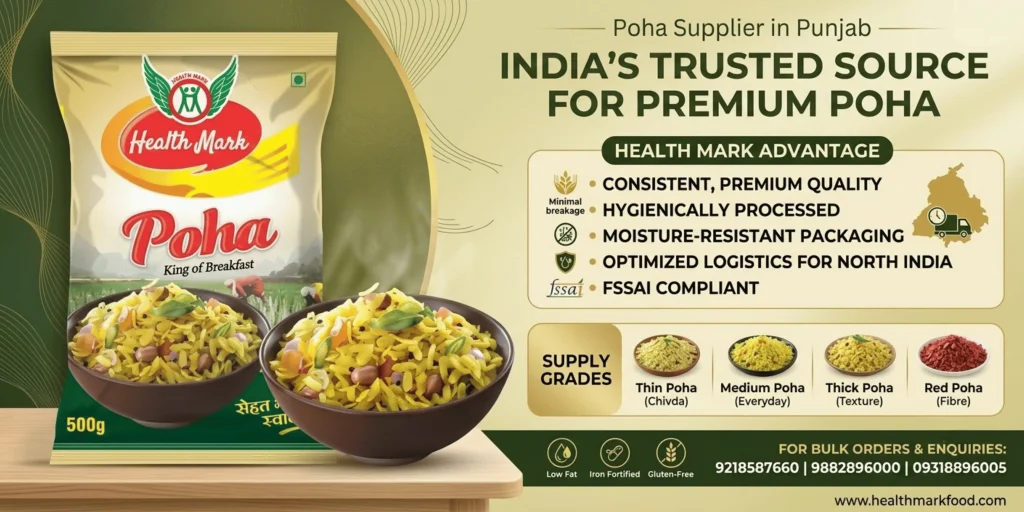
- Consistent, premium-grade Poha across thin, medium, thick, and red varieties, so retailers and distributors aren’t locked into a single grade
- Hygienic, modern manufacturing processes with attention to moisture control and batch consistency
- A Punjab-based supply base that gives Tricity, Punjab, Haryana, and North Indian buyers shorter delivery timelines and fresher stock
- A broader product ecosystem through the Snacks category, making Health Mark Food a one-stop sourcing option rather than a single-SKU supplier
- Transparent pricing and direct manufacturer access, cutting out the markup and miscommunication that comes with layered distribution chains
For retailers, wholesalers, hostel and institutional buyers, and businesses building their own private-label snack range, the Poha product page is the place to start. For bulk quotes, sample requests, or distributorship enquiries, the Health Mark team can be reached directly at 09318896005, 9218587660, or 9882896000.
FAQ
1. What makes a Poha supplier in Punjab a good choice for North Indian buyers?
A Punjab-based supplier offers shorter transit routes into Chandigarh, Haryana, Himachal Pradesh, and Delhi NCR, which means fresher stock, lower transit damage, and faster reorder cycles compared to sourcing from distant regions.
2. How do I know if a Poha brand is genuinely high quality?
Check for even flake colour, minimal broken pieces, a clean smell with no mustiness, FSSAI registration, and moisture-resistant packaging. Always request a sample before placing a bulk order.
3. What is the difference between thin, medium, and thick Poha?
Thin Poha cooks fastest and suits quick snacks and chivda; medium Poha is the everyday breakfast standard; thick Poha holds its texture better in heavier or layered preparations.
4. Is Poha good for weight management?
Plain Poha is naturally low in fat and relatively light, which can fit into a calorie-conscious diet when prepared with vegetables and minimal oil. Portion size and preparation method still matter most.
5. How should Poha be stored to maintain freshness?
Store it in an airtight, moisture-resistant container in a cool, dry place away from direct sunlight, and follow a first-in, first-out rotation for bulk stock.
6. What is the typical minimum order quantity for wholesale Poha?
MOQs vary by supplier and are generally tailored to the buyer’s business type retail, institutional, or distributor. It’s best to confirm current MOQs and pricing directly with the supplier.
7. Does Health Mark Food supply Poha outside Punjab?
Health Mark Food serves buyers across Punjab, Chandigarh, and surrounding North Indian markets, with distribution reach depending on order volume and location. Contact the team directly to confirm delivery to your area.
8. What determines the best Poha price in the market?
Price is shaped by raw paddy quality, flake grade, order volume, packaging type, transportation distance, and seasonal demand not just a flat per-kg rate.
9. Is Poha suitable for people with gluten sensitivity?
Yes, Poha is made from rice and is naturally gluten-free, making it a practical option for households avoiding wheat-based products.
10. How can I place a bulk or wholesale order with Health Mark Food?
Reach out directly via phone at 9218587660 or 9882896000, or visit the Poha product page to review product details before placing an enquiry.
Conclusion
Choosing a Poha supplier is not only about finding the lowest price per kilogram. For long-term business growth, buyers also need consistent grain quality, hygienic processing, reliable supply, and transparent dealing. These factors help protect product quality, customer trust, and profit margins over time.
Punjab has become an increasingly practical sourcing destination for businesses across North India, and Health Mark Food focuses on the qualities serious buyers expect from a dependable supplier: consistency, cleanliness, competitive pricing, and a broader food product range for retail and bulk requirements.
If you are looking for a reliable Poha supplier in Punjab, explore Health Mark Food’s Poha range and other snack products to compare suitable options for your business. You can also visit healthmarkfood.com to learn more about available products, bulk supply, and business enquiries.