Walk into almost any Indian kitchen and you will find a packet of besan tucked somewhere between the atta and the spice box. It is the flour behind crisp pakoras, soft dhokla, silky kadhi, and countless festive sweets. Yet not all besan is created equal. Colour, texture, aroma, and even the way it behaves in hot oil can vary wildly from one packet to the next, and that variation almost always traces back to one thing: the quality of the chana dal it was milled from, and the care taken during grinding, sieving, and packing.
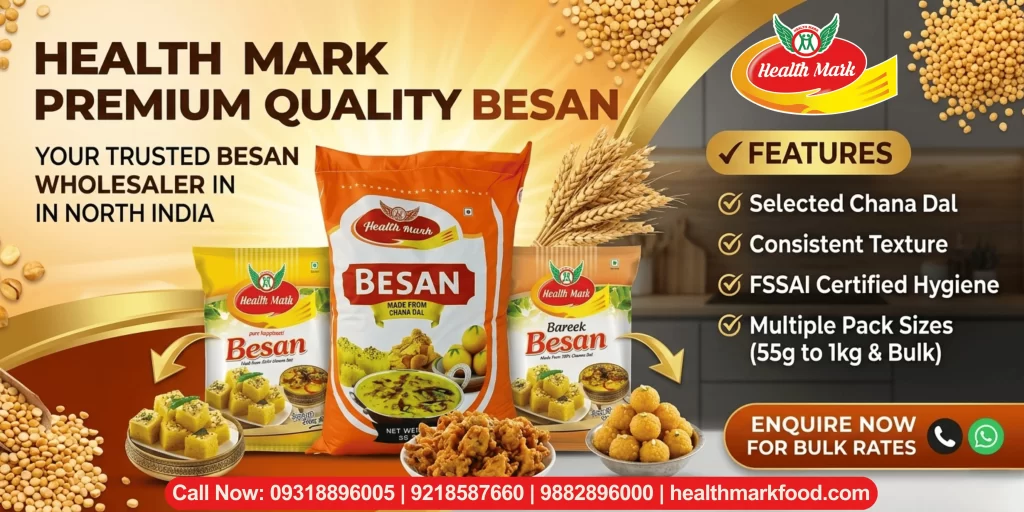
This is exactly the gap Health Mark set out to close. Based in Baddi, Himachal Pradesh, and serving households, sweet shops, restaurants, and bulk buyers across Chandigarh, Panchkula, Ludhiana, and the wider North India belt, Health Mark has built its besan business on a simple promise: consistent, premium quality besan, batch after batch. In this guide, we will unpack what “premium quality besan” actually means, how Health Mark earned its reputation as a trusted besan wholesaler, what drives besan price in the Indian market, and how you whether you are a home cook, a retailer, or a bulk buyer can identify and buy the best besan for your needs.
What Is Besan? A Quick Primer for Indian Kitchens
Besan, also called gram flour or chana flour, is made by dry-milling husked and split Bengal gram (chana dal) into a fine, pale-yellow flour. It carries a distinctive nutty aroma and a naturally slightly sweet, earthy flavour that forms the backbone of both savoury snacks and traditional sweets across India.
Depending on how finely it is ground and sieved, besan is sold under a few different names in the market:
Besan / Fine Besan – the standard, finely milled flour used for most everyday cooking.
Bareek Besan – an extra-fine grind, prized for smooth batters and delicate sweets.
Motichur / Mota Besan – a coarser grind, traditionally used for motichur ladoo and boondi where a grainier texture is needed.
Powder Besan – a super-fine, almost powdery grind used where a silky finish is essential, such as in certain mithai and skincare-style pastes.
Health Mark stocks all four variants, which already sets it apart from many local sellers who offer only one generic “besan” without acknowledging that different recipes genuinely need different grinds.
Why Besan Quality Actually Matters
It is tempting to think of besan as a commodity one packet is as good as another. In practice, quality differences show up in very tangible ways:
Colour and freshness: Good besan has a bright, even pale-yellow colour. Dull, greyish, or patchy besan often signals old stock or poor storage.
Texture consistency: Premium besan is uniformly milled, without gritty lumps or uneven particle size, which affects how batters bind and fry.
Aroma and taste: Fresh, high-grade chana dal gives besan a clean, nutty smell. A stale or musty odour usually means the flour has been sitting too long or was stored poorly.
Purity: Adulteration with cheaper flours or fillers is an unfortunate reality in loose, unbranded besan sold without proper labelling or hygiene standards.
Cooking performance: High-quality besan absorbs water evenly, fries up crisp rather than soggy, and holds its shape in sweets like ladoo and barfi.
About Health Mark: The Story Behind the Brand
Health Mark positions itself within the broader FMCG (Fast-Moving Consumer Goods) space as a company built around purity, nutrition, and sustainability. Rather than being a single-product operation, Health Mark operates across multiple staple categories atta, besan, pulses, rice, spices, salt, sugar, dry fruits, snacks, sauces, and more which gives it the scale, milling infrastructure, and quality-control experience that smaller, single-product besan sellers typically lack.
The company’s manufacturing base is located at Plot No. 60, Industrial Township, Bhatoli Kalan, Baddi, Himachal Pradesh a region well known for organised food-processing units. From this base, Health Mark supplies retail customers, kirana stores, sweet shops, and bulk buyers across Chandigarh, Panchkula, Baddi, Ludhiana, and neighbouring towns, making it a genuinely accessible besan seller near me search for much of North India.
What stands out about Health Mark’s approach is traceability. The brand talks openly about sourcing from carefully selected, quality-checked ingredients and maintaining hygienic processing and packing standards the kind of transparency that increasingly matters to both households and B2B buyers who need to trust what is going into their food.
What Makes Health Mark the Best Besan Brand in India
Claiming to be the best Besan brand in India is easy; proving it consistently is harder. Here is what Health Mark does differently across the production chain:
1. Careful Selection of Chana Dal
Health Mark’s besan starts with premium quality Bengal gram (chana dal), selected for size, colour, and cleanliness before it ever reaches the mill. Lower-grade dal, with broken grains, dust, or foreign matter, produces flour with poor texture and shorter shelf life which is precisely what Health Mark screens out at the sourcing stage.
2. Fine, Controlled Milling
The dal is finely ground to deliver a smooth, even texture rather than a coarse, uneven one. This is what allows Health Mark’s besan to blend seamlessly into batters, coat vegetables evenly for pakoras, and dissolve smoothly in kadhi without lumps.
3. Hygienic Processing and Packing
Hygiene is not a footnote for Health Mark it is built into the promise on every pack. From milling to sealing, the process is designed to protect freshness and purity, which matters enormously for a flour product that can otherwise pick up moisture, pests, or odours if handled carelessly.
4. Multiple Pack Sizes for Every Buyer
Health Mark’s besan is available in 55gm, 200gm, 500gm, and 1kg packs, which means a small household, a hostel mess, and a sweet shop can all buy the exact quantity they need without waste a detail that matters for both convenience and besan price management.
5. A Genuine Product Range, Not Just One SKU
Because Health Mark offers Besan, Bareek Besan, Motichur/Mota Besan, and Powder Besan side by side, buyers do not need to compromise on grind type. This range is a meaningful differentiator versus generic local besan sellers who typically stock only one grind.
Health Mark’s Besan Range: Besan, Bareek Besan, Motichur & Powder Besan
Choosing the right grind can noticeably improve your results in the kitchen. Here is a practical breakdown:
| Product | Grind Type | Best Used For |
| Besan | Standard fine | Everyday cooking, dhokla, kadhi, chilla, general batters |
| Bareek Besan | Extra-fine | Smooth sweets, delicate batters, silky textures |
| Motichur / Mota Besan | Coarse | Motichur ladoo, boondi, and dishes needing a grainy bite |
| Powder Besan | Super-fine powder | Fine mithai, ubtan-style pastes, delicate desserts |
Besan Price in India: What Really Affects the Cost
Besan price is not fixed it moves with several interlinked factors, and understanding them helps you judge whether a price you are seeing online or at a local store is fair:
Raw material cost: Chana dal prices fluctuate with the seasonal chana (Bengal gram) harvest, monsoon performance, and mandi (market) rates.
Grade of dal used: Premium, cleaned, high-protein dal costs more to source than lower-grade dal, which is reflected in the final besan price.
Milling and processing quality: Finer, more controlled milling and stricter hygiene standards add to production cost but improve consistency and shelf life.
Packaging size: Smaller packs (like 55gm or 200gm) usually carry a slightly higher per-kg price than bulk packs, due to packaging and logistics overheads.
Brand and quality assurance: Branded, hygienically packed besan from an established besan manufacturer in India typically costs a little more than loose, unbranded besan but it also carries far less risk of adulteration.
Bulk vs. retail purchase: Wholesale and bulk orders from a besan wholesaler generally work out cheaper per kilogram than small retail packs, which matters for sweet shops, caterers, and restaurants.
Because Health Mark offers besan in four different pack sizes and also caters to bulk buyers, customers can choose the price point that suits them a small trial pack to test quality, or a wholesale quantity for commercial use. For the latest besan price, quantity-wise availability, and bulk quotations, buyers can reach Health Mark directly at +91 93188 96005, +91 92185 87660, or +91 98828 96000.
Health Mark vs. Other Besan Brands: A Quick Comparison
Here is how Health Mark generally compares against typical local and unbranded besan sellers on the factors that matter most to buyers:
| Factor | Health Mark Besan | Typical Local / Unbranded Besan |
| Sourcing | Selected, quality-checked chana dal | Often mixed-grade, unverified dal |
| Milling consistency | Fine, controlled, uniform texture | Frequently inconsistent between batches |
| Hygiene & packing | Hygienically processed and sealed packs | Loose or minimally packaged |
| Product variety | Besan, Bareek, Motichur, Powder Besan | Usually a single generic grind |
| Pack size options | 55gm to 1kg, plus bulk supply | Limited or loose-weight only |
| Traceability | Traceable, brand-backed sourcing | Little to no traceability |
| Bulk / wholesale support | Dedicated wholesale enquiry and contact lines | Informal, inconsistent supply |
How to Identify Premium Quality Besan: A Buyer’s Checklist
Whether you are buying from Health Mark or comparing sellers, use this checklist before you commit to a packet or a bulk order:
Check the colour: Look for a bright, even pale-yellow shade avoid grey, dull, or patchy flour.
Smell before you buy (where possible): Fresh besan smells mildly nutty; a musty or sour smell means it is stale.
Feel the texture: Rub a pinch between your fingers it should feel fine and uniform, not gritty or lumpy, unless you specifically want a coarser grind like Motichur Besan.
Look for proper packaging: Sealed, labelled packs with manufacturing details protect against contamination far better than loose, open besan.
Check the manufacturing and expiry details: A trustworthy besan manufacturer in India will always mention batch and date information on the pack.
Do a small cooking test: Before switching to a new brand for bulk use, try a small pack first fry a test batch of pakoras or make a small dhokla to judge texture and taste.
Buy from a known, accessible seller: Choosing an established best Besan seller or best wholesale besan supplier reduces the risk of adulteration and inconsistent quality.
Nutritional & Health Benefits of Besan
Beyond taste and texture, besan is genuinely one of the more nutritious flours used in Indian cooking, which is part of why it remains a top selling Besan in India across both health-conscious and traditional households:
Good plant protein source: Being made from chana dal (a pulse), besan naturally contains a meaningfully higher protein content than refined wheat flour.
Naturally gluten-free: This makes besan a popular choice for people avoiding gluten, whether for dietary preference or medical reasons.
Rich in dietary fibre: Fibre from besan supports digestion and contributes to a longer-lasting feeling of fullness.
Lower glycemic impact than refined flours: Because pulses digest more slowly than refined cereal flours, besan-based dishes tend to cause a gentler rise in blood sugar.
Contains essential minerals: Besan naturally provides minerals such as iron and folate that are part of a balanced diet.
For readers who want to go deeper into pulse nutrition and food safety standards in India, the Food Safety and Standards Authority of India (FSSAI) and the National Institute of Nutrition publish detailed, government-backed guidance on pulses and gram flour that is worth cross-referencing.
Everyday Uses of Besan in Indian Cooking
Part of what makes besan such a kitchen staple is its sheer versatility. A few of its most popular uses include:
Savoury snacks: Pakoras, bhajiyas, and fritters, where besan forms a crisp, flavourful coating.
Steamed classics: Dhokla and khaman, which rely on a smooth, well-milled besan for the right rise and texture.
Curries and gravies: Besan is used to thicken kadhi and certain North Indian curries, giving them body and a subtle nutty depth.
Traditional sweets: Besan ladoo, mysore pak, and barfi, where the grind (fine vs. coarse) directly affects the final mouthfeel.
Flatbreads and parathas: Besan is often mixed into missi roti and other flatbread doughs for flavour and nutrition.
Batters and coatings: For tempura-style vegetable fritters, cutlets, and pakora-style coatings in fusion cooking.
Health Mark as a Besan Wholesaler & Supplier in North India
For sweet shops, restaurants, hostels, caterers, and retailers, sourcing besan from a reliable besan manufacturer in India matters just as much as it does for home cooks arguably more, because inconsistency at scale is far more costly. This is where Health Mark’s positioning as a besan wholesaler and besan supplier in North India becomes particularly relevant.
Operating from its Baddi, Himachal Pradesh facility and serving the Chandigarh–Panchkula–Ludhiana corridor and the broader North India region, Health Mark is well placed to fulfil recurring bulk orders without the supply gaps that often plague smaller, informal besan sellers. Businesses looking for a besan seller near me in this belt can reach out directly through Health Mark’s product enquiry page or contact numbers to discuss recurring supply, custom pack sizes, and wholesale besan price.
How to Buy Besan Online or in Bulk from Health Mark
Visit the official Besan product category to browse Besan, Bareek Besan, Motichur/Mota Besan, and Powder Besan.
Open the specific product page for pack size, quantity options, and product details.
For retail quantities, use the on-page enquiry option to confirm current besan price and availability.
For bulk or wholesale orders, call the Health Mark sales team directly at +91 93188 96005, +91 92185 87660, or +91 98828 96000, or use the WhatsApp enquiry option on the product page.
Discuss required quantity, pack size, and delivery location Health Mark’s team can guide you on the most cost-effective option for regular or one-time orders.
Confirm order details and delivery timeline before finalising, especially for time-sensitive commercial requirements like festive-season sweet production.
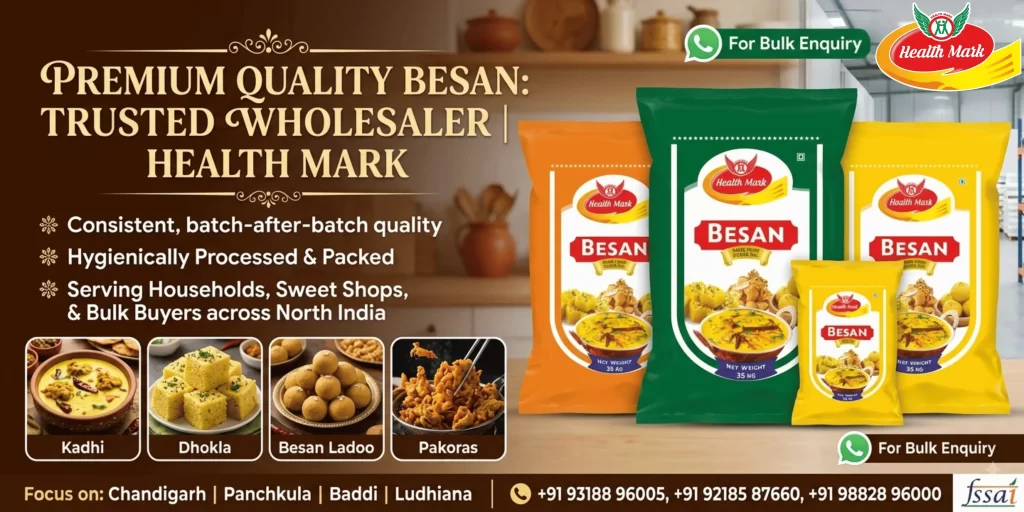
Common Mistakes to Avoid When Buying Besan
Buying purely on price: The cheapest besan is often cheap because of lower-grade dal or poor hygiene standards false savings that show up in cooking results.
Ignoring the grind type: Using coarse Motichur Besan for dhokla, or fine besan for motichur ladoo, leads to disappointing texture always match the grind to the recipe.
Overbuying loose besan: Because besan can pick up moisture and odours, buying more loose, unpackaged besan than you will use within a few weeks increases the risk of spoilage.
Not checking manufacturing details: Skipping the label means skipping crucial information on freshness and traceability.
Sticking with an inconsistent supplier out of habit: If a besan seller’s quality varies noticeably batch to batch, it is worth switching to a more consistent, traceable besan manufacturer in India.
Expert Tips for Storing Besan the Right Way
Store in an airtight container to protect against moisture and pantry pests.
Keep it in a cool, dry place away from direct sunlight and heat sources like the stovetop.
Avoid using a wet spoon or scoop, which introduces moisture and shortens shelf life.
Buy smaller pack sizes (like Health Mark’s 55gm or 200gm options) if your usage is occasional, rather than letting a large pack sit half-used for months.
For bulk stock, rotate older packs to the front and use them first a simple first-in, first-out approach that commercial kitchens already know well.
FAQ
Q1. What is the difference between besan, bareek besan, and motichur besan?
Besan is the standard fine grind used for everyday cooking. Bareek besan is milled even finer, ideal for smooth batters and delicate sweets. Motichur (mota) besan is coarser, traditionally used for motichur ladoo and boondi where a grainier texture is preferred.
Q2. Is Health Mark besan good for daily cooking?
Yes. Health Mark’s standard besan is finely milled from selected chana dal and hygienically packed, making it suitable for everyday dishes like pakoras, dhokla, kadhi, and chillas, as well as festive sweets.
Q3. What affects besan price in India?
Besan price depends mainly on chana dal (raw material) cost, the grade of dal used, milling and hygiene quality, pack size, brand assurance, and whether you are buying retail packs or wholesale quantities.
Q4. Where can I buy premium quality besan online?
You can browse and enquire about Health Mark’s besan range, including Besan, Bareek Besan, Motichur/Mota Besan, and Powder Besan, on the official Health Mark website, or contact the sales team directly for current pricing and delivery.
Q5. Does Health Mark supply besan in bulk or wholesale quantities?
Yes. Health Mark serves both retail customers and bulk buyers such as sweet shops, restaurants, caterers, and retailers across North India. Wholesale enquiries can be made directly through the sales contact numbers listed on the website.
Q6. Is besan gluten-free?
Yes, besan is naturally gluten-free because it is made entirely from chana dal (Bengal gram) rather than wheat, which makes it a popular option for people avoiding gluten.
Q7. How should I store besan to keep it fresh longer?
Store besan in an airtight container in a cool, dry place away from direct sunlight and moisture. Avoid using wet utensils to scoop it, and try to use smaller packs before they sit for too long, especially in humid weather.
Q8. What pack sizes does Health Mark besan come in?
Health Mark besan is available in 55gm, 200gm, 500gm, and 1kg packs, allowing both households and commercial buyers to choose a quantity that matches their needs.
Q9. How can I tell if besan is adulterated or low quality?
Look for an uneven or dull colour, a musty smell, a gritty or inconsistent texture, and missing manufacturing or packaging details. Buying from a traceable, hygienically packed brand significantly reduces this risk.
Q10. Is Health Mark considered one of the best besan brands in India?
Health Mark has built its reputation around careful chana dal sourcing, controlled fine milling, hygienic packing, a genuine product range across four besan variants, and dedicated support for both retail and wholesale buyers the combination of factors buyers typically look for in a top besan brand.
Conclusion
Besan may look like a simple pantry staple, but as this guide shows, the difference between an average packet and a genuinely premium quality besan comes down to sourcing, milling precision, hygiene, and consistency details that are easy to overlook until you taste the difference in your kadhi or feel it in a limp, oily pakora. Health Mark has built its position as a trusted besan wholesaler in North India precisely by getting these fundamentals right, offering a full range from fine besan to bareek, motichur, and powder besan, in pack sizes that suit everyone from a single household to a busy sweet shop.
If you are searching for the best Besan brand in India, comparing besan price across sellers, or looking for a dependable besan supplier in North India for regular bulk orders, it is worth putting Health Mark’s besan to the test.