
Ask any halwai or namkeen maker what ruins a batch, and the answer is rarely the oil or the masala. It is the flour.
Imagine a sev batter that keeps clogging the jhara. Or motichur laddoos that come out dense instead of soft. Or bhujia that absorbs too much oil and turns greasy within a week. In many of these cases, the culprit is besan that was too coarse, too damp, or inconsistent from one lot to the next.
That is why choosing a premium quality besan supplier is not a small purchasing decision. For a business that ships thousands of kilos of snacks a month, besan is the base ingredient. If the base wobbles, everything on top of it wobbles too.
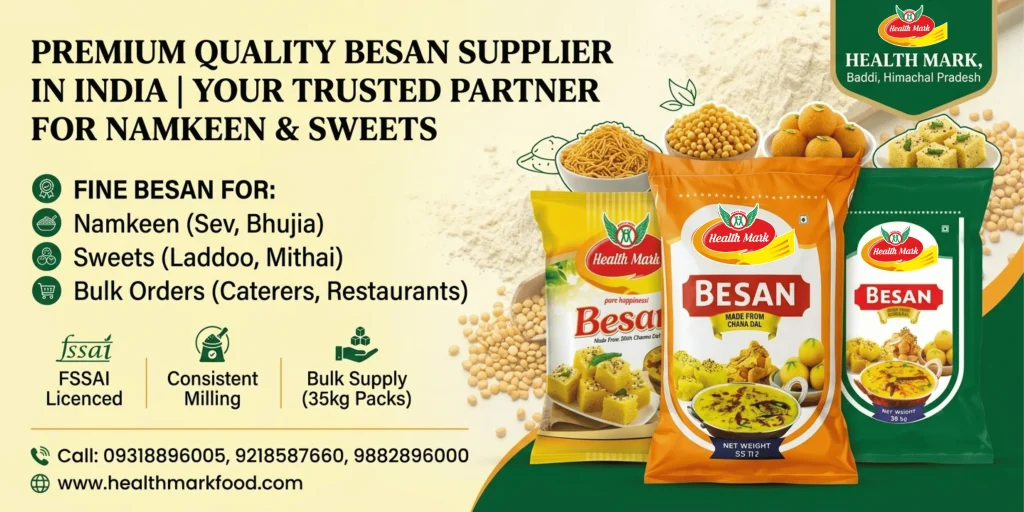
This guide walks through what actually separates good gram flour from average gram flour, how to test it yourself, and what to ask before you sign off on a bulk order. It is written from a practical, kitchen-and-factory point of view, not a brochure point of view.
What Exactly Is Besan (and What Is It Made From)?
Besan, also called gram flour or chickpea flour, is a flour made by grinding dehusked and split Bengal gram (desi chana), known as chana dal. It is naturally gluten-free, rich in plant protein, and has a mildly nutty flavour that is hard to replace in Indian cooking.
Besan is the backbone of pakoras, kadhi, dhokla, sev, bhujia, boondi, laddoos and mohanthal. In the namkeen and sweets trade, it is one of the highest-volume raw materials after oil and sugar.
Two things shape the final flour more than anything else:
The dal itself. Clean, uniform, properly dried chana dal gives a pale-yellow, evenly flavoured flour. Mixed or stale dal gives a patchy, sometimes bitter result.
The milling. Grinding speed, temperature, and sieving decide whether you get fine, soft besan or gritty besan.
Besan Grades Explained: Bareek, Mota and Everything Between
Not all besan is the same, and using the wrong grade is one of the most common reasons for failed batches. In the Indian trade, besan is usually described by how fine or coarse the grind is.
| Grade | Texture | Typical Uses |
| Bareek / Barik besan (fine) | Ultra-smooth, powder-like | Smooth batters, delicate sweets such as motichur laddoo, fine sev, pakora batter |
| Regular besan | Fine to medium | Everyday cooking, pakoras, kadhi, dhokla, general namkeen |
| Mota / Motichur besan (coarse) | Slightly granular | Laddoo and mithai styles that need grain, boondi-style preparations |
| Powder besan | Very fine, dry powder | Industrial and bulk food applications |
What Does “Barik Besan” Actually Mean?
“Barik” (also spelt bareek) simply means fine in Hindi. Barik besan is milled to a very small particle size, so it mixes into a smooth batter without lumps and gives a soft, even texture in the finished product. If your recipe depends on a smooth flow or a delicate bite, this is the grade to look at.
Why Fine Besan Matters for Namkeen Manufacturing
If you make namkeen at scale, you already know how sensitive the process is. Besan for namkeen manufacturing has to do several jobs at once:
- Form a smooth, lump-free batter that passes through the sev or ganthiya machine without choking it.
- Hold shape when it hits hot oil, so strands do not break or clump.
- Absorb the right amount of oil. Coarse or uneven flour tends to soak up more, which affects taste, shelf life and cost.
- Fry to an even colour, so the whole batch looks uniform in the pack.
- Deliver consistent crunch from one batch to the next, because your customers notice if last month’s bhujia was crispier.
Fine, uniformly milled besan supports all five. That is why many namkeen manufacturers specifically look for a fine besan supplier in India who can supply the same grade every month, not just a good sample once.
A Simple Example
Suppose a mid-size namkeen unit in Punjab fries 500 kg of sev daily. If the besan lot changes grade halfway through the week, the operator has to adjust water, kneading time and machine pressure each time. That slows production and increases wastage. A supplier who keeps the grind consistent saves that unit hours every week, which is why consistency often beats a slightly lower price.
How to Identify Quality Gram Flour: 7 Practical Checks
You do not need a lab to spot most quality issues. These quick checks are used by experienced buyers across the trade.
- Check the colour. Good besan is a clean, light yellow. Dull, grey or overly bright yellow shades can point to old stock, mixed dal or colouring.
- Do the rub test. Rub a pinch between your fingers. Fine besan feels silky and soft, not gritty.
- Smell it. Fresh besan has a mild, nutty, sweet aroma. A musty, sour or oily smell suggests age, moisture or rancidity.
- Taste a tiny pinch. It should not taste bitter or metallic.
- Test the batter. Mix a small quantity with water. Quality besan forms a smooth batter quickly and does not leave stubborn lumps.
- Look for impurities. Spread a thin layer on white paper. Husk specks, stones or dark particles should be minimal to none.
- Run a trial fry. The most honest test of all. Make a small batch of your actual product and check texture, oil absorption and colour.
What Makes a Premium Quality Besan Supplier?
Anyone can put “premium” on a pack. Here is what to actually look for in a premium quality besan supplier.
1. Controlled Sourcing and Cleaning
A good supplier cleans and sorts chana dal before milling, removing stones, husk and damaged grains. Ask how they source dal and what cleaning steps they follow.
2. Consistent Milling
Particle size should stay stable across batches. Ask whether they sieve the flour and how they check fineness.
3. Freshness and Packing
Besan is best when freshly milled and properly packed. Moisture is its enemy. Look for sturdy, moisture-resistant packing and a clearly printed packing date.
4. Food Safety Compliance
A genuine food business in India should hold a valid FSSAI licence, and the number should be visible on packaging. You can verify FSSAI licence details on the official FSSAI portal (fssai.gov.in).
5. Reliable Bulk Supply
For a wholesale besan supplier, capacity matters. Can they deliver your monthly volume on time, without quality drift?
6. Transparent Communication
A trustworthy supplier answers questions directly: grade, packing size, minimum order, dispatch time, and payment terms. If answers are vague, that is a signal.
7. Sample Policy
Suppliers confident in their product are happy to share samples for trial.
Wholesale and Bulk Fine Besan: What Buyers Should Ask
Buying bulk fine besan is different from buying a 1 kg pack at a grocery store. Before placing a large order, ask these questions:
- Which grade am I getting (bareek, regular, mota, powder)?
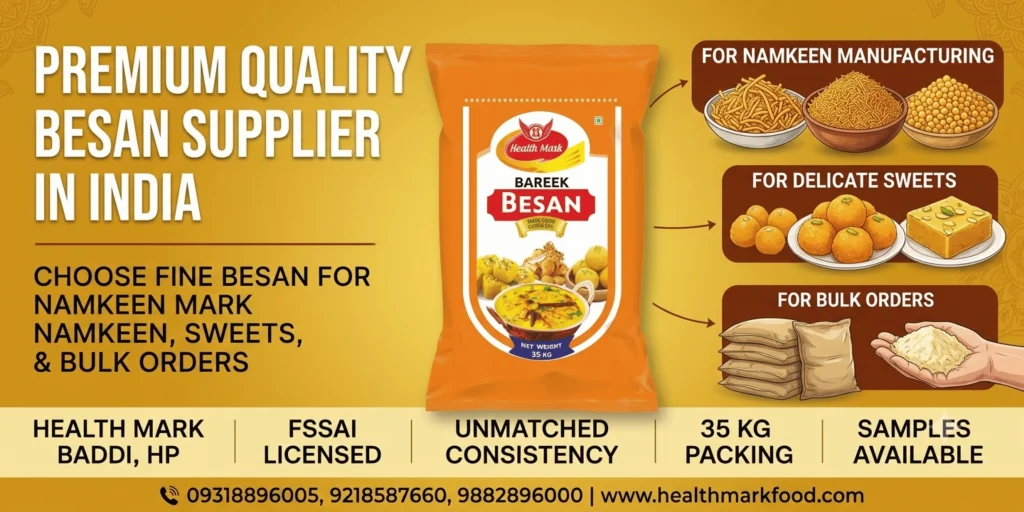
- What is the packing size? (Health Mark’s Bareek Besan, for instance, is listed in 35 kg packing.)
- What is the minimum order quantity?
- What is the packing date, and how is moisture controlled during storage and transit?
- Can you provide samples before the first bulk order?
- How consistent is the grind from batch to batch?
- What are the delivery timelines for my location?
- Do you support repeat or scheduled supply for regular buyers?
Who Typically Buys Wholesale Besan?
- Namkeen and snack manufacturers
- Sweet shops and mithai makers
- Caterers and large kitchens
- Packaged-food and FMCG brands needing a dependable FMCG besan supplier
- Retailers and distributors
- Dhabas, restaurants and hotel chains
Health Mark Besan Range at a Glance
Health Mark, based in Baddi, Himachal Pradesh, supplies a focused range of gram flour for both professional kitchens and everyday cooking. The besan category currently lists four options:
| Product | Best For |
| Bareek Besan | Ultra-fine gram flour for soft, delicate sweets like motichur laddoo; smooth batter; sweet shops and bulk preparation |
| Besan | Everyday cooking, pakoras and general use |
| Motichur / Mota Besan | Coarser grind for traditional sweets |
| Powder Besan | Very fine powder for bulk applications |
The Bareek Besan is described as specially milled, ultra-fine gram flour made for smooth batter and consistent sweet-making results, available in 35 kg packing for professional kitchens and manufacturers. If you are a namkeen unit unsure which grade suits your machine and recipe, speak to the sales team and request a sample before committing to a bulk order.
Best Besan Brand in India: How to Judge Fairly
Searches like “best besan” and “top besan” are common, and the honest answer is that the best besan brand in India depends on what you are making. A sweet shop needs different qualities than a pakora stall or a packaged-snack company.
Instead of trusting rankings, judge brands on these points:
| Criteria | What Good Looks Like |
| Texture | Uniform, silky, minimal grit |
| Colour and aroma | Light yellow, mild nutty smell |
| Purity | No visible husk, stones or off-odours |
| Consistency | Same performance across batches |
| Packaging | Sealed, moisture-resistant, dated |
| Compliance | Visible FSSAI licence number |
| Service | Clear pricing, samples, on-time delivery |
A brand that scores well on all seven is a strong contender for best fine besan in your category, whatever name is on the bag.
Common Mistakes Buyers Make
1. Buying only on price. The cheapest besan can cost more once you count wastage, extra oil absorption, and rejected batches.
2. Skipping the trial. Never scale up without testing your own recipe on the supplier’s sample.
3. Ignoring the packing date. Old stock can smell stale and fry poorly, even if it looks fine.
4. Using one grade for everything. Fine, regular and coarse besan behave differently. Match the grade to the product.
5. Storing bulk bags carelessly. Damp floors and humid rooms ruin flour fast.
6. Not verifying licences. Always check the FSSAI number, especially for new suppliers.
7. Changing suppliers too often. Switching creates inconsistency. Once you find a reliable partner, build the relationship.
Storage and Handling Tips for Bulk Besan
Even the best flour will spoil if stored badly. Follow these basics:
- Store bags on pallets or racks, never directly on the floor.
- Keep the room cool, dry and well ventilated.
- Keep bags away from walls and water sources.
- Reseal opened bags tightly or transfer to airtight containers.
- Use older stock first (FIFO: first in, first out).
- Keep besan away from strong-smelling items such as spices and chemicals, since flour absorbs odours.
- Protect from pests with regular cleaning and inspection.
In humid regions and monsoon months, check stock more often. If you notice clumping, odour or colour change, do not use that lot for food production.
Nutrition Snapshot: Why Besan Is Valued
Besan is popular beyond taste. Gram flour is generally recognised as a good source of plant protein and dietary fibre, and it is naturally gluten-free. As a rough guide, nutrition databases such as USDA FoodData Central list chickpea flour at around 20 to 22 g of protein per 100 g, though values vary by product and processing.
For consumers, that is why besan chilla, kadhi and dhokla are often chosen as satisfying, protein-friendly meals. For manufacturers, it supports positioning around natural, plant-based ingredients.
Expert Tips for Consistent Results
- Sieve before use. Even good flour can clump in transit. A quick sieve gives a smoother batter.
- Rest the batter. A short rest lets the flour hydrate fully, giving softer texture.
- Control water temperature. Cold or lukewarm water often gives better batter control for sev and boondi.
- Keep a retained sample from each lot. If a problem appears later, you can compare against the original.
- Log your batches. Record besan lot number, water ratio and frying result. Patterns show up quickly.
- Build a two-way relationship. Share your product type and machine setup with your supplier. A good supplier will help recommend the right grade.
FAQ
1. Who is a premium quality besan supplier in India?
A premium quality besan supplier is one who provides clean, uniformly milled gram flour, with batch-to-batch consistency, hygienic packing, FSSAI compliance, and dependable bulk delivery. Health Mark is one such supplier, offering besan in multiple grades from Baddi, Himachal Pradesh.
2. What is barik besan and where is it used?
Barik (bareek) besan is ultra-fine gram flour. It is used for smooth batters, soft sweets such as motichur laddoo, and recipes where a delicate, even texture is important.
3. Which besan is best for namkeen manufacturing?
Fine, consistently milled besan generally works best because it forms smooth batter and fries evenly. The exact grade depends on the product (sev, bhujia, boondi), so always run a trial fry with a sample first.
4. How do I check if besan is pure and fresh?
Check for light-yellow colour, mild nutty smell, silky texture, no bitterness, no visible husk or stones, and a recent packing date. A small trial batter and fry test confirms quality.
5. Can I buy wholesale fine besan directly from a supplier?
Yes. Many suppliers, including Health Mark, sell besan in bulk packing. Health Mark’s Bareek Besan is listed in 35 kg packing. Contact the sales team for pricing, minimum order quantity and delivery details.
6. What is the difference between mota besan and fine besan?
Mota besan has a coarser, more granular texture suited to certain traditional sweets, while fine besan is smoother and suited to delicate batters and uniform textures.
7. How long can besan be stored?
Storage life depends on packing, moisture and temperature. Always follow the date and storage guidance printed on the pack, and store in a cool, dry place away from humidity.
8. Is besan gluten-free and healthy?
Besan is naturally gluten-free and provides plant protein and fibre. Those with coeliac disease should confirm there is no cross-contamination during processing.
9. What should an FMCG brand look for in a besan supplier?
Consistent specifications, documented quality checks, FSSAI compliance, scalable capacity, reliable packing, and clear communication on lead times are the key factors.
10. How can I get a sample or quote from Health Mark?
Call 09318896005, 9218587660 or 9882896000, or use the product enquiry option on the Health Mark website. You can also message on WhatsApp from the product page.
Conclusion: Choose the Base, Win the Batch
Great namkeen, soft laddoos and smooth pakora batter all begin with one decision: the flour you buy. A premium quality besan supplier gives you more than a bag of powder. You get consistency, freshness, dependable delivery, and one less thing to worry about on a busy production day.
Before your next bulk order, test samples, confirm the grade, verify compliance, and judge the supplier on consistency rather than claims.
If you are looking for fine, bulk-ready gram flour, explore the Health Mark besan range, take a closer look at the Bareek Besan, and call 09318896005, 9218587660 or 9882896000 to request a sample or wholesale quote.