
If you run a sweet shop, namkeen factory, catering business, or restaurant kitchen, you already know how important the quality of besan is. Its texture, freshness, and consistency can directly affect the taste and appearance of your final product.
A good batch should give you smooth batter, consistent results, and the right texture every time. On the other hand, flour that is too coarse, stale, or inconsistent can affect everything from boondi and pakoras to sweets and snacks. For businesses that purchase regularly, these small differences can quickly turn into higher wastage and unhappy customers.
This is why choosing the right fine besan supplier in India is an important part of maintaining consistent product quality. A dependable supplier should be able to provide fresh flour, consistent quality, reliable packaging, and regular supply according to your business requirements.
In this guide, we’ll explain what to look for when buying bulk besan, how Bareek Besan can be useful for different commercial applications, how to check its quality before placing a large order, and what factors can influence the price. We’ll also share practical tips to help you choose a supplier you can rely on for regular orders.
Whether you are purchasing besan for a small food business or managing regular wholesale requirements, the goal is simple: find a product that delivers consistent results and offers good value for your business.
What Is Fine Besan (Bareek Besan)?
Besan, also called gram flour or chickpea flour, is made by milling chana dal (split Bengal gram). In India, it is the backbone of pakoras, kadhi, sev, bhujia, boondi, dhokla and dozens of sweets.
Fine besan, commonly called bareek besan or barik besan, is the same flour milled to a much finer particle size. When you rub it between your fingers it feels silky, almost like talcum powder, instead of slightly sandy.
That difference sounds small. In a commercial kitchen, it is huge.
Why the grind matters:
- Smoother batter: fine particles hydrate evenly, so you get fewer lumps and less resting time.
- Better droplets and shapes: for boondi and motichur, the batter flows cleanly through the jhara (perforated ladle) without clogging.
- Softer bite: delicate sweets feel light rather than grainy.
- More uniform frying: even particle size means even cooking and colour.
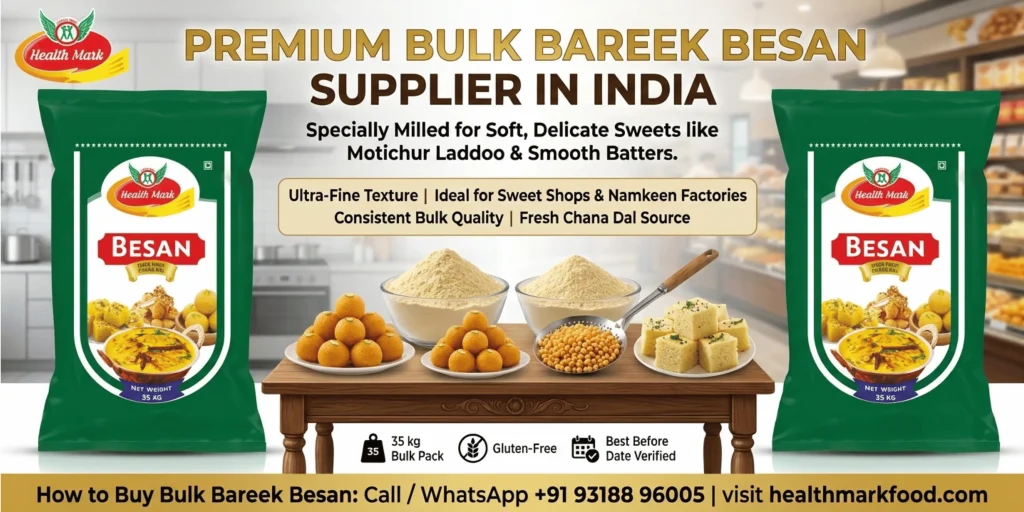
Health Mark describes its Bareek Besan as specially milled ultra-fine gram flour designed for soft, delicate sweets like motichur laddoo, with a smooth consistency that helps create even batter droplets. It is positioned for sweet shops, professional kitchens and bulk preparation.
Besan Grades Explained: Bareek vs Mota vs Regular
Most buyers talk about besan as one product. Experienced manufacturers talk about it as a range. Here is a practical comparison.
| Grade | Texture | Typical Uses | Why Buyers Choose It |
| Bareek / Barik Besan (Fine) | Silky, powder-like | Motichur laddoo, boondi, fine sev, smooth batters, delicate sweets | Smooth batter, soft finish, clean droplets |
| Regular Besan | Medium, balanced | Pakora, kadhi, chilla, everyday cooking, general snacks | Good all-round performance |
| Mota / Motichur Besan (Coarse) | Slightly granular | Besan laddoo, barfi, halwa where a grainy bite is wanted | Traditional texture in certain sweets |
Health Mark’s Besan category lists several options, including Besan, Powder Besan, Motichur / Mota Besan and Bareek Besan, so a single supplier can cover multiple uses in your product line. You can browse them in the Health Mark Besan category.
Practical example: A sweet shop making both motichur laddoo and besan laddoo might use fine besan for the first and a coarser grade for the second. Using one grade for everything usually means one of the two products is compromised.
Why Businesses Look for a Fine Besan Supplier in India
Demand for good gram flour is not slowing down. Chickpea sits at the centre of Indian snacking, festive sweets and home cooking, and India is widely recognised as the world’s largest chickpea producer. That scale is good news, but it also means quality varies enormously from mill to mill.
Here is who typically searches for a bulk besan supplier:
Namkeen and snack manufacturers who need besan for namkeen manufacturing, such as sev, bhujia, boondi and papdi
Sweet shops and halwais preparing motichur laddoo, boondi laddoo and besan-based mithai, especially around Diwali, Raksha Bandhan and wedding season
Caterers and restaurant chains that go through sacks of besan every week for pakoras, kadhi and dhokla
Retailers, kirana distributors and wholesalers looking for dependable gram flour wholesale stock
Cloud kitchens and tiffin services that want consistent results at low wastage
What do all of these buyers want? The same three things: consistency, freshness and a fair price. Every section below is built around those three.
How to Choose a Bulk Besan Supplier: 10-Point Checklist
Before you place a large order, run your shortlist through this checklist. It takes ten minutes and can save months of trouble.
- Raw material clarity. Does the supplier use clean, sorted chana dal? Besan is only as good as the dal it comes from.
- Grind consistency. Ask for a sample, then ask for a second sample from a different batch. Compare them.
- Moisture control. Excess moisture shortens shelf life and invites lumps and odour.
- Freshness and smell. Good besan smells mildly nutty and sweet. Bitter, musty or sour is a red flag.
- Colour uniformity. Natural besan is pale yellow. Dull grey or unnaturally bright yellow deserves questions.
- Packaging strength. For bulk, you want sealed, sturdy sacks that survive transport and stacking.
- Grade range. A supplier with bareek, regular and mota options is easier to grow with.
- Transparent pricing. Clear per-kg or per-bag rates, with freight and GST stated up front.
- Responsiveness. Do they pick up the phone or reply on WhatsApp quickly? Festival season will test this.
- Reorder reliability. Can they deliver the same quality in month six as in month one?
Five Practical Quality Tests You Can Do Today
You do not need a laboratory to screen besan. These simple checks, used by many kitchen managers, give you a strong first impression.
Test 1: The Rub Test
Take a pinch and rub it between thumb and forefinger. Fine besan feels smooth and silky. If it feels gritty or sandy, it is a coarser grade or poorly sifted.
Test 2: The Smell Test
Cup some flour in your palm and smell it. Fresh besan has a gentle, nutty aroma. Any sour, bitter, stale or oily smell can point to old stock or poor storage.
Test 3: The Water Batter Test
- Mix two tablespoons of besan with water to a flowing batter.
- Stir for one minute and let it rest for five.
- Check for lumps, separation and how smoothly it coats a spoon.
A good fine besan makes a smooth, uniform batter quickly.
Test 4: The Fry Test
Make a small batch of pakoras or boondi in your regular oil. Look at colour, crispness, oil absorption and taste. This is the test that matters most to your actual product.
Test 5: The Pinch-and-Press Test
Press a handful firmly and open your hand. Besan that holds a shape for a moment and then crumbles is usually dry and properly milled. Besan that stays in a wet, sticky lump may carry too much moisture.
Besan for Namkeen Manufacturing: What Works Best
Namkeen is where small differences in flour show up loudly. A bhujia that looks perfect in the batch can lose crunch overnight if the flour is wrong.
What namkeen makers should look for in besan:
- Fine, uniform particle size so the dough or batter extrudes smoothly through sev moulds and sev presses
- Low moisture for crisp, longer-lasting snacks
- Consistent protein behaviour so every batch binds the same way
- Clean taste with no bitterness that survives frying
Which grade for which snack?
| Snack | Recommended Grind | Reason |
| Fine sev, ratlami sev | Fine (Bareek) | Thin strands need smooth dough |
| Boondi (for raita or mixture) | Fine (Bareek) | Round, even droplets |
| Bhujia | Fine to regular | Smooth dough, crisp texture |
| Papdi, gathiya | Regular to fine | Balanced dough strength |
| Pakora mixes | Regular | Good coating and bite |
Common namkeen mistake: switching besan suppliers mid-season without re-testing. Even if the new flour looks identical, water absorption can differ, which changes dough texture and frying time. Always run a small trial first.
If you run a namkeen unit and need steady bulk besan, ask your supplier whether they can commit to a consistent grind specification, not just a brand name.
Besan for Sweet Shops and Halwai Kitchens
For sweets, texture is everything, and fine flour is the secret behind many classics.
Motichur Laddoo
This is where bareek besan truly shines. The batter must flow through the jhara into tiny, uniform pearls that fry evenly and bind into a soft laddoo. Coarse flour causes clogging and uneven, grainy pearls. This is exactly the use Health Mark’s Bareek Besan is built for.
Boondi Laddoo
Fine flour gives round, crisp boondi that absorbs sugar syrup beautifully without turning mushy.
Besan Laddoo, Barfi and Mysore Pak
These often benefit from a slightly coarser or medium grade for richness and mouthfeel, though many shops prefer fine flour for a melt-in-mouth finish. Decide based on your signature style and test both.
Why Sweet Shops Care About Batch Consistency
A customer who loves your laddoo in October expects the same laddoo in November. A bulk supplier who maintains the same grind and freshness helps you protect the reputation you spent years building.
Best Besan Price: What Really Decides the Rate
Everyone searches for the best besan price. But the cheapest rate per kilogram is rarely the best price. Here is what actually moves the number.
Factors that influence besan pricing:
Chana dal market rates, which change with harvest, demand and government policy
Grade and grind, because finer milling and sifting takes more processing
Packaging size and quality, with 35 kg sacks priced differently from small retail packs
Freight and distance from the mill to your location
Order volume, where larger and regular orders often earn better terms
Season, with festival months typically seeing stronger demand
How to Compare Quotes Fairly
Use this simple formula:
Real cost = (Price per kg + freight per kg + wastage cost per kg)
Wastage cost matters more than people think. If a cheaper flour gives you 5 percent more rejected or off-spec product, the saving disappears immediately.
| Quote | Rate/kg | Freight/kg | Wastage Impact | True Cost |
| Supplier A (cheap, inconsistent) | Lowest | Medium | High | Often highest |
| Supplier B (premium, consistent) | Slightly higher | Medium | Low | Often lowest |
Storage and Handling Best Practices
Besan contains natural oils, so it can turn stale or rancid if stored badly. Even the best besan will disappoint if your godown works against it.
Follow these rules:
- Store in a cool, dry, well-ventilated space. Heat and humidity are the enemies.
- Keep sacks off the floor on pallets or racks to avoid damp and pests.
- Stack away from walls so air can circulate.
- Reseal opened sacks tightly or transfer to food-grade airtight containers.
- Follow FIFO (first in, first out). Use older stock first.
- Keep away from strong odours such as spices, pickles or chemicals, since flour absorbs smells.
- Check the best-before date printed on the pack and never use flour past it.
- Inspect regularly for lumps, insects, or any sour smell.
Nutrition Snapshot of Gram Flour
Besan is valued not only for taste but also for nutrition. According to USDA FoodData Central, 100 grams of chickpea flour provides roughly 387 calories, about 22 grams of protein and around 11 grams of dietary fibre, and it is naturally gluten-free.
| Nutrient (approx. per 100 g) | Amount |
| Energy | about 387 kcal |
| Protein | about 22 g |
| Dietary fibre | about 11 g |
| Gluten | None naturally |
Values are approximate and vary by product. Always refer to the nutrition label on the pack you purchase.
Why this matters for your business: Health-conscious customers, gluten-free buyers and protein-focused diners all respond well to besan-based products. If you can speak confidently about besan’s nutrition, you add value to your menu and your marketing.
Common Mistakes Buyers Make
After watching how bulk buyers choose flour, the same mistakes appear again and again:
- Buying on price alone and ignoring wastage and consistency
- Testing only one sample instead of comparing multiple batches
- Using one grade for every recipe instead of matching grind to product
- Ignoring packaging, then dealing with torn sacks and moisture damage
- Over-ordering and letting stock sit through a humid season
- Skipping written specifications, which leaves no reference when quality changes
- Switching suppliers during peak season without trial runs
- Poor storage at the buyer’s end, then blaming the supplier
Expert Tips from the Production Floor
- Sift again if you need perfection. Even fine flour benefits from a quick sift before making delicate boondi batter.
- Rest the batter. A short rest lets besan hydrate fully and gives a smoother texture.
- Control water temperature. Cool water gives better control of batter thickness.
- Record your recipe by weight, not scoops. Besan density changes between grades.
- Keep a retention sample from every delivery. If something goes wrong later, you can compare.
- Ask for the catalogue. A good supplier will share product specifications clearly.
Why Health Mark Bareek Besan
Health Mark is a food brand based at Plot No. 60, Industrial Township, Bhatoli Kalan, Baddi (Himachal Pradesh), offering a wide range that includes atta, besan, pulses, rice, spices and more.
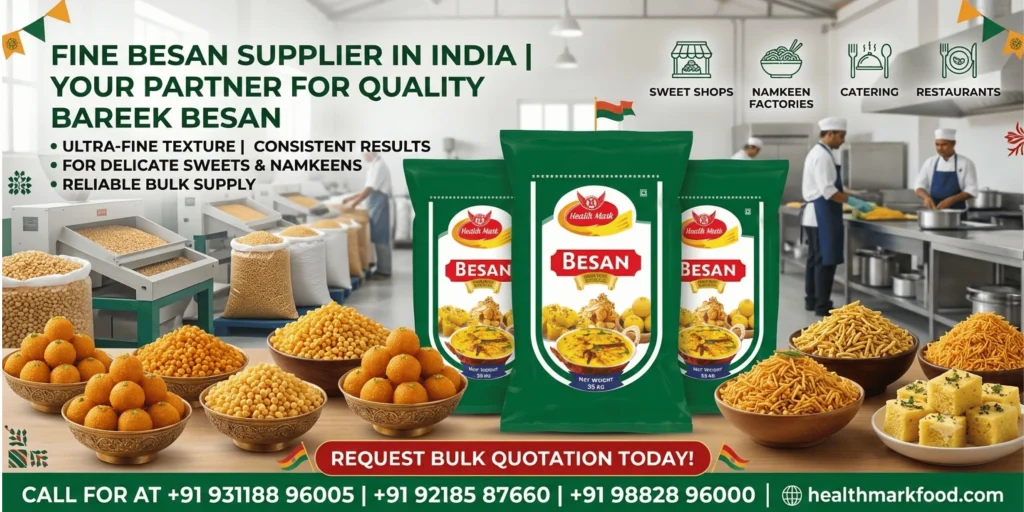
Its Bareek Besan is designed with professional buyers in mind:
- Ultra-fine texture for smooth, lump-resistant batter
- Ideal for motichur laddoo and other delicate sweets
- Consistent sweet-making results batch after batch
- Premium quality gram as the base ingredient
- 35 kg bulk pack, suited to sweet shops, namkeen units and professional kitchens
If you want to see it for yourself, visit the Bareek Besan product page, or explore the full Besan range to match the right grade to each recipe. You can also learn more about the brand on the Health Mark website.
How to Order Bulk Besan: Step by Step
- Decide your use case. Motichur, namkeen, pakoras or general cooking?
- Choose the grade. Fine (Bareek), regular or coarse (Mota).
- Estimate monthly quantity so you can ask for volume-based pricing.
- Contact the sales team by phone or WhatsApp and share your city and requirement.
- Request a quotation with rate, freight and delivery timeline.
- Trial first. Run a test batch before scaling up.
- Place a confirmed order and set a reorder schedule that avoids festival-season stockouts.
FAQ
1. Who is the best fine besan supplier in India?
The best supplier is the one that delivers a consistent fine grind, fresh and clean flour, sturdy bulk packaging and transparent pricing every time, not just on the first order. Compare samples from multiple batches, check packaging and ask about reorder reliability. Health Mark offers Bareek Besan in 35 kg packs for sweet shops and professional kitchens.
2. What is the difference between bareek besan and regular besan?
Bareek (barik) besan is milled to a much finer, silkier texture than regular besan. It makes smoother batter and softer sweets, and it is preferred for motichur laddoo, boondi and fine sev. Regular besan suits pakoras, kadhi and everyday cooking.
3. Which besan is best for motichur laddoo?
Fine (bareek) besan is best because it flows through the jhara cleanly and forms even, small pearls. Coarse flour tends to clog and produces uneven boondi.
4. What is the best besan price for bulk orders?
The best price is the lowest true cost per kilogram of usable product, after considering freight, wastage and consistency. Rates change with chana dal market prices, grade and volume, so request a current written quotation.
5. Is besan suitable for namkeen manufacturing?
Yes. Besan is the base of sev, bhujia, boondi and many other snacks. For namkeen, look for fine, uniform, low-moisture flour so dough extrudes smoothly and products stay crisp.
6. How do I check if besan is pure and fresh?
Use the rub, smell, water-batter and fry tests. Pure, fresh besan is pale yellow, feels smooth, smells mildly nutty and makes lump-free batter. For formal assurance, choose a supplier following recognised food-safety standards.
7. How should I store bulk besan?
Keep sacks on pallets in a cool, dry, ventilated place, away from walls, floors and strong odours. Reseal opened bags, use FIFO and always follow the best-before date.
8. Is besan gluten-free?
Chickpea flour is naturally gluten-free. However, if you serve gluten-sensitive customers, confirm cross-contamination practices with your supplier and check the pack label.
9. What is the pack size of Health Mark Bareek Besan?
Health Mark Bareek Besan is listed in a 35 kg pack, suitable for bulk and commercial use.
10. How can I buy wholesale besan from Health Mark?
Call +91 93188 96005, +91 92185 87660 or +91 98828 96000, message on WhatsApp, or use the Enquiry button on the Bareek Besan page.
Conclusion
Choosing a fine besan supplier in India comes down to trust built on evidence: a smooth, consistent grind, fresh and clean flour, sensible packaging and honest pricing that accounts for what really matters, your finished product.
Test samples across batches. Match the grade to the recipe. Calculate true cost, not just rate per kilo. Store flour the right way. And pick a partner who will still be delivering the same quality when your busiest season arrives.
If you are ready to try premium quality besan built for motichur laddoo, boondi and professional kitchens, explore Health Mark Bareek Besan or browse the complete Besan category.
Talk to Health Mark today:
- Call / WhatsApp: +91 93188 96005
- Call: +91 92185 87660 | +91 98828 96000
- Website: healthmarkfood.com
Request a quotation for bulk Bareek Besan and bring consistent quality to every batch.