
The secret to making crispy, golden, and delicious sev starts with choosing the right ingredients. While spices and frying techniques matter, the type of flour you use can make a noticeable difference in the final taste and texture.
For the best results, finely ground besan is generally preferred because it helps create smooth dough and evenly shaped strands. Choosing premium quality besan with the right freshness and moisture levels also plays an important role in achieving the perfect crunch.
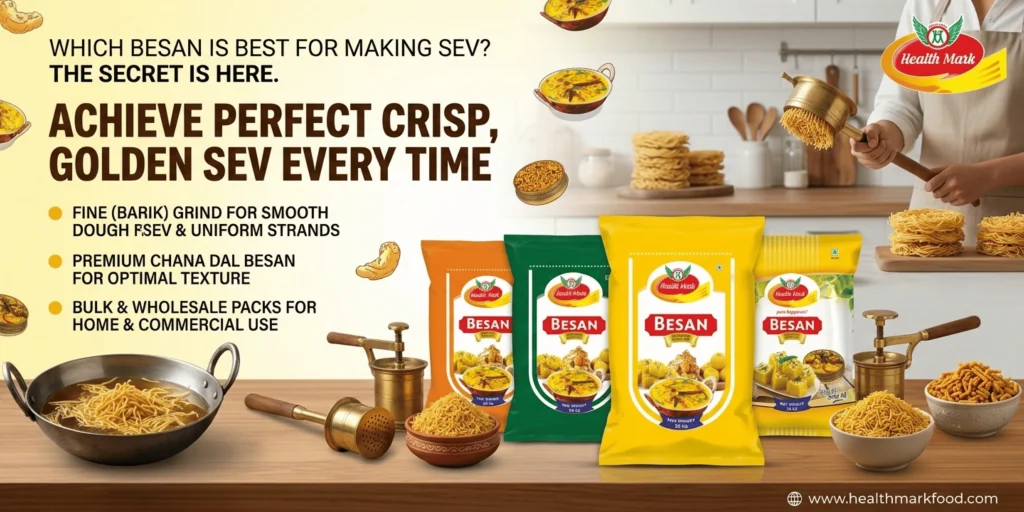
Whether you’re making sev at home or preparing it for commercial production, understanding how to select the right flour can help you achieve consistent results. In this guide, we’ll cover the essential factors to consider before making your choice.
What Besan Actually Does Inside Sev
Besan is ground chickpea (chana) flour. In sev dough it plays three jobs at once.
1. It provides structure. Besan contains protein and starch. When you add water and a little hot oil and knead, these components bind into a pliable dough that holds a strand shape.
2. It controls texture. Particle size decides how the dough feels. Finer flour gives a smooth, cohesive dough. Coarser flour gives a grainy dough that can crack at the press holes.
3. It controls how it fries. Water leaves the strand as steam in hot oil. A uniform dough dries evenly. An uneven one fries unevenly, leaving some parts soft and some hard.
Besan is also naturally rich in plant protein and fibre. According to USDA FoodData Central, chickpea flour provides roughly 20–22 g of protein per 100 g, though exact values vary by product. That nutrition is part of why besan snacks are so popular, but for sev the practical story is texture.
Besan Grades Explained: Mota, Regular, Barik and Powder
Indian mills usually sell besan in several grinds. Names vary by region and brand, but the logic is consistent.
| Grade | Typical Texture | Best Used For | Suitability for Sev |
| Mota / Motichur besan | Coarse, granular | Motichur and boondi-style sweets, some rustic snacks | Low for thin sev; acceptable only for very thick, rustic strands |
| Regular besan | Medium grind | Pakoras, kadhi, everyday cooking | Good for medium sev |
| Barik / Bareek besan | Fine, smooth | Sev, bhujia, delicate namkeen, smooth batters | Best for thin and medium sev |
| Powder besan | Very fine, talc-like | Beauty uses, ultra-smooth batters, some commercial applications | Works if hydration is carefully managed; can feel too soft or pasty |
A quick rule: the thinner the sev you want, the finer the besan should be. If your press has small holes, such as the ones used for ratlami or nylon-style sev, a coarse flour will clog or break strands.
Health Mark lists four besan products in its range: Bareek Besan, regular Besan, Motichur / Mota Besan and Powder Besan. That spread mirrors how real kitchens and factories actually buy: a different grind for each job.
Why Barik Besan Is the Best Besan for Sev
Let’s go deeper into the reasons, because this is the heart of the question.
Smoother dough, fewer tears
Fine particles hydrate quickly and uniformly. You get a dough that stretches slightly and slides through the press. With coarse flour, large granules sit unhydrated in the dough and act like tiny fault lines. Under pressure the strand tears right there.
Thinner, longer strands
If you like the classic thin sev used on bhel, chaat, poha and Indori-style snacks, you need a grind that fits through small holes. Barik besan does this without special tricks.
Crisper bite
Uniform particles dry out uniformly in the fryer. That is how you get the clean, light snap people associate with good sev, rather than a dense or chewy centre.
Better colour and finish
Even dough browns evenly. You avoid dark patches and pale, undercooked sections in the same batch.
Consistency batch after batch
For a commercial kitchen this matters most. A uniform grind means your water ratio and frying time do not need constant adjustment. Many sweet shops and namkeen units prefer a dependable best fine besan for exactly this reason.
A note on Health Mark Bareek Besan
Per the product page, Health Mark Bareek Besan is a specially milled, ultra-fine gram flour made from chana dal, supplied in a 35 kg pack and positioned for sweet shops and bulk preparation (for example, motichur laddoo batter). That same smooth consistency is what thin-strand savoury work like sev needs. As with any flour, run a small trial batch on your own press and recipe before committing to a large order.
How to Judge Quality Gram Flour Before You Buy
Packaging claims are easy. Here are tests you can do yourself in a few minutes, even before you place a bulk order.
The 7-point quality checklist
- Colour: Look for a natural, bright yellow. Dull grey or brownish tones can suggest old stock or poor raw material.
- Smell: Fresh besan smells mild and slightly nutty. A musty, sour or oily smell is a warning sign.
- Feel: Rub a pinch between thumb and finger. Good barik besan feels silky and uniform, not sandy.
- Flow: Fresh flour is light and free-flowing. Clumps may indicate moisture.
- Sieve test: Sieve 100 g through a fine mesh. A very large residue means an uneven grind.
- Water test: Make a small dough. It should come together smoothly within a minute or two without becoming sticky.
- Fry test: Press a few strands and fry. Check for breakage, oil absorption and taste.
Taste matters too
Raw or bitter notes after frying can point to poor-quality chickpeas or stale flour. Good chana dal besan tastes clean and lightly sweet when fried.
Check the label
Look for a clear ingredient list (ideally just chickpea / chana dal), packing date, batch number, net weight and food safety licence details as required in India. These are basics every serious FMCG besan supplier should show on every pack.
Chana Dal Besan vs Other Flours
Not all “gram flour” is the same product.
| Type | Made From | Notes for Sev |
| Chana dal besan | Split, husked Bengal gram | The standard for sev; clean taste, good binding |
| Whole chana flour | Whole chickpea including husk | Darker, more rustic, slightly bitter; not ideal for fine sev |
| Roasted besan | Roasted chana dal flour | Used in laddoos and some masalas; not for raw dough |
| Blended or adulterated flour | Besan mixed with cheaper flours | Weak binding, off taste; avoid |
Some recipes add a little rice flour (about 5–10% of the besan weight) to make strands lighter and crispier. That is a technique, not a substitute for good besan.
Besan for Namkeen Manufacturing: What Changes at Scale
A home cook can fix a bad batch by adding a spoon of water. A namkeen unit running hundreds of kilos a day cannot. When you choose besan for namkeen manufacturing, these factors matter far more than they do at home:
- Particle size consistency across batches. If one bag is finer than the last, your dough behaves differently and rejection rates rise.
- Moisture control. Higher moisture shortens shelf life and affects frying.
- Freshness and milling date. Besan can go stale, especially in humid conditions.
- Pack size and handling. 25–50 kg sacks are common in the trade. Health Mark’s Bareek Besan is listed in a 35 kg pack.
- Supply reliability. A stock-out can stop a line. A dependable wholesale besan supplier with predictable dispatch is worth as much as a small price difference.
- Documentation. Buyers supplying modern trade or institutions often need batch traceability and food-safety paperwork.
Quick comparison: home buyer vs commercial buyer
| Priority | Home Cook | Namkeen Unit / Sweet Shop |
| Pack size | 500 g – 1 kg | 25–50 kg sacks |
| Biggest risk | One bad batch | Line downtime, rejected lots |
| Key need | Fresh, fine flour | Consistent grind and supply |
| Buying channel | Retail | Wholesale / direct from mill |
Step-by-Step: Making Crisp Sev With Fine Besan
This is a reliable base recipe you can scale. Adjust water slightly, because every besan absorbs differently.
Ingredients (serves 4–5 as a snack)
- 200 g fine (barik) besan, sifted
- 15 g (about 1 tbsp) hot oil for the dough
- ½ teaspoon salt, or to taste
- ¼ teaspoon turmeric (optional, for colour)
- ½ teaspoon ajwain, lightly crushed
- ¼ teaspoon red chilli powder (optional)
- 90–110 ml water, added gradually
- Oil for deep frying
Method
- Sift the besan. Sifting removes lumps and aerates the flour. Do not skip this.
- Add the dry spices. Mix salt, turmeric, ajwain and chilli into the besan.
- Add hot oil. Pour the hot oil over the flour and rub it in until the mix looks like crumbly sand. This step tenderises the strands.
- Add water slowly. Add about three-quarters of the water first, then knead. Add the rest only if needed. The dough should be soft but not sticky, firmer than pakora batter and softer than chapati dough.
- Rest the dough. Cover and rest for 10 minutes so the flour fully hydrates.
- Heat the oil. Aim for medium heat, roughly 170–180°C. Test with a small piece of dough: it should rise gently with steady bubbles, not sink or brown instantly.
- Press the sev. Grease the press, fill it with dough and press strands directly into the oil in a circular motion.
- Fry until the bubbling slows. This takes about 1–2 minutes. When the sizzling quietens, the moisture is mostly gone.
- Drain and cool. Lift onto kitchen paper, cool fully, then store in an airtight container.
Matching besan to sev type
| Sev Type | Recommended Besan | Notes |
| Extra-thin sev (bhel, chaat) | Barik / bareek besan | Use finest jhara; keep dough slightly softer |
| Ratlami / spiced sev | Barik or regular besan | Firmer dough, more spice |
| Thick or ganthiya-style strands | Regular besan, or a barik and regular mix | Slightly coarser grind is acceptable |
| Commercial sev | Consistent barik besan from a single supplier | Fix water ratio per batch size |
Common Mistakes and How to Fix Them
| Problem | Likely Cause | Fix |
| Strands break while pressing | Dough too dry or flour too coarse | Add a few drops of water; switch to barik besan |
| Sev turns out oily | Oil not hot enough, or dough too soft | Raise heat slightly; firm up the dough |
| Sev is hard, not crisp | Too little oil in dough or overworked dough | Add hot oil; knead gently and briefly |
| Raw taste inside | Fried too fast at high heat | Lower the heat and fry longer |
| Dough sticks to the press | Dough too wet | Dust a little besan, rest, re-knead |
| Dark spots or uneven colour | Uneven grind or old flour | Use fresh, uniform fine besan |
| Bitter aftertaste | Stale or poor-quality besan, burnt oil | Check flour freshness; change frying oil |
| Sev goes soft after a day | Moisture or poor storage | Cool fully; use airtight containers |
Five mistakes people rarely notice
Not sifting. Lumps become weak points in strands.
Adding all the water at once. Fine besan hydrates quickly, so you can overshoot easily.
Skipping the rest. Unrested dough is uneven.
Reusing dark frying oil. It transfers bitterness.
Buying besan by price alone. A cheaper flour with inconsistent grind often costs more in rejected batches.
Expert Tips for Better Sev
Buy small first. Whichever brand you consider, test a small pack on your own press before bulk buying.
Mix grinds for control. Some makers blend roughly three parts barik with one part regular besan for sev that is strong but still crisp.
Use warm, not cold, water in winter. It helps the dough come together.
Keep dough covered. Besan dough dries and crusts quickly.
Fry in small batches. Crowding drops oil temperature and makes sev greasy.
Let the oil recover between batches. Wait for it to return to temperature.
Match the jhara to the flour. A fine plate needs fine flour.
Season after frying for extra punch. A sprinkle of chaat masala or black salt works well on warm sev.
Storage: Keeping Besan Fresh
Besan is a natural product with some fat, so it can turn stale if stored carelessly.
Keep it in an airtight, food-grade container away from sunlight and moisture.
Store in a cool, dry place. Humidity is the enemy, especially during monsoon.
Use a dry spoon every time. Wet utensils introduce moisture and spoilage.
For commercial stock, follow first in, first out (FIFO) and keep sacks off the floor on pallets.
Buy quantities you can use within a reasonable time instead of stockpiling for months.
If the flour smells sour or musty, or shows clumps or insects, do not use it.
Fried sev should be fully cooled before storing, then kept airtight. Done properly, it stays crisp for a few weeks, though exact shelf life depends on oil quality, humidity and packaging.
Best Besan Brand in India | How to Make the Right Choice
Choosing the best besan brand in India depends on quality, freshness, texture, and your cooking requirements. Whether you’re purchasing for household use or large-scale food production, selecting the right besan can make a noticeable difference in taste and consistency.
Here are seven important factors to consider:
- Identify Your Requirements: Fine (barik) besan works well for sev and smooth batters, while coarser varieties are suitable for certain traditional sweets.
- Check Ingredient Quality: Choose besan made from good-quality chana dal, with clear ingredient information and no unnecessary additives.
- Evaluate Freshness: Look for a natural aroma, uniform colour, and appropriate manufacturing and best-before dates.
- Compare Product Consistency: For bulk purchases, request samples to check grinding quality and cooking performance.
- Review Packaging: Select properly sealed packaging that protects the flour from moisture and contamination.
- Verify Supplier Reliability: Check food safety licensing, product information, delivery commitments, and customer feedback.
- Compare Price and Value: Consider quality, packaging, and overall cost rather than choosing the lowest price alone.
The best besan is one that consistently meets your cooking or manufacturing needs. For businesses seeking premium quality besan in bulk, Health Mark offers a sourcing option worth exploring.
Where Health Mark fits
Health Mark is a food products company based at Industrial Township, Bhatoli Kalan, Baddi (Himachal Pradesh), supplying staples such as atta, besan, pulses, rice and spices. Its besan range covers four grades, so a buyer can match grind to application. You can browse the Health Mark besan category and decide on your own trial results.
Wholesale and Bulk Fine Besan: What Buyers Should Ask
If you run a sweet shop, a namkeen unit, a restaurant chain or a packaged-snack brand, you are probably searching for wholesale fine besan or bulk fine besan rather than retail packs. Here is a practical buyer’s checklist.

Questions to ask any wholesale besan supplier
- Is the besan made from chana dal, and is it 100% pure with no blending?
- What is the grind specification, and can you share a sample before the order?
- What is the moisture level and the typical shelf life?
- What pack sizes are available, and what is the minimum order quantity?
- How is the flour packed, and how do you protect it against moisture in transit?
- What are the dispatch time and delivery coverage in my region?
- Can you provide food safety licence details and batch information?
- Do you offer repeat-order pricing for regular buyers?
Why direct sourcing from a manufacturer helps
- Fewer middlemen, so fresher stock and clearer accountability
- Better price stability on repeat orders
- Easier troubleshooting if a batch behaves differently
- Scope for customised grind, depending on the manufacturer
Sourcing fine besan from Health Mark
Health Mark supplies Bareek Besan as an ultra-fine gram flour in a 35 kg pack, aimed at sweet shops and bulk kitchens. For businesses searching for a fine besan supplier in India or an FMCG besan supplier with a Himachal-based production base, it is worth requesting a sample and trial.
To enquire, call or WhatsApp the Health Mark sales team:
- 09318896005
- 9218587660
- 9882896000
You can also use the product page’s Enquiry button on healthmarkfood.com.
Nutrition Note: Is Sev Healthy?
Besan itself is a good source of plant protein and fibre, and it is naturally gluten-free. Sev, however, is deep fried, so it is calorie-dense. Enjoy it as a topping or an occasional snack, use fresh oil, and keep portions sensible. People with specific dietary needs, such as managing diabetes or heart conditions, should check with a qualified dietitian or doctor.
FAQ
1. Which besan is best for making sev?
Fine (barik) besan made from chana dal is best for making sev. It hydrates evenly, makes a smooth dough that passes through the press without tearing, and fries into crisp, uniform strands. Choose freshly milled flour with no musty smell.
2. Can I use regular besan instead of barik besan for sev?
Yes, for medium or thicker sev. Regular besan works well with a larger-holed jhara. For extra-thin sev, a coarser grind tends to clog the holes and break strands, so barik besan is the safer choice.
3. Is motichur (mota) besan good for sev?
Usually not. Mota or motichur besan is coarse and suited to sweets such as motichur laddoo. It can make sev grainy and fragile. Use it only if you want a very rustic, thick strand, and ideally blend it with finer flour.
4. Why does my sev break when I press it?
The common reasons are a dry dough, too little oil in the dough, an unsifted or coarse flour, or a rushed knead. Add a few drops of water, rub in hot oil, sift the besan, rest the dough and try again.
5. How much water should I add to besan for sev?
As a starting point, use roughly 45–55 ml of water per 100 g of besan, added gradually. Fine besan absorbs quickly, so add three-quarters first and adjust. Exact quantity varies with flour, humidity and recipe.
6. How can I tell if besan is good quality?
Check for a bright natural yellow colour, a mild nutty smell, a silky feel, free flow without clumps and a smooth dough. Do a small fry test. Good quality gram flour fries clean, with no bitterness.
7. Which is the best besan brand in India?
There is no single best brand for every buyer. The best one is the brand whose grind, freshness and supply match your use. Test samples, compare batches, check labels and documentation, and prefer manufacturers who control their own milling and packing.
8. Where can I buy wholesale or bulk fine besan?
You can buy from besan manufacturers and wholesale suppliers who sell in 25–50 kg packs. Health Mark offers Bareek Besan in a 35 kg pack; sales enquiries can be made on 09318896005, 9218587660 or 9882896000.
9. What besan is used for namkeen manufacturing?
Namkeen units typically use chana dal besan in the grind that suits each product: fine for sev and bhujia, regular for ganthiya and papdi-type items, and coarser grades for specific sweets. Consistency between batches is the key requirement.
10. How long does besan stay fresh?
Stored airtight in a cool, dry place, besan generally stays usable for a few months, but freshness matters for taste. Check the packing date, avoid humidity, and discard flour that smells sour or looks clumpy.
Conclusion
So, which besan is best for making sev? For nearly every sev recipe, the answer is fresh, uniformly ground, fine barik besan from chana dal. Match the grind to the strand: finest for thin sev, regular for medium, and avoid coarse motichur flour unless you want a rustic bite.
If you cook in volume, treat flour as a process input, not just an ingredient. Test samples, check batch consistency, and choose a wholesale besan supplier you can rely on.
Ready to try it? Explore the Health Mark besan range, view the Bareek Besan product page, or speak to the sales team on 09318896005, 9218587660 or 9882896000 to request a sample or a bulk quote.