
If you run a namkeen unit, you already know the uncomfortable truth. You can have the best fryer, the sharpest recipe and a loyal distributor network, and still lose a week of production because one lot of besan behaved differently from the last. Sev turns brittle. Bhujia drinks oil. Boondi comes out flat and pale. Nothing in your process changed. The flour did.
That is why experienced namkeen companies treat besan as a strategic ingredient, not a commodity. It is also why the search for a dependable besan supplier for namkeen manufacturers usually begins after a bad batch rather than before it.

This guide walks through how namkeen companies actually select besan: the specifications they check, the tests they run on their own shop floor, the questions they put to suppliers, and the mistakes that quietly inflate costs. Whether you run a small unit or a growing brand shipping across North India, you will finish with a checklist you can use tomorrow.
Why Besan Makes or Breaks a Namkeen Batch
In sev, bhujia, gathiya, boondi, papdi and most other besan-based snacks, the flour is not a background ingredient. It is the structure. Its protein and starch set the shape of each strand, its natural sugars help it turn golden in the fryer, and its nutty flavour is what the customer tastes first.
Three things go wrong quickly when the flour is inconsistent:
Texture. Coarse or uneven particles clog fine extruder holes and give snacks a gritty bite. Overly fine, starchy flour can turn dough sticky and make finished pieces hard rather than crisp.
Oil and yield. Flour that absorbs water differently absorbs oil differently. A lot with poor frying behaviour raises your oil bill and lowers the weight of saleable product per kilo of flour.
Taste and shelf life. Old or damp besan can smell musty or turn rancid, and that off-note survives seasoning. It also shortens the life of the finished snack on the shelf.
The takeaway is simple: a small difference in flour, multiplied by hundreds of kilos a day, becomes a large difference in profit and reputation.
Match the Grind to the Snack: The Besan Grades Namkeen Makers Use
One reason namkeen companies rarely buy “just besan” is that different snacks want different particle sizes. Health Mark, for example, lists regular besan alongside Powder Besan, Bareek Besan and Motichur / Mota Besan on its website, which reflects how buyers in this trade think about grind.
| Snack or use | Typical grind | Why it tends to work |
| Thin sev, fine bhujia | Bareek (fine) | Flows evenly through small extrusion holes and gives smooth, even strands with less breakage |
| Boondi, papdi, gathiya, general namkeen dough | Regular (medium-fine) | Balances dough handling with a clean, crisp bite |
| Motichur-style products and snacks that need a grainy bite | Mota / motichur (coarse) | Coarser particles give body and a slightly granular texture |
| Pakora and dhokla mixes | Regular | Blends easily into batters and spreads cleanly |
The 9-Point Checklist Namkeen Companies Use Before Approving Besan
Procurement heads at established snack brands rarely rely on one test. They build a short specification and hold every supplier to it. Here is what that specification usually covers.
1. Raw material: the chana dal behind the flour
Everything starts with the pulse. Clean, sound, well-graded chana dal gives a brighter colour and a cleaner taste than mixed or damaged grain. Ask what dal the supplier uses, how it is cleaned before milling and whether foreign matter and broken grain are removed. Health Mark’s besan page, for instance, says its flour is made from carefully selected chana dal.
2. Grind fineness and particle uniformity
Ask for the mesh or sieve specification and check a sample on your own sieve. What matters is not just the average size but how uniform it is lot after lot. Many units also sift besan before kneading to remove larger particles, and the NIFTEM project report on besan namkeen processing lists a sifter as standard equipment.
3. Moisture content
Moisture drives shelf life, lumping and dough behaviour. Higher moisture invites mould and insects, and it changes how much water your dough needs. A supplier should be able to tell you the moisture of each lot, not just quote a general range.
4. Colour, aroma and taste
Fresh besan is a uniform pale yellow with a clean, slightly nutty smell. Grey tones, dark specks, a sour or musty note or any bitterness are all reasons to reject a lot. Keep a retained sample of your best lot as a permanent reference.
5. Water absorption and dough behaviour
Make dough with your usual water ratio and rest it for the usual time. Does it come together the same way as your reference lot? A flour that needs noticeably more or less water will disturb your recipe, your machine settings and your yield.
6. Frying performance
This is the test that counts most. Fry a small batch at your normal oil temperature and judge colour, crunch, breakage and oil uptake against your reference. A lot can pass every lab number and still fry poorly, which is why namkeen companies always trial before they approve.
7. Purity: no kesari dal, no added colour
The FSSAI definition of besan is dehusked Bengal gram ground into flour, with no added colouring matter. Adulteration with cheaper kesari dal or artificial colour is a known risk in the trade, and it cannot be judged by eye. This is where documentation, lab tests and a supplier who mills their own dal earn their value.
8. Hygiene and pest control
Besan should be free from living insects, filth and abnormal odours. Look at how the supplier stores dal, how the mill is cleaned and how finished flour is packed. Certifications such as ISO 22000, HACCP, GMP and GHP indicate that a documented food-safety system exists, though you should always verify the certificate is current.
9. Batch-to-batch consistency
A single perfect sample proves very little. What you are buying is repeatability. Ask for batch-wise reports, check lot codes on the bags and compare three or four consecutive deliveries in the first few months.
What FSSAI Says About Besan
India’s food regulator sets legal standards for besan in the Food Safety and Standards (Food Products Standards and Food Additives) Regulations. The cereals chapter published by FSSAI defines besan and lists the parameters below.
| Parameter | Limit in the FSSAI cereals chapter |
| Definition | Product obtained by grinding dehusked Bengal gram (Cicer arietinum); no added colouring matter |
| Moisture, % by mass | Not more than 12.0 |
| Ash insoluble in dilute HCl, % | Not more than 0.3 |
| Alcoholic acidity (as H2SO4, 90% alcohol), % by mass | Not more than 0.18 |
| Protein (N x 6.25), % by mass, dry basis | Not less than 20.0 |
| Uric acid, mg/kg | Not more than 100 |
| General condition | Free from abnormal flavours and odours, living insects and filth |
Simple In-House Tests You Can Run in an Hour
You do not need a full laboratory to screen a new lot. These quick checks catch most problems early.
| Test | How to do it | What good looks like |
| Colour check | Spread a spoonful on white paper beside your reference sample | Even pale yellow, no dark specks |
| Smell and taste | Smell a fresh handful, then warm a pinch with a little water and smell again | Clean, nutty aroma. Bitter, musty or sour means reject |
| Sieve test | Pass 100 g through the mesh you normally use and weigh the residue | Residue close to your reference lot |
| Moisture | Use a moisture balance if you have one | Within your written specification |
| Dough test | Knead with your standard water ratio and rest it | Same feel and workability as the reference |
| Fry test | Fry a small trial at normal oil temperature | Colour, crunch and oil uptake match the reference |
Keep a labelled retention sample from every delivery. If a complaint arrives from the market six weeks later, that jar is your evidence. For purity questions such as kesari dal, use an accredited lab; FSSAI has published test methods for detecting it in besan.
Step-by-Step: How to Evaluate and Onboard a Besan Supplier
Here is the sequence most namkeen companies follow when they add a new source of flour.
1. Write your own specification first. Note grind, moisture ceiling, colour, packaging and delivery expectations, so you compare suppliers against your needs rather than their brochures.
2. Shortlist three suppliers. Include at least one direct besan manufacturer in India that mills its own dal.
3. Collect paperwork. Ask for the FSSAI licence, ISO or HACCP certificates if claimed, a product specification sheet and a recent certificate of analysis.
4. Request samples from a real production lot. Not a hand-picked showpiece, but a sample that represents what will be delivered.
5. Run your own trials. Do the dough and fry tests in the previous section on every sample, side by side, with the same operator and oil.
6. Visit or video-audit the mill. Look at dal storage, cleaning, milling, packing and pest control. A supplier who welcomes this is usually a good sign.
7. Place a pilot order. Start with a modest quantity and compare three consecutive deliveries against your specification.
8. Formalise the deal. Put grind, moisture limits, packaging, lot coding, delivery timelines and the rejection procedure in writing, then review quality every quarter.
Manufacturer, Trader or Distributor: Who Should You Buy From?
The name on the invoice matters more than most buyers realise. A trader may source from several mills, so the flour you receive in March may not come from the mill that supplied your February lot. That is fine for one-off top-ups. It is riskier for a product whose taste customers expect to stay identical.
| Factor | Direct manufacturer | Trader or reseller |
| Traceability | Usually the supplier controls dal sourcing and milling, so lot tracing is easier | Origin can change between deliveries |
| Consistency | One mill and one process to hold accountable | Depends on which mill filled the order |
| Grades on offer | Can often mill different grinds on request | Limited to what is in stock |
| Accountability | One party to call when a batch goes wrong | Problems may bounce between reseller and mill |
| Small urgent orders | May have minimums | Often more flexible |
Proximity also counts. Buyers often search for a besan seller near me because shorter transport means faster replenishment and fewer stock-outs during festival peaks. But nearby is only useful if the quality is right, so use distance as a tiebreaker, not the first filter. A capable best besan seller is the one whose flour passes your trials and whose lot reports you can trust, whether they sit down the road or a day’s drive away.
Price vs Value: Finding the Best Besan Price for Your Unit
Every buyer wants the best besan price, but the invoice rate is only half the story. What matters is the effective cost of every kilo that ends up as sellable snack.
Here is an illustration with made-up numbers, not market prices:
| Lot A (cheaper quote) | Lot B (higher quote) | Difference | |
| Quoted price per kg | ₹80 | ₹84 | B costs ₹4 more |
| Share lost to rejects and breakage | 6% | 1% | B loses 5 points less |
| Effective cost per usable kg | ₹85.11 | ₹84.85 | B is cheaper |
The cheaper quote lost. Add a few days of production stopped by an inconsistent lot, and the gap widens. Also weigh payment terms, delivery reliability and packaging when you compare offers.
If you buy at scale, ask for best wholesale besan rates for committed monthly volumes, and pair the price discussion with a written quality specification so that a lower rate never becomes an excuse for a lower standard.
Common Mistakes Namkeen Companies Make When Choosing Besan
• Choosing on price alone. The cheapest quote often carries hidden costs in oil, rejects and lost trust.
• Approving from one sample. One good bag proves nothing about the next twenty.
• Skipping the fry test. Lab numbers do not always predict how flour behaves in a real fryer.
• Ignoring the grind for the product. A fine grade in a snack that wants body, or the reverse, causes avoidable complaints.
• Not keeping retention samples. Without them you cannot prove or trace a problem.
• Trusting a claim without a document. Certificates, licences and test reports should be verified, not assumed.
• Relying on popularity. Searches for the top selling besan in India are common, but sales rank does not tell you whether a brand suits your dough, your machine or your snack. Test it.
• Having a single supplier. Keep a qualified backup in case of a mill shutdown or a bad crop year.
Storage, Seasonality and Stock Planning
Chickpea is a rabi crop, so fresh supply and pricing tend to shift around the spring harvest. India is the world’s largest producer of chickpea, but that does not make prices stable, and demand jumps before festivals. Plan for it.
• Store cool and dry. Keep besan in sealed bags on pallets, away from walls and floors.
• Use first-in, first-out. Mark every delivery with its date and lot code and use the oldest first.
• Buy for realistic turnover. Besan is a fresh flour, not a forever ingredient, so overstocking risks staleness.
• Build a buffer before peak demand. Order ahead of festive seasons instead of during them.
• Inspect on arrival. Check bag integrity, smell, lot code and date before unloading everything.
Where Health Mark Fits on Your Besan Shortlist
If you are compiling a shortlist of suppliers, here is what Health Mark states about its besan, so you can test it against your own specification.
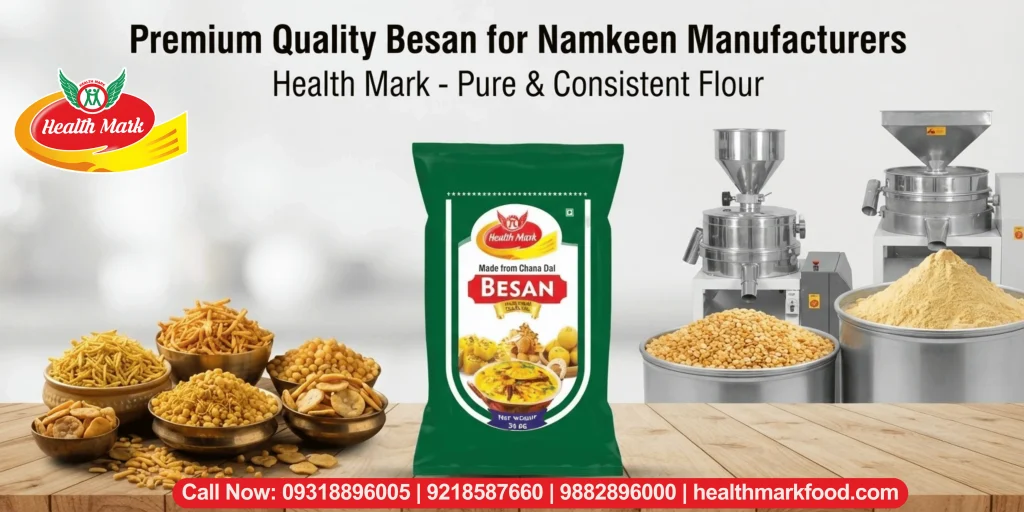
• Product description. The company says Health Mark besan is made from carefully selected chana dal, finely ground for a smooth texture and a rich nutty flavour, and hygienically processed and packed.
• Range. Besan, Powder Besan, Bareek Besan and Motichur / Mota Besan, which lets you match a grade to each snack instead of forcing one flour to do everything.
• Accreditation. The website’s accreditation section shows ISO 22000, ISO 9001, GHP, GMP and HACCP logos. As with any supplier, ask to see current certificates.
• Base. Plot No. 60, Industrial Township Bhatoli Kalan, Baddi, Himachal Pradesh 173205.
• Positioning. The company describes itself as North India’s No1 brand in wholesale and retail consumer goods. Treat any “No 1 besan brand” claim, ours included, as a reason to run your own trial, not a substitute for it.
Buyers looking for premium quality besan in retail packs can see the Health Mark besan product page, which lists 55 g, 200 g, 500 g and 1 kg packs, and the full besan category for other grades. For bulk requirements, packing formats and pricing, speak to the sales team directly. Pack sizes, quantities and rates for factory orders are best confirmed on a call.
Anyone comparing a top Besan supplier with premium high quality besan in mind should hold this shortlist to the same standard: samples, paperwork, trials and consistency. If Health Mark Besan meets your specification, you have a source in Baddi that can serve North Indian units. If it does not, the checklist above will have told you why before you signed anything.
Expert Tips for Namkeen Buyers
• Ask every supplier the same ten questions, and write down the answers. Patterns show up fast.
• Test at the season’s edges too. A supplier who is consistent in peak demand is worth more than one who shines in a slow month.
• Ask how the mill handles complaints, not just how it handles orders.
• When you find the best Besan for a snack, freeze the specification in writing, including the grind, and audit against it.
• Whenever you decide to buy besan in a new grade, trial it on one product line before switching everything.
• A best quality besan is defined by fit: for your recipe, your machine and your customer’s taste, not by adjectives on a pack.
FAQ
Which besan is best for making sev and bhujia?
Most namkeen makers choose a fine (bareek) grind for sev and bhujia because it flows evenly through fine extrusion holes and gives smooth, unbroken strands. The right pick still depends on your recipe and machine, so run a fry trial with two or three grades before you place a bulk order.
What moisture level should besan have for namkeen?
The FSSAI standard for besan caps moisture at 12 percent by mass. Staying comfortably below that ceiling generally helps the flour store better and behave more predictably in dough. Ask for a batch-wise test report and confirm the limit against the latest FSSAI notification.
How can I check whether besan is adulterated with kesari dal?
Kesari dal (Lathyrus sativus) is a cheaper pulse that is sometimes mixed into besan illegally, and you cannot reliably spot it by eye. Send a sample to an accredited lab; FSSAI has published methods for detecting kesari dal in besan. Buying from a manufacturer that mills its own chana dal and shares test reports lowers the risk.
Is bareek besan better than regular besan for namkeen?
Neither is better across the board. Bareek besan suits thin, delicate products such as fine sev, while regular or coarser grades suit snacks that need more body and bite. Choose by product, then confirm with a trial batch.
How should besan be stored in a namkeen factory?
Keep besan in sealed bags in a cool, dry, well-ventilated store, stacked off the floor and away from walls, and use it first-in, first-out. Heat and humidity raise the risk of lumps, musty smell and rancidity, so follow the best-before date printed on the pack.
Should namkeen makers buy from a manufacturer or a trader?
Buying directly from a manufacturer usually gives you better traceability, tighter control over grind and moisture, and one point of accountability when something goes wrong. Traders can be useful for small or urgent top-ups, but ask them who mills the flour and request the same test reports.
What documents should a besan supplier provide?
At minimum, ask for a valid FSSAI licence, a product specification sheet, a batch-wise certificate of analysis, and proof of any certifications the supplier advertises, such as ISO 22000 or HACCP. Also ask about lot coding, so any problem can be traced to a single production batch.
Does the lowest price per kg mean the cheapest besan?
Not always. A lower quote can carry hidden costs through higher oil uptake, more rejected batches, breakage and returns. Compare effective cost, which is the price per kg divided by the share of flour that turns into sellable snack, rather than the invoice rate alone.
Can I get a sample before placing a bulk besan order?
You should insist on one. Run the sample through your own dough and fry test before committing. To request samples or a bulk quote from Health Mark, call 09318896005, 9218587660 or 9882896000.
How do I find a reliable besan supplier near my unit?
Start with manufacturers within a practical transport radius, because shorter lead times reduce stock-outs. Health Mark operates from Baddi in Himachal Pradesh, which places it within reach of buyers across Punjab, Haryana, Himachal and Chandigarh, and its website also mentions nationwide delivery.
Conclusion: Make Besan a Decision, Not a Default
Namkeen companies that stay consistent for decades usually have one thing in common: they never left flour to chance. They define the grind, hold suppliers to numbers, run their own trials, keep retention samples and review quality on a schedule. None of that is complicated. It just has to be done every time.
Start with the nine-point checklist, run a fry trial on two or three samples and write a specification you can defend. Then choose a besan supplier for namkeen manufacturers who can prove consistency, not just promise it.