
If you run a sweet shop in Sector 22, a dhaba on the Chandigarh-Ludhiana highway, a catering business in Panchkula, or you simply go through kilos of gram flour every month at home, you’ve probably typed some version of this into Google: where can I buy besan in bulk near Chandigarh?
It’s a fair question and a surprisingly tricky one to answer well. Tri-city besan buyers (Chandigarh, Mohali, Panchkula) are stuck between two bad options most of the time: overpriced small-pack besan from local kirana stores, or unbranded “loose” besan from wholesale mandis with no clarity on hygiene, sourcing, or shelf life.
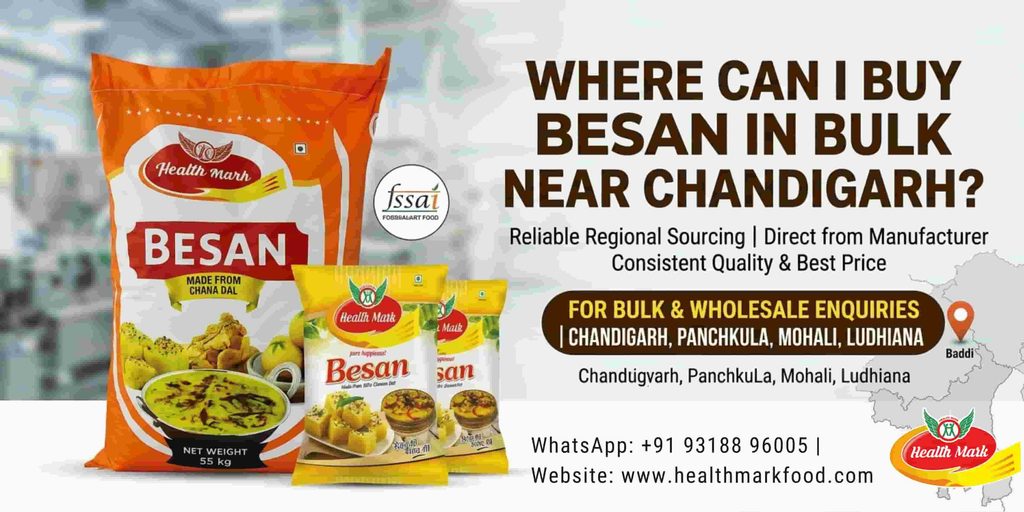
This guide cuts through that confusion. We’ll walk through exactly what makes besan “good,” how to judge quality before you buy a single kilo, what a fair besan price actually looks like in 2026, and where a genuine besan manufacturer near Chandigarh Health Mark, based in Baddi, roughly 60 km from the tri-city fits into the picture for bulk buyers.
What Is Besan and Why Bulk Buyers Care So Much About Quality
Besan, also called gram flour or chana flour, is made by dry-grinding chana dal (split Bengal gram) into a fine powder. It’s one of the most-used ingredients in Indian kitchens from pakoras and kadhi to dhokla, laddoos, and thickening agents in gravies.
For home cooks, a 500 gm pack every couple of weeks is fine. But for businesses sweet shops, snack manufacturers, restaurants, hostels, caterers, and hotels besan isn’t a pantry item. It’s a raw material that directly affects product consistency, taste, and cost per unit. That’s exactly why “buy besan” searches increasingly include the word “bulk,” and why buyers specifically look for a besan supplier in north India rather than the nearest supermarket shelf.
When you’re buying besan by the sack instead of the packet, three things matter far more than they do for a single household pack:
Consistency across batches a bulk buyer can’t afford besan that behaves differently every 25 kg bag
Moisture content and shelf life because bulk stock sits in storage longer
Verified processing standards since you’re serving the end product to hundreds of customers, not just your own family
This is the gap that a genuine besan manufacturer, rather than a repackaged wholesaler, is built to close.
Why “Near Chandigarh” Matters When Buying Besan in Bulk
Chandigarh, Mohali, and Panchkula sit in a region with heavy demand for besan driven by the sweet shop and namkeen industry, wedding catering, dhaba culture, and a large hostel and PG population. Yet very few large-scale besan manufacturing units are actually located inside the tri-city itself.
Searching for a “besan seller near me” in Chandigarh usually surfaces two kinds of results:
- Local kirana and wholesale grocery shops that repack besan sourced from third-party mills
- Regional besan manufacturers based in the wider Punjab–Himachal–Haryana belt who supply directly to the tri-city
The second option is almost always the better one for bulk buyers, for a simple reason: buying closer to the source cuts out layers of middlemen, keeps the besan price competitive, and shortens the time between milling and delivery which matters a lot for a product that’s sensitive to moisture and rancidity.
Health Mark, for instance, is manufactured out of Baddi in Himachal Pradesh’s Industrial Township about an hour to ninety minutes from Chandigarh depending on traffic through Panchkula or Zirakpur. That regional proximity is exactly why it shows up as a relevant answer to “besan manufacturer near Chandigarh” and “besan supplier in north India” searches, without being physically inside the city.
How to Identify the Best Besan Brand in India
Every packet on a wholesale shelf claims to be “the best besan brand in India” or the “No 1 besan brand.” That’s marketing. Here’s what to actually check.
1. Colour and texture
Good besan has a consistent, natural yellow colour and a fine, uniform texture no visible lumps, no greyish tinge, and no gritty feel between your fingers.
2. Smell
Fresh besan smells mildly nutty. A sour, musty, or stale smell is the single biggest red flag of poor storage or old stock something you cannot afford to miss when buying in bulk.
3. Source dal quality
Premium quality besan starts with premium quality chana dal. Manufacturers who control their own dal sourcing tend to deliver far more consistent flour than traders who buy ground besan from unknown mills and simply repackage it.
4. Hygiene and processing standards
Look for FSSAI licensing at minimum, and ideally a manufacturer that’s transparent about hygienic processing and packaging not just a sticker on the bag, but an actual described process.
5. Batch consistency
Ask any potential supplier: does this taste, smell, and behave the same in every batch? A top selling besan brand earns repeat business specifically because large buyers don’t have to requalify the product every time they reorder.
6. Real accountability
A brand willing to share its manufacturing address, FSSAI details, and a direct sales contact (not just a marketplace listing) is generally a safer long-term bulk supplier than an anonymous wholesale trader.
Types of Besan You Should Know Before Ordering in Bulk
Not all besan is the same and ordering the wrong grade in bulk can throw off your recipes at scale. Here are the common variants worth knowing:
Fine besan (standard gram flour): The everyday variety, used for kadhi, batters, and general cooking
Bareek besan: An extra-fine grind, preferred where a very smooth batter or coating is needed
Motichur / mota besan: A coarser grind specifically used for motichur laddoo and boondi, where texture matters for the final bite
Powder besan: A very fine, almost powdery grind often used in sweets and specific bakery-style preparations
If you’re buying in bulk for a specific product line say, a namkeen unit that makes both pakoras and boondi it’s worth ordering the correct grade for each use case rather than trying to make one grade do everything.
Health Mark: A Besan Manufacturer Near Chandigarh Worth Knowing
Health Mark Besan is produced from carefully selected chana dal, finely milled to get a smooth texture and a rich, nutty flavour that holds up in both savoury dishes and sweets. It’s manufactured at Health Mark’s facility in Industrial Township, Bhatoli Kalan, Baddi a location that puts it within practical reach of Chandigarh, Panchkula, Mohali, Ludhiana, and the wider Punjab belt for both retail and bulk supply.
What buyers typically look for and where Health Mark Besan fits:
Premium quality besan: Made from selected Bengal gram, milled for smooth, consistent texture batch after batch
Hygienic processing and packing: Processed and packed with freshness and purity in mind, rather than repackaged from unverified stock
Multiple pack sizes: Available in 55 gm, 200 gm, 500 gm, and 1 kg formats useful for businesses that want to test a size before scaling to bulk ordering
Product range depth: Beyond the standard variety, Health Mark also manufactures Powder Besan, Bareek Besan, and Motichur / Mota Besan so bulk buyers with different use cases (pakoras, dhokla, laddoo, boondi) can source everything from one supplier instead of juggling multiple vendors
You can view the full besan range on the Besan product category page, or check the main Besan product listing for specifications.
For businesses and bulk buyers near Chandigarh, Panchkula, Baddi, or Ludhiana specifically evaluating a besan manufacturer in India, the practical questions to ask any supplier Health Mark included are: What’s the minimum bulk order quantity? What’s the delivery timeline to your city? And can they commit to consistent supply during high-demand seasons like Diwali and wedding season, when besan consumption spikes sharply?
Best Besan Price: What Actually Drives the Cost
There’s no single “correct” besan price it moves with a handful of real factors, and understanding them helps you evaluate whether a quote from a supplier is fair.
| Factor | Impact on Price |
| Chana dal market rate | Directly drives base besan cost; fluctuates with the pulses market |
| Grind type (fine, bareek, mota, powder) | Finer grinding and specialty grades can cost marginally more |
| Order quantity | Bulk orders typically bring a lower per-kg rate than retail packs |
| Packaging | Loose/bulk sacks are cheaper per kg than small retail pouches |
| Transport distance | A besan supplier in north India delivering regionally usually has a freight advantage over one shipping pan-India |
| Brand and quality assurance | Manufacturers investing in hygiene, sourcing, and consistent milling may price slightly above unbranded mandi besan but reduce your quality-control burden |
Comparison: Loose Mandi Besan vs. Branded Wholesale Besan
| Parameter | Loose / Unbranded Mandi Besan | Branded Bulk Besan (e.g., Health Mark) |
| Source traceability | Often unclear | Traceable to a known manufacturer |
| Batch-to-batch consistency | Variable | Generally consistent |
| Hygiene standards | Difficult to verify | Documented processing & packaging |
| Packaging quality | Basic, sometimes unsealed | Sealed, moisture-resistant packing |
| Shelf life clarity | Rarely mentioned | Typically labelled |
| Price per kg | Usually lower upfront | Slightly higher, but lower wastage |
| Support for reorders | Limited, informal | Direct contact for repeat bulk orders |
| Product variety (bareek, mota, powder) | Rarely available together | Available under one supplier |
Step-by-Step: How to Order Bulk Besan Near Chandigarh
If you’re moving from “just researching” to actually placing a bulk order, here’s a sensible process to follow:
Define your monthly or seasonal quantity bulk pricing and delivery planning both depend on volume, so estimate this before contacting any supplier.
Identify the besan grade you need standard, bareek, mota, or powder based on what you’re making.
Shortlist 2–3 potential suppliers or manufacturers near Chandigarh, Panchkula, Baddi, or the wider Punjab region.
Request a sample pack first in a retail size (like 500 gm or 1 kg) to test colour, smell, and cooking performance before committing to bulk.
Ask direct questions: FSSAI license number, minimum order quantity, delivery timeline, and packaging options for bulk.
Compare the landed price, not just the quoted per-kg rate factor in transport and any packaging costs.
Place a trial bulk order rather than a full season’s supply, to confirm consistency before scaling up.
Lock in a reorder process a direct contact number or enquiry channel makes repeat bulk buying far smoother than starting from scratch each time.
Common Mistakes Bulk Besan Buyers Make
- Buying purely on price without checking hygiene standards or sourcing the cheapest besan seller isn’t automatically the best besan seller.
- Skipping the sample stage and jumping straight to a large bulk order from an unfamiliar supplier.
- Ignoring pack sealing quality, which directly affects how long bulk stock stays fresh in storage.
- Not asking about grind type, then discovering the besan is too coarse or too fine for the specific recipe.
- Overstocking before checking shelf-life guidance, leading to wastage during slower business months.
- Assuming “near me” always means best a besan manufacturer slightly outside city limits with strong hygiene practices can be a far better long-term choice than a closer but unverified local seller.
Health Benefits of Besan (Backed by Nutrition Science)
Besan isn’t just a cooking staple it’s genuinely nutrient-dense, which is part of why it’s positioned as a health-conscious flour choice in Indian kitchens.
Good source of plant protein, making it a useful ingredient in vegetarian diets
Naturally gluten-free, which makes it suitable for people avoiding wheat-based flours
Contains dietary fibre, which supports digestion when used as part of a balanced diet
Lower glycemic impact than many refined flours, according to general nutrition guidance on pulses and legume flours
Source of micronutrients such as folate and iron, typical of gram-based legume flours
Best Uses for Bulk Besan Business & Home
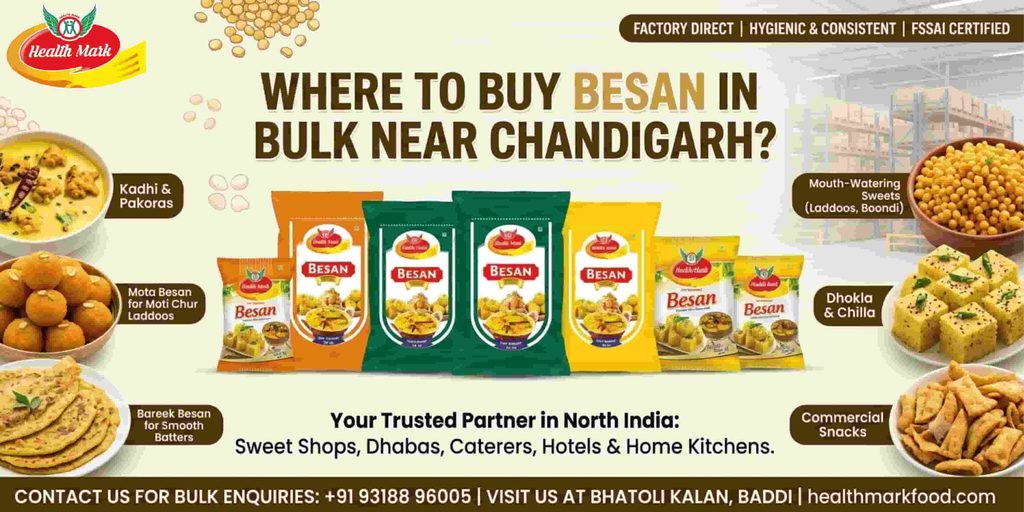
Snacks: Pakoras, bhajis, and fritters of every kind
Breakfast items: Dhokla, khaman, and chilla
Curries and gravies: Kadhi and besan-thickened gravies
Sweets: Besan laddoo, mysore pak, and motichur-based sweets
Bakery-style uses: Certain gluten-free baked goods and coatings
Commercial food production: Namkeen units, catering kitchens, and hostel/PG mess kitchens that need a steady, large-volume supply
How to Store Bulk Besan Without Losing Freshness
Buying in bulk only pays off if the besan stays fresh until it’s used. A few practical guidelines:
- Store in airtight containers besan absorbs moisture and odours easily
- Keep it in a cool, dry place, away from direct sunlight and heat sources like stoves
- For very large bulk stock, consider splitting into smaller airtight batches rather than repeatedly opening one large sack
- Check periodically for smell and texture changes, especially during humid months
- Refrigeration can extend shelf life further in warmer climates or during monsoon storage
Expert Tips Before You Place a Bulk Order
Always request the manufacturing and expiry dates on bulk packaging, not just the retail packs
If you’re a business, negotiate a standing bulk rate with a reliable supplier instead of renegotiating every purchase cycle
Keep a backup supplier in mind for peak seasons like Diwali and wedding season when demand for besan surges regionally
Where possible, buy directly from the manufacturer rather than through multiple resale layers it typically improves both price and freshness
For north India buyers specifically, sourcing from a besan supplier in north India rather than a distant national brand can meaningfully cut delivery time and transport cost
FAQ
1. Where can I buy besan in bulk near Chandigarh?
Bulk besan near Chandigarh is typically sourced either from local wholesale markets or from regional manufacturers based in the wider Punjab–Himachal belt, such as Health Mark in Baddi, which supplies besan to the tri-city area and surrounding regions.
2. What is the best besan brand in India for bulk buying?
There isn’t one universal “best” it depends on your grade requirement (fine, bareek, mota, or powder), your order volume, and how consistently the manufacturer can supply. Look for FSSAI compliance, hygienic processing, and transparent sourcing rather than just brand recognition.
3. What is a fair besan price when buying wholesale?
Wholesale besan price varies with the chana dal market rate, order quantity, and grind type. Bulk buyers should compare total landed cost including packaging and delivery rather than just the quoted per-kg price.
4. How is besan different from chana dal flour or gram flour?
They refer to the same product besan, chana flour, and gram flour are commonly used interchangeably in India to describe flour milled from split Bengal gram (chana dal).
5. What’s the difference between bareek besan and regular besan?
Bareek besan is ground to a finer texture than standard besan, and is often preferred for smoother batters, while regular besan works well for general cooking like pakoras and kadhi.
6. Is besan good for health?
Besan is a plant-based protein source, naturally gluten-free, and contains dietary fibre, making it a commonly recommended flour in balanced Indian diets. It’s still best used as part of an overall varied diet.
7. How much besan should a small business order in bulk to start?
This depends on your monthly consumption, but most suppliers recommend starting with a trial bulk order enough for 2–4 weeks of use before committing to a larger standing order.
8. How should bulk besan be stored to avoid spoilage?
Store bulk besan in airtight containers, in a cool and dry place away from sunlight and moisture, and check periodically for changes in smell or texture, especially during humid months.
9. Does Health Mark supply besan in bulk near Chandigarh?
Health Mark manufactures besan (including bareek, mota/motichur, and powder besan) from its facility in Baddi, within reach of Chandigarh, Panchkula, and Mohali. For bulk and wholesale enquiries, buyers can contact Health Mark directly via phone, WhatsApp, or the product enquiry page listed on their website.
10. What besan grade should I use for laddoo versus pakoras?
Motichur or mota besan is generally preferred for laddoo and boondi due to its coarser texture, while regular or bareek besan is better suited for pakoras and batters that need a smoother consistency.
Final Thoughts
Buying besan in bulk isn’t just about finding the lowest besan price it’s about finding a supplier whose quality, hygiene standards, and consistency you can rely on order after order. For businesses and households near Chandigarh, Panchkula, Mohali, and the wider north India belt, that often means looking slightly beyond city limits to a genuine manufacturer rather than settling for repackaged, unverified stock.
Health Mark manufactures a full range of besan regular, bareek, motichur/mota, and powder from its facility in Baddi, close enough to the tri-city to be a practical option for both retail and bulk buyers.
Ready to place a bulk enquiry? Browse the full Besan range, check product details on the Besan product page, or reach out directly for wholesale pricing via Product Enquiry or call/WhatsApp +91 93188 96005 / +91 92185 87660 / +91 98828 96000.