
If you run a restaurant, a grocery store, a catering business, or an export unit anywhere in North India, one decision affects your food quality more than almost any other: who supplies your spices.
Spices aren’t a commodity you can compromise on. A red chilli powder cut with brick dust or Sudan-red colouring, a turmeric powder with low curcumin content, or a garam masala blend that’s been sitting in a warehouse for a year each of these quietly damages the taste of your food, the trust of your customers, and eventually your reputation.
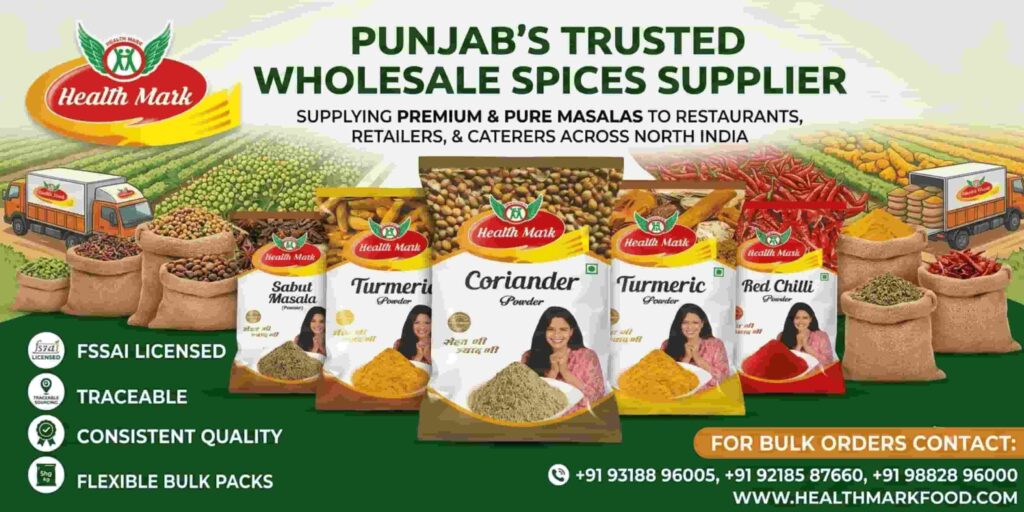
That’s why so many buyers actively search for the best wholesale spices supplier in Punjab rather than settling for whichever local trader is closest. The right supplier gives you consistency, purity, and pricing that scales with your business the wrong one costs you far more than you saved.
This guide breaks down exactly what to look for in a wholesale spices supplier, why Health Mark has become a name buyers across Punjab, Chandigarh, Panchkula, and Himachal’s Baddi belt rely on, and how to make a smart, informed bulk purchase whether you need 5 kg or 5,000 kg.
Punjab’s Spice Market: A Quick Snapshot
Punjab sits at the heart of North India’s food economy. Between its dense network of dhabas, restaurants, hotels, catering units, and retail grocery chains, the region consumes an enormous volume of masala every single day. Add to that the export-oriented food processing units clustered around the Punjab–Himachal industrial corridor (Baddi, Barotiwala, Nalagarh), and you have one of India’s most active spice-trading zones.
Because demand is high, supply is also crowded mandis, small local grinders, and large manufacturers all compete for the same buyers. This is exactly why due diligence matters: not every seller labeled “wholesale” actually delivers high quality spices at scale.
What Makes a Supplier the “Best” Wholesale Spices Supplier in Punjab?
Before comparing brands, it helps to define the criteria buyers should actually use. A genuinely best spices supplier checks these boxes:
- FSSAI licensing and food-safety compliance non-negotiable for any commercial buyer
- Traceable sourcing spices linked back to known farms or verified regions, not anonymous mandi lots
- No harmful adulterants no artificial colour, no filler starch, no foreign resins
- Consistent batch quality the turmeric powder you buy in March should taste the same in September
- True bulk capability enough production and packaging infrastructure to fulfil large, recurring orders
- Transparent, fair pricing a best spices price that reflects quality, not the cheapest possible rate achieved by cutting corners
- Responsive customer service a real phone number, real support, and real accountability if something’s wrong
Keep this checklist in mind as you read the rest of this guide it’s the same framework we’ll use to evaluate suppliers.
Health Mark: A Trusted Name in Bulk Spices Supply
Among suppliers serving the Punjab, Chandigarh, Panchkula, and Baddi belt, Health Mark has built a reputation as a dependable wholesale spices supplier for retailers, restaurants, distributors, and households buying in volume.
Health Mark positions itself around organic and health-conscious sourcing selecting ingredients from farms that avoid synthetic pesticides, herbicides, and GMOs, and maintaining traceability from farm to shelf. This “farm to shelf” transparency is exactly the kind of accountability bulk buyers should demand from any best spices manufacturer.
The brand’s spice range includes:
- Turmeric Powder a kitchen staple valued for colour, flavour, and curcumin content
- Red Chilli Powder ground for consistent heat and colour without artificial dyes
- Coriander Powder a base spice used in nearly every Indian curry and marinade
- Garam Masala a balanced blended masala for everyday and festive cooking
- Carom Seeds (Ajwain) used in tempering, parathas, and digestive preparations
- Fennel Seeds (Saunf) used as a mouth freshener, tea ingredient, and spice-mix component
You can browse the complete, current range on the Health Mark Spices category page, and explore the brand’s wider FMCG catalogue including atta, besan, pulses, rice, salt, sugar, pickles, and dry fruits on the Health Mark homepage.
Health Mark operates out of Plot No. 60, Industrial Township Bhatoli Kalan, Baddi, India a manufacturing hub positioned to serve buyers across the Punjab–Chandigarh–Himachal belt efficiently, with direct sales contact available at +91 93188 96005, +91 92185 87660, and +91 98828 96000.
Top Selling Spices in India You Should Stock
If you’re building or refreshing a bulk spice order, these are consistently among the top selling spices in India across retail and HoReCa (hotel, restaurant, catering) channels:
| Spice | Primary Use | Why It Sells |
| Turmeric Powder | Curries, dals, marination | Everyday staple, health association with curcumin |
| Red Chilli Powder | Heat, colour in nearly all dishes | High-frequency repeat purchase |
| Coriander Powder | Base spice for gravies | Used in almost every regional cuisine |
| Garam Masala | Finishing spice blend | High margin, strong brand loyalty |
| Ajwain (Carom Seeds) | Tempering, parathas, digestion aid | Steady demand, long shelf life |
| Fennel Seeds (Saunf) | Mouth freshener, spice mixes | Dual use culinary and post-meal |
Stocking this core set covers roughly 70–80% of what most Indian kitchens home or commercial reach for daily, making it a smart starting basket for any bulk order.
Whole Spices vs Spice Powders: What Bulk Buyers Should Know
A common question from new wholesale buyers: should you buy whole spices and grind them in-house, or buy pre-ground spices powder?
Whole spices (like ajwain, fennel seeds):
- Longer shelf life
- Retain essential oils and aroma longer
- Require grinding equipment and labour if used as powder
Ground spice powders (like turmeric, red chilli, coriander, garam masala):
Ready to use saves time and labour, critical for restaurants and high-volume kitchens
Must come from a supplier with strict hygiene and adulteration control, since powder form makes tampering harder to detect visually
Shelf life is shorter than whole spices, so buy from a supplier with high inventory turnover, not one selling old stock
How to Identify High Quality Spices (Buyer’s Checklist)
Before finalizing any bulk order, run through this practical quality checklist:
Colour consistency Natural turmeric is a warm golden-yellow, not neon or overly bright (which can signal added dye)
Aroma test High quality spices release a strong, natural fragrance immediately; weak or musty smell indicates old stock or poor storage
Texture check Powders should be fine and uniform, not gritty or containing visible husk/foreign particles
Moisture content Spices should feel dry; damp or clumped powder risks fungal contamination
Certification Ask for FSSAI license number and, where relevant, organic or export certification
Batch/lot traceability A serious best wholesale spices supplier can tell you which batch and approximate harvest period your stock comes from
Packaging integrity Bulk bags should be sealed, moisture-resistant, and clearly labeled with manufacturing and expiry dates
Key Point: If a supplier can’t answer basic questions about sourcing, certification, or batch freshness, treat that as a red flag regardless of how low their price is.
Wholesale Spices Pricing: What Affects Best Spices Price
Buyers frequently ask for the “best spices price” without realizing that price alone is a poor quality indicator. Several factors legitimately affect wholesale spice pricing:
- Raw material seasonality chilli, turmeric, and coriander prices shift with harvest cycles and weather
- Purity level 100% pure spice powder costs more to produce than blends with fillers
- Packaging format bulk sacks (10–50 kg) are cheaper per kg than smaller retail-ready packs
- Order volume larger, recurring orders typically unlock better per-kg rates
- Processing method steam-sterilized, lab-tested spices cost more than untested open-market powder
- Brand accountability an established best spices brand in India factors in consistent QC, which has a cost, but also prevents expensive product-recall or reputation risks later
Smart buyer approach: Don’t chase the single lowest quote. Compare price-per-kg at equivalent purity and certification level, and negotiate better rates through consistent, recurring bulk orders rather than one-off rock-bottom deals from unverified sellers.
Health Mark vs Typical Local Wholesalers Comparison Table
| Factor | Health Mark | Typical Unbranded Local Wholesaler |
| Sourcing transparency | Farm-linked, traceable sourcing | Often mixed-origin, untraceable mandi lots |
| Certification | FSSAI-oriented, organic-focused sourcing | Frequently undocumented |
| Product range | Turmeric, red chilli, coriander, garam masala, ajwain, saunf + full FMCG catalogue (atta, besan, pulses, rice, salt, sugar) | Usually limited to a narrow spice range only |
| Consistency across batches | Standardized processing | Can vary significantly batch to batch |
| Bulk order support | Dedicated sales contact numbers, structured enquiry process | Informal, often no dedicated support |
| Business use suitability | Suited for restaurants, retailers, distributors, exporters | Best suited only for very small, local, one-off needs |
Who Should Buy Spices in Bulk?
Bulk spice sourcing isn’t only for giant food factories. It makes financial and operational sense for:
Restaurants, dhabas, and cloud kitchens reduce per-plate cost through volume purchasing
Grocery and kirana retailers stock a wholesale spices in India range under reliable branding
Caterers and event businesses avoid running out of stock during peak wedding/event seasons
Hostel, hospital, and institutional kitchens need predictable, large-quantity supply
Regional distributors and resellers source from a best spices manufacturer to build their own retail or B2B supply chain
Health-conscious households and bulk-buying communities split large orders to save on per-kg cost
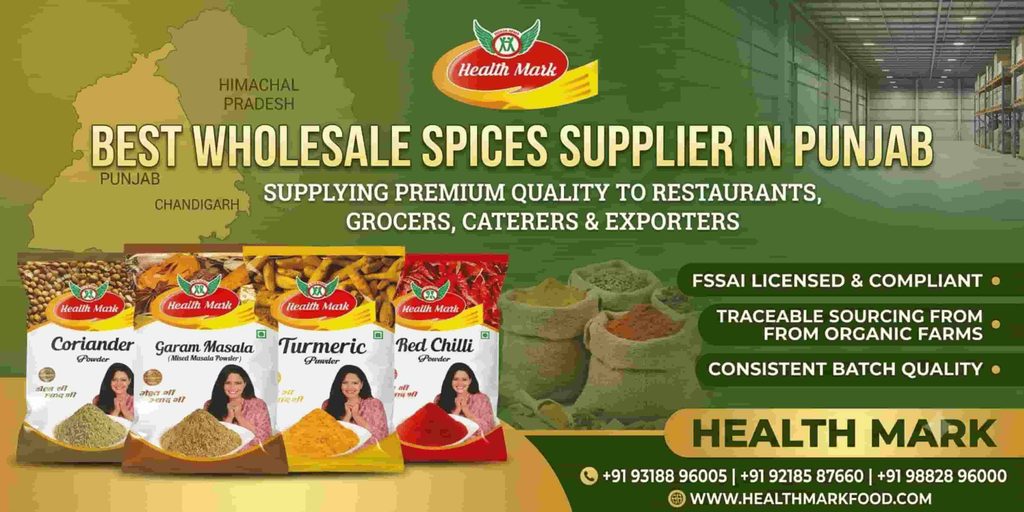
Step-by-Step: How to Place a Bulk Spices Order with Health Mark
- Review the product range Browse the Spices category page to shortlist which spices and quantities you need.
- Check the wider catalogue If you also need atta, besan, pulses, rice, salt, or sugar for the same order, explore the Health Mark homepage for the full product list.
- Contact the sales team Call +91 93188 96005, +91 92185 87660, or +91 98828 96000 to discuss bulk quantity, packaging format, and pricing.
- Submit a formal enquiry Use the official inquiry channel for documented, trackable bulk orders.
- Confirm specifications Agree on quantity, packaging (loose/bulk sack vs retail pouch), and delivery timeline before payment.
- Request quality documentation Ask for relevant certification or quality assurance details for your records, especially important for restaurants and retailers who may need this for their own compliance.
- Set up recurring supply For ongoing business needs, establish a repeat order schedule to lock in consistent pricing and avoid last-minute shortages.
Common Mistakes Buyers Make When Sourcing Spices in Bulk
Choosing solely on lowest price often leads to inconsistent quality or hidden adulteration
Not verifying certification skipping FSSAI or quality checks exposes your business to compliance risk
Over-ordering without proper storage leads to spoilage and wasted investment
Ignoring packaging quality poorly sealed bulk bags accelerate moisture damage and aroma loss
Switching suppliers too frequently inconsistent sourcing creates unpredictable taste and quality in your final product
Not building a direct relationship with the supplier one-off transactional buying misses out on better pricing, priority stock, and support during shortages
Storage & Handling Tips for Bulk Spices
Store spice powders in airtight, moisture-proof containers, away from direct sunlight
Keep storage areas cool and dry heat accelerates loss of aroma and colour
Use a first-in-first-out (FIFO) system so older stock is used before newer batches
Avoid storing spices near strong-smelling items (they absorb odours easily)
For very large bulk stock, consider vacuum-sealed or nitrogen-flushed packaging to extend shelf life
Label every batch with the received date to track freshness accurately
Expert Tips for Restaurants, Hotels & Retailers
Standardize your masala ratios across outlets by sourcing from one consistent best spices supplier, rather than multiple vendors with varying quality
Negotiate seasonal contracts for chilli and turmeric, since raw material costs fluctuate with harvest cycles
Request smaller trial batches before committing to a large first-time bulk order from any new supplier
Audit your spice inventory monthly to catch slow-moving stock before it loses potency
Build a backup-supplier relationship in addition to your primary one, so a single supply disruption doesn’t stall your kitchen
FAQ
Q1. Who is considered the best wholesale spices supplier in Punjab?
The best supplier is one offering FSSAI-oriented sourcing, traceable ingredients, consistent batch quality, and genuine bulk-order capacity. Health Mark, based in the Punjab-adjacent Baddi industrial belt, is a recognized option covering turmeric, red chilli, coriander, garam masala, ajwain, and fennel seeds in bulk.
Q2. What is the minimum quantity for a wholesale spices order?
Minimum order quantities vary by supplier and spice type. It’s best to directly contact the supplier’s sales team for Health Mark, call +91 93188 96005, +91 92185 87660, or +91 98828 96000 to confirm current minimum order requirements.
Q3. How do I check if spices are adulterated?
Look for unnatural colour intensity, gritty texture, weak aroma, or the absence of certification details. A simple aroma and colour comparison against a known-pure sample can also help identify inconsistencies.
Q4. Is buying spices in bulk cheaper than retail packs?
Yes, generally. Bulk packaging reduces per-kg cost significantly compared to small retail pouches, since packaging and distribution overhead is lower per unit at scale.
Q5. What is the shelf life of bulk spice powders?
Most ground spice powders retain optimal flavour for 6–12 months when stored in airtight, moisture-free conditions. Whole spices like ajwain and fennel seeds typically last longer.
Q6. Which are the top selling spices in India for a new business to stock first?
Turmeric powder, red chilli powder, coriander powder, and garam masala form the core “starter basket” that covers the majority of everyday Indian cooking needs.
Q7. Does Health Mark offer organic spices?
Health Mark’s overall sourcing philosophy is built around organic-farm-linked ingredients, avoiding synthetic pesticides, herbicides, and GMOs across its product range, including spices.
Q8. How can restaurants and retailers place a bulk order with Health Mark?
Restaurants, hotels, and retailers can browse the spices range on the official category page and contact the Health Mark sales team directly via phone to discuss quantity, packaging, and pricing for a bulk order.
Q9. What other products does Health Mark supply besides spices?
Beyond spices, Health Mark supplies atta, besan, dry fruits, Italian food products, pickles, protein-rich foods, pulses, rice, salt, sauces, snacks, and sugar allowing bulk buyers to consolidate multiple FMCG categories with a single supplier.
Q10. Why does spice quality matter so much for restaurants specifically?
Since spices directly shape the taste, aroma, and consistency of every dish, even small quality variations affect customer perception and repeat business making a reliable, high-quality bulk supplier a direct factor in a restaurant’s reputation.
Conclusion & Next Steps
Choosing the best wholesale spices supplier in Punjab isn’t just about finding the lowest price per kilogram it’s about protecting the quality, consistency, and reputation of everything you cook or sell. From FSSAI compliance and traceable sourcing to genuine bulk-order capability, the criteria in this guide give you a practical framework to evaluate any supplier confidently.
Health Mark offers a straightforward option for buyers across Punjab, Chandigarh, Panchkula, and the Baddi belt combining an organic-oriented sourcing philosophy with a spice range built around India’s most-used everyday masalas, alongside a broader FMCG catalogue for buyers who want to consolidate their sourcing.
Ready to place a bulk order or get current wholesale pricing? Browse the full range on the Health Mark Spices page, or call the sales team directly at +91 93188 96005 / +91 92185 87660 / +91 98828 96000 to discuss your requirements.