
If you run a snack unit, a sweet shop, a restaurant kitchen, or an export business, you already know that besan isn’t a minor line item it’s a raw material that decides whether your pakoras hold their crunch, your dhokla rises the way it should, and your kadhi doesn’t split. Yet most businesses still buy it the way a household does: in small bags, from whichever seller is closest, without asking too many questions about milling, moisture, or batch consistency.
That approach works fine for a home kitchen. It doesn’t work when you’re producing at scale, when one inconsistent batch can throw off an entire day’s production, or when a client audits your supply chain and asks who your besan manufacturer actually is.
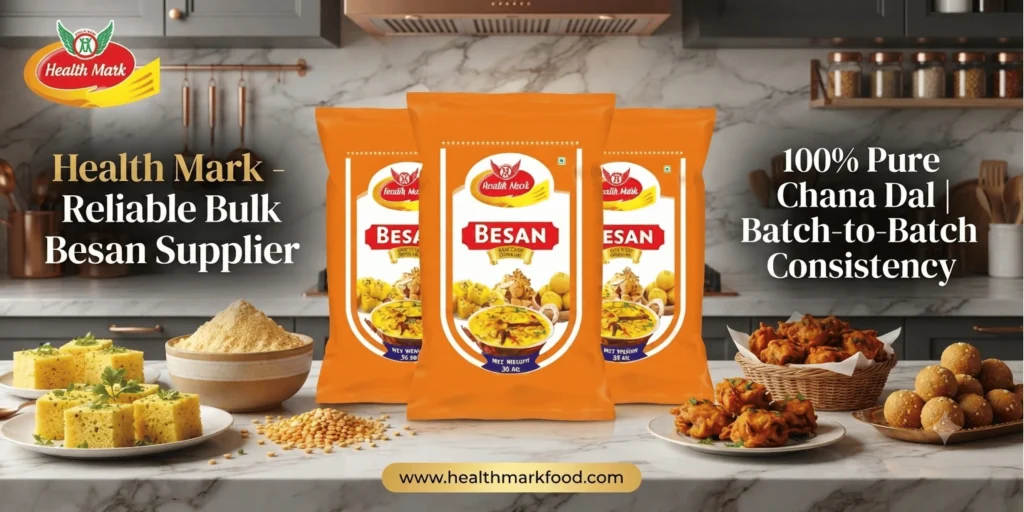
This guide is written for exactly that situation. We’ll walk through what separates a dependable bulk besan supplier from a seller who just happens to stock large bags, why Health Mark has become a recognised name among businesses looking for a best wholesale besan supplier, and how to actually evaluate a besan manufacturer in India before you sign a purchase order.
Nothing here is generic filler. It’s written for procurement managers, kitchen owners, snack manufacturers, and distributors who need a working answer, not a sales pitch.
Why Bulk Besan Sourcing Deserves More Attention Than It Gets
Besan is gram flour made from ground chana dal (split Bengal gram), and it sits at the centre of Indian food culture pakoras, dhokla, kadhi, laddoos, khaman, and countless regional snacks all depend on it. For a household, a small pack lasts weeks. For a business, besan is a recurring, high-volume input, and small variations compound fast.
A few realities that make sourcing decisions matter more than people expect:
Moisture content affects shelf life too much moisture and bulk stock can clump or spoil before it’s used.
Fineness and grind consistency affect texture a batch milled coarser than usual will change how your dhokla or besan ladoo turns out.
Colour and aroma variation signal differences in the chana dal used, which customers and clients notice even if they can’t name why.
Price swings on unbranded, unverified besan are common, making budgeting unpredictable for businesses buying every week.
None of this is solved by buying “the cheapest besan near me.” It’s solved by working with a manufacturer that controls its process from raw chana dal to the final packed product which is the case Health Mark makes for itself, and the standard we’ll use throughout this guide.
What Exactly Is Besan, and Why Does Quality Vary So Much?
Besan, also called gram flour or chana flour, is produced by dehusking and milling chana dal into a fine powder. It’s naturally high in plant protein and fibre compared to refined wheat flour, which is part of why it’s a staple across both everyday cooking and festive Indian recipes.
Quality varies for a few structural reasons that most buyers never see:
2.1 The Chana Dal Source
Not all chana dal is equal. Premium quality besan starts with clean, well-sorted Bengal gram, free of admixture, foreign matter, and damaged grains. Lower-grade dal produces flour with a duller colour, inconsistent taste, and shorter shelf life.
2.2 The Milling Process
Fine grinding versus coarse grinding changes what the besan is suited for. Health Mark’s range reflects this directly a smooth, fine Besan for everyday cooking, a coarser Bareek Besan and Motichur/Mota Besan for recipes that need texture (like certain laddoos and namkeen), and a Powder Besan milled for maximum smoothness in delicate preparations.
2.3 Hygiene and Packing Standards
Bulk buyers are especially exposed here. A besan that’s processed in an open, unhygienic setup carries contamination risk that a home cook might not notice in a single small pack, but that becomes a serious liability across a large commercial batch. This is where checking a besan manufacturer’s accreditation and facility standards genuinely matters.
Who Actually Needs a Bulk Besan Supplier?
“Bulk” doesn’t just mean giant factories. In practice, the businesses searching for a besan manufacturer in India or a besan supplier in north India tend to fall into a few clear categories:
Snack and namkeen manufacturers pakora mix, sev, bhujia, and khaman units that consume besan daily and need batch-to-batch consistency.
Sweet shops and mithai makers besan ladoo and other traditional sweets depend heavily on the flour’s texture and roasting behaviour.
Restaurants, hotels, and catering businesses consistent besan is essential for curries, kadhi, and battered items served at volume.
Institutional kitchens hostels, canteens, and event caterers that need reliable weekly or monthly supply.
Distributors and retailers businesses reselling packaged besan under their own counters or supplying smaller kirana stores.
Exporters and modern trade buyers who need documentation, accreditation, and consistent packaging that meets retail or export standards.
If your business fits any of these, the difference between an ad-hoc local seller and a structured besan manufacturer isn’t cosmetic it directly affects your product quality, cost predictability, and compliance.
Inside Health Mark’s Besan Range for Businesses
Health Mark’s Baddi (Himachal Pradesh) facility produces a focused besan range designed to cover different commercial use cases, available on the Besan product category page:
| Product | Best Suited For | Texture |
| Besan | Everyday cooking, pakoras, kadhi, curries | Smooth, fine |
| Bareek Besan | Recipes needing a finer, refined texture at scale | Fine |
| Motichur / Mota Besan | Motichur ladoo, boondi, and coarse-textured sweets | Coarse |
| Powder Besan | Delicate batters, dhokla, khaman | Ultra-fine powder |
Besan the core product is made from carefully selected chana dal, finely ground for smooth texture and rich, nutty flavour, and is hygienically processed and packed to preserve freshness. It’s available in 55gm, 200gm, 500gm, and 1kg formats, with bulk quantities available on enquiry for commercial buyers.
For businesses standardising a single SKU across production lines, or exploring which grind suits a specific recipe, Health Mark’s team can guide the selection based on your end product rather than leaving you to guess from a product label.
What Makes Health Mark the Best Besan Brand in India
There’s no shortage of sellers claiming to be the “best Besan seller” online. What actually separates a credible best Besan brand in India from a marketing claim comes down to a handful of verifiable factors:
Sourcing Discipline
Health Mark uses premium quality chana dal as its base ingredient, selected for consistency rather than lowest cost a decision that shows up directly in the final flour’s colour, aroma, and cooking behaviour.
Hygienic, Controlled Processing
The besan is hygienically processed and packed, which matters enormously for bulk buyers whose finished products (snacks, sweets, ready meals) are themselves sold to end consumers. Contamination risk anywhere in the chain becomes your business’s risk.
A Wider Food Manufacturing Base
Besan isn’t a side product for Health Mark it sits alongside a broader catalogue that includes Atta, pulses, spices, rice, and other staples, run out of an industrial facility in Baddi. A manufacturer that already operates at this scale is structurally better placed to handle recurring bulk orders than a seller doing besan as one product among many unrelated categories.
Formal Accreditation
Businesses evaluating a besan manufacturer in India for a long-term contract should always check certification status before committing volume. Health Mark publishes its certifications on its Accreditation page a step worth reviewing directly rather than taking on trust.
Direct Access, No Middlemen Guesswork
For B2B buyers, speed of communication matters. Health Mark’s sales team is reachable directly for bulk enquiries and Besan price discussions at +91 93188 96005, +91 92185 87660, or +91 98828 96000.
From Chana Dal to Packet: How Health Mark Manufactures Besan
Understanding the production flow helps explain why consistency is achievable at bulk volumes rather than being a lucky batch:
Chana dal selection Bengal gram is sourced and checked for quality before it enters the mill.
Cleaning and sorting foreign matter, damaged grains, and dust are removed.
Grinding dal is milled to the specific fineness required for each product line (Besan, Bareek Besan, Motichur/Mota Besan, Powder Besan).
Sieving and grading the ground flour is passed through sieves to achieve uniform particle size.
Hygienic packing the finished besan is packed in controlled conditions to lock in freshness and prevent contamination.
Dispatch orders are prepared for retail packs or bulk commercial quantities and shipped to the buyer’s location.
This structured flow is exactly what a household seller repackaging loose flour from a local mandi typically cannot replicate and it’s the operational difference that shows up in your finished product, not just on a spec sheet.
Health Mark vs. A Typical Local Besan Seller A Straight Comparison
| Factor | Health Mark (Manufacturer) | Typical Local Seller |
| Sourcing | Selected premium chana dal, consistent grade | Often mixed-grade, variable |
| Processing | Hygienic, controlled milling facility | Frequently unverified |
| Batch Consistency | Standardised across orders | Can vary week to week |
| Product Range | 4 besan variants for different uses | Usually one generic grind |
| Documentation / Accreditation | Published accreditation | Rarely available |
| Bulk Order Support | Dedicated sales contact for B2B | Informal, ad-hoc |
| Traceability | Manufacturer-level traceability | Limited to none |
This isn’t to say every small seller is unreliable many run honest operations. But for a business that needs to guarantee product consistency to its own customers, a manufacturer with documented process control removes a layer of risk that’s hard to manage otherwise.
Besan Price: What Really Drives the Number on Your Invoice
“What’s the Besan price?” is usually the first question a buyer asks and usually the wrong first question to lead with, because price without context is meaningless. Here’s what actually moves the number:
Chana dal market rates besan price tracks the underlying commodity price of Bengal gram, which fluctuates seasonally.
Grind type finer, more processed grinds like Powder Besan typically cost more per kg than standard Besan.
Order volume bulk and wholesale quantities generally bring a better per-kg rate than retail-pack pricing.
Packaging format small 55gm–200gm retail packs cost more per kg to produce than 1kg or bulk sacks.
Delivery location freight from the Baddi facility to Chandigarh, Panchkula, or Ludhiana differs from longer-distance dispatch.
Because these variables shift regularly, Health Mark doesn’t publish a fixed bulk rate online and honestly, no serious besan manufacturer in India should, since a static number would either overcharge you in a low-commodity month or undercut the supplier in a high one. The reliable way to get an accurate Besan price for your order volume is a direct enquiry through the Product Enquiry page or a call to the sales team.
How to Place a Bulk Order with Health Mark
Identify your besan type decide between Besan, Bareek Besan, Motichur/Mota Besan, or Powder Besan based on your recipe or production need.
Estimate your monthly volume this determines packaging format and pricing tier.
Reach out directly call +91 93188 96005 / +91 92185 87660 / +91 98828 96000, or submit a request via the Product Enquiry page.
Discuss packaging and delivery confirm bag sizes, dispatch timelines, and delivery to your city or facility.
Request a sample if you’re a first-time buyer, especially for large recurring orders.
Confirm accreditation and documentation you’ll need for your own compliance or client audits.
Finalise the order and set a recurring supply schedule if your business needs weekly or monthly restocking.
Businesses that set up a recurring supply arrangement early tend to get more predictable pricing and priority dispatch, since the manufacturer can plan production volume against confirmed demand.
Storage and Handling Best Practices for Bulk Besan
Even the best besan can lose quality if it’s mishandled after delivery. For businesses holding bulk stock:
Store in a cool, dry area besan absorbs moisture easily, which shortens shelf life and can cause clumping.
Keep bags off the floor on pallets to avoid moisture from concrete and improve air circulation.
Use airtight containers for opened bulk sacks rather than leaving them exposed between uses.
Follow first-in, first-out (FIFO) stock rotation so older batches are used before newer ones.
Avoid storing near strong-smelling ingredients besan can pick up odours during storage.
Check for a rancid or musty smell before use a sign the batch has degraded and shouldn’t go into production.
Good storage discipline protects the quality that a premium quality besan supplier has already built in poor handling on the receiving end can undo it.
Common Mistakes Businesses Make When Choosing a Besan Supplier
Mistake 1: Chasing the lowest price without checking consistency
The cheapest quote often comes from unverified sourcing. A few rupees saved per kg isn’t worth a production batch ruined by inconsistent grind or moisture.
Mistake 2: Not asking about accreditation
Businesses supplying their own retail or export customers need documentation trail. Skipping this check now often means scrambling for it later during an audit.
Mistake 3: Treating besan as one uniform product
Using a standard Besan where a Powder Besan or Bareek Besan would perform better is a common, avoidable inefficiency.
Mistake 4: No sample testing before a large order
Committing to a large first order without a trial batch removes your ability to catch quality issues before they scale.
Mistake 5: Ignoring delivery logistics
A supplier with the best product but unreliable delivery timelines can still disrupt your production schedule.
Mistake 6: Switching suppliers too frequently
Constant supplier changes make it harder to standardise your own product’s taste and texture over time. A stable relationship with one dependable besan manufacturer in India is usually better for brand consistency than hopping between the lowest bidder each month.
Why North India Businesses Keep Choosing Health Mark
Health Mark’s manufacturing unit is based in Baddi, Himachal Pradesh an industrial hub with strong connectivity to Punjab, Haryana, and Chandigarh. This location advantage is a big part of why the brand has grown into a recognised besan supplier in north India, particularly for businesses in:
Chandigarh and Panchkula tricity businesses benefiting from short delivery distances.
Ludhiana and Punjab a major hub for food processing and snack manufacturing units.
Baddi and Himachal Pradesh local businesses sourcing directly from the manufacturing base.
Haryana and Delhi-NCR reachable through the same regional distribution network.
For businesses specifically searching for a “besan seller near me” in these regions, working with a manufacturer based in the same belt rather than a supplier shipping from far outside the region usually means shorter lead times and fresher stock on arrival.
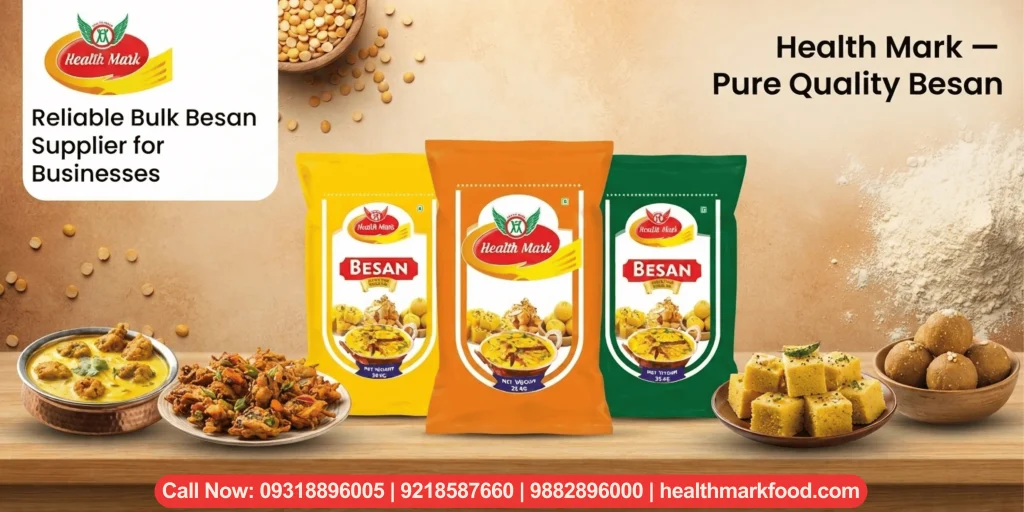
Expert Tips for Long-Term Wholesale Besan Buyers
Lock in a sample-approval process for every new batch size or grind before it enters full production use.
Track your besan-to-output ratio knowing exactly how much besan a batch of your product consumes helps you spot quality drift early.
Ask about seasonal pricing patterns so you can time larger stock-ups when chana dal rates are more favourable.
Standardise on one primary besan manufacturer for your core product line, and keep a secondary verified source only as backup not as your default rotation.
Request updated accreditation documents periodically rather than assuming a certificate checked once still applies a year later.
Build a direct line with the supplier’s sales contact rather than routing every order through a distributor it usually gets you faster resolution on urgent orders.
FAQ
1. What is the minimum order quantity for bulk besan from Health Mark?
Minimum order quantities depend on the product and packaging format. Since Health Mark serves both retail-size and bulk commercial orders, the best way to confirm current MOQs is to contact the sales team directly at +91 93188 96005.
2. How is Health Mark Besan different from ordinary market besan?
Health Mark Besan is made from carefully selected chana dal, finely milled for a smooth texture and rich, nutty flavour, and hygienically processed and packed a level of process control that unbranded, loose-sold besan typically doesn’t offer.
3. What is the current Besan price for bulk orders?
Besan price fluctuates with chana dal commodity rates, order volume, and packaging format, so it isn’t published as a fixed number. Businesses can get an accurate quote through the Product Enquiry page or by calling the sales team.
4. Which Health Mark besan variant should I choose for pakoras versus sweets?
Standard Besan and Bareek Besan work well for pakoras and savoury batters, while Motichur/Mota Besan suits boondi and motichur ladoo, and Powder Besan is ideal for delicate items like dhokla and khaman.
5. Is Health Mark Besan suitable for export or private-label businesses?
Yes Health Mark’s hygienic processing and published accreditation make it a viable option for businesses that need documented sourcing for export or private-label packaging. Buyers should confirm specific certification requirements directly with the sales team for their destination market.
6. How long does bulk besan stay fresh after delivery?
Shelf life depends heavily on storage conditions. Kept in a cool, dry, airtight environment away from moisture, bulk besan typically stays fresh for several months, but businesses should always check the batch details provided at the time of dispatch.
7. Does Health Mark deliver bulk besan outside Punjab and Himachal Pradesh?
Health Mark’s Baddi facility serves businesses across North India, including Chandigarh, Panchkula, Ludhiana, Haryana, and Delhi-NCR, with delivery to other regions available on enquiry.
8. Can I get a sample before committing to a large bulk order?
First-time bulk buyers are encouraged to request a sample batch to verify texture, colour, and performance in their own recipes before finalising a large order a standard best practice with any new besan manufacturer in India.
9. What packaging sizes are available for businesses?
Health Mark Besan is available in 55gm, 200gm, 500gm, and 1kg retail formats, with bulk commercial packaging available for wholesale buyers on request.
10. How do I contact Health Mark for a bulk besan enquiry?
You can reach the sales team directly at +91 93188 96005, +91 92185 87660, or +91 98828 96000, or submit your requirement through the Product Enquiry page at healthmarkfood.com.
Final Word: Choosing a Besan Partner, Not Just a Supplier
Bulk besan sourcing isn’t a decision to make on price alone, and it isn’t something to leave to whichever seller happens to be closest. The businesses that get it right treat their besan manufacturer as a long-term partner one whose sourcing discipline, hygiene standards, and consistency directly protect their own product’s reputation.
Health Mark’s combination of selected chana dal, a controlled milling process, a besan range built for different commercial uses, and direct accessibility for bulk buyers is why it has become a trusted name for businesses across North India looking for a reliable bulk besan supply partner rather than a one-off transaction.
If your business needs a dependable, premium quality besan supplier, get in touch with Health Mark today. Browse the full range on the Besan product page or call +91 93188 96005 to discuss your bulk requirement.