
For sweet shops, namkeen manufacturers, caterers, and grocery retailers, the quality of besan plays an important role in preparing delicious food. From soft laddoos and crispy pakoras to perfectly textured dhokla, choosing the right ingredients can make a noticeable difference in taste and consistency.
However, finding a dependable supplier isn’t always easy. With so many options available, businesses often struggle to balance quality, pricing, freshness, and reliable supply. Understanding what makes a good Besan and how to evaluate a supplier can help buyers make better purchasing decisions.
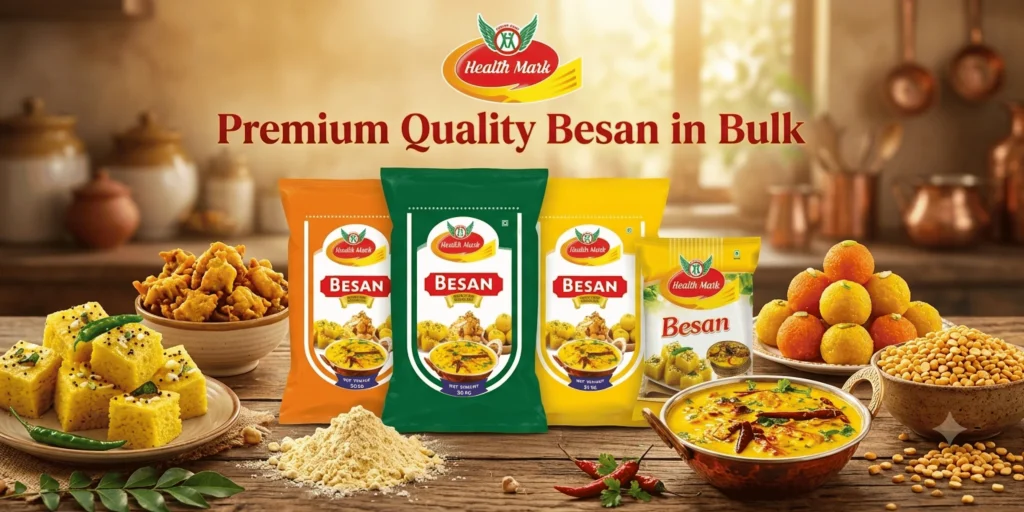
If you’re wondering where to buy premium quality besan in bulk in India, Health Mark is one option worth exploring. The brand offers different varieties of besan for everyday cooking and commercial food preparation. This guide explains what to look for when purchasing larger quantities and how to choose a product that suits your business needs.
Where Should You Buy Besan in Bulk?
Choosing the right supplier is important for businesses that need consistent quality, reasonable pricing, and dependable deliveries. Depending on your requirements, there are several purchasing options worth considering.
- Manufacturers and flour mills: Buying directly from a manufacturer can be a practical option for businesses requiring larger quantities and consistent product specifications.
- Authorised distributors: Established brand distributors are suitable for retailers and businesses that prefer regular deliveries and flexible order quantities.
- B2B marketplaces: Online platforms allow buyers to compare suppliers, product varieties, and prices before making a purchase.
- Local wholesale markets: Local dealers may offer competitive prices and convenient access, although product quality and availability can vary.
Before placing a bulk order, request a product sample, check the supplier’s FSSAI licence details, and confirm packaging, shelf life, and quality specifications.
Health Mark is another option for businesses exploring besan varieties for retail or commercial use. Buyers can visit Health Mark to explore available products and enquire about supply options.
What Is Besan, and Why Does Grade Matter?
Besan, also called gram flour, chickpea flour or chana flour, is made by cleaning, splitting, de-husking and milling chana dal (split Bengal gram) into flour. It is naturally gluten-free, rich in plant protein and fibre, and sits at the heart of Indian cooking: pakoras, kadhi, dhokla, chilla, boondi, laddoos, barfi and countless namkeen.
Nutritionally, chickpea flour is commonly cited at roughly 20–22 g of protein per 100 g, though exact values vary by lot and milling. For reference values, the USDA FoodData Central and the Indian Food Composition Tables published by the National Institute of Nutrition are good neutral sources.
Here is the part most buyers miss. Besan isn’t one product. The same chana dal can be milled fine, medium or coarse, and each grade behaves differently in a kadhai:
- A fine grind makes a smooth, flowing batter and a soft, melt-in-the-mouth sweet.
- A coarse grind gives a grainy bite and holds shape in laddoos and barfi.
- A mixed or poorly milled lot gives you lumps, uneven frying and customer complaints.
For a business, choosing the wrong grade can mean wasted ghee, rejected batches and lost regulars. That’s why grade comes before price in any serious purchase.
What Does Premium Quality Besan Actually Look Like?
“Premium” is a marketing word until you define it. Here is a practical definition you can put in a purchase specification.
1. Pure, single-source raw material
A label that says pure chana dal besan should mean exactly that: only chana dal, with no admixture of cheaper pulses, no fillers and no added colour. Ask the supplier directly what goes into the mill.
2. Consistent, even milling
Premium flour is uniform. When you rub it between your fingers there should be no gritty specks, and when you sift it there should be very little residue.
3. Natural colour and aroma
Good besan is a soft creamy-yellow and smells mildly nutty and sweet. An artificially bright, almost neon yellow is a warning sign. A sour, musty or stale smell usually means old stock or moisture damage.
4. Low moisture and clean processing
Moisture is the silent enemy of shelf life. Look for suppliers who dry, clean and mill under hygienic conditions and can quote a moisture range on their specification sheet.
5. Reliable packing and traceability
Strong, clean bags with batch numbers, packing dates and best-before information tell you the supplier takes food safety seriously.
6. Certifications that are verifiable
Look for FSSAI registration plus management-system certificates such as ISO 22000, ISO 9001, HACCP, GMP and GHP. Certificates only matter if they are current, so ask to see them.
Besan Grades Compared | Fine, Regular, Coarse and Powder
Choosing a grade is the first real decision in your purchase. This table summarises how the common grades are typically used.
| Grade | Texture | Best for | Watch out for |
| Ultra-fine (bareek) | Silky, almost talc-like | Motichur laddoo, boondi, soft sweets, smooth batters | Needs good storage; absorbs moisture quickly |
| Regular besan | Fine to medium | Pakoras, kadhi, chilla, dhokla, everyday cooking | Can vary a lot between suppliers |
| Coarse (granular) | Slightly grainy | Laddoos and barfi where a bite is wanted, some namkeen | Too coarse gives a gritty sweet |
| Powder besan | Very fine, free-flowing | Batters, coatings, commercial snack lines | Check particle consistency lot to lot |
You will hear coarser grades sold under local names like motichur besan or mota besan, which can confuse first-time buyers. Always ask for the particle size or mesh range, not just the name, because the same word can mean slightly different things to different mills.
And if you are comparing samples, remember that fine quality besan isn’t just about being fine. It is about being evenly fine. Two samples may both feel soft, but only one will pass through a boondi jhara without clogging.
Where to Buy: Six Sourcing Routes Compared
Every gram flour supplier in India falls broadly into one of the routes below. None is wrong; each suits a different kind of buyer.
| Route | Pros | Cons | Best for |
| Manufacturer / mill direct | Best consistency, traceability, spec control | May have a minimum order or fixed pack size | Sweet makers, namkeen units, large caterers |
| Authorised distributor | Smaller lots, faster local delivery | Slight price markup | Retailers, restaurants |
| Mandi dealer | Competitive rates, flexible quantity | Quality and labelling vary; limited paperwork | Experienced buyers who test every lot |
| B2B marketplaces | Wide choice, easy comparison | Listings are often vague; claims need verification | Starting your supplier search |
| Online retail platforms | Convenient, quick | Small packs, higher per-kg cost | Trials and tiny kitchens |
| Cash-and-carry wholesalers | Immediate pickup | Limited grades and brands | Emergency top-ups |
Who sells bulk besan?
Mills, flour and pulse processors, distributors and traders all sell in large packs. What differs is how much control they have over the product. A manufacturer that mills its own chana dal can adjust grind size and answer technical questions. A trader typically can’t.
Buying online | what to check
If you buy besan, treat the listing as a starting point, not a guarantee. Many B2B listings show “price on request” and generic descriptions. Call the number, ask for a specification sheet, and request a sample before you commit.
A note on wholesale buyers
Serious wholesale besan buyers rarely rely on one source. Most keep a primary supplier and a backup so that a delayed truck or a bad lot never stops production.
How to Vet a Besan Wholesale Supplier
A good-looking website is not due diligence. Work through this ten-point checklist before you place a meaningful order.
- FSSAI licence: Ask for the licence number and verify it on the FSSAI’s FoSCoS portal (foscos.fssai.gov.in).
- Certifications: Check that ISO 22000, HACCP, GMP or GHP certificates are current and issued to the supplier’s actual facility.
- Raw material: Ask which chana dal they use and how they screen it for foreign matter.
- Milling process: Traditional or roller milling, cleaning stages, magnets and sieves all affect the final product.
- Specification sheet: It should state grade, particle size, moisture, protein range and shelf life.
- Sample policy: A confident supplier lets you test before you buy.
- Lab report or COA: Ask for a certificate of analysis from a recognised laboratory for a recent lot.
- Packing options: Confirm bag size, material and labelling.
- Logistics: Ask about lead time, dispatch location and damage-handling.
- References: Talk to at least one current customer in your line of business.
In a market full of claims, the best besan supplier for you is simply the one that can document every answer above, and a top besan supplier will not hesitate to send a sample and a spec sheet without being chased. Be careful with anyone who dodges questions or pushes only on price.
Seven Quality Tests You Can Run Before Placing an Order
These quick checks don’t replace laboratory testing, but they will filter out poor lots fast.
- Colour test. Spread a spoonful on a white plate in daylight. Look for a natural creamy-yellow. Be wary of an unusually bright, uniform yellow.
- Smell test. Fresh besan smells mild, nutty and slightly sweet. Sourness or mustiness points to age or moisture.
- Touch test. Rub a pinch between thumb and finger. Fine grades feel silky; grittiness suggests uneven milling.
- Clump test. Squeeze a handful. It should form a loose clump that crumbles easily. A sticky, hard lump suggests excess moisture.
- Water test. Stir a teaspoon into a glass of clear water. Colour that bleeds out quickly and streaks the water can indicate added dye. This is only an indicator, so confirm with a lab if you are suspicious.
- Batter test. Make a small batch of your actual recipe. Let it rest for 15 minutes, then check flow, smoothness and how it fries or sets.
- Final product test. Taste the finished sweet or snack. Bitterness or an off-note often traces back to raw material quality.
Adulteration deserves a mention. Cheaper pulses and non-permitted colours have been long-standing concerns in flour markets in India, which is one more reason to buy from a licensed source with traceable batches and to send periodic samples to an accredited lab.
Understanding Besan Price per Kg
Every buyer asks about besan price per kg, and every honest supplier answers, “It depends.” Here is what it depends on.
What moves the price
- Chana dal rates. Raw material is the biggest cost. Prices follow harvest arrivals (chana is a rabi crop harvested in early spring), mandi sentiment and government procurement.
- Grade and milling. Ultra-fine grades involve additional sieving and typically cost more.
- Pack size. Larger packs usually cost less per kg, but only if you can use them before the shelf life ends.
- Freight and location. A cheaper ex-factory rate can still be more expensive once transport is added.
- GST and payment terms. Always compare quotes on the same tax and credit basis.
- Certification and brand. Certified, traceable production costs more to run and usually comes with better consistency.
If you scan marketplace listings today, you will see rates from roughly ₹50 to nearly ₹200 per kg. That range tells you something important: listings are not comparable without knowing grade, pack size, tax treatment and what the seller actually delivers.
How to compare quotes properly
Always convert every quote to a landed cost per kg (price plus freight plus tax, divided by usable quantity). Here is an illustrative example with made-up numbers:
| Supplier A | Supplier B | |
| Quoted rate | ₹90/kg ex-works | ₹96/kg delivered |
| Freight | ₹4/kg | Included |
| Subtotal | ₹94/kg | ₹96/kg |
| GST at 5% | ₹4.70 | ₹4.80 |
| Landed cost | ₹98.70/kg | ₹100.80/kg |
Supplier A looks cheaper on paper, but if Supplier B’s flour gives you fewer rejected batches or a better yield, B may be the smarter buy. The best besan price isn’t the lowest number on a quote. It is the lowest cost per good batch you actually sell.
Choosing Besan for Sweets Manufacturing
Sweet makers are the most demanding besan buyers, and for good reason. Besan for sweets manufacturing has to behave identically every time, whether you are making 20 kg or 2,000 kg.
What sweet makers should look for
- Uniform fineness. Particle size decides how the batter flows and how the sweet sets.
- Low, stable moisture. Excess moisture leads to lumps, uneven roasting and shorter shelf life of the finished sweet.
- Clean, nutty flavour. The raw taste of the flour carries through to the final product, especially in ghee-roasted sweets.
- Batch-to-batch consistency. Your regulars will notice a change before you do.
Matching the grade to the sweet
| Sweet | Recommended grade | Why |
| Motichur laddoo | Ultra-fine | Smooth batter makes even, small boondi pearls |
| Boondi laddoo | Fine | Controls droplet shape and soak |
| Besan laddoo | Medium to coarse | Granular texture after ghee roasting |
| Besan barfi / Mysore pak | Fine to medium | Smooth set with a little body |
| Soan papdi | Fine | Helps form light, flaky strands |
A practical production tip
Before you commit to a new supplier, run a side-by-side trial: same recipe, same ghee, same cook, two flours. Photograph the batter, note the frying time and let a few trusted staff taste the result blind. It takes one afternoon and can save you months of trouble.
Is There a Best Besan Brand in India?
People love asking for a single winner. Ask ten halwais about the best besan in India and you will probably hear ten different answers, because each is describing the flour that works for their recipe, their water and their equipment.
So instead of searching for a universal best besan brand in India, define what “best” means for your business:
- If you make motichur laddoos, best means ultra-fine and uniform.
- If you run a snack factory, best means consistent particle size and a predictable fry.
- If you run a retail store, best means steady supply, attractive packs and low complaints.
Then shortlist two or three brands that match, test samples side by side, and let your own batches decide. Reputation helps, but your kadhai is the final judge.
Buying from Health Mark | What You Get
Being upfront about it: this section is about our own products, so read it as a supplier profile rather than an independent review.
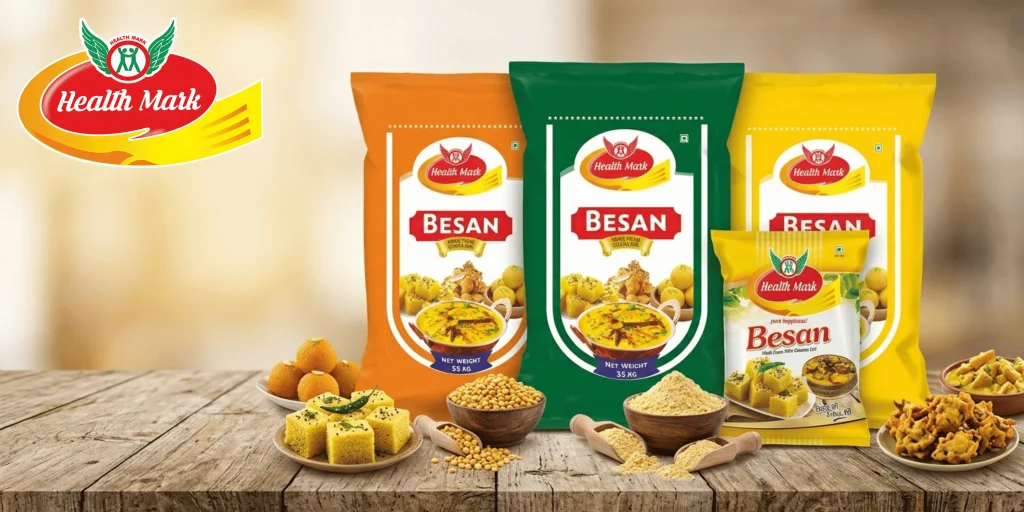
Health Mark is an FMCG company based at Plot No. 60, Industrial Township, Bhatoli Kalan, Baddi (Himachal Pradesh – 173205). Its website lists ISO 22000, ISO 9001, GHP, GMP and HACCP accreditations, and the brand positions itself as North India’s No1 name in wholesale and retail consumer goods. Whatever the label no.1 besan means to you, the right way to judge it is the same as for any supplier: request a sample and test it.
How the besan is made
According to the company, its besan is made from carefully selected premium chana dal, finely ground using traditional milling methods to retain natural aroma, smooth texture and nutrients. The result is meant for pakoras, dhoklas, snacks and everyday cooking.
The besan range
The Besan category page lists four variants: ultra-fine, regular, coarse-grade and powder besan. That covers most commercial uses, from sweet shops to namkeen lines to household retail.
Spotlight: the ultra-fine grade for sweet shops
If you make delicate sweets, the Bareek Besan is the product to look at first. Health Mark describes it as specially milled ultra-fine gram flour made for soft sweets such as motichur laddoos, with a smooth batter and consistent results, and positions it for sweet shops and bulk preparation. Key details from the product page:
- Ultra-fine texture suited to smooth batter and even boondi droplets
- Made for professional kitchens and sweet manufacturers
- Pack size listed: 35 kg
- Related tags include boondi flour, bulk sweet flour, fine gram flour and sweet shop besan
Why it works for bulk buyers
- Manufacturer-direct: You deal with the mill, not a chain of middlemen.
- Certified facility: Food-safety accreditations are displayed on the website.
- Grade variety: Four besan variants let you source your whole range from one supplier.
- Easy contact: Sales numbers and a WhatsApp enquiry option are listed, so you can ask for specifications and samples without a long form.
You can also explore the full range on the Health Mark homepage, where besan sits alongside atta, pulses, rice and other kitchen staples, which is handy if you want to consolidate purchases.
Step-by-Step: How to Place Your First Bulk Order
Before you buy besan in bulk for the first time, follow this sequence. It protects your cash flow and your reputation.
- Define your need. Write down the grade, monthly volume, preferred pack size and delivery location.
- Shortlist three suppliers. Mix one manufacturer, one distributor and one marketplace seller if you want a real comparison.
- Verify licences. Check FSSAI details and certificates before any money moves.
- Request samples and a spec sheet. Ask for the same grade from every supplier.
- Run a trial batch. Use your own recipe and compare results blind.
- Negotiate on landed cost and terms. Discuss freight, GST, payment schedule and replacement policy for bad lots.
- Start with a small first order. Confirm that the delivered lot matches the sample.
- Review every quarter. Re-test a retained sample from each lot against your reference sample.
Storage and Shelf Life
Even the best flour will spoil if stored badly. Follow these basics:
- Store bags on pallets or racks, never directly on the floor or against damp walls.
- Keep the storeroom cool, dry and well ventilated, away from direct sunlight.
- Use a first-in, first-out system and write the receiving date on every bag.
- Reseal opened bags tightly or transfer to airtight food-grade containers.
- Keep besan away from strong odours; flour absorbs smells easily.
- Control pests with regular cleaning and inspection, not by storing chemicals nearby.
Shelf life varies by supplier and packing. Many listings quote several months under proper storage. Always follow the best-before date printed on the pack and request that information in writing.
Seven Common Mistakes Buyers Make
- Choosing on price alone. A cheaper quote can cost more through rejected batches.
- Skipping the sample. Never order a truckload from a photo.
- Ignoring grade. “Besan” is not one product; match the grind to the recipe.
- Not checking the FSSAI licence. It takes two minutes and protects your own licence too.
- Overbuying. Buying more than you can use before the best-before date wastes money.
- Poor storage. Damp floors and open bags undo good quality.
- Relying on a single supplier. Always keep a vetted backup.
Smart Buying Tips for Businesses Purchasing Besan in Bulk
Buying besan in larger quantities requires careful planning to maintain product quality, control costs, and avoid unnecessary wastage. Here are some practical tips to help businesses make better purchasing decisions.
- Check Product Quality: Examine the colour, texture, aroma, and freshness of besan before placing a large order. Requesting a sample can help you assess whether it meets your requirements.
- Compare Prices and Quality: Don’t choose a supplier based on price alone. Consider product consistency, packaging, and overall value before making a decision.
- Choose Suitable Packaging: Select packaging that protects the flour from moisture and contamination during storage and transportation.
- Plan Your Stock Requirements: Estimate your monthly consumption to avoid overstocking and ensure fresh products are available when needed.
- Verify Supplier Details: Check relevant food safety licences, product labels, and shelf-life information before confirming an order.
- Maintain Good Supplier Communication: Discuss delivery schedules, product availability, and future requirements to keep your purchasing process smooth.
Following these simple practices can help retailers, wholesalers, and food businesses maintain consistent quality while managing their purchasing costs effectively.
FAQ
1. Where can I buy premium quality besan in bulk in India?
Buy directly from a licensed manufacturer or mill with FSSAI registration and food-safety certifications, or from an authorised distributor of that manufacturer. Verify the licence, test a sample and get a written specification before ordering. Health Mark, based in Baddi, Himachal Pradesh, supplies besan in several grades.
2. What is the difference between fine and coarse besan?
Fine besan is milled to a smooth, silky texture and is used for soft sweets, boondi and smooth batters. Coarse besan has a granular texture that suits laddoos, barfi and some snacks. Pakoras, kadhi and dhokla usually work well with regular grade.
3. How can I check if besan is pure?
Check for a creamy-yellow colour, a nutty smell and an even silky feel. Run a batter test with your own recipe. For certainty, send a sample to an accredited food-testing laboratory, as home tests are only indicators.
4. Which besan is best for motichur laddoo?
Ultra-fine besan is the preferred choice because it creates a smooth batter and even, small boondi pearls. Health Mark’s ultra-fine grade is designed for this use and is listed in a 35 kg pack.
5. What is the minimum order quantity for bulk besan?
It depends on the supplier and variant. Health Mark’s ultra-fine variant is listed in a 35 kg pack. For other variants, pack sizes and delivery to your location, contact the sales team on the numbers below.
6. How long does besan last?
Stored in a cool, dry place in sealed packaging, besan generally stays usable for several months. Always follow the best-before date on the pack and keep it away from moisture, heat and strong smells.
7. Is besan gluten-free?
Chickpea flour is naturally gluten-free. However, if you need a strictly gluten-free product, confirm with the supplier how the flour is milled and packed, since shared equipment can introduce cross-contact.
8. How do I compare quotes from different suppliers?
Convert each quote to landed cost per kg, including freight and GST, and compare like for like on grade, pack size, payment terms and best-before date. Then factor in sample quality and consistency.
9. Can I get a sample before placing a bulk order?
Reputable suppliers will usually discuss sampling. Ask the Health Mark sales team about samples and specifications for the variant you need before committing to a full order.
10. Do I need an FSSAI licence to buy besan in bulk?
Not to buy it, but if you use besan to make or sell food commercially, your own business needs the appropriate FSSAI registration or licence. It is also wise to buy only from suppliers who hold valid licences.
Conclusion
Finding the right place to buy premium quality besan in bulk in India comes down to a handful of disciplined habits: define the grade you need, buy from licensed and certified sources, test a sample with your own recipe, compare quotes on landed cost, and keep a backup supplier. Do that, and besan stops being a recurring headache and becomes the most dependable ingredient in your kitchen.
If you want to see how our mill-direct supply works for your business, explore the full Besan range, take a look at the ultra-fine Bareek Besan for sweets, or visit Health Mark to learn more about the company.
Talk to the Health Mark sales team for specifications, samples and bulk quotes:
- 📞 09318896005
- 📞 9218587660
- 📞 9882896000
- 📍 Plot No. 60, Industrial Township, Bhatoli Kalan, Baddi, India 173205