
Have you ever wondered why some motichur laddoos have a perfectly soft texture while others turn out dry, grainy, or uneven? The secret often lies in the quality of the ingredients, especially the besan used in preparation.
Not all gram flour is the same. Different varieties of besan are available for different culinary applications, from smooth batters for pakoras and fine boondi to coarser textures preferred in certain traditional sweets. Choosing the right flour can make a noticeable difference in the taste, texture, and consistency of the finished product.
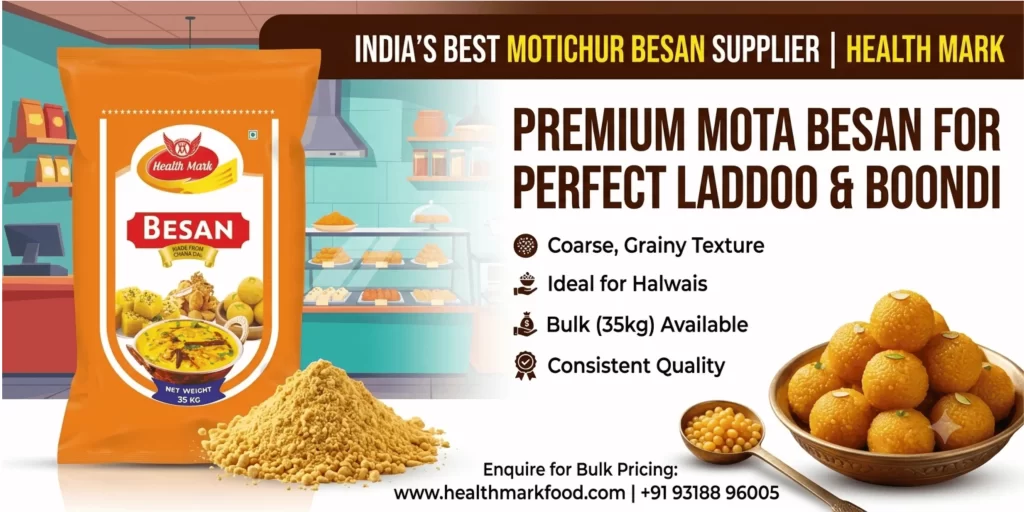
For sweet shops, professional halwais, catering businesses, and food manufacturers, selecting a reliable motichur besan supplier in India is an important part of maintaining consistent product quality.
In this guide, we’ll explore what makes besan suitable for traditional sweets, the factors that influence its quality, and how to choose the right supplier for your business. We’ll also introduce Health Mark as a brand to explore for your besan sourcing requirements.
What Is Motichur / Mota Besan?
Besan is gram flour milled from chana dal (split Bengal gram), and it comes in more than one grind. Mota besan, also sold as motichur besan, is deliberately ground coarser than regular besan. Instead of a fine, powdery texture, it has a slightly grainy, granular feel almost like very fine semolina.
That coarseness isn’t a flaw; it’s the entire point. When mota besan is pressed through a boondi ladle (jhara) into hot oil, the coarser granules form small, round, slightly textured droplets that hold their shape instead of dissolving into a paste. This is exactly the texture needed for:
- Motichur laddoo the tiny-bead laddoo famous across North India
- Boondi both the sweet variety and the savoury version used in raita
- Certain regional sweets and snacks that rely on a grainy bite rather than a smooth one
If you use fine besan or besan powder for these recipes, the boondi often turns flat, sticky, or loses its characteristic bead shape which is why professional kitchens are specific about sourcing genuine mota besan rather than substituting whatever gram flour is on hand.
Why Your Choice of Besan Makes or Breaks the Final Dish
Besan isn’t a background ingredient it directly decides:
- Texture: Coarse grind = defined boondi beads. Fine grind = a smoother, cake-like crumb, better suited to barfis or fine-textured sweets.
- Oil absorption: Poor-quality or inconsistently milled besan absorbs oil unevenly, leaving boondi greasy in some batches and dry in others.
- Flavor: Chana quality and freshness of milling directly affect the natural nutty flavor. Stale or low-grade besan tastes flat, sometimes faintly bitter.
- Shelf stability: Improperly dried or packed besan picks up moisture, clumps, and can turn rancid faster a real risk for anyone buying in bulk for a sweet shop or catering business.
- Consistency across batches: For a commercial kitchen, the biggest frustration isn’t a single bad batch it’s inconsistency. A reliable supplier delivers the same grind, the same quality, every single order.
This is precisely why the search for the best besan brand in India usually isn’t about finding the cheapest pack it’s about finding a besan manufacturer in India that can guarantee the same premium quality besan, order after order.
How to Identify the Best Besan Supplier in India: A Buyer’s Checklist
With dozens of besan sellers near me, online, and in wholesale markets, it helps to have a structured way to evaluate them. Here’s what actually separates a top besan supplier from an average one:
| What to Check | Why It Matters |
| Chana sourcing | Besan made from high-grade, well-cleaned chana dal has better color, flavor and swelling capacity |
| Grinding consistency | A top selling besan supplier in India controls grind size precisely critical for mota besan specifically |
| Hygiene & processing standards | Look for FSSAI-registered, hygienically processed facilities |
| Packaging | Proper moisture-proof packaging prevents clumping, pest contamination and rancidity |
| Bulk supply capacity | A genuine manufacturer can fulfil recurring bulk orders (25kg, 35kg+ packs) without supply gaps |
| Transparency on pricing | The best besan price is clearly communicated, with no hidden costs on bulk or wholesale orders |
| Reputation & reviews | Established besan sellers build trust over years of consistent supply to sweet shops, caterers and food brands |
| Product range | A reliable brand usually offers multiple besan grades mota, bareek, and powder for different culinary uses |
If a supplier checks most of these boxes, they’re worth shortlisting as a long-term besan seller for your kitchen or business.
Health Mark: A Trusted Besan Manufacturer in India
Health Mark is a food products company based out of an industrial facility in Baddi, Himachal Pradesh a region known for food manufacturing in North India. The company works across a wide catalogue of staples including atta, besan, pulses, rice, dry fruits, oils, and spices, with an emphasis on sourcing quality raw material and maintaining hygienic processing standards.
As a besan manufacturer in India, Health Mark’s approach to its Besan range focuses on a few consistent principles:
- Premium quality chana as the base for every besan variant
- Controlled grinding so that mota besan, bareek besan and besan powder each hold their intended texture
- Hygienic packing designed to protect freshness during storage and transport
- Multiple pack sizes, including bulk formats suited to sweet shops, caterers and food manufacturers
This combination is why Health Mark has positioned itself as a dependable choice for buyers searching for the best besan seller rather than a one-time, inconsistent source.
Health Mark Motichur / Mota Besan Product Deep Dive
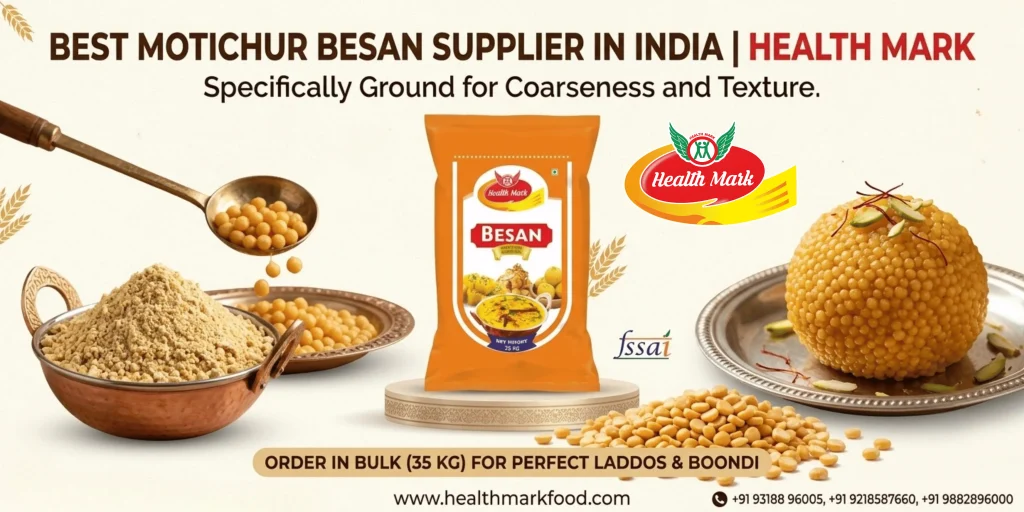
Health Mark Motichur / Mota Besan is purpose-made for exactly the use case discussed above: recipes that depend on a coarse, grainy texture rather than a smooth one.
Key product highlights:
Coarsely ground gram flour, built specifically for a slightly grainy, motichur-style texture
Made from premium quality chana, selected for natural flavor and consistent swelling
Suited to laddoo, boondi, and traditional regional sweets and snacks
Carefully processed and hygienically packed to preserve freshness during storage
Available in a 35kg bulk pack, making it practical for sweet shops, catering kitchens and FMCG-scale production rather than only small household use
Best suited for:
Sweet shop owners making motichur laddoo and boondi at scale
Caterers preparing large festive or wedding orders
Snack and sweets manufacturers needing a consistent raw material supply
Home bakers and cooks who want restaurant-style texture in their laddoo
Best Besan Price in India: What Actually Drives the Cost
There’s no single fixed “best besan price” across India it moves with a handful of real factors:
- Raw chana prices Gram (chana) prices fluctuate seasonally based on harvest and mandi rates, and besan pricing follows closely behind.
- Grind type Mota besan, bareek besan, and fine besan powder can carry slightly different processing costs depending on milling precision.
- Pack size Wholesale or bulk packs (like 35kg) typically work out cheaper per kilogram than small retail packs.
- Quality tier Premium quality besan made from carefully cleaned, high-grade chana will cost more than mass-market, unbranded besan but it also performs far more consistently in cooking.
- Transport & logistics Delivery distance from the manufacturing unit affects landed cost, especially for bulk buyers.
Rather than chasing the lowest number on a price list, serious buyers sweet shop owners, caterers, and food manufacturers tend to prioritise consistency and quality per rupee spent, since inconsistent besan leads to wasted batches, which costs far more than a small price difference ever would. For an accurate, current quote, it’s best to contact a supplier like Health Mark directly rather than relying on outdated online price lists.
Mota Besan vs Bareek Besan vs Besan Powder: Which One for What
| Type | Texture | Best For |
| Mota / Motichur Besan | Coarse, grainy | Boondi, motichur laddoo, dishes needing a defined bead/grain texture |
| Bareek Besan | Medium-fine | Pakoras, kadhi, besan-based batters |
| Besan Powder | Very fine, smooth | Barfis, smooth-textured sweets, face packs, fine-batter snacks |
Using the wrong grade is one of the most common (and avoidable) reasons home cooks and even small kitchens end up with disappointing boondi or laddoo the recipe wasn’t wrong, the besan grade was.
How to Order Bulk Besan from Health Mark (Step by Step)
- Browse the Besan range on the Health Mark Besan category page to compare mota besan, bareek besan, and besan powder options.
- Open the Motichur / Mota Besan product page for full specifications, including the available 35kg bulk pack.
- Use the Enquiry or WhatsApp option on the product page to ask about current pricing, minimum order quantity, and delivery timelines.
- Call the sales team directly at +91 93188 96005, +91 9218587660, or +91 9882896000 for wholesale/bulk rates and recurring supply arrangements.
- Confirm quantity, packaging, and delivery schedule, especially important for sweet shops planning ahead of festive seasons like Diwali, Holi, or wedding season.
- Place a recurring order once satisfied with quality and consistency, to lock in predictable supply for ongoing production.
Common Mistakes to Avoid When Buying Besan for Your Business
- Buying on price alone the cheapest besan seller near me isn’t automatically the best long-term choice if quality varies batch to batch.
- Ignoring grind type ordering regular besan when a recipe specifically needs mota besan (or vice versa).
- Not checking packaging quality poorly sealed bulk bags lead to moisture absorption, clumping, and faster spoilage.
- Skipping a trial order especially for large-scale buyers, a small trial batch before committing to bulk saves money and avoids wasted production runs.
- Overlooking storage conditions even premium quality besan degrades faster in humid, poorly ventilated storage.
- Switching suppliers too often inconsistent sourcing leads to inconsistent results; a stable relationship with one reliable besan manufacturer in India tends to pay off over time.
Expert Tips for Using Motichur Besan in Boondi & Laddoo
- Batter consistency matters as much as besan grade. Even with genuine mota besan, a batter that’s too thin or too thick will affect boondi shape.
- Use fresh oil and the right temperature. Oil that’s too hot burns the boondi before it sets; oil that’s too cool makes it soak up excess oil and turn soft.
- Rest the batter briefly before frying to let the besan hydrate evenly this improves texture noticeably.
- Sieve the besan before mixing to catch any lumps, even with a high-quality, hygienically packed product.
- Store opened besan in an airtight container, away from moisture and direct sunlight, to preserve freshness between uses.
Health Mark vs Typical Market Besan: A Quick Comparison
| Factor | Health Mark Motichur Besan | Typical Unbranded Local Besan |
| Chana quality | Premium, selected chana | Often inconsistent, unspecified grade |
| Grind consistency | Controlled coarse grind for motichur use | Frequently inconsistent between batches |
| Packaging | Hygienically packed, bulk-ready (35kg) | Often loose or basic packaging |
| Supply reliability | Structured bulk/wholesale supply | Can vary with local market availability |
| Transparency | Direct enquiry, WhatsApp & phone support | Limited traceability or support |
This is a general comparison intended to help buyers evaluate options individual sellers in any local market may vary.
Who Should Be Buying Motichur Besan in Bulk?
- Sweet shop owners producing motichur laddoo and boondi regularly, especially around festive seasons
- Caterers handling wedding and event orders where besan-based sweets are a staple
- Snack and sweets manufacturers who need a dependable, consistent raw material supplier
- Hotels and restaurants with in-house dessert or sweet counters
- Home cooks and small bakers who want professional-grade texture without buying from multiple small retail packs
FAQ
Q1. Who is the best motichur besan supplier in India for bulk orders?
For bulk orders, look for a besan manufacturer in India that offers consistent grind quality, hygienic packing, and transparent bulk pricing. Health Mark supplies Motichur / Mota Besan in 35kg bulk packs suited to sweet shops, caterers, and food manufacturers.
Q2. What is the difference between mota besan and regular besan?
Mota besan is ground coarser, giving it a grainy texture ideal for boondi and motichur laddoo. Regular (fine) besan is smoother and better suited to pakoras, batters, and kadhi.
Q3. Why does motichur laddoo need a specific type of besan?
Motichur laddoo relies on small, round boondi beads that hold their shape when fried. Coarsely ground mota besan creates this texture naturally; finer besan tends to produce flatter, less defined boondi.
Q4. What is the best besan price in India for bulk/wholesale buyers?
Besan pricing depends on chana quality, grind type, pack size, and current market rates for raw gram. Wholesale buyers typically get a better per-kilogram rate on bulk packs. Contact a supplier directly, such as Health Mark, for current wholesale pricing.
Q5. How can I buy besan in bulk directly from a manufacturer?
Most manufacturers, including Health Mark, allow bulk buyers to enquire via their website’s product enquiry form, WhatsApp, or by phone, and then confirm quantity, pricing, and delivery timelines directly with the sales team.
Q6. What should I check before choosing a besan seller near me?
heck chana sourcing quality, grind consistency, hygiene and packaging standards, bulk supply capability, and pricing transparency. A trial order before committing to a large bulk purchase is a smart first step.
Q7. Is premium quality besan worth paying more for?
Yes, especially for commercial use. Premium quality besan made from well-sourced chana performs more consistently across batches, reducing wastage from failed boondi or laddoo batches, which usually offsets any price difference.
Q8. Can motichur besan be used for anything other than laddoo and boondi?
While it’s best known for laddoo and boondi, mota besan’s grainy texture also works well in certain traditional regional snacks and sweets that call for a similar bite and structure.
Q9. How should bulk besan be stored to maintain freshness?
Store besan in a cool, dry place away from direct sunlight and moisture. Once opened, transfer it to an airtight container to prevent clumping and preserve its natural flavor for longer.
Q10. Does Health Mark supply besan outside its local region?
Health Mark, based in Baddi, Himachal Pradesh, supplies its besan range including Motichur / Mota Besan to buyers across India. For delivery availability in your specific location, contact the sales team at +91 93188 96005, +91 9218587660, or +91 9882896000.
Final Word
The difference between an average motichur laddoo and a genuinely memorable one almost always comes down to the besan. Coarse, well-milled, fresh mota besan gives boondi its signature bead shape and gives laddoo its characteristic bite something no amount of extra ghee, sugar, or saffron can compensate for if the base flour is wrong.
If you’re a sweet shop owner, caterer, or food manufacturer searching for a dependable, premium quality besan supplier, Health Mark Motichur / Mota Besan is built specifically for this purpose coarsely ground from premium chana, hygienically packed, and available in bulk 35kg packs for consistent commercial supply.
Ready to order or get a wholesale quote? Browse the Besan range, check out Motichur / Mota Besan in detail, or call the Health Mark sales team directly at +91 93188 96005, +91 9218587660, or +91 9882896000 for bulk pricing and availability.