
If you run a restaurant, a catering unit, a food processing brand, a hotel kitchen, or even a neighbourhood kirana store, you already know one uncomfortable truth: your spices supplier can make or break your business. A single batch of adulterated turmeric powder, an inconsistent chilli powder that changes colour every month, or a supplier who ghosts you during festive season demand can cost you customers you spent years building.
And yet, most businesses choose a spices supplier the same way they choose a vegetable vendor on price alone, or because “everyone else buys from them.” That’s a mistake. Spices are not a commodity you can afford to gamble on. They affect food safety, brand reputation, repeat customers, and because spices are one of the most adulterated food categories in India even legal compliance under FSSAI norms.
This guide breaks down exactly how to choose the best spices supplier for your business, whether you need bulk sabut masale (whole spices), powder masale (ground spices), or a long-term wholesale partner who can scale with you.
Why Your Spices Supplier Matters More Than You Think
Spices are a small line item on your purchase sheet but a massive lever on your final product. Think about it a biryani, a pickle brand, a snack manufacturer, or a QSR chain lives or dies by consistency of taste. That consistency starts at the sourcing stage, not the cooking stage.
A dependable best spices seller gives you three things that a random vendor rarely can:
Consistency the same colour, aroma, pungency, and particle size, order after order.
Compliance spices that meet FSSAI limits for pesticide residue, moisture, and adulterants.
Continuity supply that doesn’t collapse the moment a festival season or crop shortage hits.
When any one of these breaks down, the cost isn’t just financial. It’s the customer who never orders again because your dal today didn’t taste like your dal last month.
Powder Masale vs Sabut Masale: What Should You Actually Buy?
Before you even start comparing suppliers, decide what format of spice actually fits your kitchen or production line. This single decision affects shelf life, flavour intensity, and cost per use.
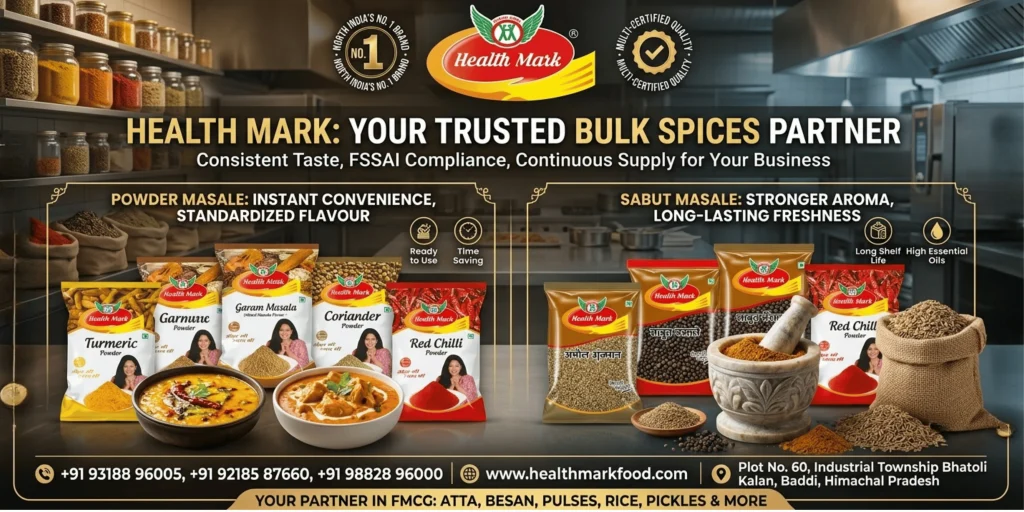
Powder Masale (Ground Spices) pre-ground spices like turmeric powder, red chilli powder, and coriander powder are ready to use, save prep time, and are ideal for high-volume kitchens, restaurants, and packaged food brands that need speed and consistency.
Sabut Masale (Whole Spices) whole spices such as dalchini (cinnamon), badi elaichi, kali mirch (black pepper), saunf, kalonji, and dhaniya sabut retain their essential oils far longer than ground versions, giving fine-dining kitchens, biryani houses, and pickle or masala-blend manufacturers a stronger, fresher flavour profile.
| Factor | Powder Masale | Sabut Masale |
| Shelf life | Shorter (oils oxidise faster once ground) | Longer (oils stay locked inside until crushed) |
| Convenience | Ready to use instantly | Needs roasting/grinding before use |
| Flavour intensity | Good, but fades over weeks | Stronger, fresher aroma when ground fresh |
| Ideal for | Restaurants, dhabas, packaged snacks, everyday cooking | Biryani houses, pickle units, masala blenders, premium kitchens |
| Adulteration risk | Higher (powder form is easier to mix with fillers) | Lower (visible texture makes tampering harder to hide) |
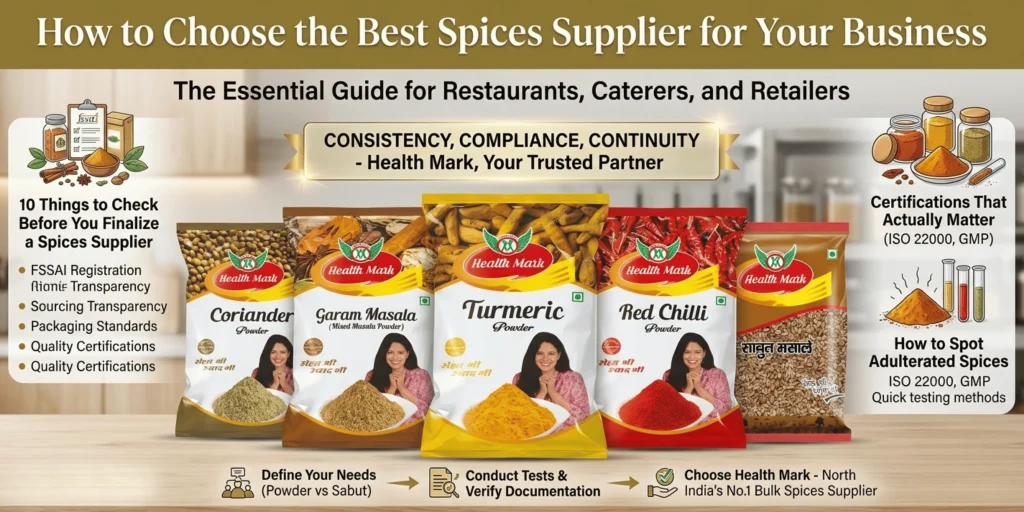
10 Things to Check Before You Finalize a Spices Supplier
If you remember nothing else from this guide, remember this checklist. Run every potential supplier through it before you sign a purchase order.
- FSSAI Registration/License Non-negotiable. No FSSAI number, no deal.
- Quality Certifications Look for ISO 22000, ISO 9001, GMP, GHP, or HACCP. These indicate the supplier follows documented food-safety processes, not just good intentions.
- Sourcing Transparency Ask where the raw spices are procured from (which growing belt/mandi) and how they’re tested on arrival.
- Consistency Across Batches Request samples from two different production batches and compare colour, aroma, and texture.
- Minimum Order Quantity (MOQ) & Bulk Pricing Confirm MOQs match your order volume and that bulk pricing is genuinely competitive, not inflated then “discounted.”
- Packaging Standards Moisture-proof, tamper-evident, and correctly labelled packaging protects shelf life and builds trust with your own customers if you’re reselling.
- Lead Time & Delivery Reliability Ask about average dispatch time and how they handle peak-season demand (festivals, wedding season).
- Private Labelling / Custom Packing If you plan to sell under your own brand, check whether the supplier offers white-label or custom packaging options.
- After-Sales Support A supplier who responds only until the payment clears is a red flag. Test their responsiveness before you commit.
- Reviews, References & Track Record Ask for references from existing B2B clients in your city or category (hotel, restaurant, retail chain, distributor).
Certifications That Actually Matter (And the Ones That Don’t)
Not every certificate on a supplier’s website is meaningful. Here’s how to separate genuine quality assurance from marketing wallpaper.
Certifications worth checking for:
FSSAI License Mandatory under Indian law for anyone manufacturing, packaging, or selling food products.
ISO 22000 Food safety management systems; confirms hazard analysis is built into the process.
ISO 9001 General quality management standard; shows consistent operating procedures.
GMP (Good Manufacturing Practices) Confirms hygienic, standardised production methods.
GHP (Good Hygiene Practices) Focuses specifically on hygiene protocols across the facility.
HACCP (Hazard Analysis and Critical Control Points) A globally recognised system for identifying and controlling food-safety risks at each production stage.
A supplier that holds a genuine combination of these rather than just an FSSAI number pasted on an invoice is signalling that it takes high quality spices seriously as a system, not a slogan.
How to Spot Adulterated or Low-Quality Spices
Spice adulteration is unfortunately common in India, especially in loose, unbranded, and heavily discounted products. A few quick checks you (or your kitchen staff) can run before accepting a bulk delivery:
- Turmeric powder: Add a pinch to water. Pure turmeric settles with a light yellow trail; adulterated turmeric (mixed with metanil yellow dye) leaves an intense, unnatural yellow-red streak.
- Red chilli powder: Adulterated chilli powder often contains brick powder or artificial colour. Rub a small amount between wet fingers brick powder leaves gritty residue and doesn’t dissolve cleanly.
- Black pepper (kali mirch): Adulteration with papaya seeds is common. Genuine peppercorns sink in water; light, papery fakes tend to float.
- Coriander powder: Check for sawdust or bran adulteration by soaking in water genuine coriander powder settles without excessive frothing or a woody smell.
- General rule: Buy from a best spices manufacturer that shares lab test reports or batch quality certificates on request, rather than one that resists any transparency.
Wholesale Spices vs Retail Spices: What Changes When You Buy in Bulk
Buying wholesale spices in India is not simply “the retail pack, but bigger.” Several things genuinely change:
Pricing structure Wholesale pricing is typically tiered by quantity slabs (e.g., 25kg, 50kg, 100kg+), so always ask for a slab-wise rate card rather than a single flat price.
Packaging format Bulk orders usually come in larger sacks or catering packs rather than consumer-facing pouches, which reduces per-kg packaging cost.
Payment terms Established B2B suppliers often offer credit cycles or advance-with-balance-on-delivery terms for repeat, verified buyers.
Quality control expectations At scale, even a 2–3% quality dip affects hundreds of kilos. Insist on the same certifications and batch testing you’d expect on a retail pack.
Logistics Confirm whether the supplier delivers pan-India or only regionally, and what the average transit time looks like for your city.
Comparison: Local Spice Seller vs Branded Wholesale Manufacturer
| Parameter | Local/Unbranded Spice Seller | Branded Wholesale Manufacturer |
| Certifications | Often minimal or unverifiable | ISO, FSSAI, GMP, HACCP typically documented |
| Batch consistency | Varies significantly | Standardised processes reduce variation |
| Traceability | Rarely available | Sourcing and production traceable |
| Pricing | May look cheaper upfront | Competitive at bulk slabs, fewer hidden losses |
| Packaging | Basic, sometimes unlabelled | Moisture-proof, labelled, export-grade options |
| Support after sale | Minimal | Dedicated sales/support contact |
| Best suited for | Very small, occasional purchases | Restaurants, hotels, distributors, food brands, retailers |
Questions to Ask a Spices Supplier Before Placing Your First Order
Can you share your FSSAI license number and current quality certifications?
Where do you source your raw spices from, and how do you test incoming stock?
What is your MOQ, and what does your bulk price slab look like at 25kg, 50kg, and 100kg+?
Can I get a small sample batch before committing to a full order?
What is your average lead time, and how do you handle peak-season demand?
Do you offer private labelling or custom packaging for resale?
What happens if a batch doesn’t meet the agreed quality on arrival?
Do you supply pan-India, or only within a specific region?
Common Mistakes Businesses Make While Sourcing Spices
- Chasing the lowest price without checking quality. Cheap spices are frequently cheap because they’re cut with fillers, dyes, or low-grade raw material.
- Not asking for samples before bulk ordering. A single sample check can save you an entire spoiled batch.
- Ignoring packaging quality. Poor packaging leads to moisture damage, clumping, and reduced shelf life even if the spice itself was good at the time of dispatch.
- Sticking with one supplier out of habit. Re-evaluate your supplier at least once a year against current market options.
- Overlooking certifications. A supplier without FSSAI or ISO documentation is a compliance risk you’re taking on, not just a quality risk.
- Not clarifying return/replacement policy upfront. Always confirm this in writing before the first large order, not after a problem arises.
Why Businesses Across North India Choose Health Mark as Their Spices Supplier
At Health Mark, spices aren’t a side business they’re part of a wider FMCG portfolio built on the same promise the brand is known for across North India: (health, along with taste). Positioned as North India’s No.1 brand in wholesale and retail consumer goods, Health Mark manufactures both powder masale and sabut masale from a dedicated facility at Plot No. 60, Industrial Township Bhatoli Kalan, Baddi, Himachal Pradesh a region known for food manufacturing.
Here’s what sets Health Mark apart as a best wholesale spices supplier:
Certified quality systems Health Mark’s facility is backed by ISO 22000, ISO 9001, GMP, GHP, and HACCP certifications, covering food safety, hygiene, and quality management from raw material to final pack.
Full spice range for every kitchen need From powder masale like turmeric, red chilli, and coriander powder, to a wide sabut masale range including badi elaichi, chhoti elaichi, dalchini, kali mirch, saunf, ajwain, kalonji, javitri, dhaniya sabut, kali sarson, and badyan khatai (star anise) Health Mark covers both everyday and specialty sourcing needs.
Beyond spices Health Mark also supplies atta, besan, pulses, rice, dry fruits, pickles, sauces, snacks, and sugar making it a genuine one-stop sourcing partner for FMCG buyers who don’t want to juggle multiple vendors.
Built for bulk and wholesale The brand is structured for both wholesale and retail consumer goods distribution, meaning volume buyers, distributors, hotels, and restaurants are served as core customers, not an afterthought.
A traceable, accountable manufacturer As a listed, certified manufacturer rather than an anonymous trader, Health Mark can be held accountable for consistency and compliance in a way loose, unbranded suppliers cannot.
If you’re evaluating a spices seller near me search result against an established, certified manufacturer, the deciding factor should always be documentation and consistency both of which are built into how Health Mark operates.
Step-by-Step: How to Start Sourcing Bulk Spices From Health Mark
- Browse the spice range. Review the Powder Masale and Sabut Masale categories to shortlist what your kitchen or brand needs.
- Check the full product catalogue. Visit the Our Products page if you also want to bundle atta, besan, pulses, rice, or dry fruits into the same order.
- Submit a product enquiry. Use the enquiry form on healthmarkfood.com to specify quantity, packaging preference, and delivery location.
- Call the sales team directly for faster quotes on bulk/wholesale slabs: +91 93188 96005, +91 92185 87660, or +91 98828 96000.
- Request a sample batch if you’re a first-time B2B buyer, before committing to a large order.
- Confirm certifications and CoA for the specific batch you intend to purchase.
- Finalise quantity, pricing slab, and delivery timeline, then place your order.
FAQ
1. What is the best way to check if a spices supplier is genuine?
Verify their FSSAI license number, ask for ISO/GMP/HACCP certificates, and request a small sample batch before placing a bulk order. A genuine supplier will never hesitate to share documentation.
2. What is the difference between powder masale and sabut masale?
Powder masale refers to pre-ground spices like turmeric, red chilli, and coriander powder, ready to use immediately. Sabut masale refers to whole, unground spices like cinnamon, cardamom, and black pepper, which retain flavour longer and are typically ground fresh before use.
3. How do I find a reliable wholesale spices supplier in India?
Look for a manufacturer (not just a trader) with documented certifications, a transparent sourcing process, sample availability, and a track record with B2B clients such as restaurants, hotels, or distributors in your category.
4. What certifications should a good spices manufacturer have?
At minimum, an FSSAI license. Beyond that, look for ISO 22000 (food safety), ISO 9001 (quality management), GMP, GHP, and HACCP together, these indicate a systematic approach to hygiene and quality control.
5. How can I tell if turmeric or chilli powder is adulterated?
For turmeric, a water test can reveal unnatural yellow-red dye trails from added colourants. For chilli powder, gritty residue after rubbing a wet sample between your fingers can indicate brick powder or other fillers. When in doubt, request a Certificate of Analysis from your supplier.
6. Is it cheaper to buy whole spices or ground spices in bulk?
Whole spices are often more cost-efficient over time since they have a longer shelf life and you control the freshness of grinding. However, ground spices save labour and time, which matters more for high-volume kitchens.
7. What is the minimum order quantity for wholesale spices?
This varies by supplier and product. Always ask for a slab-wise price list (e.g., 25kg, 50kg, 100kg+) so you can plan your order size around the best available rate.
8. Can I get private label or custom packaging for spices I resell?
Many established manufacturers offer private labelling or custom packing for bulk buyers who plan to resell under their own brand. Confirm this directly with the supplier’s sales team before finalising your order.
9. How often should a business review or change its spices supplier?
At least once a year. Market pricing, quality standards, and your own business volume all change a periodic review ensures you’re not overpaying or compromising on quality out of habit.
10. Why should I choose a certified manufacturer like Health Mark over a local spice trader?
A certified manufacturer like Health Mark offers documented quality systems (ISO 22000, ISO 9001, GMP, GHP, HACCP), consistent batch quality, a full range of powder and whole spices, and accountability that anonymous local traders typically cannot match which matters most when you’re buying in bulk for a business, not a household.
Final Word
Choosing the best spices supplier for your business isn’t about finding the cheapest quote it’s about finding a manufacturer whose quality, certifications, and consistency you can rely on order after order, season after season. Whether you need powder masale for daily kitchen use or sabut masale for signature recipes and long-shelf-life products, the checklist in this guide gives you a repeatable way to evaluate any supplier that comes your way.
If you’d rather skip the trial-and-error and start with a certified, bulk-ready manufacturer, Health Mark offers a full range of high-quality spices backed by ISO 22000, ISO 9001, GMP, GHP, and HACCP certifications along with a wider FMCG catalogue for businesses that want a single, reliable sourcing partner.
Get a wholesale quote today: Call +91 93188 96005, +91 92185 87660, or +91 98828 96000, or submit a product enquiry directly on the Health Mark website.