
Punjab runs on flavour. From the tandoors of Amritsar to the dhabas lining the GT Road, from home kitchens in Ludhiana to five-star hotel pantries in Chandigarh everything starts with the same question: where do you source spices you can actually trust, in the quantity your business needs?
If you’re a restaurant owner, retailer, distributor, caterer, or even a household that cooks in bulk, buying spices one small packet at a time from the local kirana store simply doesn’t work. You need wholesale spices in Punjab that are consistently fresh, hygienically processed, competitively priced, and available in the quantities that match your demand week after week, season after season.
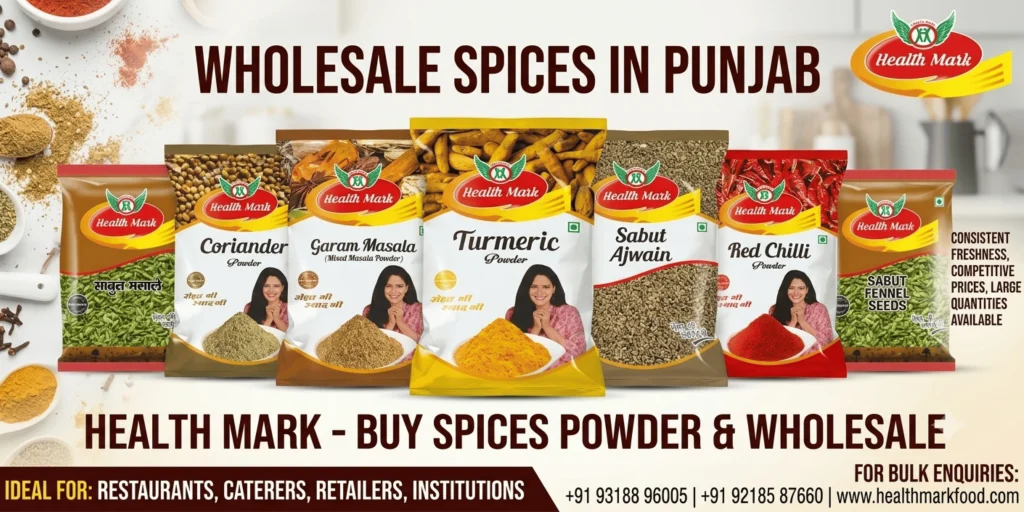
This guide walks you through everything you need to know before you place your first bulk order: how wholesale spice sourcing works, what separates a genuine manufacturer from a repackager, how to judge quality before you buy, current market trends, and how to pick the best wholesale spices supplier for your business, whether you need powder masale, sabut masale (whole spices), or a mix of both.
Punjab’s food economy has always leaned heavily on spice-forward cooking think of butter chicken, sarson da saag, amritsari fish, and the countless dhaba-style curries that define North Indian cuisine. But over the last few years, something has shifted: the state’s food service and retail sector has scaled up dramatically.
A few factors are driving demand for wholesale spices in Punjab:
A booming restaurant and QSR sector across Ludhiana, Amritsar, Jalandhar, Patiala, and Chandigarh tri-city, all needing consistent bulk supply.
Growth of cloud kitchens and catering businesses, which need reliable spice partners rather than one-off retail purchases.
Rising consumer awareness around adulteration, pushing both businesses and households toward certified, lab-tested spice brands.
Proximity to Himachal Pradesh’s industrial belt (Baddi–Barotiwala–Nalagarh), which has become a manufacturing base for several FMCG and food processing companies supplying into Punjab, Haryana, and Chandigarh.
Export and institutional demand, with hotels, hostels, and processed-food units needing standardized masala at scale.
This is why more buyers today are searching for a best spices manufacturer rather than settling for whatever is available at the nearest wholesale mandi.
Powder Masale vs Sabut Masale: What’s the Difference and Why It Matters
Before buying in bulk, it helps to understand the two broad categories most suppliers including Health Mark organize their spice range around.
Powder Masale (Ground Spices)
These are pre-ground, ready-to-use spice powders such as turmeric powder, red chilli powder, coriander powder, garam masala, and chaat masala. They save preparation time and are ideal for:
- Restaurants with high order volume
- Packaged food manufacturers
- Households that want convenience without compromising taste
Sabut Masale (Whole Spices)
These are unground, whole-form spices such as whole black pepper, cinnamon (dalchini), green cardamom (elaichi), cloves, star anise, and cumin. They are preferred by:
- Chefs who want to grind spices fresh for maximum aroma
- Dishes like biryani, pulao, and tempering (tadka) that need whole spices for texture and visual appeal
- Buyers who want a longer shelf life, since whole spices retain their essential oils longer than ground powder
A serious wholesale spices supplier should offer both categories not just one so buyers can match the format to their kitchen’s actual usage pattern.
Who Actually Needs Wholesale Spices?
“Wholesale” doesn’t just mean big factories. In practice, the buyer base for bulk spices is far broader:
Restaurants, dhabas & QSRs consistent, high-volume usage of powder masale
Hotels & catering companies need both powder and sabut masale for varied menus
Retailers & kirana store owners buying in bulk to break into smaller retail packs
Distributors sourcing from a manufacturer to supply across a region
Institutional buyers hostels, canteens, army messes, hospitals
Food processing & packaged food units using spices as raw material inputs
Health-conscious bulk households families who cook for large gatherings or joint families and prefer buying 6 months’ worth of spices at once from a trusted brand instead of small retail packets
If you fall into any of these categories, buying direct from a best spices manufacture rather than a middleman typically saves 15–30% on cost while improving consistency.
How to Identify High-Quality Spices Before You Buy in Bulk
This is the single most important section of this guide, because bulk buying means you’re committing to a large quantity a mistake here is expensive. Use this checklist before finalizing any supplier.
Look For:
- Certifications FSSAI license number displayed clearly, along with ISO 22000, ISO 9001, HACCP, GMP, or GHP marks, which indicate the manufacturer follows documented food safety systems, not just claims
- Color consistency natural, not artificially bright (a red chilli powder that looks unnaturally red may contain added colour)
- Aroma test high quality spices should have a strong, natural aroma the moment the pack is opened
- Packaging date & shelf life always visible, never vague
- Source transparency brands that can tell you where their raw material is sourced from tend to have tighter quality control
- Texture uniformity powder should be fine and uniform, without visible impurities, husk, or lumps
- No pooling of oil or moisture in the pack, which indicates poor storage or old stock
Red Flags to Avoid:
- Unusually low prices with no visible certification often the biggest sign of adulteration or low-grade filler content
- No batch number or manufacturing date on packaging
- Suppliers unwilling to share lab test/quality reports on request
- Excessive use of “starch” or “husk” smell in powdered spices, which indicates the use of low-grade fillers
Buying premium high quality spices in bulk is ultimately a trust decision you’re relying on a supplier’s internal quality process because you cannot personally inspect every batch. This is why certification and brand reputation matter more in wholesale buying than in a one-off retail purchase.
Health Mark: A Trusted Wholesale Spices Supplier Based in North India
Health Mark is an FMCG food brand manufacturing and supplying a wide range of packaged staples from atta and besan to pulses, rice, and spices out of its production facility in the Industrial Township of Bhatoli Kalan, Baddi, strategically located to serve the Punjab, Chandigarh, Haryana, and Himachal Pradesh markets.
What makes Health Mark relevant for buyers specifically searching for wholesale spices in Punjab and the broader wholesale spices in India market:
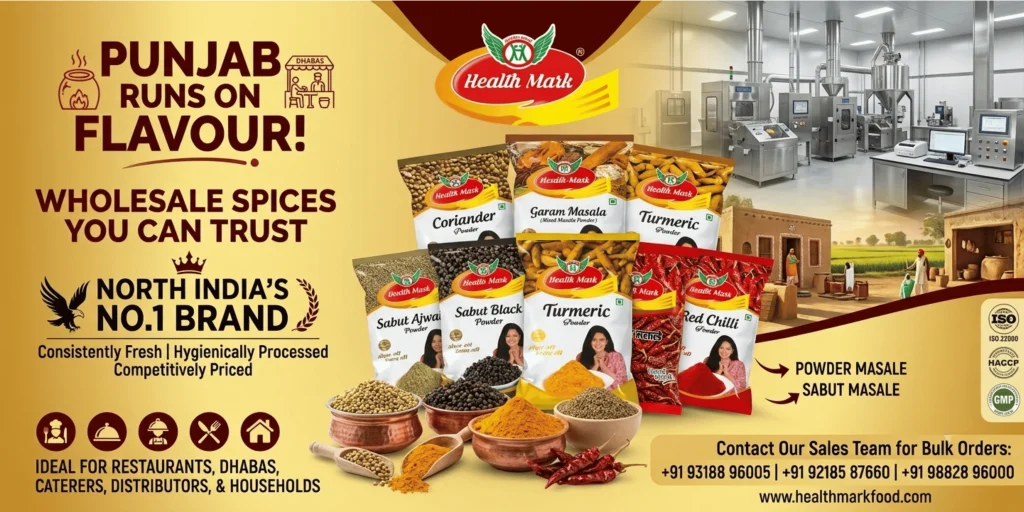
- Certified manufacturing standards the facility operates under ISO 22000, ISO 9001, HACCP, GMP, and GHP accreditation, which are internationally recognized food safety and quality management systems. You can review these on the Health Mark Accreditation page.
- Two dedicated spice categories Powder Masale and Sabut Masale, covering both ground and whole spice needs under one roof.
- A broader FMCG catalogue atta, besan, pulses, rice, dry fruits, salt, sugar, sauces, snacks, and Italian range, meaning bulk buyers can consolidate multiple staple categories with a single best spices seller rather than juggling several vendors.
- Direct manufacturer pricing because Health Mark manufactures rather than simply repackages, bulk buyers get closer to factory pricing instead of paying multiple distributor margins.
- North India-focused supply reach, positioning it well for buyers across Punjab, Chandigarh, Panchkula, and Baddi looking for a spices seller near me with real production infrastructure behind the brand, not just a trading counter.
Health Mark positions itself as “North India’s No.1 Brand” in its wholesale and retail consumer goods segment a claim buyers should independently verify against order volume, client base, and certifications, but one that reflects the company’s ambition in the space of the No 1 spices brand conversation in this region.
Health Mark Powder Masale Range
Health Mark’s Powder Masale category currently includes:
| Product | Common Use |
| Turmeric Powder (Haldi) | Daily cooking, curries, health remedies |
| Red Chilli Powder (Lal Mirch) | Curries, marinades, tandoori dishes |
| Coriander Powder (Dhania) | Base masala for gravies and dry sabzis |
| Garam Masala | Finishing spice for North Indian dishes |
| Chaat Masala | Snacks, chaats, fruit seasoning |
| Rajma Masala | Ready-to-use rajma curry preparation |
| Kasuri Methi (Dried Fenugreek Leaves) | Aromatic finishing for gravies and paneer dishes |
These cover the core rotation that any restaurant kitchen, catering unit, or retail counter needs on a weekly basis, making bulk restocking simpler with a single supplier.
Health Mark’s Sabut Masale (Whole Spices) Range
The Sabut Masale category is more extensive, reflecting a broader whole-spice offering, including:
- Badi Elaichi (Black Cardamom)
- Chhoti Elaichi (Whole Green Cardamom)
- Dalchini (Whole Cinnamon)
- Kali Mirch (Whole Black Pepper)
- Lal Mirch Sabut (Whole Red Chilli)
- Dhaniya Sabut (Whole Coriander Seeds)
- Fennel Seeds (Saunf)
- Carom Seeds (Ajwain)
- Kalonji (Nigella Seeds)
- Kali Sarson (Whole Black Mustard Seeds)
- Javitri (Whole Mace)
- Badyan Khatai (Whole Star Anise)
This range supports biryani houses, tandoor-based kitchens, achaar (pickle) manufacturers, and any business that prefers grinding or tempering with whole spices for maximum freshness.
Comparison: Retail Buying vs Wholesale Buying of Spices
| Factor | Retail Buying (Small Packets) | Wholesale Buying (Bulk) |
| Cost per kg | Higher | 15–30% lower typically |
| Consistency across batches | Variable (different brands/batches) | Consistent, single-source supply |
| Convenience for high usage | Frequent reordering required | Fewer, larger orders |
| Suitable for | Households, occasional cooking | Restaurants, hotels, distributors, large households |
| Negotiation on price | Not possible | Often possible for repeat/large orders |
| Packaging customization | Not available | Often available with manufacturers |
| Shelf life management | Small quantity finishes fast | Requires proper storage (see Section 12) |
How Bulk Spice Pricing Works (And How to Get the Best Spices Price)
Spice pricing in the wholesale market fluctuates based on several factors, and understanding them helps you negotiate the best spices price confidently rather than simply accepting a quoted rate.
- Raw material seasonality chilli, turmeric, and coriander harvests are seasonal; prices are typically lower right after harvest season and firmer in the off-season.
- Order volume most manufacturers offer tiered pricing; a 50 kg order will always cost less per kg than a 5 kg order.
- Packaging format loose bulk packaging is cheaper per kg than pre-packed retail-ready pouches.
- Transportation distance buyers closer to the manufacturing unit (in this case, Punjab and neighbouring Himachal/Haryana buyers relative to Health Mark’s Baddi facility) often benefit from lower logistics costs.
- Payment terms advance/bulk payment sometimes unlocks better pricing than credit-based smaller orders.
Step-by-Step: How to Place a Wholesale Spice Order
If you’re ready to move from research to actually sourcing, here’s the general process for working with a manufacturer like Health Mark:
- List your requirement which powder masale and/or sabut masale items you need, and estimated monthly quantity.
- Reach out directly via the Product Enquiry page or by calling the sales team directly at +91 93188 96005, +91 92185 87660, or +91 98828 96000.
- Request samples a genuine wholesale supplier will usually accommodate a sample request before a large order.
- Confirm certifications and batch documentation ask for FSSAI details and any relevant lab test reports for the batch you’re purchasing.
- Discuss pricing slabs and delivery timelines clarify minimum order quantity (MOQ), payment terms, and delivery schedule for your region.
- Place a trial order start with a moderate quantity before committing to a long-term supply contract.
- Set a reorder cycle based on your usage rate, establish a recurring order schedule to avoid last-minute shortages.
Common Mistakes Buyers Make When Sourcing Spices in Bulk
Chasing the lowest price without checking certification the cheapest spice is rarely the safest or most flavourful; adulterated spices often cost more in reputational damage than they save in rupees.
Overbuying without a storage plan bulk purchases without proper storage lead to moisture damage, clumping, and flavour loss.
Not requesting a sample first committing to a large order sight-unseen is a common and costly mistake.
Ignoring packaging quality poor packaging accelerates spice degradation during transport and storage.
Switching suppliers too frequently inconsistent sourcing leads to inconsistent taste in your final dishes, which customers notice.
Not verifying batch-to-batch consistency always spot-check color, aroma, and texture even from a trusted supplier.
Best Practices for Storing Bulk Spices
Buying wholesale only pays off if you store the product correctly:
- Store powdered spices in airtight containers, away from direct sunlight and moisture
- Keep whole spices in a cool, dry place; they last significantly longer than powder if stored well
- Avoid storing near heat sources (stoves, ovens) heat accelerates loss of essential oils
- Use a first-in-first-out (FIFO) rotation system for large stock so older batches are used before newer ones
- Label bulk containers with the purchase/packaging date to track freshness
- For very large quantities, consider vacuum-sealed sub-packs instead of one large open container, to limit air exposure each time you use the product
Expert Tips for Restaurants, Retailers, and Distributors
Standardize your masala blend with one supplier rather than mixing sources this keeps your dish flavour consistent, which matters enormously for repeat customers and brand reputation.
Negotiate a fixed-rate contract for 3–6 months during stable harvest periods to protect against sudden price spikes.
Diversify between powder and whole spice usage based on dish type use whole spices for slow-cooked, aromatic dishes and powders for high-speed kitchen operations.
Ask your supplier about private labelling if you’re a retailer many manufacturers, including larger FMCG players, offer white-label or co-branded packaging for bulk retail buyers.
Track seasonal price dips (post-harvest months) to time your largest bulk purchases.
Build a direct relationship with the manufacturer, not just a distributor, whenever order volume justifies it this typically improves both pricing and quality accountability.
FAQ
1. What is the minimum order quantity (MOQ) for wholesale spices in Punjab?
MOQ varies by supplier and product. Most manufacturers offer tiered options starting from a few kilograms for trial orders up to bulk quantities of 50–100+ kg for regular business supply. It’s best to confirm directly with the supplier’s sales team.
2. How do I know if a spice brand is genuinely a manufacturer and not just a repackager?
Check for a listed manufacturing address, food safety certifications (FSSAI, ISO, HACCP, GMP), and whether the company shows an actual production facility rather than only a trading or office address.
3. Is buying whole spices (sabut masale) better than powder masale for restaurants?
It depends on your kitchen workflow. Whole spices retain flavour longer and are ideal for slow-cooked or tempered dishes, while powder masale saves preparation time for high-volume kitchens. Most established restaurants use a combination of both.
4. How can I verify the quality of spices before placing a large order?
Request a sample batch, check the aroma, color, and texture, and ask for the supplier’s certification documents and recent lab test reports if available.
5. What is the shelf life of bulk wholesale spices?
Whole spices typically last 2–3 years when stored properly, while ground spice powders generally retain optimal flavour for 6–12 months. Always check the manufacturing date and store according to best practices.
6. Are ISO and HACCP certifications necessary when choosing a spices manufacturer?
While not legally mandatory in every case, these certifications indicate the manufacturer follows documented food safety and quality control systems, which significantly reduces the risk of contamination or inconsistent quality an important factor for bulk buyers.
7. Can I get customized packaging for wholesale spice orders?
Many manufacturers offer bulk packaging as well as retail-ready or private-label packaging options for distributors and retailers. This should be discussed directly with the supplier based on your order volume.
8. How often should a restaurant or retailer reorder wholesale spices?
This depends on usage volume, but most businesses set a monthly or bi-monthly reorder cycle to balance freshness with the cost benefits of bulk buying.
9. Do wholesale spice prices change seasonally?
Yes. Prices are usually more competitive right after the harvest season for raw ingredients like chilli, turmeric, and coriander, and tend to firm up during the off-season due to reduced raw material availability.
10. How do I contact a wholesale spices supplier like Health Mark for bulk orders?
You can reach out via the Product Enquiry page on the Health Mark website or call the sales team directly at +91 93188 96005, +91 92185 87660, or +91 98828 96000.
Conclusion
Sourcing wholesale spices in Punjab isn’t just about finding the lowest price per kilogram it’s about building a dependable supply relationship with a manufacturer who can consistently deliver on quality, hygiene, and volume. Whether your business needs powder masale for daily kitchen operations or sabut masale for signature slow-cooked dishes, the right supplier should offer both, back it up with real certifications, and be transparent about sourcing and pricing.
Health Mark’s ISO, HACCP, and GMP-certified facility, combined with a dedicated Powder Masale and Sabut Masale range, positions it as a practical option for restaurants, retailers, distributors, and bulk household buyers across Punjab and North India looking for a genuine manufacturer rather than a middleman reseller.
Ready to place a bulk enquiry? Visit the Health Mark Product Enquiry page or call the sales team directly at +91 93188 96005 / +91 92185 87660 / +91 98828 96000 to discuss your quantity requirements and get current wholesale pricing.