
Walk into any Indian kitchen, restaurant, or food-processing unit and you will find one non-negotiable ingredient behind every memorable dish: spices. Whether it is the deep red of chilli powder, the earthy gold of turmeric, or the warm aroma of a well-balanced garam masala, spices are what turn simple ingredients into food people remember. But for hotels, restaurants, retailers, caterers, and exporters, the real challenge is not choosing the right spice it is finding a bulk spices supplier in Himachal Pradesh (or anywhere in India) who can be trusted to deliver purity, consistency, and volume, order after order.
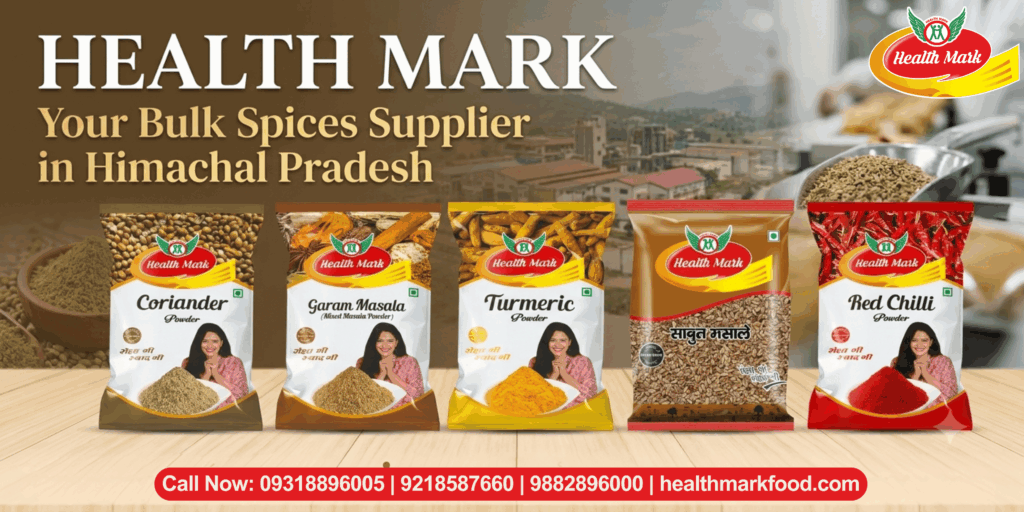
This guide is built for exactly that audience: business owners, kirana store chains, HoReCa buyers, and distributors who are searching for a genuine wholesale spices in India partner rather than a random online seller. We will walk through why Himachal Pradesh and specifically the Baddi industrial belt has quietly become one of North India’s most reliable spice and FMCG manufacturing zones, and how Health Mark, an ISO-22000, ISO-9001, HACCP, GMP, and GHP certified manufacturer based in Baddi, has positioned itself as a dependable bulk spice distributor Baddi businesses keep coming back to.
By the end of this article, you will know exactly what separates the best spices manufacturing partners from the rest, which factors actually affect the quality of spice powder, how bulk pricing works, and how to place your first order with confidence.
Why Himachal Pradesh Is Becoming India’s Trusted Spice Manufacturing Hub
A decade ago, most large-scale spice processing in North India was concentrated around traditional mandis in Delhi, Rajasthan, and Madhya Pradesh. That is changing fast, and Himachal Pradesh particularly the Baddi-Barotiwala-Nalagarh (BBN) industrial belt has emerged as a serious contender. Here is why:
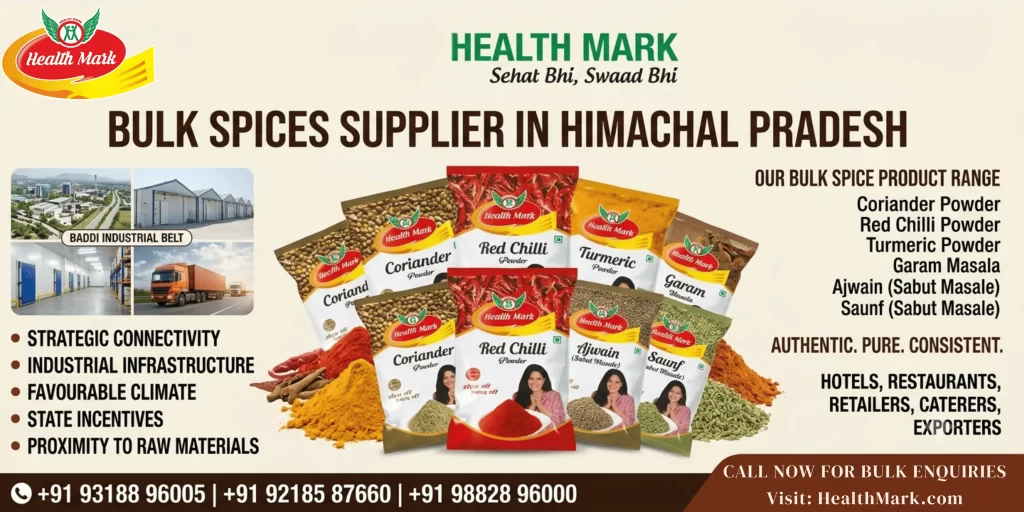
Strategic connectivity: Baddi sits within easy reach of Chandigarh, Punjab, Haryana, and Delhi-NCR, which keeps freight and distribution costs low for a bulk spice distributor Baddi-based businesses rely on.
Industrial infrastructure: The BBN belt is one of Asia’s largest pharma and FMCG manufacturing clusters, which means access to modern cold-chain warehousing, food-grade packaging units, and skilled labour, all in one place.
Favourable climate for storage: The relatively dry, moderate climate of the region is better suited to storing dried spices without excess moisture absorption compared to humid coastal manufacturing hubs.
State incentives for food processing: Himachal Pradesh’s industrial policies have historically encouraged food and FMCG units to set up base here, resulting in more competitive pricing for buyers of wholesale spices in India.
Proximity to raw material belts: Punjab, Haryana, and Rajasthan major producers of chilli, coriander, and other raw spices are all a short trucking distance away, shortening the farm-to-factory timeline.
All of this adds up to a simple advantage for buyers: sourcing from a bulk spice supplier in Himachal Pradesh often means fresher stock, tighter quality control, and better logistics economics than sourcing from more congested, older spice markets.
Health Mark: A Leading Bulk Spice Supplier in Himachal Pradesh
Health Mark is a Baddi-headquartered FMCG manufacturer that has built its reputation on one simple promise: quality that customers can taste, batch after batch. While many buyers know Health Mark for its Chakki Fresh Atta and premium Besan, the brand’s spice division has quietly grown into one of the more dependable names for retailers and institutional buyers looking for a best spices seller they do not have to double-check every time.
What makes Health Mark stand apart from a typical local spices seller is its accreditation stack. The company holds ISO 22000 (Food Safety Management), GMP (Good Manufacturing Practices), GHP (Good Hygiene Practices), and HACCP (Hazard Analysis and Critical Control Points) certifications. For a bulk buyer, that is not just a badge on a website it is a documented guarantee of traceability, hygiene, and consistent processing standards across every batch of spice powder that leaves the facility.
Health Mark operates out of Plot No. 60, Industrial Township, Bhatoli Kalan, Baddi, Himachal Pradesh 173205 placing it firmly inside the BBN industrial corridor discussed above, with the logistics advantages that come with it.
You can explore the full Health Mark product ecosystem including atta, besan, pulses, dry fruits, and more on the official Health Mark website.
Our Bulk Spice Product Range
Health Mark spices portfolio is deliberately curated around the everyday essentials that move fastest in Indian kitchens, restaurants, and retail shelves. Instead of spreading thin across dozens of niche blends, the focus stays on high-turnover staples that a wholesale buyer can stock with confidence:
Turmeric Powder (Haldi)
Ground from select turmeric roots and valued for its natural colour and curcumin content, this is one of the highest-demand SKUs for any best spices powder buyer in India, used across curries, dals, and even skincare-adjacent food products.
Red Chilli Powder
A consistent grind, vibrant colour, and controlled heat level make this a staple for restaurants and packaged food units that cannot afford batch-to-batch variation.
Coriander Powder (Dhania)
The base note of most Indian gravies freshness and aroma retention are the two factors that separate an average coriander powder from a great one.
Garam Masala
A balanced, aromatic blend used to finish curries and dals. Consistency in the spice ratio is what keeps repeat institutional buyers loyal to one supplier.
Carom Seeds (Ajwain)
Widely used in both cooking and traditional home remedies, ajwain demand stays steady across seasons, making it a reliable bulk SKU.
Fennel Seeds (Saunf)
Used as a spice, a mouth freshener, and a garnish, fennel rounds out a well-stocked wholesale spice catalogue.
The complete, up-to-date spice catalogue with all six core products is available on the Health Mark Spices category page. Bulk and institutional buyers can also request custom pack sizes for any SKU.
What Makes These the Best Spices Powder & High-Quality Spices
“Best” is a word every seller uses. For a wholesale buyer, it needs to mean something measurable. Here is what actually determines whether a spice powder deserves the label high quality spices:
Purity and absence of adulteration: No added colour, no starch fillers, no foreign resin verified through lab testing rather than just a label claim.
Optimal moisture content: Spices with excess moisture clump, lose potency faster, and are more prone to microbial growth during storage and transit.
Volatile oil and pungency retention: For chilli and pepper-based spices, oleoresin and capsaicin levels determine real heat and flavour strength, not just visual colour.
Fine, uniform particle size: A consistent grind ensures the spice dissolves and releases flavour evenly in cooking, rather than settling unevenly in gravies.
Food-safe, sealed packaging: Nitrogen-flushed or vacuum-sealed packs that block light and air are what keep spice powder fresh over long transit and storage periods.
Certified manufacturing environment: ISO 22000, HACCP, GMP, and GHP compliance (as Health Mark holds) reduce contamination risk at every stage sourcing, grinding, and packing.
When a supplier can demonstrate all six factors with documentation rather than marketing language, that is a genuine signal you are dealing with a best health mark spices–grade manufacturer rather than a repackaging trader.
Top-Selling Spices in India: A Quick Market Snapshot
Understanding which spices move fastest helps wholesale buyers plan stock levels and negotiate better bulk pricing. Here is a quick snapshot of the top selling spices in india and where Health Mark’s current range fits in:
| Spice | Primary Use | Why It Sells Fast | In Health Mark Range |
| Turmeric Powder | Curries, dals, colour base | Daily-use staple in every household | Yes |
| Red Chilli Powder | Heat & colour in gravies | High repeat-purchase frequency | Yes |
| Coriander Powder | Base spice for gravies | Used in almost every regional cuisine | Yes |
| Garam Masala | Finishing blend | Signature flavour for restaurants | Yes |
| Cumin (Jeera) | Tempering, whole & ground | Pan-India kitchen essential | Expanding range |
| Carom Seeds (Ajwain) | Cooking & home remedies | Steady, season-independent demand | Yes |
| Fennel Seeds (Saunf) | Spice, mouth freshener | Dual-use demand (food + post-meal) | Yes |
This spread of fast-moving SKUs is exactly why retailers, hotels, and distributors treat Health Mark as more than just a best spices manufacturing add-on to their atta and besan orders it becomes a genuine one-stop wholesale spices in india cart.
Wholesale Spices in India: Why Bulk Buying Makes Business Sense
For any business that consumes spices at scale a restaurant chain, a catering unit, a retail chain, or an exporter buying retail-sized packs simply does not scale. Bulk sourcing changes the economics in several concrete ways:
Lower per-unit cost: Manufacturer-direct pricing removes the retail and distributor margin layers, which matters enormously at high volumes.
Consistent supply: A dependable bulk spice distributor Baddi-based or otherwise reduces the risk of running out of stock during peak demand seasons like festivals and wedding months.
Custom packaging and private labelling: Many manufacturers, including Health Mark, can accommodate custom pack sizes for institutional buyers, which retail-only sellers cannot.
Simplified vendor management: Sourcing multiple spice SKUs turmeric, chilli, coriander, garam masala from a single best spices seller cuts down on the number of vendors a purchase team has to coordinate with.
Better quality control: Working directly with a certified manufacturer means fewer hands touching the product between processing and delivery, reducing contamination and tampering risk.
In short, wholesale spices in india is not just about lower prices it is about supply chain reliability, something that becomes critical once a business scales past a handful of retail purchases per month.
Health Mark: Your Bulk Spice Distributor in Baddi
Being based in Baddi gives Health Mark a genuine geographic advantage as a bulk spice distributor Baddi businesses and beyond can lean on. The Baddi industrial township offers direct road connectivity to Chandigarh, Panchkula, Mohali, Ludhiana, and Delhi-NCR, which keeps delivery timelines predictable for institutional buyers across North India.
Because Health Mark already runs a wider FMCG catalogue atta, besan, pulses, dry fruits, pickles, snacks, and sugar bulk spice buyers can consolidate multiple grocery categories into a single supplier relationship and a single delivery schedule, which meaningfully reduces logistics overhead for retailers and hospitality businesses.
Retailers and distributors interested in a consolidated FMCG plus spice supply arrangement can review the full range on the Health Mark homepage before placing a bulk enquiry.
How to Choose the Best Spices Manufacturing Partner (Checklist)
Not every supplier calling themselves a top spices seller can back that claim with documentation. Use this checklist before finalising a bulk vendor:
Verify certifications: Ask for ISO 22000, HACCP, GMP, and FSSAI licence numbers, not just logos on a website.
Request lab test reports: A genuine best spices manufacturing partner should be able to share adulteration and purity test results on request.
Ask for samples before a large order: Reputable suppliers rarely hesitate to send trial samples for quality approval.
Check packaging standards: Confirm whether packs are moisture-proof, light-blocking, and suitable for your storage duration.
Understand minimum order quantities (MOQs): Clarify MOQs and whether custom pack sizes or private labelling are available.
Evaluate delivery reach and lead times: Especially important if your business operates across multiple cities or states.
Review pricing transparency: Compare bulk rate cards against market averages rather than judging on price alone.
Assess responsiveness: A supplier’s pre-sales communication quality is often a preview of post-sales support quality.
Common Mistakes to Avoid When Sourcing Spices in Bulk
Choosing the cheapest quote without checking certifications low price is often a sign of fillers, poor grinding, or expired stock.
Skipping sample testing before committing to a large purchase order.
Ignoring shelf life and storage conditions, which leads to clumping, odour loss, or spoilage mid-transit.
Relying on a single supplier with no backup plan for peak-season shortages.
Not clarifying return or replacement policy for damaged or substandard batches upfront.
Overlooking packaging quality, which directly affects shelf life once the product reaches your storeroom or kitchen.
Retail vs Wholesale Spice Buying: A Side-by-Side Comparison
| Factor | Retail Buying | Wholesale / Bulk Buying (Health Mark) |
| Cost per kg | Higher due to retail margins | Lower with manufacturer-direct pricing |
| Supply consistency | Depends on local stock availability | Planned, scheduled bulk supply |
| Quality documentation | Rarely shared | Lab reports & certifications available on request |
| Packaging options | Fixed retail packs only | Custom pack sizes for institutional buyers |
| Vendor management | Multiple small vendors needed | Single consolidated FMCG + spice vendor |
| Best suited for | Households, small kitchens | Restaurants, hotels, retailers, exporters |
How to Place a Bulk Order With Health Mark (Step-by-Step)
Browse the catalogue: Review the current spice range on the Health Mark Spices category page to shortlist required SKUs.
Shortlist quantities: Decide monthly or quarterly volume requirements per spice for accurate quoting.
Reach out directly: Contact the Health Mark sales team by phone for a bulk quote and MOQ details.
Discuss customisation: Share any private-label, pack-size, or delivery-schedule requirements at this stage.
Request and approve a sample: Confirm quality against your internal standards before a full order is placed.
Confirm order and logistics: Finalise quantities, delivery address, and expected lead time for your first bulk shipment.
Expert Tips for Long-Term Spice Freshness & Quality
Store bulk spice stock in a cool, dry, dark area away from direct sunlight and kitchen heat sources.
Use airtight containers for daily-use quantities and keep bulk packs sealed until needed.
Rotate stock using a first-in-first-out (FIFO) system, especially for high-turnover SKUs like chilli and turmeric powder.
Avoid transferring spices near steam or moisture sources, which accelerates clumping and flavour loss.
Periodically check aroma and colour a dulling colour or fading aroma is an early sign it’s time to reorder fresh stock.
FAQ
What is the minimum order quantity (MOQ) for bulk spices from Health Mark?
MOQs vary by product and pack size. It is best to contact the Health Mark sales team directly at +91 93188 96005 to get an accurate MOQ and quote based on your required volumes.
Does Health Mark offer private labelling for retailers?
Institutional and retail buyers looking for custom packaging or private-label arrangements should discuss requirements directly with the sales team, as options depend on order volume and product.
Are Health Mark spices lab-tested for purity and adulteration?
Health Mark operates under ISO 22000, ISO 9001, HACCP, GMP, and GHP certifications, which require documented quality checks throughout sourcing, processing, and packaging.
Does Health Mark supply spices outside Himachal Pradesh?
Yes. Being based in the Baddi industrial belt gives Health Mark strong connectivity to Punjab, Haryana, Chandigarh, and Delhi-NCR, supporting wider distribution across North India.
Which Health Mark spice products are best suited for restaurants?
Turmeric powder, red chilli powder, coriander powder, and garam masala are the highest-demand SKUs for restaurants and catering businesses due to their daily, high-volume usage.
How is Health Mark different from other bulk spice distributors in Baddi?
Health Mark combines multi-certification quality standards (ISO, HACCP, GMP, GHP) with a broader FMCG catalogue spanning atta, besan, pulses, and dry fruits, allowing buyers to consolidate multiple grocery categories with one supplier.
Can small retailers order in wholesale quantities, or is it only for large businesses?
Wholesale enquiries are welcomed from businesses of varying sizes. It’s best to call the sales team to discuss volumes that work for your specific retail or business needs.
How should bulk spice powder be stored after delivery?
Store in a cool, dry, dark space in airtight containers, and follow a first-in-first-out (FIFO) approach to preserve aroma, colour, and potency over time.
Does Health Mark provide product samples before a bulk order?
Buyers are encouraged to request samples for quality approval before committing to a large-volume purchase order.
How can I get a bulk spice quote from Health Mark?
You can call +91 93188 96005, +91 92185 87660, or +91 98828 96000, or use the Product Enquiry option on the Health Mark website to request a quote.
Conclusion & Next Steps
Choosing a bulk spices supplier in Himachal Pradesh is ultimately a decision about risk versus reliability. A cheaper, uncertified vendor might save a little on the invoice today, but inconsistent quality, supply gaps, and hidden adulteration risks cost far more in customer trust and repeat business over time. Health Mark’s combination of ISO, HACCP, GMP, and GHP certification, its strategic Baddi location within the BBN industrial belt, and its wider FMCG catalogue make it a genuinely dependable option for restaurants, retailers, distributors, and exporters looking for wholesale spices in india at scale.
If your business is ready to move from uncertain, inconsistent spice sourcing to a certified, bulk-ready supply partner, reach out to Health Mark today.
Call now for bulk enquiries: +91 93188 96005 | +91 92185 87660 | +91 98828 96000
Browse the full spice range here: Health Mark Spices Category or visit the
Health Mark homepage to explore the complete FMCG product catalogue.