
Spices sit at the centre of Indian cooking, and demand for them from home kitchens to five-star hotel chains never really slows down. But there’s a real gap between buying a 100-gram packet off a supermarket shelf and sourcing spices in bulk for a business. Wholesale buying involves questions retail shoppers never have to ask: Is this batch adulterated? Does the seller have FSSAI approval? Will the price stay stable through the year? Can they deliver 500 kg on a Tuesday deadline?
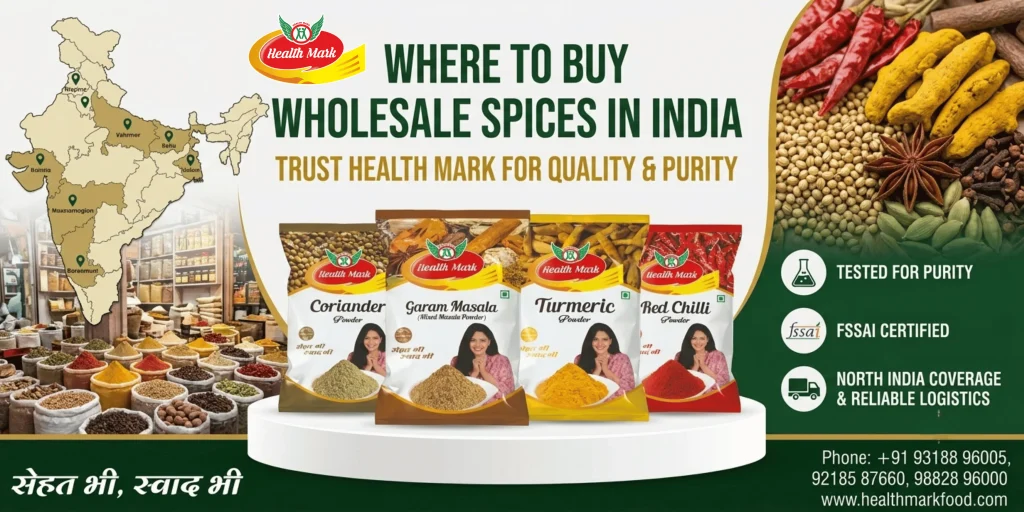
This guide walks through exactly where to buy wholesale spices in India, what separates a dependable supplier from a risky one, which spices sell fastest, how bulk pricing actually works, and how a certified spices manufacturer like Health Mark fits into that picture. Whether you’re a restaurant owner, a kirana store expanding into private label, a caterer, or a distributor scouting a new vendor, you’ll find a practical, no-fluff roadmap here.
Why India’s Wholesale Spice Market Keeps Growing
India has long been recognised as one of the world’s largest producers, consumers, and exporters of spices, thanks to its diverse agro-climatic zones from the chilli belts of Andhra Pradesh to the turmeric fields of Maharashtra and the aromatic hill regions of the Himalayas. That scale creates a deep, competitive wholesale market, but it also means quality varies enormously from one seller to the next.
A few forces are pushing more buyers toward organised, bulk spice sourcing:
Rapid growth of cloud kitchens, QSR chains, and catering businesses that need consistent flavour batch after batch.
Rising consumer awareness around purity, chemical-free processing, and ‘health mark’ style clean-label claims.
Export demand for Indian masalas, which pushes manufacturers to tighten hygiene and certification standards.
E-commerce and B2B platforms making it possible to compare and order bulk spices online without visiting a mandi in person.
The result is a market where buyers finally have leverage but only if they know what to look for.
What to Check Before You Buy Spices in Bulk
Before you commit to any bulk spices order, run every potential supplier through this checklist.
1. Purity and Adulteration
Adulteration chalk powder in turmeric, brick powder in red chilli, or artificial colour in coriander is the single biggest risk in the spice trade. Ask for a Certificate of Analysis (CoA) for each batch, and where possible, request a small sample before placing a large order. High quality spices should have a natural, consistent colour and a strong, clean aroma with no synthetic or musty smell.
2. Certifications That Actually Matter
A credible wholesale spices supplier should be able to show:
FSSAI licence mandatory for any food business operator in India.
ISO / HACCP or equivalent food-safety certification for processing units.
Organic certification, if the spices are marketed as organic or pesticide-free.
Traceability documentation linking the batch back to sourcing farms.
3. Packaging and Shelf Life
Moisture-proof, food-grade packaging protects flavour and prevents fungal growth during transit and storage. Check the manufacturing date, best-before date, and batch number printed on every pack a seller who can’t produce these details on request is not one to build a long-term relationship with.
4. Minimum Order Quantity (MOQ) and Price Transparency
Wholesale doesn’t always mean truckloads. Many legitimate best spices sellers now offer MOQs starting from a few kilograms for small restaurants, scaling up to bulk pallets for distributors. Get a written price list, not just a verbal quote, and clarify whether GST, packaging, and freight are included.
5. Sourcing and Traceability
The best spices manufacture units work directly with farms or trusted regional aggregators rather than buying anonymous open-market stock. This shortens the supply chain, improves consistency, and usually means better pricing over time because there are fewer middlemen taking a cut.
Where to Buy Wholesale Spices in India: Every Channel Compared
There isn’t a single ‘best’ place to buy the right channel depends on your order size, location, and how much quality control you’re willing to manage yourself.
Traditional Spice Mandis and Wholesale Markets
Cities like Delhi (Khari Baoli), Kolkata, and various regional mandis remain the backbone of India’s spice trade. They offer competitive pricing and huge variety, but quality is inconsistent, invoicing can be informal, and buyers often need local expertise to avoid getting an inferior batch.
Online B2B Marketplaces
B2B platforms let you compare multiple sellers, read basic company profiles, and place bulk spices orders without travelling. The trade-off is that you’re relying on photos and descriptions rather than physically inspecting the product, so verifying certifications and asking for samples matters even more here.
Direct-from-Manufacturer Buying
Buying straight from a manufacturer like Health Mark usually gives you the shortest supply chain, the most consistent quality control, and better pricing at scale because there’s no distributor margin stacked on top. It also makes it easier to build a long-term, accountable relationship where the same team handles your order every time.
Local Spice Distributors (‘Spices Seller Near Me’)
For businesses that value fast delivery and face-to-face relationships, a regional distributor can be ideal particularly across Punjab, Haryana, Himachal Pradesh, and Chandigarh, where established FMCG suppliers already run efficient regional logistics.
Channel Comparison at a Glance
| Sourcing Channel | Best For | Watch Out For |
| Local mandi / wholesale market | Small buyers wanting to inspect stock in person | Inconsistent quality, informal billing |
| Online B2B marketplace | Comparing multiple sellers quickly | Limited physical verification before purchase |
| Direct from manufacturer (e.g. Health Mark) | Restaurants, distributors, exporters wanting consistency | Fewer options if you need a single-source variety mix |
| Regional distributor / ‘near me’ | Fast local delivery and relationship-based buying | Pricing may include an extra distribution margin |
Top Selling Spices in India You Should Stock
A handful of spices account for most of the volume moving through India’s wholesale channels because they’re the daily backbone of Indian cooking. Here’s a quick reference for the top selling spices in India and how they’re typically used in bulk kitchens and retail:
| Spice | Typical Use | Why Buyers Stock It in Bulk |
| Turmeric Powder | Curries, dals, marination, colouring | Used in nearly every Indian dish; high, steady demand |
| Red Chilli Powder | Curries, tandoori marinades, pickles | Drives both heat and colour; one of the fastest-moving SKUs |
| Coriander Powder | Base masala for gravies and curries | Essential thickening and flavour-balancing spice |
| Garam Masala | Finishing spice for curries, biryanis | High margin blended product; strong repeat demand |
| Carom Seeds (Ajwain) | Tempering, parathas, digestive use | Popular in both home cooking and Ayurvedic/health-food segments |
| Fennel Seeds (Saunf) | Tempering, mukhwas, teas, biryani | Dual-use as a spice and a post-meal digestive aid |
What Makes a Brand the ‘No. 1 Spices Brand’ in India
Buyers searching for the best spices brand in India are usually really asking one question: who can I trust to deliver the same quality, order after order, at a fair price? A brand earns that trust through a few consistent signals:
Verified food-safety and quality certifications, not just marketing claims.
Transparent sourcing knowing which farms or regions the raw material comes from.
Consistent grinding, packaging, and hygiene standards across every batch.
Responsive customer support for bulk and repeat B2B orders.
Competitive, transparent pricing without hidden charges.
No single brand can honestly claim to be the universal ‘No. 1’ for every buyer the right fit depends on your order volume, region, and quality priorities. What you should evaluate instead is which supplier consistently checks every box above for your specific business.
Health Mark: A Trusted Wholesale Spices Manufacturer
Based out of the Industrial Township in Bhatoli Kalan, Baddi (Himachal Pradesh) within easy reach of Chandigarh, Panchkula, and Ludhiana Health Mark is an FMCG company built around organic sourcing, supply-chain transparency, and clean-label food products. Alongside spices, the brand also supplies atta, besan, pulses, rice, dry fruits, salt, sugar, pickles, sauces, and snacks which makes it a convenient single-source option for grocery retailers and distributors who don’t want to juggle multiple vendors.
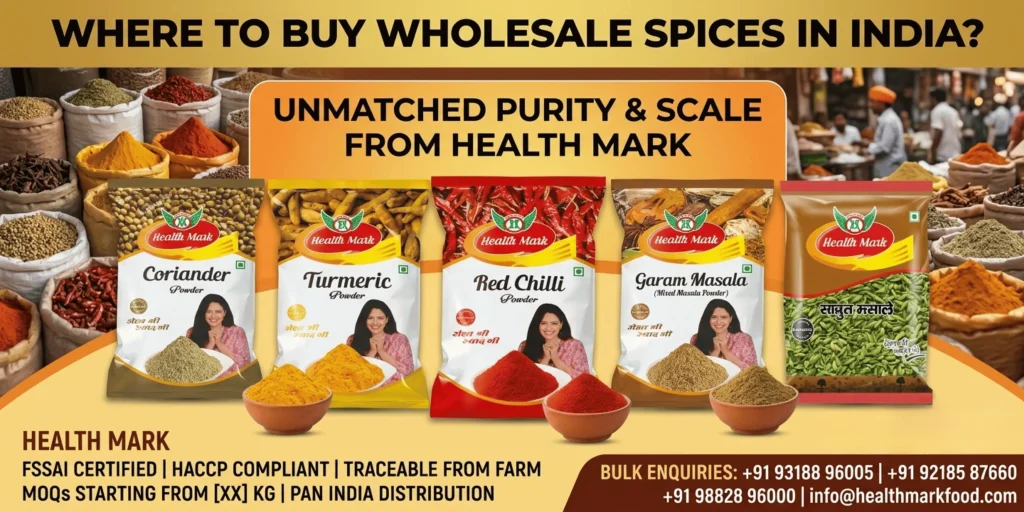
Health Mark’s current wholesale spices range includes:
Why bulk buyers and distributors work with Health Mark:
Sourcing tied back to certified organic farms, with an emphasis on staying free of synthetic pesticides, herbicides, and GMOs.
A traceable supply chain, so buyers can understand where each batch originates.
Published quality credentials see the Accreditation page for details.
A single manufacturing base in Baddi with regional dispatch coverage across North India.
A dedicated Product inquiry process for bulk and B2B orders.
To place a wholesale enquiry or ask about MOQs, pack sizes, and delivery timelines, you can reach the Health Mark sales team directly:
Phone: +91 93188 96005
Phone: +91 92185 87660
Phone: +91 98828 96000
Or explore the full range on the Health Mark Spices category page
Best Spices Price: What Actually Drives Wholesale Cost
Spice prices swing more than most grocery categories because raw material output depends heavily on weather, harvest cycles, and export demand. Understanding the underlying cost drivers helps you negotiate better and avoid overpaying.
| Factor | Impact on Wholesale Price |
| Seasonality of the harvest | Prices typically dip post-harvest and firm up as stock depletes |
| Whole spice vs. ground powder | Processing, grinding, and packaging add cost over raw whole spice |
| Certification (organic, FSSAI, ISO) | Certified, tested stock generally carries a modest premium over uncertified supply |
| Pack size and packaging quality | Smaller retail-style packs cost more per kg than bulk sacks or drums |
| Order volume / MOQ | Larger, recurring orders typically unlock better per-kg pricing |
| Freight and delivery distance | Regional buyers close to the manufacturing hub often save on logistics |
When comparing best spices price across sellers, always normalise the comparison to price-per-kilogram at the same purity grade and pack format a cheaper quote is meaningless if it’s for a lower grade or a smaller effective quantity.
How to Order Bulk Spices Online (Step by Step)
Shortlist 2–3 suppliers and request their FSSAI licence number, certifications, and a current price list.
Ask for product samples or a small trial order before committing to a large quantity.
Compare pricing on a like-for-like basis same grade, pack size, and delivery terms.
Confirm MOQ, payment terms, and expected delivery timelines in writing.
Place your first order through the supplier’s website, phone line, or B2B enquiry form.
Inspect the delivered batch for packaging integrity, batch codes, and expected aroma/colour.
If satisfied, set up a recurring order schedule to lock in consistent supply and pricing.
Common Mistakes to Avoid When Buying Wholesale Spices
Choosing the lowest quoted price without checking the purity grade behind it.
Skipping a sample order and going straight to a bulk purchase with an unfamiliar seller.
Not confirming FSSAI and other certifications before onboarding a new supplier.
Over-ordering perishable ground spices without a realistic usage timeline.
Ignoring packaging quality, which directly affects shelf life and flavour retention.
Failing to negotiate fixed pricing or a price-review clause for longer-term contracts.
Best Practices for Storing Bulk Spices
Store in airtight, food-grade containers away from direct sunlight and moisture.
Keep whole spices separate from ground powders whole spices last considerably longer.
Maintain a cool, dry storage area; avoid placing containers near ovens, stoves, or steam.
Label every container with the batch number and received date for FIFO (first-in-first-out) rotation.
Buy ground spices in quantities you can realistically use within a few months for peak flavour.
Expert Tips for Choosing a Reliable Spices Seller
Prioritise sellers who are transparent about sourcing over those who only advertise low prices.
Ask how they test each batch for adulteration and whether they can share a Certificate of Analysis.
Start with a smaller trial order even from an established best spices manufacture unit before scaling up.
Check whether the seller offers consistent SKUs so your recipes don’t need adjusting batch to batch.
Favour suppliers who provide a direct phone line or enquiry desk for bulk B2B orders, not just a generic contact form.
FAQ
Where can I buy wholesale spices in India?
You can buy wholesale spices through traditional mandis, online B2B marketplaces, regional distributors, or directly from certified manufacturers such as Health Mark, which supplies turmeric, red chilli, coriander, garam masala, and more from its Baddi, Himachal Pradesh facility.
What is the minimum order quantity (MOQ) for bulk spices?
MOQs vary widely by supplier some accept orders of a few kilograms for small restaurants, while others require pallet-level quantities for distributors. Always confirm the MOQ and pricing tiers directly with the seller before ordering.
How can I tell if spices are adulterated?
Look for unnatural colour, a weak or off aroma, and ask the seller for a Certificate of Analysis. Reputable sellers welcome this question and can provide batch-level testing documentation.
Which is the best spices brand in India?
There’s no single universal answer the ‘best’ brand depends on your region, order size, and quality priorities. Evaluate certifications, sourcing transparency, and consistency rather than relying on marketing claims alone.
What is the price difference between retail and wholesale spices?
Wholesale pricing is typically lower per kilogram than retail packs because it removes retail packaging costs and margins, and rewards larger order volumes.
Do I need an FSSAI licence to buy spices wholesale for resale?
Yes. Any business that stores, packages, or resells food products in India, including spices, generally needs to be registered with the Food Safety and Standards Authority of India (FSSAI).
How long do bulk spices stay fresh?
Whole spices can retain flavour for up to a year or more when stored properly, while ground spices are best used within a few months for peak aroma and taste.
Can I buy spices directly from a manufacturer instead of a distributor?
Yes, and it’s often advantageous. Buying direct from a manufacturer like Health Mark shortens the supply chain, improves traceability, and can offer better pricing at volume.
What’s the best way to store spices bought in bulk?
Use airtight, food-grade containers, keep them away from heat and moisture, label batches clearly, and rotate stock using a first-in-first-out approach.
Does Health Mark supply spices across India?
Health Mark operates from its manufacturing base in Baddi, Himachal Pradesh, with regional dispatch coverage. For delivery availability in your area and current MOQs, contact the sales team directly at +91 93188 96005, +91 92185 87660, or +91 98828 96000.
Conclusion: Choose a Wholesale Spices Supplier You Can Rely On
Sourcing spices in bulk isn’t just about finding the lowest per-kilogram price it’s about building a relationship with a supplier who consistently delivers high quality spices, stands behind their certifications, and shows up on time, order after order. Whether you go through a local mandi, a B2B marketplace, or straight to a manufacturer, run every seller through the checklist in this guide before you commit.
If you’re ready to start with a certified, organically-sourced supplier, explore Health Mark’s full spice range on the Spices category page, or reach out for a bulk quote at +91 93188 96005, 91 98828 96000.