If you run a sweet shop in Ludhiana, a snacks unit in Chandigarh, a hotel kitchen in Patiala, or a food-processing business anywhere in North India, you already know one thing: besan is not a “maybe” ingredient. It is the backbone of pakoras, dhoklas, kadhi, laddoos, and dozens of everyday dishes that keep customers coming back. Which is exactly why choosing the wrong supplier one with inconsistent milling, poor hygiene, or unstable pricing can quietly damage your food quality and your margins at the same time.
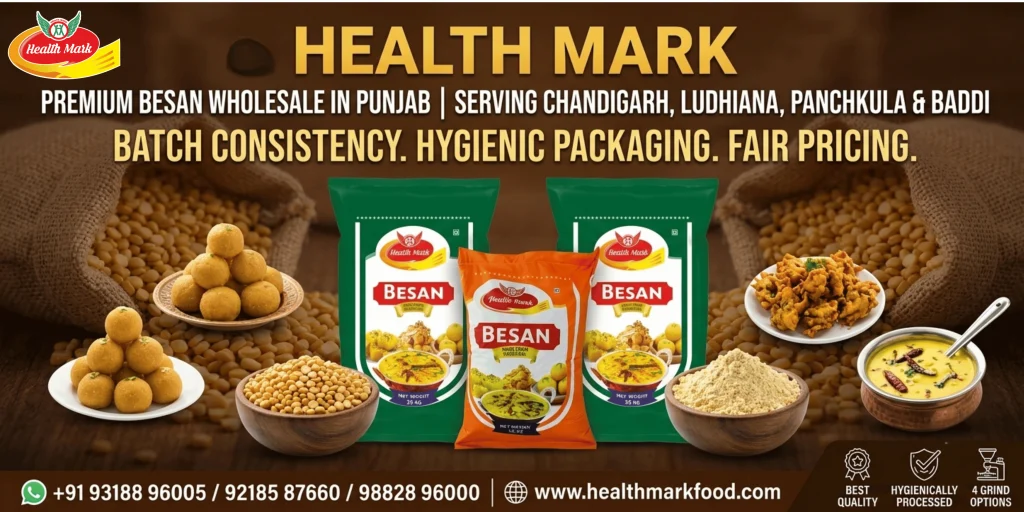
This guide walks you through everything you need to know before you buy premium besan wholesale in Punjab: what actually makes besan “premium,” how to evaluate a besan manufacturer in India, what fair wholesale pricing looks like, and how Health Mark a Baddi-based FMCG brand serving Chandigarh, Panchkula, Ludhiana, Baddi, and the wider Punjab-Himachal belt fits into that decision.
What Is Besan and Why Quality Matters
Besan, also called gram flour or chana flour, is made by milling chana dal (split Bengal gram) into a fine, pale-yellow flour. It’s naturally gluten-free, has a distinctive nutty flavour, and is used across Indian cuisine from crispy pakoras and soft dhokla to besan kadhi, chillas, laddoos, and industrial snack coatings.
Not all besan is equal, though. The quality of the final dish depends heavily on three things: the grade of chana dal used, how finely and evenly it’s milled, and how hygienically it’s packed and stored before it reaches your kitchen. A besan seller near you selling loose, unbranded flour may look cheaper on paper, but inconsistent particle size, higher moisture content, or poor storage can lead to lumpy batter, uneven frying, and a shorter shelf life problems that show up in customer complaints, not on the invoice.
Besan Nutrition: The Numbers Behind the Hype
Besan isn’t just a cooking staple it’s genuinely nutrient-dense compared to refined wheat flour, which is part of why it’s increasingly used in health-focused and protein-rich food lines. According to USDA FoodData Central figures, here’s how besan stacks up per 100 grams:
| Nutrient | Per 100g (approx.) | Why It Matters |
| Protein | 22 g | Roughly 1.5x more than wheat flour; supports plant-protein product lines |
| Dietary Fibre | 10–11 g | Aids digestion and satiety in snacks and sweets |
| Fat | 6–7 g | Naturally low, mostly unsaturated |
| Carbohydrates | 57–58 g | Complex carbs suited to slow energy release |
| Iron | 4–5 mg | Supports iron intake, especially in vegetarian diets |
| Gluten | None | Naturally gluten-free by composition |
These figures come from standard nutrition databases referencing USDA FoodData Central for chickpea flour (besan); exact values can vary slightly by chana dal variety and milling process, which is one more reason consistent sourcing matters for wholesale buyers.
Why Punjab Businesses Are Switching to Wholesale Besan Suppliers
Punjab’s food economy runs on volume halwai shops, dhaba kitchens, hotel banquets, snack manufacturers, and export-oriented food units all consume besan in bulk. Buying loose besan in small batches from local markets might work for a home kitchen, but for a business, it creates three recurring headaches:
Inconsistent quality between batches, which changes the taste and texture of finished dishes.
No traceability you often can’t verify which mill or dal batch the flour came from.
Price volatility, since informal sellers adjust rates without notice or contracts.
A dependable besan manufacturer in India that supplies wholesale solves all three. You get batch consistency, hygienic FMCG-standard packaging, and a stable, negotiable best besan price for recurring bulk orders which is exactly why more restaurants, sweet shops, and food processors across Chandigarh, Ludhiana, Panchkula, and Baddi are moving away from open-market besan toward branded wholesale supply.
Health Mark Besan Range: Choosing the Right Grind
Not every dish needs the same besan. Health Mark, a Baddi (Himachal Pradesh)-based FMCG company serving the Chandigarh–Panchkula–Baddi–Ludhiana region, produces four distinct besan variants so businesses can match the grind to the recipe:
Besan (Standard)
Made from carefully selected chana dal, finely ground for a smooth texture and rich, nutty flavour. This is the everyday workhorse suitable for kadhi, curries, batters, and traditional recipes, and available in 55g, 200g, 500g and 1kg packs for retail and institutional buyers alike.
Bareek Besan
A finer grind designed for recipes that need a silky, lump-free batter think delicate pakoras and smooth sweets where texture is everything.
Motichur / Mota Besan
A coarser grind purpose-built for motichur laddoo and other sweets where the classic pearl-like texture depends on the flour’s granularity.
Powder Besan
An ultra-fine powdered variant suited to industrial and bakery applications where uniform blending with other dry ingredients is essential.
What Makes a Besan Brand “Premium” and “No. 1”?
Buyers searching for the best besan brand in India or a No. 1 besan brand are usually judging on the same handful of factors, whether they realise it or not. Here’s what separates a premium high quality besan brand from an average one:
Sourcing: Premium quality chana dal, cleaned and graded before milling.
Processing hygiene: Enclosed, hygienically processed and packed facilities not open-air grinding.
Consistency: The same fineness, colour, and aroma in every batch, not just the first order.
Packaging integrity: Sealed packs that protect against moisture, pests, and contamination during transit and storage.
Range depth: Multiple grinds (fine, coarse, powdered) so one supplier can serve multiple recipe needs.
Reliable wholesale support: Transparent pricing, bulk order handling, and responsive customer service for repeat B2B buyers.
A brand that checks all six boxes as Health Mark does with its four-variant besan range and dedicated product enquiry and WhatsApp ordering channels is what buyers are really describing when they search for the “best besan seller” or “top selling besan in India.”
How to Choose the Best Besan Wholesale Supplier: A Step-by-Step Checklist
Check the raw material: Ask what chana dal grade is used. Premium besan starts with premium dal, not the cheapest available lot.
Inspect the grind options: Confirm the supplier offers different fineness levels (standard, bareek, mota, powder) so you’re not forcing one grind into every recipe.
Verify hygiene and packaging: Look for sealed, labelled packaging and ask about the processing facility’s hygiene standards.
Ask for sample batches: A serious besan manufacturer in India will happily provide samples before you commit to a bulk order.
Compare wholesale pricing structures: Understand whether pricing is per kg, tiered by order volume, or contract-based for recurring supply.
Confirm delivery reliability: For businesses in Punjab, check if the supplier already services your city Chandigarh, Ludhiana, Panchkula, and Baddi are core Health Mark delivery zones.
Test before scaling: Start with a moderate order, evaluate consistency across two or three deliveries, then move to a larger recurring wholesale arrangement.
Understanding Best Besan Price: What Drives the Cost
Wholesale besan pricing isn’t random it moves with a few predictable factors, and understanding them helps you negotiate smarter rather than just chasing the lowest number:
| Price Factor | Impact on Wholesale Cost |
| Chana dal market rate | Directly affects raw material cost; fluctuates seasonally |
| Grind type | Powder and bareek grinds often cost slightly more due to extra processing |
| Order volume | Larger, recurring orders typically unlock better per-kg pricing |
| Packaging format | Bulk/institutional packs are usually more economical per kg than small retail packs |
| Delivery distance | Local Punjab-region delivery is generally more cost-efficient than long-haul shipping |
The honest takeaway: the best besan price isn’t always the lowest quoted rate it’s the rate that stays consistent, comes with reliable quality, and doesn’t force you to reorder more frequently because of spoilage or poor performance in cooking.
Health Mark vs. Loose Market Besan: A Quick Comparison
| Factor | Loose / Unbranded Market Besan | Health Mark Wholesale Besan |
| Sourcing transparency | Often unclear | Selected, premium quality chana dal |
| Grind consistency | Varies batch to batch | Standard, Bareek, Mota & Powder options |
| Packaging | Open sacks, higher contamination risk | Hygienically processed and sealed packs |
| Traceability | Minimal | Branded FMCG manufacturer with fixed facility |
| Ordering | Manual, market-visit based | WhatsApp / product enquiry & bulk wholesale support |
| Regional reach | Limited to local mandi | Chandigarh, Panchkula, Baddi, Ludhiana & North India |
Common Mistakes Wholesale Buyers Make
Choosing only on price: The cheapest quote often means inconsistent quality or hidden delivery costs.
Not testing before bulk ordering: Skipping a trial batch can mean discovering quality issues only after a large order is already in your kitchen.
Ignoring grind type: Using standard besan for motichur laddoo, or bareek besan for coarse recipes, wastes both product and time.
Overstocking without proper storage: Buying in bulk without airtight, moisture-proof storage shortens shelf life fast.
Switching suppliers too often: Frequent supplier changes make it harder to maintain consistent recipe results across your menu.
Storage, Shelf Life and Handling Tips
Store besan in a cool, dry place away from direct sunlight and moisture.
Use airtight containers for opened packs to prevent humidity absorption and pest contamination.
Follow a first-in, first-out (FIFO) rotation for bulk stock so older batches are used before newer ones.
Check for any change in smell, colour, or texture before use fresh besan should have a mild nutty aroma and pale yellow colour.
Avoid storing besan near strong-smelling spices, as flour can absorb odours over time.
Why Health Mark Is a Trusted Besan Supplier in North India
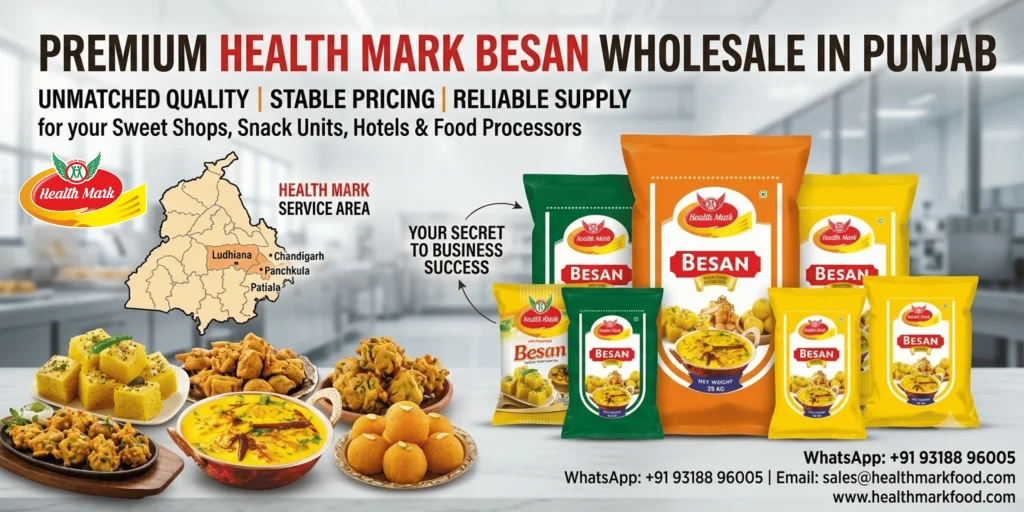
Health Mark operates out of an industrial facility in Bhatoli Kalan, Baddi (Himachal Pradesh), positioning it centrally for fast wholesale delivery across Chandigarh, Panchkula, Ludhiana, Baddi, and the wider Punjab market. Beyond besan, the company’s broader food portfolio atta, pulses, spices, rice, dry fruits, and more reflects an established FMCG operation rather than a single-product seller, which matters when you’re evaluating long-term supplier reliability.
For businesses searching for a besan seller near me, a besan supplier in north India, or simply the best besan brand in Chandigarh, the practical next step is straightforward: request a sample, compare it against your current supply, and place a trial wholesale order before committing to a full-scale contract.
FAQ
1. What is the difference between besan and Bareek besan?
Standard besan is milled to a general-purpose fineness suited to most recipes, while Bareek besan is ground finer for a smoother, lump-free batter ideal for delicate pakoras and sweets that need a silky texture.
2. Is besan gluten-free?
Yes. Besan is made purely from ground chana dal (chickpeas), which is naturally gluten-free, making it suitable for people avoiding wheat-based flours.
3. How do I buy premium besan wholesale in Punjab?
Identify a besan manufacturer in India that services your region, request a sample batch, confirm pricing for your expected order volume, and place a trial order before scaling to a recurring wholesale arrangement. Health Mark Besan category page lists current product options for enquiry.
4. What is Motichur or Mota besan used for?
Motichur (Mota) besan has a coarser grind specifically suited to motichur laddoo and other sweets that rely on a granular, pearl-like texture.
5. How should businesses store bulk besan?
Keep it in a cool, dry, airtight environment away from moisture and direct sunlight, and follow a first-in, first-out rotation so older stock is used before newer deliveries arrive.
6. What determines the best besan price for wholesale buyers?
Chana dal market rates, grind type, order volume, packaging format, and delivery distance all influence wholesale pricing. Larger, recurring orders typically secure better per-kg rates.
7. Why choose a branded besan supplier over loose market besan?
Branded, hygienically packed besan offers batch-to-batch consistency, better traceability, and longer shelf life compared to loose, unbranded flour sold in open sacks.
8. Does Health Mark supply besan to businesses outside Punjab?
Health Mark’s core delivery region covers Chandigarh, Panchkula, Baddi, and Ludhiana, with wholesale enquiries welcomed from businesses across North India. Contact the sales team directly to confirm delivery to your city.
9. What besan variant is best for industrial or bakery use?
Powder besan, an ultra-fine grind, is generally best suited for industrial and bakery applications that require uniform blending with other dry ingredients.
10. How can I place a bulk or wholesale enquiry with Health Mark?
You can reach the Health Mark sales team directly at +91 93188 96005, +91 92185 87660, or +91 98828 96000, or use the WhatsApp enquiry option on the Besan product page for a faster response.
Conclusion: Make Besan Quality a Business Decision, Not an Afterthought
Besan might seem like a small line item in your procurement list, but it directly shapes the taste, texture, and consistency of dishes your customers judge you on every single day. Whether you’re a halwai in Ludhiana, a restaurant in Chandigarh, or a snacks manufacturer anywhere in North India, moving from unpredictable loose-market besan to a dependable, premium wholesale supplier pays off in fewer batch failures, better shelf life, and steadier costs.
Health Mark offers four besan variants Besan, Bareek Besan, Motichur/Mota Besan, and Powder Besan hygienically processed and packed from premium quality chana dal, with wholesale support for businesses across Punjab and North India.
Ready to buy premium besan wholesale in Punjab?
Browse the range at healthmarkfood.com/product-category/besan, or call the Health Mark sales team at +91 93188 96005 / +91 92185 87660 / +91 98828 96000 to request a wholesale quote and sample batch today.