
For sweet shops, namkeen manufacturers, restaurants, and food businesses, the quality of besan plays an important role in achieving the right taste and texture. Whether you’re preparing soft laddoos, crispy pakoras, or traditional Indian snacks, choosing the right flour can make a noticeable difference in the final product.
When buying in bulk, businesses need to consider more than just price. Freshness, fine texture, consistent quality, and proper packaging are equally important. Working with a reliable bareek besan supplier can help maintain product standards and ensure smoother production.
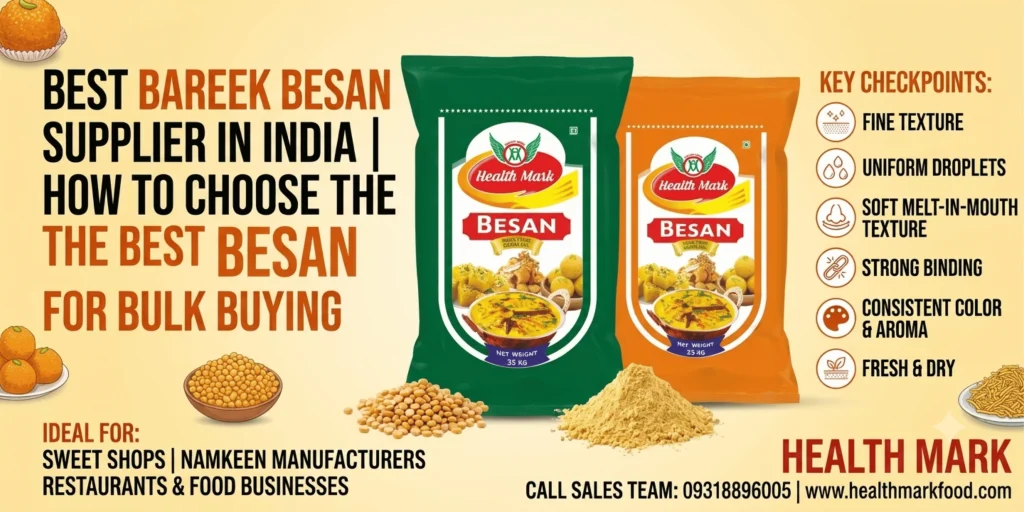
In this guide, we’ll explore how to identify good-quality fine besan, what to check before placing a bulk order, and how to choose a supplier that meets your business needs. We’ll also share practical tips to help you make a confident purchasing decision.
What Is Bareek Besan (and Why Is It Different)?
Besan is gram flour, made from chana dal (split Bengal gram). Bareek (also spelled barik or barik besan) simply means fine or thin in Hindi. So bareek besan is besan milled to a much smoother, finer consistency than the regular flour you find in most kitchens.
Why does fineness matter?
- Smooth batter: Fine particles absorb water evenly, so you avoid dry pockets and lumps.
- Uniform droplets: In boondi and motichur, the batter falls in clean, round drops when the flour is fine.
- Soft texture: Sweets made with fine besan feel delicate and melt-in-mouth rather than gritty.
- Better binding: Fine flour holds together better in laddoos and barfis.
Think of it like the difference between coarse sooji and fine maida. Both are useful, but they are not interchangeable.
Is “Bareek Besan” the Same as “Powder Besan”?
Not always. Different mills and suppliers use these names slightly differently. Many use “powder besan” for very fine, almost talc-like flour, and “bareek” for the fine grade used in sweets and batter. The safest approach is to ask for a sample and compare instead of relying on the name alone.
Who Actually Needs Fine Besan?
Not every buyer needs the finest grade. Here is a quick way to think about it.
1. Sweet shops and mithai manufacturers
Motichur laddoo, boondi laddoo, besan barfi and many festive sweets depend on smooth batter. If you sell sweets at volume, particularly during Diwali, Raksha Bandhan and wedding seasons, fine besan is not optional.
2. Namkeen and snack manufacturers
Sev, bhujia, fine ghathiya, papdi and coated snacks often need a flour that is smooth enough to extrude or fry evenly. Your recipe decides the exact grade, but many units use fine besan as the base.
3. Caterers, hotels and restaurants
Pakoras, kadhi, dhokla and cheela all work better with a flour that mixes quickly and does not settle.
4. FMCG and private-label brands
If you are building a packaged product, you need a FMCG besan supplier who can deliver consistent texture, colour and aroma across batches, because customers notice when your product tastes different next month.
5. Distributors and kirana wholesalers
You want stable quality, sealed packing and a supplier who answers calls. A bad batch costs you customers, not just money.
Bareek vs Mota vs Regular Besan: Comparison Table
| Feature | Bareek (Fine) Besan | Regular Besan | Mota / Motichur Besan |
| Texture | Ultra-smooth, powder-like | Medium-fine | Slightly granular |
| Best for | Motichur laddoo, boondi, delicate sweets, smooth batters | Daily cooking, pakora, kadhi, cheela | Specific sweets and recipes needing a grainier bite |
| Batter feel | Silky, even | Good, may need more whisking | Thicker, textured |
| Typical buyers | Sweet shops, namkeen units, caterers | Households, restaurants | Halwai-style and traditional recipes |
| Price tendency | Often slightly higher due to finer milling | Standard |
Health Mark lists several besan options on its besan category page, including bareek, motichur/mota, powder and regular besan, so buyers can match the grade to the recipe.
Why Quality Gram Flour Starts with the Chana Dal
A good mill cannot fully rescue poor raw material. When people ask, “Who makes the best fine besan?”, the honest answer begins before milling.
What good chana dal looks like
- Uniform golden-yellow colour
- Clean, with minimal broken pieces, stones or foreign matter
- Properly dried, with no musty smell
- No signs of insects or dampness
What happens in milling
After cleaning and sorting, the dal is ground and sifted to the required fineness. Heat control matters here. Excess heat can dull the natural nutty aroma and shorten shelf life, which is one reason traditional buyers often say a good besan “smells fresh”.
Nutrition snapshot
Chickpea flour is a nutritious ingredient. According to widely referenced food composition data such as USDA FoodData Central, chickpea flour provides roughly 20 to 22 g of protein and around 10 g of dietary fibre per 100 g, and it is naturally gluten-free. That is one reason besan keeps showing up in health-conscious and protein-rich food ideas. Exact values vary by brand and batch, so check the nutrition label on the pack you buy.
9 Things to Check Before Choosing a Wholesale Besan Supplier
Buying wholesale besan is a bit like hiring a team member. You are not only buying flour; you are buying reliability. Use this list.
1. Fineness and consistency
Rub a pinch between thumb and finger. Fine besan feels silky, almost like talcum. Then repeat with a sample from a second batch. If the feel changes, consistency is a risk.
2. Colour
Good besan has a natural pale-to-golden yellow shade. A greyish or very dull colour can point to old stock or poor storage. A suspiciously bright yellow can mean additives. Ask what is in the pack.
3. Aroma
Fresh besan has a mild, nutty, pulse-like smell. A sour, musty or rancid smell is a red flag.
4. Moisture and dryness
High moisture shortens shelf life and encourages lumps and spoilage. The flour should flow freely and not clump in your hand.
5. Raw material source
Ask where the chana dal comes from and how it is cleaned. A supplier that is open about sourcing is usually careful about quality too.
6. Food safety credentials
For food businesses in India, ask about FSSAI licensing and relevant quality certifications. Keep copies for your records, especially if you are a packaged-food brand. You can learn about licensing basics on the official FSSAI website.
7. Packaging
Bulk besan should arrive in clean, sealed, strong bags. For large buyers, a standard 35 kg pack is common and practical. Check stitching, labelling and batch details.
8. Supply capacity and lead time
Can the supplier handle festival-season spikes? Ask about dispatch time, transport support and how they manage repeat orders.
9. Communication
This sounds small, but it matters. Does the supplier answer calls and WhatsApp messages clearly? Can they share a sample, a catalogue and a quotation without delay?
Besan for Namkeen Manufacturing: What Matters
Searching for besan for namkeen manufacturing? Here is what experienced snack makers focus on.
Batch-to-batch consistency
If your sev is thin and crisp this week and slightly thick next week, customers notice. Consistent fineness helps you keep the same dough hydration and frying time.
Oil absorption
Very coarse or poorly milled besan can absorb oil unevenly. Smooth, uniform flour usually fries more evenly. Your results will depend on recipe and temperature, so run a trial batch.
Dough and batter handling
Fine besan blends quickly with water, spices and oil. That saves mixing time and reduces lumps in large-scale production.
Taste and aroma
Good gram flour has a clean, slightly nutty flavour. Old or badly stored flour can leave a bitter or stale note in the finished snack.
Cost per finished kg, not per raw kg
A cheaper flour that causes more rejection or wastage costs more in the end. Calculate your yield per 100 kg of flour before deciding.
Besan for Sweet Shops and Motichur Laddoo
Motichur laddoo is the classic example of why fineness matters. The batter is dropped through a fine jhara (perforated ladle) to form tiny pearls. If the flour is gritty, the holes clog and the pearls come out uneven.
Why fine besan suits motichur
- Smoother batter passes through the jhara easily
- Pearls (boondi) fry evenly and stay soft after soaking in sugar syrup
- The finished laddoo feels delicate, not heavy
A simple step-by-step batter guide
Sieve the besan once to break any tiny lumps.
Add water gradually while whisking. Aim for a flowing batter, not a thick paste.
Rest the batter for 10 to 15 minutes so the flour hydrates fully.
Test one drop in hot oil. It should form a round pearl and not a tail.
Adjust with a little water or flour as needed.
Fry in small batches, keeping the oil temperature steady.
Soak lightly in warm sugar syrup, then shape while warm.
These are general guidelines. Every halwai has a personal ratio, and humidity affects results, so adjust on the day.
Health Mark’s Bareek Besan is described as ultra-fine gram flour made for motichur laddoos and delicate sweets, supplied in 35 kg quantity for sweet shops and bulk preparation.
Bulk Fine Besan: Packaging, Storage and Shelf Life
Good flour can be spoiled quickly by bad storage. If you buy bulk fine besan, follow these habits.
Storage best practices
Keep it dry. Store bags on pallets or racks, not directly on the floor and away from walls.
Avoid heat and sunlight. A cool, ventilated store room works best.
Use FIFO (first in, first out). Older stock should be used first.
Reseal opened bags tightly or transfer to airtight food-grade containers.
Keep away from strong smells. Besan can absorb odours.
Check for pests regularly. Inspect stock and keep the store clean.
How to tell if besan has gone bad
- Sour or rancid smell
- Lumps that do not break easily
- Visible insects or webbing
- Bitter taste when a pinch is tested
If you see any of these, do not use the batch in production.
Common Mistakes Buyers Make
- Choosing only on price. The lowest quote often hides inconsistent quality.
- Skipping the sample. Never order a truckload without testing a trial pack.
- Not checking the batch. Ask for the same quality in the second and third order.
- Ignoring packaging. Torn or poorly sealed bags invite moisture and pests.
- Assuming all “fine” besan is equal. Names vary between mills.
- Poor storage after delivery. Even the best flour suffers in a damp godown.
- No written specification. Agree on grade, packing and delivery terms in writing.
- Forgetting seasonal demand. Book early before festivals to avoid shortages.
Expert Tips from the Production Floor
- Do a hand test and a water test. Make a small batter and check how smoothly it mixes and rests.
- Test in your real recipe, not only in a lab-style trial.
- Keep a retained sample from each lot for comparison if a problem appears later.
- Plan stock for peak season at least a few weeks ahead.
- Build a long-term relationship. A supplier who knows your recipe can recommend the right grade.
- Ask for a product catalogue so you can see the full range, including other staples such as atta, pulses and rice for your business.
A Simple Buying Checklist (Printable)
| Check | What to look for | Done |
| Fineness | Silky feel, uniform texture | ☐ |
| Colour | Natural golden-yellow | ☐ |
| Aroma | Fresh, nutty, no mustiness | ☐ |
| Moisture | Free-flowing, no clumps | ☐ |
| Raw material | Clean chana dal, source known | ☐ |
| Licence | FSSAI details on record | ☐ |
| Packaging | Sealed, labelled, strong bags | ☐ |
| Trial batch | Tested in your own recipe | ☐ |
| Supply | Lead time and repeat order confirmed | ☐ |
| Support | Quick, clear communication | ☐ |
Meet Health Mark Bareek Besan
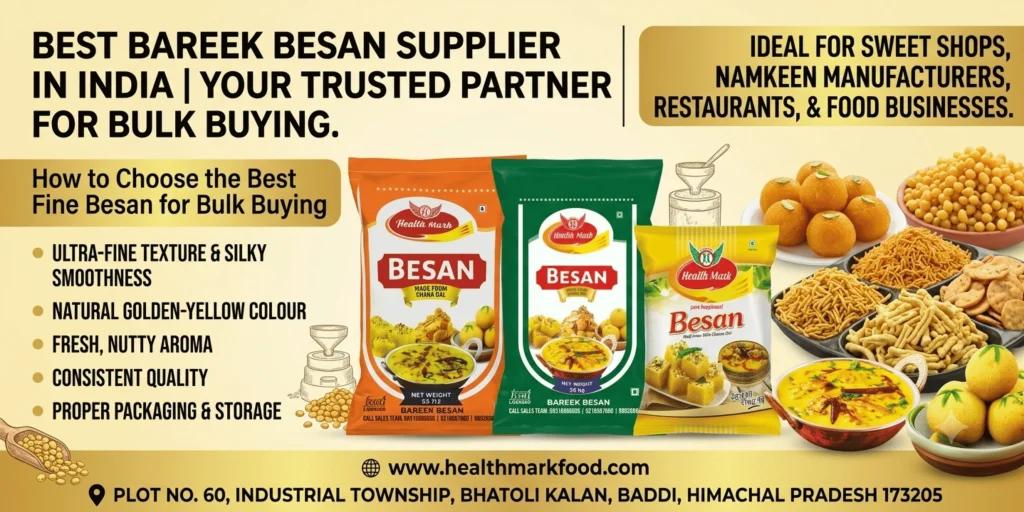
Health Mark is a food products company based at Plot No. 60, Industrial Township, Bhatoli Kalan, Baddi, Himachal Pradesh 173205, with a range that spans besan, atta, pulses, rice, spices and more.
Its Bareek Besan is positioned as a specially milled, ultra-fine gram flour for soft and delicate sweets such as motichur laddoos, designed for professional kitchens, sweet shops and bulk preparation.
What buyers can expect, based on the product page:
- Ultra-fine texture
- Ideal for motichur laddoo and similar sweets
- Smooth batter preparation
- Consistent sweet-making results
- Premium quality gram
- 35 kg quantity for bulk needs
If your requirement is different, for example a coarser grade or a general-purpose flour, browse the full besan category and compare options. You can also request the product catalogue from the website.
How to Enquire
- Decide your monthly volume and preferred grade.
- Ask for a sample and test it in your recipe.
- Confirm packing, price and delivery terms in writing.
- Place a trial order, then scale up.
FAQ
1. What is bareek besan?
Bareek besan is ultra-fine gram flour made from chana dal. The word “bareek” means fine, so it refers to besan milled to a smooth, powder-like texture that suits sweets, boondi and smooth batters.
2. What is the difference between bareek besan and regular besan?
Bareek besan is milled finer than regular besan. This gives a silkier batter and a softer texture in sweets like motichur laddoo. Regular besan suits everyday cooking such as pakora and kadhi.
3. Which besan is best for motichur laddoo?
Fine (bareek) besan is generally preferred because the smooth batter passes through the jhara easily and forms even boondi pearls.
4. How do I choose a good wholesale besan supplier?
Check fineness, colour, aroma, moisture, packaging, food-safety licensing and consistency across batches. Always test a sample in your own recipe before placing a bulk order.
5. Can I use fine besan for namkeen manufacturing?
Yes. Many snack makers use fine besan for sev, bhujia and similar products because it mixes smoothly and fries evenly. Test the grade in your recipe, since results depend on formulation and process.
6. What pack size is available for bulk fine besan?
Health Mark lists its Bareek Besan in a 35 kg quantity. Contact the sales team for other requirements.
7. How long can besan be stored?
Shelf life depends on moisture, packaging and storage. Always follow the date printed on the pack, keep the flour dry and cool, and avoid using any batch with a sour or musty smell.
8. Is besan gluten-free and nutritious?
Besan is made from chickpeas and is naturally gluten-free. It provides protein and fibre, though exact nutrition varies by brand. Check the label if you need precise values.
9. What should I look for in quality gram flour?
Look for a natural golden-yellow colour, fresh nutty aroma, smooth feel, free-flowing texture and clean, sealed packing.
10. How can I get a quotation or sample from Health Mark?
Call 09318896005, 9218587660 or 9882896000, or use the enquiry options on the Bareek Besan product page.
Conclusion
Choosing a best bareek besan supplier is a business decision, not just a purchase. Fineness, freshness, packing and consistency affect your texture, taste, wastage and customer loyalty. The smartest approach is simple: shortlist suppliers, test samples in your real recipe, compare the finished product, and place a small trial order before scaling up.
If you make motichur laddoos, boondi sweets or delicate snacks, take a look at Health Mark Bareek Besan, explore the full besan range, and speak to the team on 09318896005, 9218587660 or 9882896000 for samples, pricing and bulk supply details.