
If you run a bakery, a sweets unit, a namkeen factory, or any food manufacturing line in India, you already know that besan is not just another item on the raw-material list it’s often the ingredient that decides whether your boondi holds its shape, your pakora batter fries up light and crisp, or your laddoo gets that classic grainy bite. Get the besan wrong, and no amount of seasoning or process tweaking fixes it downstream.
That’s exactly why “besan supplier for food manufacturers” has become such a frequently searched phrase among procurement teams, production heads, and small business owners across India. Everyone is looking for the same thing: a besan manufacturer in India who can deliver consistent particle size, clean chana dal sourcing, hygienic processing, and pricing that works at bulk volumes order after order, season after season.
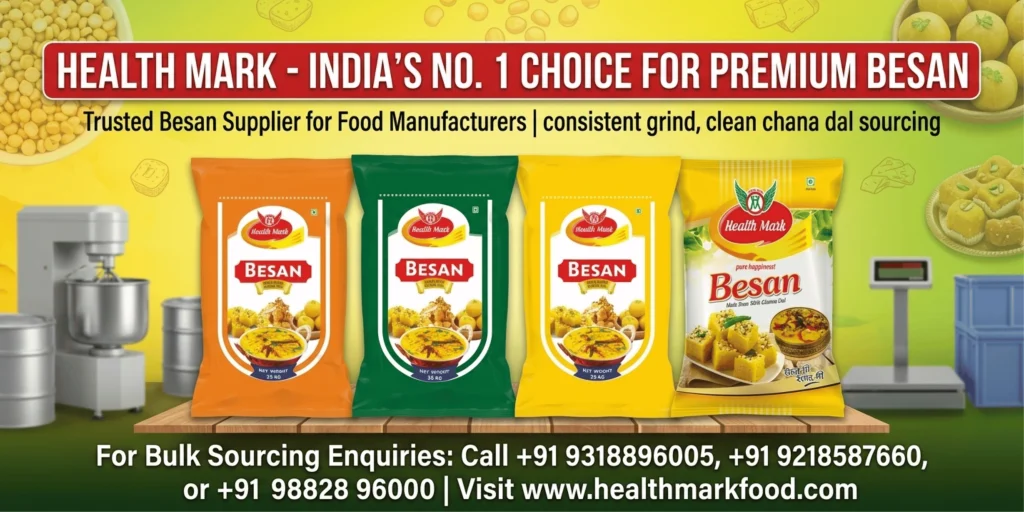
In this guide, we’ll walk through what actually separates a good besan supplier from a great one, break down the different grinds of besan (mota, bareek, and powder) and where each performs best, and show you exactly what to look for before you commit to a long-term sourcing partner. Along the way, we’ll also introduce you to Health Mark’s besan range, including our popular Motichur / Mota Besan, and explain why so many food businesses now consider us among the best besan brands in India.
What Is Besan, and Why Does Sourcing Quality Matter?
Besan is gram flour milled from chana dal (split Bengal gram). It’s a staple across Indian kitchens and commercial food production alike used in everything from pakoras and dhoklas to laddoos, boondi, kadhi, and batters for snacks sold at scale.
For a home cook, a slightly inconsistent batch of besan is a minor inconvenience. For a food manufacturer running thousands of units a day, it’s a production risk. Inconsistent grind size changes absorption rates in batter. Poor-quality chana dal affects color and flavor. Moisture content that’s even slightly off can shorten shelf life or clump during storage.
This is why sourcing besan isn’t just a purchasing decision it’s a quality-control decision. A dependable besan supplier for food manufacturers needs to deliver the same texture, color, and performance in batch #500 as they did in batch #1.
Who Actually Needs a Dedicated Besan Supplier?
While any home cook can pick up a packet of besan from a local store, the search for a reliable, bulk besan manufacturer in India is typically driven by:
- Sweet shops and mithai manufacturers laddoo, boondi, and barfi production that depends on the right coarseness
- Namkeen and snack food units pakora mixes, bhujia, and fried snack coatings
- Bakeries and commercial kitchens batters, binding agents, and gluten-free product lines
- Restaurants and HoReCa chains consistent kadhi, pakora, and curry-base requirements across multiple outlets
- FMCG and packaged food brands private-label besan-based mixes, instant food products, and ready-to-cook ranges
- Wholesalers and distributors businesses that need a top besan supplier they can resell through regional networks
If your operation touches any of the above, the difference between a “big-box” besan purchase and a relationship with a dedicated besan manufacturer will show up directly in your finished product’s quality and consistency.
Mota Besan vs Bareek Besan vs Powder Besan: Which One Does Your Product Need?
One of the most overlooked parts of besan sourcing is grind size. Not all besan is created equal, and using the wrong grade can quietly undermine your recipe.
| Besan Type | Texture | Best For | Health Mark Product |
| Mota Besan (Motichur) | Coarse, slightly grainy | Laddoo, boondi, traditional sweets needing structure | Motichur / Mota Besan |
| Bareek Besan | Fine, smooth | Pakora batter, dhokla, everyday cooking | Bareek Besan (Health Mark Besan range) |
| Powder Besan | Ultra-fine | Baking, instant mixes, products needing fast dissolution | Powder Besan (Health Mark Besan range) |
| Standard Besan | Medium grind, all-purpose | General commercial kitchen use | Besan (Health Mark Besan range) |
See the complete range on the Health Mark Besan category page.
Why this matters for manufacturers: if you’re producing boondi or motichur laddoo, a fine besan will give you the wrong droplet texture when passed through the boondi jhara (perforated ladle). You need the coarser mota besan specifically engineered for that grainy bite. On the other hand, if you’re making a smooth pakora batter, mota besan will leave your coating uneven. This is why a besan seller who stocks multiple grinds rather than one generic SKU gives food manufacturers far more control over product consistency.
What Makes Health Mark a Top Besan Supplier in India
When food manufacturers search for “best Besan brand in India” or “No 1 besan brand,” they’re usually evaluating suppliers against a consistent set of criteria: raw material quality, hygiene standards, consistency across batches, and the ability to fulfil bulk orders reliably. Here’s how Health Mark approaches each:
- Premium chana sourcing Health Mark’s besan range is milled from carefully selected, premium-quality chana, chosen specifically for color, flavor, and protein content.
- Multiple grind options from coarse Mota Besan to fine Powder Besan, manufacturers can match the exact grade to their recipe instead of compromising with a one-size-fits-all flour.
- Hygienically processed and packed processing and packaging are handled to protect freshness from mill to delivery, which matters enormously for food-safety-conscious manufacturers.
- Bulk-ready packaging Health Mark’s Motichur / Mota Besan, for example, is available in 35kg packs suited to commercial kitchens and production lines rather than retail-only quantities.
- Part of a wider trusted food portfolio Health Mark isn’t a single-product besan seller; the brand also manufactures atta, pulses, spices, rice, and other staples, which signals the kind of consistent manufacturing discipline that food businesses look for in a long-term ingredient partner.
- Direct manufacturer access because Health Mark operates its own processing unit (Baddi, Himachal Pradesh), food manufacturers deal with the source, not a layer of resellers, which typically means better besan price control and more transparency on quality.
These factors are exactly why Health Mark is increasingly positioned among India’s top besan suppliers for commercial and bulk buyers, not just retail customers.
Spotlight: Health Mark Motichur / Mota Besan
Among Health Mark besan range, the Motichur / Mota Besan deserves special mention because it solves a problem many food manufacturers struggle to source well: a genuinely coarse, consistent gram flour built for traditional sweets.
Key characteristics:
- Coarsely ground for the authentic grainy texture that laddoo and boondi recipes depend on
- Made from premium-quality chana for rich, natural flavor
- Hygienically processed and packed to preserve freshness through transport and storage
- Supplied in 35kg packs, suited to commercial and bulk kitchen use
- Tagged and positioned specifically for bulk besan and besan-for-ladoo use cases
If your production line depends on getting that classic motichur texture right whether for festival-season laddoo runs or year-round mithai production this is the grade built for that exact job. You can view full details or place a bulk enquiry directly on the product page.
From Chana to Flour: How Quality Besan Is Actually Made
Understanding the production process helps manufacturers ask smarter questions when evaluating a besan supplier. At a high level, quality besan production involves:
Chana dal selection sourcing split Bengal gram that’s clean, properly dried, and free from impurities or admixture.
Cleaning and grading removing stones, husk, and broken grain before milling.
Milling to the required grind coarse for mota besan, fine for powder besan, with calibrated milling equipment to keep particle size consistent batch after batch.
Sieving and quality checks screening for uniform texture and checking color and moisture levels.
Hygienic packing sealed packaging that protects against moisture absorption, pests, and contamination during storage and transit.
A besan manufacturer in India that controls each of these steps in-house rather than outsourcing milling to third parties is generally in a stronger position to guarantee the batch-to-batch consistency that food manufacturers need.
Besan Price: What Food Manufacturers Should Know Before Negotiating
“Best besan price” is one of the most searched terms around besan sourcing, and understandably so at manufacturing volumes, even small per-kilogram differences add up fast. But price should never be evaluated in isolation. Here’s what actually drives besan pricing:
| Factor | Why It Affects Price |
| Chana dal quality grade | Premium chana costs more but yields better color, flavor, and shelf stability |
| Grind type | Fine/powder besan often requires additional processing passes |
| Order volume | Bulk orders (like 35kg packs) typically unlock better per-kg pricing than retail packs |
| Seasonality | Chana prices fluctuate with harvest cycles, affecting raw material cost |
| Packaging | Food-grade, moisture-resistant packaging adds a small cost but reduces spoilage losses |
| Logistics and delivery distance | Transport costs factor into landed price, especially for PAN-India delivery |
Practical tip for manufacturers: rather than chasing the single lowest quote, request pricing against a fixed quality specification (grind size, chana grade, moisture %) so you’re comparing suppliers on equal terms. A slightly higher besan price from a consistent best besan seller often works out cheaper overall once you factor in reduced wastage and fewer failed production batches.
For current bulk pricing on Health Mark’s besan range, the fastest route is a direct enquiry call +91 93188 96005, +91 9218587660, or +91 98828 96000, or use the WhatsApp enquiry option on the Motichur / Mota Besan product page.
How to Choose the Best Besan Manufacturer in India (Step-by-Step)
- Define your grind requirement first. Know whether your recipe needs mota, bareek, powder, or standard besan before you start comparing suppliers.
- Ask for a sample batch. A credible besan manufacturer in India should be willing to provide a trial quantity before you commit to bulk ordering.
- Check hygiene and processing standards. Ask how the besan is milled, sieved, and packed, and whether the facility follows food-safety practices.
- Verify bulk packaging options. Confirm whether the supplier offers commercial pack sizes (like 35kg) rather than only retail quantities.
- Evaluate consistency, not just one batch. Where possible, review feedback or order a second sample weeks apart to check batch-to-batch uniformity.
- Compare besan price against a fixed spec. Don’t compare quotes unless grind size, chana grade, and pack size are the same across suppliers.
- Confirm delivery reach. If you need a besan seller near me or a supplier capable of PAN-India delivery, confirm logistics timelines upfront.
- Look at the supplier’s broader portfolio. Manufacturers with a wider staples range (atta, pulses, spices) often maintain more disciplined, audited production processes.
Common Mistakes Food Manufacturers Make When Sourcing Besan
- Choosing on price alone the cheapest besan price often comes with inconsistent grind or lower chana quality, leading to production rework.
- Not specifying grind size clearly “besan” alone is not a specification; always confirm mota, bareek, or powder.
- Switching suppliers frequently constant supplier-hopping makes it harder to maintain consistent recipe output.
- Ignoring packaging quality poor packaging leads to moisture absorption and reduced shelf life, especially during monsoon months.
- Skipping sample testing committing to bulk orders without a trial batch is one of the most common and costly sourcing mistakes.
- Overlooking storage conditions on arrival even premium besan degrades if stored in humid or poorly ventilated areas after delivery.
Besan’s Nutritional Profile and Why It’s a Protein-Rich Ingredient of Choice
Beyond texture and taste, besan is valued by food manufacturers building health-conscious or protein-forward product lines because gram flour is naturally:
- A good source of plant-based protein, making it attractive for vegetarian and health-focused snack formulations
- Naturally gluten-free, useful for manufacturers developing gluten-free product ranges
- Rich in dietary fiber, which supports product positioning around digestive-friendly snacking
- A traditional ingredient with strong consumer trust, especially across North and West Indian markets where besan-based products have deep cultural familiarity
This is part of why “premium quality Besan” and “premium high quality besan” are such common search terms manufacturers aren’t just buying a commodity flour, they’re buying an ingredient that carries nutritional and brand-trust value into the finished product.
Bulk Supply, Reach, and Finding a “Besan Seller Near Me”
For food manufacturers, proximity matters less than reliability but when it does matter (faster replenishment, lower freight costs), it helps to work with a besan manufacturer that has established bulk logistics. Health Mark is based in Baddi, Himachal Pradesh, within reach of the Chandigarh–Panchkula–Baddi–Ludhiana industrial belt, and supplies besan in bulk packaging suited for food manufacturers across India.
If you’re searching for a “besan seller near me” specifically for commercial-scale sourcing, the more reliable approach is to contact the supplier directly and confirm delivery timelines to your facility rather than relying on generic local search results, which often surface retail-only sellers.
To start a bulk besan enquiry with Health Mark:
- Browse the full Besan product category
- View the Motichur / Mota Besan product page for specifications and enquiry options
- Call +91 93188 96005 / +91 9218587660 / +91 98828 96000
FAQ
1. What is the difference between mota besan and regular besan?
Mota besan is coarsely ground gram flour, giving a grainy texture ideal for laddoo and boondi, while regular besan has a finer, medium grind suited to everyday cooking like pakoras and kadhi.
2. Which besan is best for laddoo and boondi production?
Mota besan (motichur besan) is specifically suited for laddoo and boondi because its coarser texture gives the characteristic grainy structure these sweets need.
3. How do food manufacturers decide on besan grind size?
Grind size should be matched to the final product: coarse (mota) for traditional sweets, fine (bareek or powder) for batters, baking, and instant mixes.
4. What packaging sizes are available for bulk besan orders?
Health Mark’s Motichur / Mota Besan is available in 35kg packs, designed for commercial kitchens and food manufacturing use rather than small retail quantities.
5. How is besan price determined for bulk orders?
Besan price depends on chana dal grade, grind type, order volume, seasonal chana costs, packaging, and delivery distance. Contact Health Mark directly for current bulk pricing.
6. Is besan naturally gluten-free?
Yes, besan (gram flour) is naturally gluten-free, which makes it a popular ingredient for gluten-free product development in food manufacturing.
7. How can I verify besan quality before placing a bulk order?
Request a sample batch, check the grind consistency, color, and aroma, and confirm the chana dal sourcing and processing standards with the supplier before committing to bulk volumes.
8. Does Health Mark deliver besan across India?
Health Mark supplies its besan range to food manufacturers and businesses across India; contact the team directly to confirm delivery timelines for your location.
9. What other products does Health Mark besan come alongside?
Health Mark also manufactures atta, pulses, spices, rice, dry fruits, oil, and other staples, reflecting a broader commitment to quality food manufacturing beyond besan alone.
10. How do I place a bulk enquiry for Health Mark Besan?
You can enquire directly through the Besan product category page, the Motichur / Mota Besan product page, or by calling +91 93188 96005, +91 9218587660, or +91 98828 96000.
Conclusion
Sourcing besan for food manufacturing isn’t about finding just any supplier willing to sell in bulk it’s about finding a besan manufacturer in India who understands that grind size, chana quality, hygiene, and consistency directly shape your finished product’s taste, texture, and shelf performance. Whether you need a coarse mota besan for authentic laddoo and boondi production, a finer grade for batters and baking, or a dependable partner who can scale with your order volumes, the right sourcing decision pays off in fewer failed batches and more consistent output.
Health Mark’s besan range including the popular Motichur / Mota Besan is built specifically around the needs of commercial kitchens and food manufacturers: premium chana sourcing, hygienic processing, multiple grind options, and bulk-ready 35kg packaging.
Ready to source premium besan for your production line? Explore the full Besan range or speak directly with the Health Mark team at +91 93188 96005, +91 9218587660, or +91 98828 96000 to discuss bulk pricing and delivery.