
Walk into almost any hotel kitchen in India early in the morning and you are likely to find a bucket of batter resting somewhere. Pakoras, kadhi, dhokla, khandvi, boondi, sev, laddoos, cheela, bhajiya, and even the coating on many fried starters all depend heavily on besan.

Yet besan is also one of the easiest ingredients to take for granted. A chef who would never compromise on basmati rice or paneer may sometimes accept whatever flour arrives at the back door. Then the batter turns bitter, pakoras lose their crispness too quickly, or the kadhi lacks the expected taste and texture. One common reason can be inconsistent flour quality and behind that, the reliability of the supplier.
If you run a hotel, restaurant chain, cloud kitchen, sweet shop, catering business, or other commercial kitchen, choosing a dependable besan supplier for hotels and restaurants is not just a purchasing decision. It can influence food cost, recipe consistency, kitchen efficiency, and ultimately your customer experience.
For businesses buying bulk besan, price matters, but so do freshness, consistency, grinding quality, packaging, and dependable supply.
This guide explains how experienced buyers evaluate a besan supplier: what to check, what questions to ask, what warning signs to avoid, and how to compare suppliers carefully instead of choosing only on the lowest price.
What Makes a Good Besan Supplier for Hotels and Restaurants?
A commercial kitchen needs more than a bag of flour. It needs a partner who behaves like part of the supply chain. Here is what separates a dependable supplier from a risky one.
1. Batch-to-batch consistency
Your customers do not know that this week’s pakora came from a different batch. They only know it tasted different. A good supplier mills from carefully selected chana dal and keeps colour, fineness and flavour steady across deliveries.
2. Food-safety compliance
Any supplier you take seriously should hold a valid FSSAI licence and be willing to share it. The Food Safety and Standards Authority of India publishes licensing and labelling rules on fssai.gov.in. Ask for the licence number, check the packaging for a lot number and date, and keep these records for audits.
3. Packaging suited to commercial use
Kitchens that use besan daily usually prefer larger, sturdy packs that reduce handling and spillage. Sealed packaging also limits moisture and pest exposure during transport.
4. Reliable delivery and communication
A supplier who answers the phone, confirms dispatch dates and tells you early about delays saves you from emergency market runs. This matters most before festival seasons, when demand for sweets and snacks spikes.
5. Transparent pricing
Clear rate cards, GST invoices and written quotes make costing easier. Hidden charges are a sign to slow down.
6. Willingness to support samples
A confident supplier will let you test before you commit. If they refuse, ask yourself why.
How to Judge the Best Quality Besan Before You Buy
You do not need a laboratory. A trained chef can assess best quality besan with a few simple checks.
Step-by-step quality test
- Look at the colour. Good besan has a natural pale yellow to light golden shade. Very bright, almost neon yellow can suggest added colour. Dull grey or brownish tones may suggest age or poor storage.
- Smell it. Fresh flour smells mildly nutty and clean. A musty, sour or oily smell means it has absorbed moisture or has gone rancid.
- Feel the texture. Rub a pinch between your fingers. Quality flour feels soft, smooth and uniformly fine, not gritty or lumpy.
- Make a small batter. Mix with water and a pinch of salt, whisk for two minutes, rest for ten. A good batter turns glossy, holds its body and does not separate quickly.
- Fry a test pakora. It should puff well, crisp evenly and stay crunchy for a reasonable time without absorbing excess oil.
- Taste the cooked product. Bitterness or a raw, beany aftertaste points to poor roasting of the raw material or old stock.
- Check the pack. Look for manufacturing date, batch number, FSSAI number, weight and storage instructions.
Quick-reference table: good vs. poor besan
| Parameter | Good besan | Warning sign |
| Colour | Natural pale golden | Neon yellow or greyish |
| Smell | Mild, nutty | Musty, sour, oily |
| Texture | Soft, even, fine | Gritty, lumpy |
| Batter | Smooth, holds body | Watery, splits quickly |
| Fried result | Crisp, light | Dense, greasy, soggy |
| Packaging | Sealed, dated, labelled | Loose, unlabelled |
Besan Types and Grades: What to Order for Which Dish
Not every dish wants the same grind. Chefs often keep two grades on hand.
| Menu item | Preferred texture | Why |
| Pakora, bhajiya | Medium-fine | Holds spices and gives a rough crispy crust |
| Kadhi | Fine | Dissolves smoothly into yogurt without lumps |
| Dhokla, khandvi | Very fine | Gives a soft, even crumb |
| Boondi, sev, gathiya | Fine to medium | Controls flow and crunch |
| Besan laddoo, barfi | Slightly coarse (ladoo grade) | Roasts evenly and gives a grainy melt |
| Cheela, chilla | Fine | Spreads thin and cooks evenly |
| Tempura-style coating | Fine, often blended | Light, crisp finish |
Ask your supplier whether they can offer different grinds, rather than assuming one product fits everything.
Where to Buy Besan: Manufacturer, Wholesaler or Local Seller?
Kitchen owners usually choose among three routes.
Direct from a manufacturer
A besan manufacturer in India with its own milling unit controls raw material selection, cleaning and packing. That usually means better traceability and steadier quality. It suits hotels, chains and caterers with regular monthly volumes.
From a wholesaler or distributor
The best wholesale besan option often balances price, convenience and credit terms. It works well for mid-sized restaurants that need flexible quantities. The risk is that stock may come from several mills, so quality can vary. Ask which brand the wholesaler carries and whether it stays the same.
From a nearby retail seller
A besan seller near me is handy for emergencies and small outlets. For daily commercial volumes, though, retail packs usually cost more per kilo and rarely offer batch records.
Searching online for a top Besan supplier is a good starting point, but do not stop at search rankings. Phone calls, samples and references tell you far more than a website alone.
Comparison at a glance
| Factor | Manufacturer | Wholesaler | Local retail |
| Price per kg | Usually lowest at volume | Competitive | Highest |
| Consistency | High | Medium | Variable |
| Traceability | Strong | Moderate | Weak |
| Flexibility | Medium | High | High |
| Best for | Hotels, chains, caterers | Mid-size restaurants | Small cafes, emergencies |
Understanding Pricing and Bulk Orders
Everyone wants the best Besan price, but the lowest rate on paper is rarely the lowest cost in the kitchen. Here is why.
Consider yield, not just rate. A flour that absorbs water well and fries crisply may need less oil and fewer rejected batches. A cheaper flour that gives soggy pakoras costs more in waste and lost goodwill.
Factors that move besan prices
- Chana dal prices, which depend on harvest, imports and demand
- Season and festival demand
- Grade and fineness
- Pack size and packaging type
- Transport distance and fuel
- Payment terms and order frequency
Smart ways to manage cost
- Order for a fixed monthly cycle rather than ad hoc.
- Ask for quotes valid for at least a week so you can compare fairly.
- Build a relationship with one primary supplier and one backup.
- Stock up modestly before Diwali, Holi and wedding season, but never beyond what you can store properly.
- Track per-portion cost for your top five besan dishes.
When you want a premium quality Besan at a transparent rate, compare suppliers on the same specification: same grade, same pack, same delivery terms.
Storage, Shelf Life and Handling in a Busy Kitchen
Even excellent flour will fail if it is stored badly. Besan is rich in protein and natural oils, so it picks up moisture and odours easily.
Best practices
- Store in a cool, dry, well-ventilated room away from the stove and dishwashing area.
- Keep sacks on pallets or racks, not directly on the floor or against walls.
- Transfer opened packs into airtight food-grade containers.
- Use a first-in, first-out system and label every container with the date received.
- Use clean, dry scoops. A single wet spoon can spoil a whole container.
- Keep flour away from strong-smelling items like spices, onions and cleaning supplies.
- Inspect weekly for lumps, odour, insects or colour change.
In monsoon: Reduce stock size, check more often, and consider smaller airtight bins. Humidity is the main enemy.
Check the best-before date on the pack and follow its storage instructions. If you notice a sour or rancid smell, discard the batch rather than risk your reputation.
Nutrition and Health Value
Besan is naturally gluten-free and made from ground chickpeas (chana dal), which makes it valuable for menus that serve gluten-sensitive guests. According to USDA FoodData Central, chickpea flour provides roughly 22 g of protein and around 11 g of dietary fibre per 100 g, with about 387 kcal. Exact values vary by product, so check the pack label of the one you buy.
Why it appeals to modern guests
- A plant-based protein source for vegetarian and vegan menus
- Gluten-free base for batters, flatbreads and snacks
- Rich in fibre compared with refined wheat flour
- Versatile across traditional and contemporary dishes
Menu ideas for health-conscious customers
- Baked or air-fried besan crisps
- Millet-and-besan cheela with vegetable filling
- Steamed dhokla with a light tempering
- Besan-crusted paneer or fish tikka
- High-protein besan wraps
A gluten-free claim on your menu must be handled carefully. Cross-contact in shared fryers or shared storage can undermine it, so ask your supplier about their handling practices and train your staff accordingly.
Common Mistakes Buyers Make
- Choosing on price alone. Cheap flour can cost more in waste.
- Skipping samples. Always test in your own recipes and equipment.
- Ignoring the manufacturing date. Old stock gives flat taste and bitterness.
- Buying too much at once. Overstocking invites moisture and pests.
- Not asking for the FSSAI licence. It is a basic compliance check.
- Relying on a single source. One delay can stop a whole breakfast service.
- Mixing old and new stock. It makes quality unpredictable.
- Forgetting to retrain staff. Even the best flour needs correct batter ratios and resting time.
- Overlooking delivery timing. Late deliveries disrupt prep schedules.
- Not recording feedback. Without notes, you cannot hold a supplier accountable.
A Simple Supplier Checklist for Hotels and Restaurants
Use this before you finalise any contract.
- Valid FSSAI licence number shared
- Sample delivered and tested in your kitchen
- Colour, smell and texture match your standard
- Clear pack size, price and GST invoice
- Delivery timeline and frequency agreed in writing
- Batch and date marked on every pack
- Backup plan for emergency orders
- Named contact person who answers calls
- Payment terms confirmed
- Feedback and complaint process defined
Why Kitchens Consider Health Mark
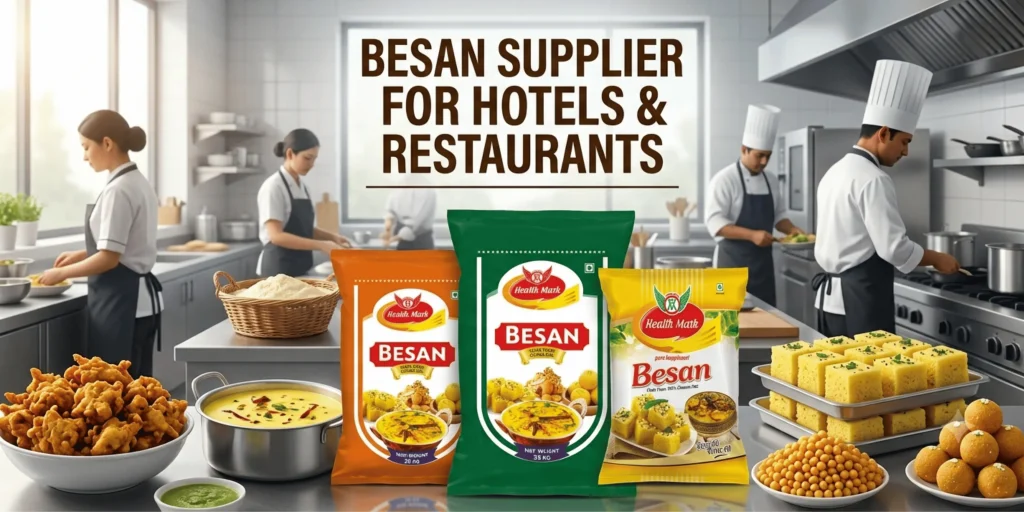
If you are comparing different suppliers, Health Mark Besan is worth including in your shortlist. Health Mark Food offers a dedicated range on its besan product category page, while the brand’s broader selection of everyday kitchen staples is available on the Health Mark website.
Before making a final decision, evaluate Health Mark the same way you would assess any serious supplier:
- Request a sample and test it in your regular batter, kadhi, snack and sweet recipes.
- Compare the available specifications and pack sizes with your kitchen’s actual consumption.
- Ask for a written quotation based on your monthly or bulk requirement.
- Confirm licence details, delivery timelines, service support and order consistency.
This is also the right way to evaluate claims such as No 1 besan brand or top selling Besan in India. Such rankings can vary by region, sales channel, market data and source, so a practical kitchen trial is often more useful than relying on a slogan alone.
The same approach applies when you search for the best Besan seller or plan to buy Besan in larger quantities. Shortlist two or three suppliers, test them under the same cooking conditions, compare cost and consistency, and let your chef’s actual results guide the final decision.
FAQ
1. How do I choose a reliable besan supplier for hotels and restaurants?
Check FSSAI licensing, ask for a sample, test it in your recipes, compare batch consistency and confirm delivery reliability. Written quotes and a named contact person make ordering smoother.
2. What is the difference between besan and gram flour?
They are essentially the same thing. Besan is the Indian name for flour made from ground chana dal (split Bengal gram), and gram flour is the English term.
3. How can I tell if besan is fresh?
Fresh besan has a pale golden colour, a mild nutty aroma and a soft, even feel. A sour, musty or oily smell signals old or badly stored stock.
4. How long can besan be stored in a commercial kitchen?
Follow the best-before date on the pack. Stored in a cool, dry place in airtight containers, it stays usable for that period, but humidity shortens it. Smaller, frequent orders are safer in monsoon.
5. Is it better to buy from a manufacturer or a wholesaler?
Manufacturers generally give better traceability and consistency for regular volumes. Wholesalers offer flexible quantities and faster local delivery. Many kitchens use one as primary and the other as backup.
6. Why does my besan batter taste bitter?
Bitterness usually comes from old or poorly stored flour, or from rancidity. Check the date, smell the flour and try a fresh batch before blaming the recipe.
7. What besan grade is best for pakoras and kadhi?
Medium-fine suits pakoras for a crisp, textured coating. Fine grade works best for kadhi so it blends smoothly without lumps.
8. Is besan gluten-free?
Besan is naturally gluten-free as it is made from chickpeas. However, cross-contact can occur during milling, packing or in shared kitchen equipment, so confirm handling practices if serving gluten-sensitive guests.
9. How do I compare besan prices fairly?
Compare the same grade, pack size, delivery terms and payment terms. Also compare yield: how many portions you get and how much waste you avoid.
10. How can I place a bulk order with Health Mark Food?
Visit the Besan category page or call 09318896005, 9218587660 or 9882896000 to discuss quantity, pack size and delivery.
Conclusion
Choosing a besan supplier for hotels and restaurants looks simple until a bad batch lands in the middle of a wedding week. The kitchens that avoid that stress treat sourcing as a process: they test samples, check licences, compare like with like, store flour properly and keep a backup.
Start small. Request samples from two or three suppliers, run the same recipes, record the results and pick the partner who gives you consistency, honest pricing and responsive service. If you would like to evaluate Health Mark, browse the Besan range and call 09318896005, 9218587660 or 9882896000 to request a quote for your kitchen.