
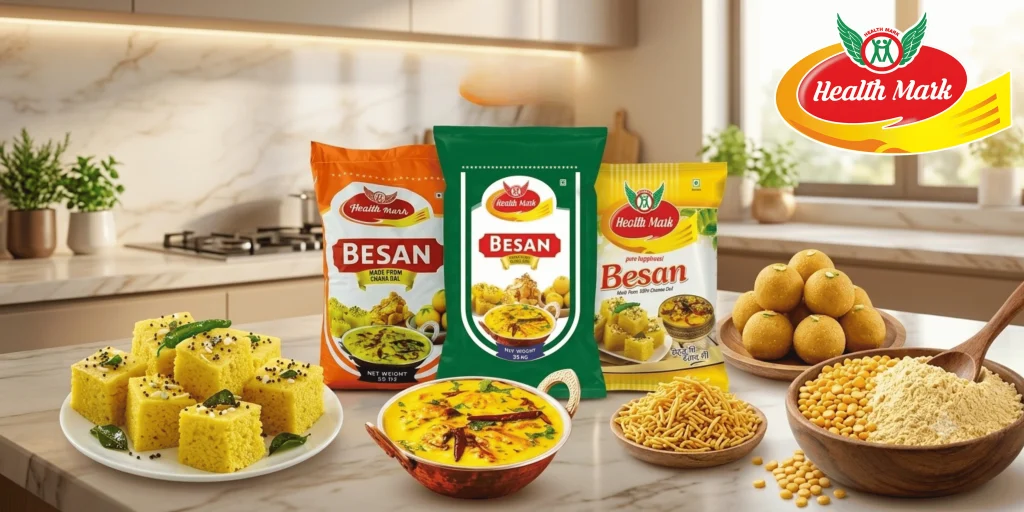
For food manufacturers, retailers, and distributors, choosing the right ingredients is essential to maintaining product consistency and customer satisfaction. Besan is one such ingredient that plays an important role in Indian food production, from traditional sweets and snacks to ready-to-cook products.
Made from ground chana dal (split Bengal gram), besan is widely used in preparing bhujia, sev, boondi, pakoras, dhokla, kadhi, and besan ladoo. While price is often a major consideration when purchasing in large quantities, factors such as freshness, texture, and consistency are equally important.
For businesses that rely on regular production, even small variations in ingredient quality can affect the taste, appearance, and overall performance of finished products. This makes selecting a dependable supplier an important part of the purchasing process.
In this guide, we’ll explore what to look for when sourcing wholesale besan for FMCG businesses, how to evaluate suppliers, and which factors can help businesses make better purchasing decisions.
What “quality bulk besan” actually means
The phrase “premium quality besan” gets used on almost every packet. For a business buyer, it needs to be measurable. Here is what to look for.
1. Pure raw material
Genuine besan is made from chana dal alone. Some low-cost flours are blended with cheaper pulses or flours, or made from poorly cleaned grain. The easiest check is the label: the ingredient list should read simply “Chana Dal” (or “Bengal gram”). Health Mark’s own besan is described as made from 100% premium chana dal, which is exactly the kind of clear declaration you should expect from any supplier.
2. Consistent particle size
Particle size decides how a batter flows, how it coats, and how a fried snack feels in the mouth. Fine flour gives smooth batters and delicate sweets. A coarser grind gives a granular bite in mithai. If the grind varies from batch to batch, your recipes will drift even if you follow them exactly.
3. Controlled moisture
Moisture is the quiet enemy of flour. Higher moisture means faster clumping, mould risk and rancid smell. Reliable suppliers dry and mill within controlled limits and can share test data when asked.
4. Natural colour and aroma
Good besan has an even, bright yellow tone and a mild, nutty, fresh smell. Grey patches, dull colour, a sour smell or a bitter aftertaste are warning signs of old stock, poor roasting or storage damage.
5. Clean, hygienic milling
Contaminants such as stones, husk, metal fragments and insect residue are manufacturing failures, not bad luck. Look for suppliers who sieve, magnet-separate and process under recognised food safety systems. Health Mark’s website lists ISO 22000, ISO 9001, GHP, GMP and HACCP accreditations, which signal a documented approach to food safety and quality management.
6. Regulatory compliance
In India, packaged besan must meet FSSAI requirements for labelling, hygiene and composition. A serious bulk besan supplier should hold a valid FSSAI licence and be able to share it on request. You can verify standards and licence information on the official FSSAI website (fssai.gov.in).
7. Batch traceability
When something goes wrong, you need to know which lot it came from. Batch numbers, manufacturing dates and a clear complaint process are marks of a professional FMCG raw material supplier.
Seven ways quality besan protects your FMCG business
1. It keeps your product taste and texture consistent
Customers are loyal to a taste. When your sev or kachori tastes slightly different every month, they notice before you do. Uniform besan means predictable water absorption, predictable frying time, and a predictable bite.
2. It reduces wastage and rejected batches
Poor flour leads to batter that breaks, snacks that crumble, or sweets that fail to set. Every failed batch costs flour, oil, fuel, labour and time. A slightly higher purchase price often pays for itself through lower wastage.
3. It improves oil behaviour in frying
Flour that is too fine or too moist can absorb more oil, making snacks greasy and shortening shelf life. Consistent milling helps your fryer operate within a stable range, saving oil cost too.
4. It extends shelf life
For packaged namkeen and mixes, shelf life is a selling point. Fresh, correctly dried and well-packed besan resists rancidity longer, which protects your finished product on distributor and retail shelves.
5. It supports food safety and audit readiness
Modern retail chains, institutional buyers and export customers ask for supplier documents. If your raw material supplier cannot provide certificates, specifications and traceability, your own audits become harder.
6. It protects brand reputation
One viral complaint about a stale or bitter product can outlast months of marketing. Quality raw material is the cheapest form of brand insurance.
7. It makes planning and costing easier
A dependable supplier delivers on schedule, in the same specification, and in the same pack format. That stability lets you forecast production, negotiate with your own customers and avoid emergency purchases at inflated rates.
Types of besan and where each one fits
Not every kitchen or factory needs the same grind. Health Mark besan category lists four variants, and the table below shows typical uses of each style.
| Type | Texture | Typical applications |
| Powder / fine besan | Very fine, silky | Pakora and bhajia batter, kadhi, dhokla, cheela, cosmetics-free kitchen use |
| Bareek besan | Extra-fine | Delicate sev, boondi, papdi, smooth batters, ready-mix blends |
| Regular besan | Medium-fine, all-rounder | Everyday cooking, snack mixes, sweets, institutional kitchens |
| Motichur / Mota besan | Coarse, granular | Motichur ladoo, mohanthal, besan chikki and laddu where grain is wanted |
Good vs. poor besan: a comparison table
| Factor | Quality bulk besan | Low-quality besan |
| Raw material | 100% chana dal, cleaned and graded | Mixed pulses or poorly cleaned grain |
| Colour | Even, natural yellow | Dull, greyish or patchy |
| Smell | Fresh, mildly nutty | Sour, musty or bitter |
| Particle size | Uniform across batches | Varies lot to lot |
| Moisture | Controlled and tested | Unknown or high |
| Shelf life | Longer, stable | Short, risk of rancidity |
| Documentation | FSSAI licence, certificates, batch codes | Little or none |
| Impact on products | Consistent taste, low wastage | Complaints, rejections, oil absorption issues |
| Real cost | Fair price, lower total cost | Cheap per kg, expensive in losses |
How to choose a wholesale besan supplier in India
India has thousands of mills and traders, from small local chakkis to organised FMCG manufacturers. Here is a practical framework for judging a besan supplier in India.
Check the manufacturing credentials
Ask whether the supplier is the actual manufacturer or a trader. Manufacturers usually control raw material selection, milling and packing. Look for a physical plant, documented processes and food safety certifications.
Ask for samples and test them
Never approve a supplier on a sales pitch alone. Request a sample from the same lot that would be supplied to you, then run a real production trial: your own batter, your own frying, your own storage test over a few weeks.
Verify consistency, not just one good lot
Ask for samples across different dates, or visit the plant. The first batch is rarely the problem; the fifth or tenth is.
Review packaging options
Bulk buyers need pack sizes that match their production. Confirm available formats (retail packs, sacks, bulk bags), the strength of the packing material, and whether private-label packing is possible.
Understand logistics and lead time
A good product is useless if it arrives late. Ask about dispatch time, delivery coverage, minimum order quantity and how the supplier handles urgent top-up orders. Health Mark, for example, operates from Baddi in Himachal Pradesh and positions itself around wholesale and retail supply across North India.
Talk to the team
A responsive sales team is a signal of how complaints will be handled. If calls go unanswered before you have even placed an order, imagine the experience after.
Step-by-step sourcing process for FMCG buyers
- Define your specification. Decide on grind (fine, bareek, coarse), packaging, monthly volume and shelf-life needs.
- Shortlist 3 to 5 suppliers. Include manufacturers with recognised certifications.
- Request documents. FSSAI licence, ISO or HACCP certificates, product specification sheet, packaging details.
- Order samples from a production lot. Not a showroom sample.
- Run trials. Test water absorption, frying behaviour, taste, colour and smell. Keep a record.
- Run a storage test. Store sample packs under your warehouse conditions and check after several weeks.
- Negotiate the commercial terms. Compare total landed cost, payment terms and delivery schedule, not just rate per kg.
- Place a pilot order. Start with one or two regular lots before committing to annual volumes.
- Set up quality checks on receipt. Inspect packaging, smell, colour and batch codes on every delivery.
- Review quarterly. Score the supplier on quality, delivery and service.
Common mistakes FMCG buyers make
Choosing on price alone. The cheapest quote often hides blends, higher moisture or older stock.
Skipping production trials. A flour that looks fine in a hand test can behave differently at scale.
Ignoring grind specification. Using fine besan where coarse is needed (or vice versa) changes the product.
Not asking for FSSAI and food safety documents. This creates compliance risk for you, not just the supplier.
Depending on a single supplier. Keep a qualified backup to avoid stoppages.
Poor warehouse storage. Even excellent flour spoils in a humid, hot or pest-prone godown.
Overstocking. Flour is not a financial asset. Buy according to a realistic consumption cycle.
Never reviewing the supplier. Quality can drift over time. Review regularly.
Storage, packaging and shelf-life tips
Quality does not end at delivery. How you store besan matters just as much.
Keep it cool and dry. Aim for a well-ventilated store away from walls, water lines and direct sunlight.
Use pallets. Never place sacks directly on the floor.
Follow FIFO. First in, first out. Always use older stock first.
Seal opened bags. Transfer leftover flour into airtight food-grade containers.
Control pests. Schedule regular pest management and inspect stacks.
Check smell before use. Any sour or rancid note means the lot should be set aside and reported to the supplier.
Avoid mixing batches. It makes traceability and troubleshooting harder.
Nutrition and market context: why demand keeps growing
Besan is naturally gluten-free and valued for its protein and fibre. According to USDA FoodData Central, chickpea (gram) flour provides roughly 22 g of protein and around 11 g of dietary fibre per 100 g, which is much higher than refined wheat flour. These values vary slightly by source and processing, so always rely on your own lab test or supplier specification for labelling.
This nutrition profile has made besan popular beyond traditional Indian snacks. Gluten-free bakers, health-conscious consumers, vegan product developers and protein-focused brands are all using chickpea flour. For FMCG companies, that means a larger and more diverse customer base, and higher expectations on ingredient quality and clean labels.
Pricing: how to get the best besan price without cutting corners
Everyone wants the best besan price, and that is fair. The smarter question is: What is my cost per successful kilo of finished product?
Here is how professional buyers approach pricing:
Compare on specification. Two quotes are only comparable if grind, moisture, packing and delivery terms match.
Look at yield. A flour that gives better batter yield or lower oil uptake can be cheaper in practice.
Factor in wastage. Rejections and rework are real costs.
Negotiate on volume and schedule. Predictable monthly offtake usually earns better terms than random one-off orders.
Watch seasonality. Chana prices move with crop cycles, so discuss price-review mechanisms openly.
Consider total landed cost. Transport, handling and payment terms all matter.
Honest suppliers will explain what drives their price. If a quote looks far below market, ask why before you say yes.
Why Health Mark for bulk besan
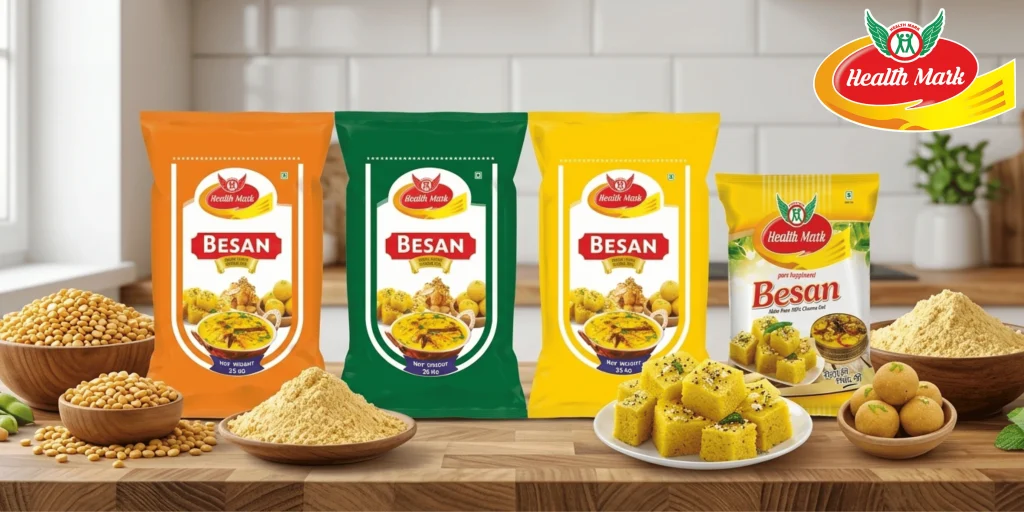
Health Mark is a Baddi-based FMCG company supplying wholesale and retail consumer goods. Its besan range is built on a simple promise: carefully selected, 100% premium chana dal, ground using traditional milling methods so that natural aroma, smooth texture and nutrients are retained.
What this means for a business buyer:
- A range that fits different needs. Powder besan, bareek besan, regular besan and motichur (mota) besan are all listed in the besan category.
- Food safety systems. The company displays ISO 22000, ISO 9001, GHP, GMP and HACCP accreditations on its website.
- Broader FMCG portfolio. Besides besan, you can source atta, pulses, rice, spices, snacks and more from the same supplier, which simplifies vendor management.
- Direct access to the sales team. You can discuss specifications, pack sizes, minimum order quantities and delivery directly.
Talk to the Health Mark sales team:
- 📞 09318896005
- 📞 9218587660
- 📞 9882896000
- 📍 Plot No. 60, Industrial Township, Bhatoli Kalan, Baddi, India 173205
You can also explore the complete besan range or visit the Health Mark homepage to download the product catalogue.
FAQ
1. Why does quality bulk besan matter for FMCG businesses?
Quality bulk besan ensures consistent taste, texture, colour and frying behaviour across batches. It reduces wastage, extends shelf life, supports compliance and protects brand reputation, which makes it more valuable than a low price per kilo.
2. How do I identify premium quality besan?
Look for an ingredient list of only chana dal, even yellow colour, fresh nutty aroma, uniform grind, no lumps or bitterness, intact packaging and clear batch and FSSAI details. Always confirm with a sample trial.
3. What is the difference between besan and gram flour?
There is no real difference in common use. Besan is the Indian name for gram flour, made by grinding chana dal. Some international “chickpea flour” may use whole chickpeas, so check the specification.
4. Which besan grade is best for food manufacturers?
It depends on the product. Bareek or fine besan suits sev, boondi and smooth batters, regular besan suits snack mixes and daily cooking, and coarse motichur besan suits granular sweets.
5. What should I check before choosing a wholesale besan supplier?
Verify FSSAI licence, food safety certifications, manufacturing capability, sample quality, batch consistency, packaging options, delivery reliability and after-sales support.
6. How can I get the best besan price in bulk?
Compare quotes on equal specifications, negotiate based on volume and predictable monthly orders, and judge suppliers on total landed cost and yield, not only on rate per kilo.
7. How long can bulk besan be stored?
Shelf life depends on moisture, packaging and storage. Stored in a cool, dry, pest-free place and used FIFO, besan stays fresh for the period stated on the pack. Always follow the printed best-before date.
8. Is besan a good FMCG raw material for new brands?
Yes. It is a staple with steady demand, versatile across snacks, sweets and ready mixes, and increasingly popular in gluten-free and plant-protein products.
9. Can I get private-label or custom pack sizes for besan?
Many manufacturers offer custom packaging and bulk formats. Contact Health Mark on 09318896005, 9218587660 or 9882896000 to ask about current pack sizes, minimum quantities and availability.
Conclusion: Quality besan is a business decision, not just a purchase
For FMCG businesses, besan quietly decides whether your product is crisp or soggy, consistent or unpredictable, trusted or returned. Choosing a supplier on price alone is a gamble. Choosing on purity, consistency, hygiene, documentation and reliability is a strategy.
Start with clear specifications, test real samples, insist on paperwork, and build a long-term relationship with a manufacturer who treats besan as seriously as you do.
Ready to source dependable gram flour? Explore the Health Mark besan range or call 09318896005, 9218587660 or 9882896000 to discuss your bulk requirement with the team.