
Walk into any Indian kitchen, sweet shop, or snack unit and you will find one ingredient that quietly does the heaviest lifting: besan. It thickens kadhi, binds pakoras, gives ladoos their melt-in-the-mouth texture, and forms the base of dozens of regional delicacies. Yet most buyers only think about besan quality after a batch of pakoras turns lumpy, a dhokla refuses to rise, or a customer complains about a raw, chalky aftertaste.
If you run a restaurant, a sweet shop, a namkeen manufacturing unit, a grocery store, or a distribution business, the flour you choose is not a small line item it directly affects taste, shelf life, customer trust, and your margins. That is exactly why so many buyers today search specifically to buy premium quality besan wholesale rather than settling for whatever is available at the nearest mandi.
This guide is built for exactly that search. We will walk through what separates ordinary gram flour from premium quality besan, how a genuine besan manufacturer in India processes and packs it, what actually drives best besan price, how to vet a besan supplier in north India, and why Health Mark has earned a reputation as a trusted, No.1 besan brand for households and businesses across Chandigarh, Punjab, Himachal Pradesh, and beyond. By the end, you will have a practical, no-nonsense framework for choosing the best wholesale besan supplier for your needs and know exactly where to place your first bulk order.
What Is Besan? A Quick Refresher Before You Buy
Besan, also called gram flour or chana flour, is made by milling dehusked and split Bengal gram (chana dal) into a fine powder. It is naturally gluten-free, protein-rich, and carries a distinct nutty aroma that forms the backbone of Indian savory and sweet cooking alike.
Not all besan is created equal. The taste, colour, texture, and cooking performance of besan depend heavily on:
Raw material quality the grade of chana dal used, and whether it is clean, well-graded, and free from foreign matter.
Milling technique stone-ground versus roller-milled flour behaves differently in batters, doughs, and sweets.
Moisture control excess moisture shortens shelf life and invites weevils or clumping.
Hygiene standards how the flour is processed, sieved, and packed determines its purity and safety.
Understanding these fundamentals is the first step toward recognising why some brands can genuinely claim to sell the best quality besan, while others are simply repackaging inconsistent, mixed-grade flour.
Why Buying Premium Quality Besan Wholesale Makes Business Sense
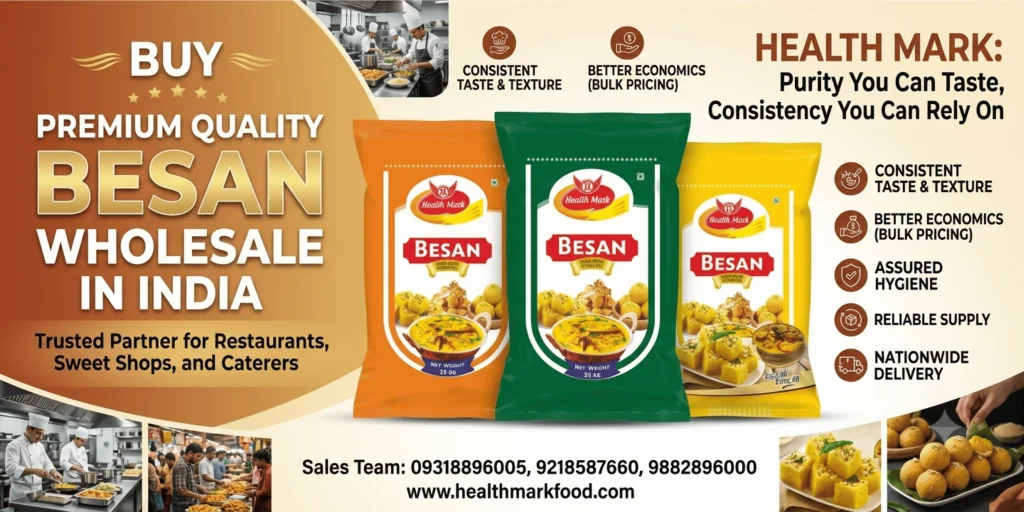
For any business that uses besan regularly sweet shops, caterers, namkeen brands, hostels, cloud kitchens, or retail chains buying loose besan in small quantities is inefficient and risky. Here is why sourcing premium quality besan wholesale, directly from a reliable besan manufacturer in India, is the smarter route:
Consistent taste and texture: wholesale buyers who lock in one trusted source avoid the batch-to-batch variation that comes from switching local sellers.
Better economics: bulk pricing from a genuine best besan seller reduces your per-kg cost significantly compared to retail purchases.
Assured hygiene and food safety: an established manufacturer follows documented cleaning, sieving, and packing protocols that a roadside chakki simply cannot match.
Reliable supply: seasonal shortages or price spikes in chana dal affect the market, but an experienced wholesale besan supplier plans inventory to keep supply steady.
Business credibility: sourcing from a recognised, No.1 besan brand adds a layer of trust when you are, in turn, selling food products to your own customers.
What Makes Health Mark India’s Best Besan Brand
Health Mark has built its reputation in the food business around one simple principle: purity you can taste and consistency you can rely on. Based out of Baddi, Himachal Pradesh, and serving customers across Chandigarh, Panchkula, Punjab, and the wider north Indian market, Health Mark has positioned its besan as a genuinely premium quality besan choice for both households and bulk buyers.
Careful Sourcing of Chana Dal
Health Mark Besan is prepared from carefully selected, premium quality Bengal gram. Before milling, the dal is checked for cleanliness and grading, which is the single biggest factor behind a smooth, fine, and consistent besan.
Fine, Smooth Milling for a Rich, Nutty Flavour
The gram is finely ground to deliver a smooth texture that performs well whether you are making a light, crisp pakora batter or a delicate, melt-in-mouth ladoo. This is part of what makes it stand out as one of the best besan options for both sweet and savory Indian recipes.
Hygienic Processing and Sealed Packaging
Every batch is hygienically processed and packed to lock in freshness and purity from the mill to your kitchen or production line an essential standard for any buyer evaluating a besan manufacturer in India for long-term supply.
A Product Range Built for Every Kind of Buyer
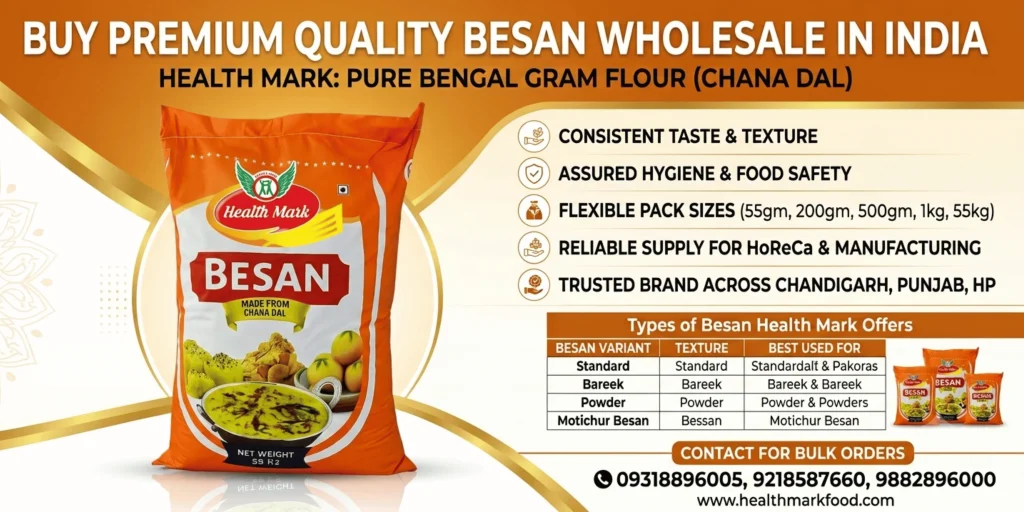
Health Mark besan is available in multiple pack sizes 55gm, 200gm, 500gm, and 1kg making it practical for everything from a home cook’s monthly grocery run to a business placing repeat wholesale orders.
Types of Besan Health Mark Offers
Different recipes call for different besan textures. Health Mark’s product line reflects this, giving buyers a genuine choice instead of a one-size-fits-all flour.
| Besan Variant | Texture | Best Used For |
| Standard Besan | Fine, smooth | Pakoras, kadhi, dhokla, everyday cooking |
| Bareek Besan | Extra-fine, sieved | Sweets, ladoos, delicate batters |
| Powder Besan | Ultra-fine powder | Instant mixes, bakery and snack blends |
| Motichur / Mota Besan | Coarser granules | Motichur ladoo, boondi, traditional sweets |
Explore the full besan range on the Health Mark Besan category page to compare variants and pack sizes before placing a bulk order.
How Premium Quality Besan Is Made: Farm to Packet
Understanding the journey of your besan from raw chana dal to the sealed packet on your shelf helps you evaluate whether a supplier truly deserves the label ‘premium quality Besan’ or is simply using the term as marketing.
Sourcing: Bengal gram is procured from trusted growing regions and checked for grade, colour, and cleanliness.
Cleaning and grading: Foreign matter, broken grains, and impurities are removed before the dal ever reaches the mill.
Dehusking and splitting: Whole chana is dehusked and split into dal, which is the direct raw material for besan.
Milling: The dal is ground to a fine, consistent particle size this step defines whether the final besan feels smooth or gritty.
Sieving: Multiple sieving passes remove husk particles and coarse fragments, giving the flour its signature smooth texture.
Quality checks: Moisture, colour, and aroma are checked to ensure the batch meets food-safety and taste standards.
Hygienic packing: The finished besan is packed in sealed, moisture-resistant packaging to protect freshness in transit and storage.
This is the process behind every packet that leaves a genuine besan manufacturer in India and it is the reason premium quality besan performs so differently from loose, unbranded flour sold without any traceability.
How to Choose the Best Besan Supplier in India: A Buyer’s Checklist
Whether you are a retailer typing ‘besan seller near me’ into Google or a distributor evaluating a long-term wholesale partner, use this checklist before you commit to any supplier.
Ask about raw material sourcing: a credible top Besan supplier should be able to explain where their chana dal comes from and how it is graded.
Check texture and colour consistency: request a sample before a bulk order premium high quality besan should look and feel uniform across batches.
Verify hygiene and packaging standards: sealed, moisture-proof packaging is non-negotiable for shelf life.
Compare pack-size flexibility: a good best wholesale besan supplier offers multiple sizes so you are not overstocking or understocking.
Review pricing transparency: get clarity on best besan price per kg at different order volumes, with no hidden costs.
Look at delivery reliability: ask how the supplier handles peak festive season demand, when besan consumption spikes sharply.
Confirm accreditation and food-safety practices: a manufacturer that is transparent about its accreditation and processes is one you can trust for repeat business.
You can review Health Mark’s certifications and standards on the Accreditation page before making a bulk buying decision.
Health Mark vs. Typical Local Besan Sellers
Here is an honest, practical comparison to help you understand what changes when you move from an unbranded local seller to a structured, quality-focused best besan brand in India.
| Parameter | Typical Local Seller | Health Mark (Premium Wholesale Besan) |
| Raw material grading | Often unverified, mixed grade | Selected, graded premium Bengal gram |
| Texture consistency | Varies batch to batch | Fine, uniform texture every batch |
| Packaging | Loose or basic packing | Hygienically sealed, moisture-resistant packs |
| Traceability | Limited or none | Traceable sourcing and processing |
| Pack size options | Usually one size | 55gm, 200gm, 500gm, 1kg |
| Suitability for business use | Inconsistent for scale | Built for retail, HoReCa, and bulk buyers |
What Affects Best Besan Price? Understanding Wholesale Pricing
Buyers frequently ask why besan price fluctuates between suppliers and seasons. If you want the best besan price without compromising on quality, it helps to understand what actually drives the number:
Chana dal market rates: besan price is closely tied to the wholesale price of Bengal gram, which moves with harvest cycles and demand.
Grade of raw material: premium quality besan made from higher-grade dal naturally costs more than mixed-grade flour, but delivers better yield and taste.
Order volume: wholesale buyers ordering in bulk typically unlock better per-kg pricing than retail-quantity buyers.
Packaging format: smaller retail packs (like 55gm or 200gm) carry a higher per-kg cost than bulk 1kg or industrial packs.
Seasonal demand: prices often firm up ahead of festivals like Diwali and Navratri, when besan-based sweets and snacks see peak demand.
For an accurate, current best besan price quote based on your required quantity and pack size, it is best to contact the supplier directly rather than relying on outdated online listings.
Request a wholesale quote through the Health Mark Product Enquiry form or call the sales team directly.
Besan Supplier in North India: Why Chandigarh, Punjab & Himachal Buyers Choose Health Mark
Location matters when you are sourcing a perishable-adjacent product like besan. Shorter supply routes mean fresher stock, faster replenishment, and lower logistics cost which is exactly why so many buyers specifically search for a besan supplier in north India rather than sourcing from distant states.
Health Mark is based in Baddi, Himachal Pradesh an industrial hub strategically placed to serve Chandigarh, Panchkula, Mohali, Ludhiana, and the broader Punjab and Himachal belt efficiently. For businesses searching specifically for the best besan brand Chandigarh buyers already trust, this regional presence translates into:
• Faster order turnaround for local and regional bulk buyers
• Lower freight costs compared to sourcing besan from distant manufacturing states
• Better responsiveness for repeat and urgent orders during festive season
• A supplier who understands regional recipe preferences and pack-size demand
If you have been searching for a ‘besan seller near me’ anywhere across this belt, Health Mark’s regional presence and direct-contact sales team make it a practical choice for both one-time bulk purchases and long-term supply contracts.
Common Mistakes to Avoid When Buying Besan Wholesale
Buying purely on price: the cheapest besan per kg often means lower-grade dal, inconsistent texture, and shorter shelf life false savings in disguise.
Skipping a sample order: always test a small batch before committing to a large wholesale order, especially with a new supplier.
Ignoring packaging quality: poorly sealed packs let in moisture, leading to clumping, odour, or pest issues during storage.
Not checking pack-size flexibility: businesses with variable demand need a supplier who offers multiple sizes, not a rigid single SKU.
Overlooking delivery consistency: a supplier who cannot commit to timelines will cost you far more in stockouts than any price difference saves.
Assuming all besan is the same: fine, bareek, powder, and motichur besan each serve different recipes using the wrong grade affects your final product quality.
Health Benefits of Besan: Why It’s a Smart Everyday Choice
Beyond its culinary versatility, besan is genuinely nutritious, which is one more reason it remains a staple across Indian households and food businesses:
Naturally gluten-free: a practical flour option for people avoiding wheat-based products.
Good source of plant protein: chana dal-based flour contributes meaningfully to protein intake in vegetarian diets.
Rich in fibre: supports digestion and helps create a feeling of fullness.
Lower glycaemic impact than refined flour: besan-based dishes are often favoured by those watching blood sugar response.
Versatile in both savory and sweet preparations: making it easy to include in a balanced, varied diet.
Popular Uses of Besan in Indian Kitchens
A quick look at just how far this one ingredient stretches across regional Indian cuisine:
Savory snacks: pakoras, bhajiyas, khaman, dhokla, and mirchi bada.
Curries and gravies: besan is the base for classic kadhi and adds body to certain North Indian gravies.
Sweets: besan ladoo, mysore pak, and motichur laddu all rely on the right grade of gram flour.
Batters and coatings: used to coat vegetables and paneer before frying for a crisp finish.
Face and skin care (traditional use): besan is a long-standing ingredient in homemade skincare routines, particularly as a gentle cleansing pack.
How to Store Besan for Maximum Freshness
Keep besan in an airtight container to prevent moisture absorption and clumping.
Store in a cool, dry place away from direct sunlight and heat sources.
For bulk stock, rotate inventory on a first-in-first-out basis to avoid holding old stock too long.
Avoid storing besan near strong-smelling spices, as gram flour can absorb odours.
Check periodically for any signs of moisture, clumping, or off smell, especially during humid months.
Expert Tips for Bulk and Wholesale Buyers
Plan orders around festive demand cycles: besan consumption rises sharply before Diwali, Navratri, and wedding season order ahead to avoid last-minute price pressure.
Match pack size to your use case: 1kg and bulk packs suit production units; smaller packs suit retail shelves.
Build a direct relationship with your supplier: a direct line to a besan manufacturer in India, rather than a middleman, usually means better pricing and priority during shortages.
Negotiate on volume, not just unit price: ask about slab-based wholesale pricing as your order quantity grows.
Request consistency guarantees: a serious top selling Besan in india supplier should be willing to stand behind batch-to-batch consistency.
FAQ
1. What is the best besan for wholesale business use?
The best besan for wholesale use is one made from graded, premium quality Bengal gram, finely milled for a consistent texture, and packed hygienically to protect shelf life. Health Mark Besan is built specifically around these standards, making it a practical choice for retailers, caterers, and food manufacturers.
2. How is Health Mark different from other besan brands in India?
Health Mark focuses on selecting premium quality chana dal, fine milling for a smooth texture, and hygienic, sealed packaging across multiple pack sizes. This combination of quality control and pack-size flexibility is what positions it among the best besan brand options for both households and bulk buyers.
3. What is the minimum quantity for a wholesale besan order?
Minimum order quantities vary based on pack size and business requirement. It’s best to contact the Health Mark sales team directly at 09318896005, 9218587660, or 9882896000, or submit an enquiry through the product enquiry page, to get exact wholesale terms.
4. What determines the best besan price per kg?
Besan price is driven by chana dal market rates, the grade of raw material used, order volume, pack size, and seasonal demand. Bulk orders generally receive better per-kg pricing than small retail purchases.
5. Is Health Mark besan suitable for both sweets and savory dishes?
Yes. Health Mark’s fine, smooth-textured besan is formulated to work well across both applications from crisp pakoras and dhokla to besan ladoo and other traditional sweets.
6. How do I find a reliable besan supplier in north India?
Look for a manufacturer with transparent sourcing, hygienic processing, flexible pack sizes, and a regional presence that ensures faster delivery. Health Mark, based in Baddi, Himachal Pradesh, serves Chandigarh, Punjab, and the wider north Indian belt for exactly this reason.
7. What besan pack sizes does Health Mark offer?
Health Mark Besan is available in 55gm, 200gm, 500gm, and 1kg packs, catering to both individual household needs and larger business or wholesale requirements.
8. How should besan be stored to maintain freshness?
Store besan in an airtight container in a cool, dry place away from direct sunlight and strong odours. For bulk stock, follow a first-in-first-out rotation to ensure freshness.
9. Is besan naturally gluten-free?
Yes, besan is made purely from ground chana dal (Bengal gram) and is naturally gluten-free, making it a suitable flour option for those avoiding wheat-based products.
10. How can I place a bulk or wholesale order with Health Mark?
You can place a wholesale enquiry through the Health Mark Product Enquiry page, browse the Besan product category page for available variants, or call the sales team directly at 09318896005, 9218587660, or 9882896000.
Conclusion: Make Your Next Besan Order Count
Besan may seem like a simple staple, but the difference between an ordinary packet and truly premium quality besan shows up in every dish it touches in texture, taste, and how your customers or family respond to the final result. Whether you are a retailer, a caterer, a sweet shop owner, or simply someone who wants the best quality besan for home use, the fundamentals stay the same: check the sourcing, check the processing, check the packaging, and choose a supplier who is transparent about all three.
Health Mark has built its position as a trusted besan manufacturer in India around exactly these fundamentals graded raw material, fine and consistent milling, hygienic packing, and a product range flexible enough for both home kitchens and large-scale business use.
Ready to buy premium quality besan wholesale? Browse the Besan range or submit a wholesale enquiry today. For immediate assistance, call the Health Mark sales team at 09318896005, 9218587660, or 9882896000.