
Walk into any Indian kitchen and you’ll find the same truth: the dish is only as good as the masale dabba sitting next to the stove. Yet with hundreds of brands screaming “premium” and “100% pure” from crowded shelves, finding the best premium high quality spices in India has quietly become one of the most confusing grocery decisions a household or a hotel, restaurant, and food business has to make.
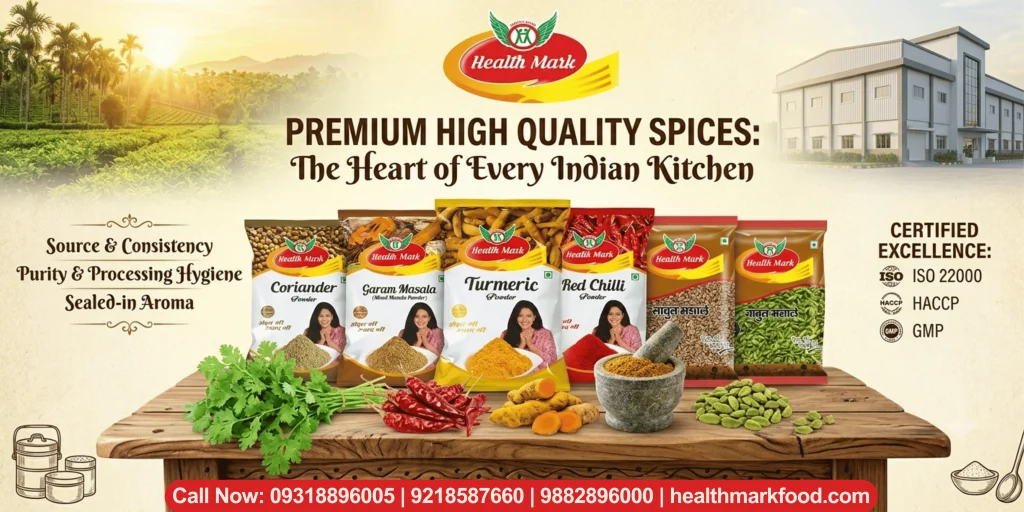
This guide cuts through the marketing noise. We’ll show you exactly how to judge spice quality like an expert, the difference between whole and powdered masale, what certifications actually matter, how bulk and wholesale buying works, and which spices deserve a permanent spot in your kitchen. Whether you’re a home cook restocking your spice rack, a retailer looking for a best wholesale spices supplier, or a business hunting for a best spices manufacturing partner, you’ll leave this article knowing precisely what to look for and what to avoid.
What Does “Premium” and “High Quality” Really Mean for Spices?
The word “premium” gets attached to everything from soap to smartphones, so it’s fair to ask what it actually means when it comes to masale. In the spice world, quality isn’t about fancy packaging it comes down to five measurable factors:
Source and sourcing consistency spices grown in the right soil and climate (like Kashmiri chillies or Kerala cardamom) develop stronger colour, aroma, and oil content.
Moisture control over-dried or under-dried spices lose flavour and are prone to fungal growth.
Purity no starch fillers, artificial colour, or foreign matter mixed in for weight or colour.
Processing hygiene stone-ground or controlled-temperature grinding that doesn’t cook away volatile oils.
Packaging and shelf stability airtight, moisture-proof packaging that locks in aroma from factory to kitchen.
A genuinely high-quality spice will smell strong the moment you open the pack, without needing to double the quantity in your recipe to taste anything.
Why India’s Spice Market Is Booming
India isn’t just a consumer of spices it’s the world’s largest producer, consumer, and exporter of them. That scale has created intense competition among brands trying to become the No. 1 spices brand in their region, which is good news for buyers: more competition means more accountability on quality.
A few trends are shaping today’s market:
Rising demand for chemical-free and lab-tested masale as consumers become more health-conscious.
Growth of D2C and wholesale spice brands selling directly to kirana stores, hotels, and households, cutting out layers of middlemen.
A shift toward regional FMCG manufacturers (based in spice- and grain-belt states) who combine traditional stone-milling with modern, certified processing facilities.
Increased search demand for top selling spices in India as buyers compare brands online before purchasing offline.
This is exactly where a manufacturer’s certifications and production standards start to matter because in a market this large, not every “pure” claim on a packet is backed by testing.
How to Identify High-Quality Spices Before You Buy
Before you buy your next batch of masale, run it through this quick checklist.
The 6-Point Quality Checklist
- Colour test Turmeric should be a deep, natural yellow-orange, not overly bright (a sign of added colour). Red chilli powder should look brick-red, not fluorescent.
- Aroma test Crush a pinch between your fingers. Genuine spices release fragrance instantly; stale or adulterated ones smell flat or musty.
- Texture test Powdered masale should feel fine and uniform, not gritty or lumpy (lumps can indicate moisture contamination).
- Water test for purity A pinch of pure turmeric or chilli powder dropped in water should settle without leaving excessive colour or chalky residue on top.
- Packaging check Look for a manufacturing date, batch number, FSSAI license number, and a resealable or airtight pack.
- Certification check ISO 22000, HACCP, GMP, and Good Hygiene Practice (GHP) certifications on the manufacturer’s website or packaging indicate controlled, audited production.
Whole Spices vs. Powdered Spices: Which Should You Choose?
Both sabut masale (whole spices) and powder masale (ground spices) have a place in a well-stocked kitchen the right choice depends on how you cook.
| Factor | Whole Spices (Sabut Masale) | Powdered Spices (Powder Masale) |
| Shelf life | Longer up to 2–3 years if stored well | Shorter best used within 6–12 months |
| Flavour intensity | Releases oils only when heated/ground fresh | Convenient, consistent, ready to use |
| Best for | Tempering (tadka), biryanis, slow-cooked dishes | Everyday cooking, curries, marinades |
| Risk of adulteration | Very low harder to fake a whole seed | Higher powders can be mixed with fillers |
| Examples | Kali Mirch (whole black pepper), Dalchini (whole cinnamon), Dhaniya Sabut | Turmeric Powder, Red Chilli Powder, Coriander Powder |
Practical advice: If purity is your top priority, lean toward whole spices and grind small batches at home. If convenience matters more, buy powdered masale only from a best spices manufacture brand that publishes its certifications and testing standards.
Top Spices Every Indian Kitchen Needs
Here’s a practical shortlist of spices worth prioritising, whether you’re stocking a home kitchen or a commercial one.
Powdered (Powder Masale) Essentials
- Turmeric Powder the backbone of Indian cooking; look for a natural golden colour and earthy aroma.
- Red Chilli Powder choose one made from sun-dried, deseeded chillies for colour without excess heat.
- Coriander Powder should smell citrusy-sweet, not dusty; a base flavour for most gravies.
Whole (Sabut Masale) Essentials
- Dhaniya Sabut and Kali Mirch – Whole Black Pepper for tempering and grinding fresh.
- Chhoti Elaichi – Whole Green Cardamom and Badi Elaichi for biryanis, kheer, and chai.
- Dalchini – Whole Cinnamon and Javitri – Whole Mace for rich, aromatic curries.
- Kalonji – Nigella Seeds, Fennel Seeds (Saunf), and Carom Seeds (Ajwain) for digestion-friendly tempering and pickling.
- Kali Sarson – Whole Black Mustard Seeds and Badyan Khatai – Whole Star Anise for regional and festive recipes.
- Lal Mirch Sabut for whole-chilli tempering with controlled heat.
Health Benefits of Using Premium Quality Spices
Beyond flavour, high-quality, chemical-free spices carry genuine wellness value which is exactly the promise behind a health mark spices approach to sourcing:
- Turmeric contains curcumin, associated with anti-inflammatory properties.
- Black pepper (kali mirch) aids nutrient absorption and digestion.
- Fennel seeds (saunf) and ajwain are traditionally used to soothe digestion after meals.
- Cinnamon (dalchini) may support healthy blood sugar balance when used regularly in moderation.
- Cardamom (elaichi) offers antioxidant properties and freshens breath naturally.
These benefits only hold up when the spice itself is pure. Adulterated or heavily processed spices lose much of their nutritional and medicinal value another reason why sourcing from a certified, transparent manufacturer matters as much as the recipe itself.
Wholesale & Bulk Spices: A Guide for Retailers and Businesses
If you run a kirana store, restaurant, catering business, or export operation, buying wholesale spices in India requires a different lens than shopping for your own kitchen.
What to Check Before Placing a Bulk Order
- Minimum order quantities (MOQ) and price slabs for bulk spices
- Consistency across batches ask for samples from at least two production runs
- Packaging options for retail resale (pouches, jars, or bulk sacks)
- Delivery reach does the supplier serve your city or region reliably?
- Documentation GST invoicing, FSSAI license, and quality certificates for every batch
Why Buyers Search for a “Spices Seller Near Me”
Many businesses still prefer a best wholesale spices supplier with a regional presence, since it reduces logistics costs and allows in-person quality checks before large orders. A manufacturer with its own certified production facility rather than a trader reselling third-party stock typically offers better pricing consistency and quality control.
What Makes a Trustworthy Spices Manufacturer or Seller
Not every seller calling themselves a top spices seller actually manufactures under audited conditions. Here’s what separates a serious best spices manufacture brand from a reseller:
| Trust Signal | Why It Matters |
| ISO 22000 & ISO 9001 | Confirms food safety management and quality management systems are in place |
| HACCP Certification | Ensures hazard analysis and critical control points are monitored during processing |
| GMP & GHP Compliance | Good Manufacturing/Hygiene Practices reduce contamination risk |
| FSSAI License Number | Legally mandatory for any food business operating in India |
| Own Manufacturing Facility | Indicates direct control over sourcing, grinding, and packaging quality |
| Transparent Contact & Address | A legitimate business publishes its factory address and active sales contacts |
Health Mark operates from its own facility at Plot No. 60, Industrial Township Bhatoli Kalan, Baddi, India, and holds ISO 22000, ISO 9001, GMP, GHP, and HACCP accreditations the same standards you should expect from any brand claiming to be a best spices brand in India.
Common Mistakes to Avoid When Buying Spices
- Buying only on price the cheapest chilli powder is often bulked up with colour or filler.
- Ignoring the manufacturing date spices ground months ago will taste flat, however good the brand.
- Storing in clear glass jars near the stove heat and light degrade spice oils quickly.
- Assuming “branded” always means “certified” always check for FSSAI and ISO markings, not just brand recognition.
- Overbuying bulk discounts aren’t worth it if half the pack goes stale before use; buy bulk only when you have proper storage and turnover.
- Skipping the smell test a quick sniff before purchase (where possible) tells you more than any label claim.
Spice Pricing: What Affects the Best Spices Price
Spice prices fluctuate more than most grocery categories because they’re tied to agricultural output. Understanding what drives the best spices price helps you judge whether a deal is genuinely good or simply low-quality stock.
| Price Driver | Impact on Cost |
| Seasonal harvest & weather | Poor monsoons or crop damage raise raw material costs |
| Purity level | Unadulterated, high-oil-content spices cost more to produce |
| Processing method | Stone-ground/traditional milling costs more than mass mechanical grinding |
| Packaging quality | Airtight, moisture-proof packaging adds cost but protects shelf life |
| Order volume | Wholesale and bulk spice orders typically reduce per-kg pricing |
| Certification & testing | Lab-tested, certified batches carry added quality-assurance costs |
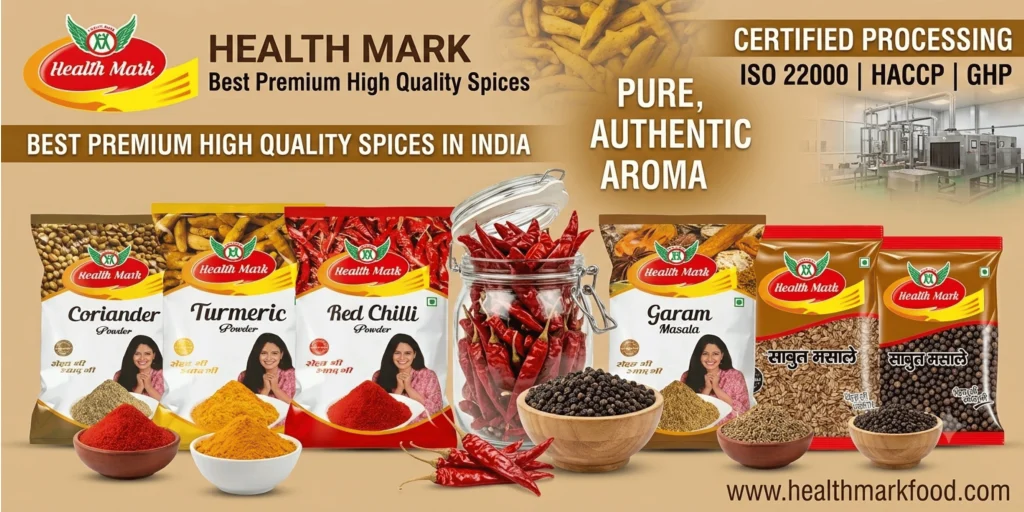
Why Health Mark Is Among the Best Spices Brands in India
Health Mark positions itself as North India’s leading FMCG name across atta, besan, pulses, rice, and importantly both powder masale and sabut masale ranges. A few reasons buyers and retailers choose the brand:
- Certified production: ISO 22000, ISO 9001, GMP, GHP, and HACCP accreditation across its Baddi, Himachal Pradesh facility.
- Wide masale range: from everyday essentials like turmeric, red chilli, and coriander powder to over a dozen whole spices including cardamom, cinnamon, star anise, mace, and mustard seeds.
- Retail and wholesale supply: suited to households as well as businesses looking for a best wholesale spices supplier relationship.
- Nationwide delivery with a dedicated sales team for bulk and trade enquiries.
Browse the ranges directly:
FAQ
Q1. What are considered the best premium high quality spices in India?
Spices sourced from certified manufacturers, free of artificial colour or fillers, and processed under ISO/HACCP/GMP-compliant facilities are generally considered premium regardless of whether they’re whole or powdered masale.
Q2. How can I tell if a spice powder is adulterated?
Check colour intensity (too bright often means added colour), do a water-settling test, check for a gritty or chalky texture, and always verify the FSSAI license and batch number on the packaging.
Q3. Is it better to buy whole spices or powdered spices?
Whole spices (sabut masale) last longer and are harder to adulterate, making them ideal for tempering and slow-cooked dishes. Powdered spices are more convenient for daily cooking but should be bought in smaller quantities from a trusted brand.
Q4. What certifications should a good spice brand have?
Look for FSSAI licensing (mandatory), plus ISO 22000, ISO 9001, HACCP, and GMP/GHP certifications, which indicate audited, hygienic manufacturing processes.
Q5. How do I find the best wholesale spices supplier in India?
Compare minimum order quantities, request batch samples, verify certifications, check delivery coverage, and prefer manufacturers with their own production facility over resellers.
Q6. What is the average shelf life of premium spices?
Whole spices can last 2–3 years if stored airtight and away from moisture. Powdered spices are best used within 6–12 months for peak aroma and flavour.
Q7. Why do spice prices vary so much between brands?
Pricing is influenced by raw material quality, processing method (stone-ground vs. mechanical), packaging, certification/testing costs, and order volume not just brand markup.
Q8. Are bulk or wholesale spices lower quality than retail packs?
Not necessarily. Reputable manufacturers use the same quality standards for bulk and retail packaging; the price difference usually reflects packaging size and volume discounts, not lower quality.
Q9. How should I store spices to keep them fresh longer?
Store in airtight containers, away from direct sunlight and heat (not right next to the stove), and use dry spoons every time to prevent moisture contamination.
Q10. Where can I buy high-quality spices online or in bulk in India?
You can order retail packs or place bulk/wholesale enquiries directly through Health Mark’s Powder Masale and Sabut Masale collections, or contact the sales team at +91 93188 96005 / +91 92185 87660 / +91 98828 96000.
Conclusion
Choosing the best premium high quality spices in India isn’t about chasing the flashiest packaging it’s about understanding sourcing, certification, freshness, and purity, then buying from a manufacturer that can prove all four. Whether you need everyday powder masale like turmeric and red chilli, whole sabut masale for authentic tempering, or a reliable best wholesale spices supplier for your business, the checklist in this guide will help you buy with confidence every single time.
Ready to upgrade your spice rack or restock your business?
Explore Health Mark certified Powder Masale and Sabut Masale ranges, or call the sales team directly at +91 93188 96005, +91 92185 87660, or +91 98828 96000 for retail, bulk, and wholesale inquiries.