
If you run a restaurant, a retail store, a hotel kitchen, a catering business, or an FMCG brand, you already know spices are never “just an ingredient.” They’re the reason a dish tastes the way it should, the reason a product gets repeat customers, and the reason a supply chain either runs smoothly or falls apart at the worst possible moment.
But the moment you move from buying a 100-gram packet off a supermarket shelf to sourcing spices powder in bulk for your business, the entire equation changes. Purity, batch-to-batch consistency, certifications, packaging, pricing, and delivery reliability all start to matter in ways a home cook never has to think about. A single inconsistent batch of red chilli powder or garam masala can change the taste of your signature dish, trigger a customer complaint, or fail a food-safety audit.
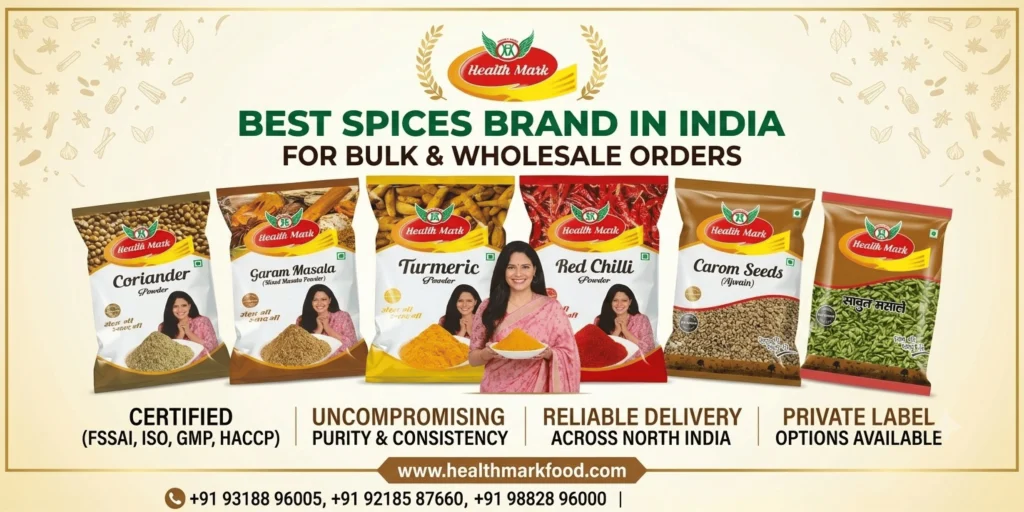
This guide breaks down exactly how to find the best spices brand in India for bulk and wholesale orders what to check before you place a purchase order, which spices sell the most across Indian kitchens and food businesses, how wholesale spice pricing actually works, and the common mistakes that cost bulk buyers both money and reputation. Along the way, we’ll also look at how brands built specifically for B2B supply like Health Mark, an FMCG company based in Baddi, Himachal Pradesh approach bulk spice manufacturing and supply for buyers across Punjab, Chandigarh, Panchkula, Ludhiana, and beyond. You can browse the full range on the Health Mark Spices category page.
What “Best Spices Brand” Really Means for Bulk & Wholesale Buyers
For a retail shopper, “best spices brand” often just means the packet that smells the freshest on the shelf. For a bulk or wholesale buyer, it means something far more specific and far more measurable.
When you’re buying 25 kg, 50 kg, or a full truckload of turmeric powder, red chilli powder, or garam masala every month, “best” has to be defined by things you can actually verify:
Consistency: does batch 47 taste, smell, and look the same as batch 1?
Compliance: is the manufacturer registered with FSSAI, and does it follow recognised food-safety systems such as ISO, GMP, and HACCP?
Purity: is the product free from adulteration, excess starch, artificial colour, or added filler?
Traceability: can the supplier tell you where the raw spice was sourced and how it was processed?
Capacity: can the seller actually fulfil a repeat, large-volume order on schedule, month after month?
Brands that manufacture at scale for wholesale and bulk buyers usually operate under recognised food-safety frameworks. Health Mark, for example, states on its accreditation page that its facility follows FSSAI guidelines and ISO-certified processes, alongside GMP and HACCP recognition the kind of documentation any serious bulk buyer should ask to see before signing a purchase order, regardless of which manufacturer you eventually choose.
Top Factors to Check Before You Buy Spices Powder in Bulk
Before you commit to a wholesale spices supplier in India, run through the following checklist. Skipping even one of these steps is where most bulk-buying mistakes begin.
1. Purity and Lab Testing
Ask whether the manufacturer conducts lab testing for moisture content, adulteration, pesticide residue, and microbial contamination. High quality spices should come with a Certificate of Analysis (CoA) on request, especially for large or export-bound orders.
2. Certifications and Accreditation
At a minimum, a legitimate spices manufacturer in India must hold FSSAI registration. Beyond that, look for ISO 22000/9001, GMP (Good Manufacturing Practices), and HACCP (Hazard Analysis Critical Control Points) recognition these indicate the facility follows structured, auditable food-safety processes rather than ad-hoc quality control.
3. Sourcing and Traceability
A brand that can explain where its turmeric, chilli, coriander, or fennel is grown and how it moves from farm to factory to your warehouse is a brand that takes quality seriously. Traceability also protects you if a batch ever needs to be recalled or investigated.
4. Packaging Built for Bulk
Retail 100 g pouches are not designed for wholesale logistics. Ask about bulk packaging formats (5 kg, 10 kg, 25 kg sacks or master cartons), moisture-barrier lining, and whether private-label or custom packaging is available if you plan to resell under your own brand.
5. Pricing Transparency (Best Spices Price)
The best spices price for a bulk buyer isn’t necessarily the cheapest per-kilo rate it’s the rate that stays consistent as volumes scale, with no hidden costs for packaging, freight, or minimum order shortfalls. Always ask for a slab-wise price list (e.g., price at 25 kg vs 100 kg vs 500 kg) rather than a single flat number.
6. Consistent Supply Capacity
A restaurant chain, distributor, or retailer can’t afford a supplier that runs out of stock mid-season. Ask about production capacity, average lead time, and how the brand handles seasonal raw-material shortages for items like red chilli and coriander.
7. Communication and After-Sales Support
Bulk buying is a relationship, not a one-time transaction. A responsive sales team that can confirm order status, resolve quality queries, and handle repeat orders quickly is often the difference between a supplier you keep and one you drop after one bad experience.
Top Selling Spices in India Every Wholesale Buyer Should Stock
Whether you’re stocking a restaurant kitchen, a grocery retail counter, or a distribution warehouse, a handful of spices consistently top the demand list across Indian households and food businesses. Here’s what most bulk buyers order first, and why each one matters.
Turmeric Powder
One of the highest-volume spices ordered by restaurants, caterers, and retailers, turmeric powder is used in nearly every Indian curry base. For bulk buyers, colour consistency (curcumin content) and freedom from added colourants are the two biggest quality markers to verify. View Turmeric Powder on Health Mark →
Red Chilli Powder
Red chilli powder sees constant demand from both households and the food-service industry. Since heat level and colour can vary batch to batch depending on the chilli variety used, ask your supplier which variety they source and how they standardise pungency across production runs. View Red Chilli Powder on Health Mark →
Coriander Powder
A base-note spice used in almost every regional Indian cuisine, coriander powder is typically ordered in large volumes by caterers and food manufacturers. Freshness of grind matters here more than almost any other spice, since coriander loses aroma quickly once powdered. View Coriander Powder on Health Mark →
Garam Masala
As a blended spice, garam masala is where brand consistency matters most the exact ratio of cardamom, cinnamon, cloves, and other spices defines the final flavour. Bulk buyers should ask for a fixed blend specification so every order tastes identical. View Garam Masala on Health Mark →
Fennel Seeds (Saunf)
Used both as a cooking spice and a post-meal mouth freshener, fennel seeds are a steady bulk order for restaurants, sweet shops, and retailers. Buyers should check seed size grading and moisture levels, since damp fennel spoils faster in storage. View Fennel Seeds (Saunf) on Health Mark →
Carom Seeds (Ajwain)
A staple in Indian snacks, parathas, and digestive preparations, ajwain is a lower-volume but consistent repeat order for most kitchens. Aroma intensity is the easiest way to judge freshness weak-smelling ajwain has usually been sitting in storage too long. View Carom Seeds (Ajwain) on Health Mark →
How to Identify a High-Quality Spices Manufacturer (Step-by-Step)
If you’re evaluating a spices manufacturer for the first time, follow this sequence rather than jumping straight to price negotiation.
1. Shortlist based on certification, not marketing claims. Ask directly for FSSAI licence details and any ISO/GMP/HACCP documentation before discussing anything else.
2. Request product samples. A serious manufacturer will send samples of the specific spices powder you intend to order in bulk colour, aroma, and texture should match what you’d expect from a premium high quality spices brand.
3. Ask about the manufacturing facility. Is it company-owned, or is production outsourced? Facility-owned manufacturers generally offer tighter quality control.
4. Clarify minimum order quantity (MOQ) and pricing slabs. Get this in writing so pricing doesn’t shift once you place a repeat order.
5. Check packaging options. Confirm bulk pack sizes, shelf-life labelling, and whether private-label packaging is available.
6. Test the supply chain with a smaller trial order. Before committing to a large annual contract, place one working order to test delivery timelines and consistency.
7. Confirm after-sales responsiveness. Call the sales team with a query before you order how quickly and clearly they respond is a strong signal of what ongoing support will look like.
Wholesale Spices in India: Understanding “Spices Seller Near Me” Searches
Many bulk buyers start their search with something like “spices seller near me” or “best spices seller” simply because proximity feels like it should mean faster delivery and lower freight costs. That’s a reasonable instinct but for wholesale spices in India, manufacturing hubs matter more than literal distance.
Regions in and around Himachal Pradesh, Punjab, and the wider Chandigarh–Panchkula–Baddi–Ludhiana belt have become established FMCG and food-processing corridors, with strong road connectivity across North India. A manufacturer based in an industrial township such as Health Mark’s facility in Baddi, Himachal Pradesh can typically service bulk and wholesale orders across Punjab, Haryana, Himachal Pradesh, Chandigarh, and neighbouring states with predictable delivery timelines, even if the buyer isn’t in the same city.
In practice, when you search for a “spices seller near me” for wholesale purposes, it’s usually more useful to look for:
• A manufacturer within your logistics region rather than your exact city
• A supplier with an established dispatch and delivery process for B2B orders
• Direct contact with the sales team rather than a middleman or reseller
Comparing Your Sourcing Options: A Quick Table
Not every spice source is built for bulk buying. Here’s how the three most common options typically compare on the factors that matter for wholesale and bulk orders.
| Factor | Local Unbranded Supplier | Big Retail Brand (Small Packs) | Dedicated Wholesale Manufacturer |
| Certifications | Rarely documented | Usually FSSAI-registered | FSSAI + ISO/GMP/HACCP common |
| Bulk Pack Sizes | Inconsistent | Not designed for bulk | 5–25 kg+ formats available |
| Pricing for Volume | Negotiable but unstructured | Fixed retail MRP, expensive at scale | Slab-wise wholesale pricing |
| Batch Consistency | Variable | Generally consistent | Process-controlled consistency |
| Private Labelling | Rarely offered | Not applicable | Often available on request |
| Best Suited For | Very small, occasional needs | Individual household use | Restaurants, retailers, distributors, exporters |
Common Mistakes Bulk Buyers Make When Choosing a Spices Seller
Even experienced procurement teams fall into a few predictable traps when sourcing spices in bulk. Watch out for these:
Chasing the lowest price first. An unusually low best spices price often means compromised purity, added fillers, or inconsistent grinding all of which cost more in customer complaints later.
Skipping the sample stage. Ordering a full bulk quantity without testing a sample batch first is one of the most common and most avoidable mistakes.
Not asking for certification proof in writing. Verbal assurances of “we’re certified” mean nothing without documentation you can file for your own compliance records.
Ignoring packaging suitability. Retail-style packaging that isn’t moisture-sealed can spoil faster in warehouse storage, especially for humid regions.
Overlooking delivery capacity. A supplier that can fulfil one large order may struggle with monthly repeat orders always ask about production capacity, not just current stock.
Assuming “No. 1 spices brand” claims are automatically true. Marketing claims of being the top or No. 1 spices brand should always be checked against verifiable certifications, customer references, and sample quality not taken at face value.
Why Health Mark Is Built for Bulk & Wholesale Spices Orders
Health Mark is an FMCG company manufacturing out of an industrial facility in Baddi, Himachal Pradesh, with a product range that spans spices, atta, besan, pulses, rice, salt, sugar, dry fruits, pickles, sauces, snacks, and more. On the spices side specifically, the current range covers turmeric powder, red chilli powder, coriander powder, garam masala, fennel seeds (saunf), and carom seeds (ajwain) the exact staples most restaurants, retailers, and distributors reorder every month.
According to its accreditation page, Health Mark follows FSSAI guidelines and ISO-certified processes, and has been recognised under GMP and HACCP frameworks the kind of documentation bulk and wholesale buyers should look for from any spices manufacturer, not just this one. The brand also positions itself around sourcing from certified, sustainably managed farms and maintaining traceability from farm to shelf, which matters for buyers who need to answer quality questions from their own customers.
For businesses across Punjab, Himachal Pradesh, Chandigarh, Panchkula, Ludhiana, and neighbouring regions specifically searching for a wholesale spices supplier, sourcing directly from a manufacturer in this belt can mean shorter delivery timelines and a direct line to the people who actually produce the spices rather than going through multiple layers of distribution.
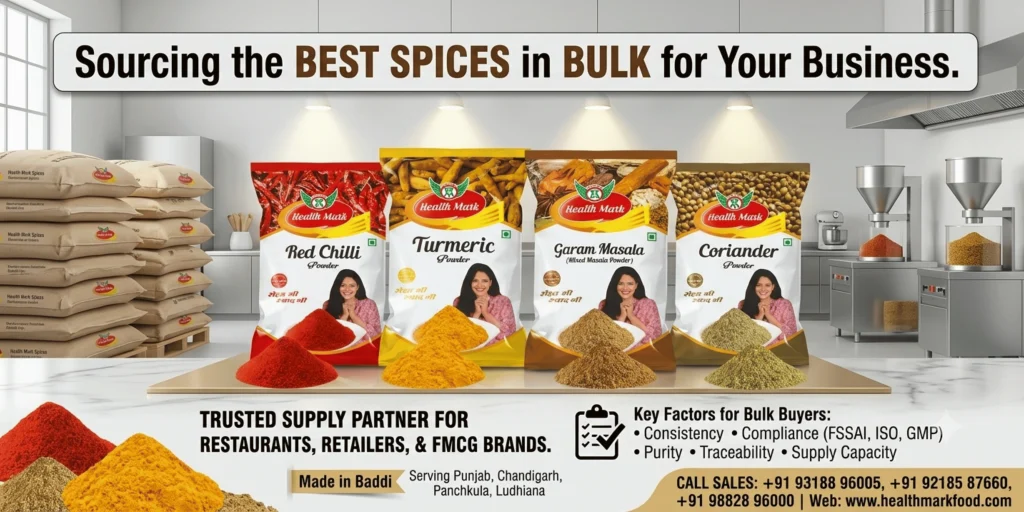
How to Place a Bulk / Wholesale Spices Order with Health Mark
If you’d like to explore bulk or wholesale spices pricing, sample availability, or private-label options with Health Mark, here’s the fastest way to get started:
Browse the range: Health Mark Spices Category
Check individual product pages for turmeric powder, red chilli powder, coriander powder, garam masala, fennel seeds, and carom seeds to shortlist what you need.
Submit a formal enquiry through the Product Enquiry page with your required quantity, pack size, and delivery location.
Or call the sales team directly at +91 93188 96005, +91 92185 87660, or +91 98828 96000 to discuss bulk pricing slabs and minimum order quantities.
Learn more about the company and its manufacturing standards on the About Us and Accreditation pages before finalising your order.
FAQ
What is the minimum order quantity (MOQ) for bulk spices orders?
MOQ varies by manufacturer and by spice, but wholesale suppliers typically start bulk pricing slabs anywhere from 25 kg upward. Always confirm the exact MOQ and pricing tiers directly with the supplier’s sales team before finalising an order.
How can I verify a spices brand is genuinely FSSAI and ISO certified?
Ask the manufacturer to share their FSSAI licence number (which you can cross-check on the official FSSAI portal) along with copies of any ISO, GMP, or HACCP certificates. A credible supplier will provide this documentation without hesitation.
What is the difference between wholesale spices and retail spices in India?
Retail spices are packed in small, consumer-facing quantities (50 g–500 g) at MRP pricing. Wholesale spices are sold in bulk formats (5 kg and above) at slab-based pricing designed for restaurants, retailers, distributors, and food manufacturers who reorder regularly.
How do I check the purity of turmeric powder, red chilli powder, or other spices before a bulk order?
Request a product sample and, for large or repeat orders, ask whether the manufacturer can share a Certificate of Analysis covering moisture content, adulteration testing, and colour/pungency standards for that batch.
What packaging options are available for bulk spice orders?
Most wholesale spice manufacturers offer multiple pack formats, from mid-size retail-ready pouches to bulk sacks or cartons of 5 kg, 10 kg, or 25 kg. Some manufacturers, including Health Mark, can also discuss private-label or custom packaging for retailers and distributors this is worth raising directly with their sales team.
How is the price of spices decided for bulk and wholesale buyers?
Wholesale spice pricing is generally slab-based: the per-kilo rate decreases as order volume increases. Prices also fluctuate with raw-material seasonality (especially for chilli, coriander, and turmeric), so it’s best to request a current price list rather than relying on old quotes.
Can restaurants, hotels, and retailers get spices directly from a manufacturer?
Yes. Most manufacturers that produce spices at scale, including Health Mark, work directly with restaurants, hotels, caterers, retailers, and distributors cutting out reseller markups and giving buyers a direct line for quality queries and repeat orders.
How do I find a spices seller near me for wholesale supply?
Rather than searching only by city, look for established manufacturers within your broader logistics region (state or multi-state belt) that already service B2B buyers proximity to a strong road network often matters more than being in the exact same city.
What documents should a bulk buyer ask for before finalising a spices supplier?
At minimum: FSSAI registration proof, any ISO/GMP/HACCP certification, a current wholesale price list with slab pricing, product specification sheets, and for first-time orders a sample batch for quality testing.
How can I place a bulk or wholesale spices order with Health Mark?
You can browse the spices range on the Health Mark website, submit a request through the Product Enquiry page, or call the sales team directly at +91 93188 96005, +91 92185 87660, or +91 98828 96000 to discuss quantities and pricing.
Conclusion & Next Steps
Finding the best spices brand in India for bulk and wholesale orders isn’t about chasing the lowest price per kilo or the loudest marketing claim it’s about verifying certifications, testing samples, confirming packaging and pricing structures, and choosing a manufacturer that can deliver the same quality on order number fifty as it did on order number one.
If you’re evaluating suppliers for turmeric powder, red chilli powder, coriander powder, garam masala, fennel seeds, or carom seeds, use the checklist in this guide as your starting point and feel free to put any manufacturer you’re considering, including Health Mark, through the same questions.
Ready to discuss a bulk or wholesale order? Explore the Health Mark Spices range or call +91 93188 96005 / +91 92185 87660 / +91 98828 96000 to speak with the sales team directly.