
Open any kitchen cabinet in India and you’ll find the same story repeating itself: a half-used jar of turmeric that’s lost its color, a garam masala tin that smells like cardboard, and a coriander powder that hasn’t tasted “fresh” in months. If you’ve typed “best spices seller near me“ into Google recently, you’re not just looking for a shop you’re looking for a seller who actually understands sourcing, hygiene, grinding freshness, and flavor consistency.
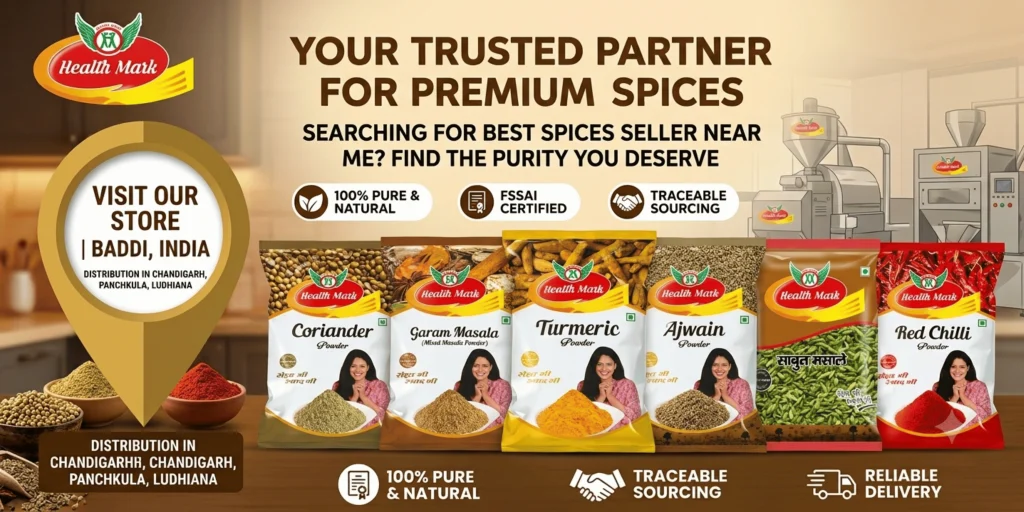
This guide breaks down exactly what separates a genuinely best spices seller from a shelf full of pretty packaging, how to evaluate spices seller near me results with a critical eye, and where brands like Health Mark fit into the picture for households, restaurants, and bulk buyers alike.
Why “Spices Seller Near Me” Searches Are Exploding in 2026
Search interest around spices seller near me, best spices brand in India, and buy spices powder has climbed steadily over the last few years, and it isn’t hard to see why. Three shifts are driving it:
Health-consciousness is up. Consumers are reading ingredient labels more carefully than ever, and that scrutiny has extended to spices a category that was historically treated as an afterthought.
Adulteration scandals have made buyers cautious. Reports of artificial coloring in chili powder or foreign matter in turmeric have pushed shoppers to actively search for health mark spices and other quality-certified brands rather than picking whatever’s cheapest at the local store.
D2C (direct-to-consumer) food brands have matured. A decade ago, “buying spices online” felt unusual. Today, it’s normal to order premium high quality spices the same way you’d order groceries with the added benefit of being able to check batch quality, packaging dates, and manufacturer credentials before you buy.
If you’re the kind of buyer who wants more than a nameless plastic pouch off a supermarket shelf, this guide is built for you.
What Actually Makes a Spices Seller “The Best”
Not every seller with a shiny website deserves the “best spices seller” label. Here’s the criteria that genuinely separates trustworthy sellers from the rest:
2.1 Sourcing Transparency
The best spices manufacturers can tell you where their raw material comes from which region, which harvest season, and how it’s inspected. A seller that can’t answer basic sourcing questions is a red flag.
2.2 Processing & Hygiene Standards
Look for manufacturing facilities that follow food safety protocols (FSSAI registration in India is the baseline, with additional certifications like HACCP or ISO being a bonus). Clean, moisture-controlled, pest-free processing units directly affect shelf life and purity.
2.3 Grinding Freshness
Spices lose essential oils and therefore flavor and aroma the moment they’re ground. A top spices seller grinds in smaller, more frequent batches rather than sitting on huge stockpiles of pre-ground powder for months.
2.4 No Artificial Additives
Genuine high quality spices don’t need artificial colors, anti-caking agents, or fillers to look appealing. If a turmeric powder looks unnaturally bright yellow-orange, that’s worth questioning.
2.5 Consistent Packaging & Batch Testing
Reliable spices manufacture operations pack in sealed, air-tight units (often nitrogen-flushed for extended freshness) and conduct regular batch testing for moisture content, adulterants, and microbial safety.
2.6 Transparent Pricing
The best spices price isn’t always the lowest one. A seller offering suspiciously cheap “pure” spices in bulk is more likely cutting corners on sourcing or blending in fillers.
Best Spices Powder vs Whole Spices: What Should You Buy?
This is one of the most common questions buyers have, and the honest answer is: it depends on your usage pattern.
| Factor | Whole Spices | Best Spices Powder |
| Shelf life | Longer (12–24 months) | Shorter (6–12 months) |
| Flavor intensity | Releases oils only when ground/roasted | Convenient, ready to use immediately |
| Best for | Slow-cooked dishes, tempering (tadka), biryanis | Daily cooking, curries, quick meals |
| Adulteration risk | Lower easier to visually inspect | Higher harder to detect fillers |
| Effort required | Needs grinding/roasting at home | None straight from the jar |
How to Identify High Quality Spices Before You Buy
You don’t need a lab to spot quality issues. Here’s a practical checklist:
- Check the color naturally. Real turmeric is a muted golden-yellow, not neon orange. Real red chili powder has a slightly brownish-red tone, not an artificially vivid red.
- Smell test. Fresh, high-quality spices have a strong, distinct aroma the moment you open the pack. Weak or musty smell = old stock or poor storage.
- Texture check. Powders should feel fine and consistent not gritty, clumpy, or unusually light (a sign of fillers like starch or sawdust in extreme cases).
- Look for certifications on the pack. FSSAI license number, batch number, manufacturing and expiry dates are non-negotiable basics.
- Read the ingredient list. A pure spice powder should list just the spice nothing else. If you see “added color” or unnamed “flavoring agents,” reconsider.
- Buy from manufacturers, not just repackagers. A best spices manufacture unit that controls its own supply chain (from raw material to packaging) generally offers better consistency than a seller who simply repacks third-party stock under their own label.
Top Selling Spices in India What’s Actually Popular
Understanding top selling spices in India helps you know what a genuinely well-stocked spices seller should carry. Based on household and commercial kitchen demand, these categories consistently top the list:
- Turmeric powder (Haldi) the everyday staple, valued for both flavor and its natural properties.
- Red chili powder (Lal Mirch) the second most-used spice in Indian households.
- Coriander powder (Dhania Powder) a base spice in most curries and gravies.
- Garam Masala the blended finishing spice used across regional cuisines.
- Whole & powdered black pepper (Kali Mirch) used both for cooking and health-focused home remedies.
- Cardamom green and black (Chhoti Elaichi & Badi Elaichi) essential for both sweet dishes and biryanis.
- Whole cinnamon (Dalchini) a key aromatic in biryanis, teas, and masalas.
- Star anise (Badyan Khatai) and mace (Javitri) used in richer, slow-cooked preparations and regional masala blends.
- Carom seeds (Ajwain) and fennel seeds (Saunf) everyday tempering and digestive-friendly seeds used across Indian kitchens.
A seller who stocks this full range rather than just the two or three “mass market” spices is generally a stronger signal of a serious spices manufacture operation rather than a reseller cherry-picking fast-moving SKUs.
Health Mark: A Closer Look at a Health-Marked Spices Brand
If you’re specifically searching for health mark spices, here’s what’s relevant to know about the brand and how it fits the criteria above.
Health Mark positions itself around purity, traceability, and sustainable sourcing across its food product range, with spices being one of its core categories. The brand’s About Us page emphasizes sourcing from certified farms, avoiding synthetic pesticides, herbicides, and GMOs, and maintaining transparency through the supply chain the kind of groundwork that matters when you’re evaluating a best spices brand in India.
What’s in the Health Mark Spices Range
Health Mark’s Spices category covers a broad mix of whole and ground spices that line up closely with the top-selling categories discussed above, including:
- Garam Masala
- Coriander Powder
- Dhaniya Sabut (Whole Coriander)
- Kali Mirch – Whole Black Pepper
- Dalchini – Whole Cinnamon
- Chhoti Elaichi – Whole Green Cardamom
- Badi Elaichi (Black Cardamom)
- Javitri – Whole Mace Spice
- Badyan Khatai – Whole Star Anise
- Fennel Seeds (Saunf)
- Carom Seeds (Ajwain)
Beyond spices, Health Mark also manufactures atta, besan, pulses, rice, salt, sugar, dry fruits, pickles, sauces, and snacks you can browse the full catalog on the Products page. That breadth is worth noting because a manufacturer running a diversified, quality-controlled FMCG operation typically has more mature sourcing and processing infrastructure than a single-category spice trader.
Facility & Location
Health Mark’s manufacturing base is listed at Plot No. 60, Industrial Township Bhatoli Kalan, Baddi, India 173205 an established industrial hub for FMCG and food manufacturing in Himachal Pradesh, with distribution reaching customers across regions including Chandigarh, Panchkula, and Ludhiana.
Getting in Touch
If you’re evaluating Health Mark as a wholesale spices supplier, a bulk buyer, or simply want to place a retail order, you can reach the sales team directly:
- 📞 +91 93188 96005
- 📞 +91 92185 87660
- 📞 +91 98828 96000
- ✉️ Or submit a Product inquiry / visit the Contact Us page
You can also check the brand’s Accreditation page for certification details before making a bulk commitment.
Wholesale Spices in India: Buying in Bulk the Smart Way
If you run a restaurant, catering business, hostel mess, or retail store, sourcing wholesale spices in India is a completely different game from buying a 100g pack for home use. Here’s what to prioritize:
Step-by-Step: Choosing a Bulk Spices Supplier
Verify manufacturing credentials first. Ask for FSSAI license number and any additional quality certifications before discussing pricing.
Request sample batches. A serious best wholesale spices supplier will happily send small samples for quality testing before you commit to bulk quantities.
Clarify packaging options. Bulk buyers typically need larger pack sizes (5kg, 10kg, 25kg) confirm the seller can accommodate this without repackaging quality loss.
Ask about consistency across batches. One good batch doesn’t guarantee the next. Ask how the supplier controls quality across production runs.
Understand the pricing structure. Bulk spices pricing should scale meaningfully with volume if the per-kg price barely drops at higher quantities, negotiate or compare with other suppliers.
Check delivery and logistics capability. For businesses, consistent, on-time delivery matters as much as the product itself.
Build a direct relationship with the manufacturer where possible. Buying from the source rather than a middleman distributor usually gets you better pricing and fresher stock.
For businesses in and around Baddi, Chandigarh, Panchkula, or Ludhiana specifically searching for a spices seller near me with bulk capability, reaching out directly to a regional manufacturer like Health Mark for a wholesale enquiry is often more efficient than going through multiple layered distributors.
Comparison Table: Local Kirana vs Online Spices Seller vs Wholesale Supplier
| Criteria | Local Kirana Store | Online Spices Seller | Direct Wholesale Supplier |
| Price transparency | Low–Medium | High | High (volume-based) |
| Quality consistency | Variable | Generally consistent | Consistent (if manufacturer-direct) |
| Certification visibility | Rarely shown | Usually listed online | Available on request |
| Bulk order convenience | Limited | Moderate | Best suited |
| Freshness control | Depends on store turnover | Depends on brand’s batch cycle | Best if sourced fresh from manufacturer |
| Best suited for | Small daily top-ups | Household monthly stock | Restaurants, caterers, retailers |
Common Mistakes People Make When Buying Spices
Judging quality purely by color. Bright, artificial-looking color is often a warning sign, not a quality indicator.
Buying the cheapest option in bulk without sampling first. Untested bulk purchases can mean months of compromised flavor in your kitchen or business.
Ignoring manufacturing and expiry dates. Spices don’t spoil overnight, but their flavor and potency fade always check dates.
Storing spices near heat or sunlight. This accelerates flavor loss regardless of how good the spice was at purchase.
Assuming all “organic” or “premium” labels are verified. Always cross-check claims against actual certification, not just packaging language.
Overlooking the manufacturer’s reputation in favor of marketing. A no 1 spices brand claim on packaging means little without transparent sourcing and certification to back it up.
Best Practices for Storing Spices at Home
Even the best spices seller near me can’t protect your spices from poor storage. Follow these basics:
Store in air-tight glass or food-grade containers not the original paper or thin plastic pouch long-term.
Keep spices away from direct sunlight and stovetop heat.
Use a dry spoon every time moisture is one of the fastest ways to spoil ground spices.
Buy smaller quantities more frequently for daily-use powders like turmeric and chili, rather than large stockpiles that sit for months.
Label containers with purchase date so you can track freshness rather than guessing.
Expert Tips to Get the Best Spices Price Without Compromising Quality
- Compare price per 100g, not per pack. Pack sizes vary, and comparing total price alone is misleading.
- Buy combo packs when available. Many manufacturers offer discounted bundles across categories like spices, atta, and pulses worth checking a brand’s full product range before ordering single items separately.
- Time bulk purchases around seasonal harvests where raw material costs (and therefore prices) are typically lower.
- Avoid over-discounted “too good to be true” bulk deals extremely low best spices price offers are one of the clearest signs of compromised quality or short-weighted packaging.
- Build a repeat relationship with one trusted seller. Loyalty often unlocks better wholesale pricing over time than one-off comparison shopping.
FAQ
Q1. How do I find the best spices seller near me?
Start by checking for FSSAI registration, reading ingredient labels for additives, and comparing aroma and freshness rather than just price. Local reputation, online reviews, and manufacturer transparency (like a visible address and certification page) are strong indicators.
Q2. What is the difference between a spices seller and a spices manufacturer?
A seller may simply repackage or resell spices sourced from third parties, while a manufacturer controls the process from raw material sourcing to grinding, packaging, and quality testing generally offering more consistency and traceability.
Q3. Are health mark spices certified or tested for purity?
Reputable brands typically maintain FSSAI registration and internal quality checks. Always verify current certification details directly through the brand’s official Accreditation page or by contacting their sales team before making assumptions.
Q4. What are the top selling spices in India right now?
Turmeric powder, red chili powder, coriander powder, and garam masala remain the most consistently high-demand spices across Indian households, alongside whole spices like cardamom, cinnamon, and black pepper used in both everyday cooking and festive dishes.
Q5. Is it better to buy whole spices or spice powder?
Whole spices generally last longer and are easier to visually verify for purity, while powders offer convenience for daily cooking. Many households keep both whole spices for tempering and slow cooking, powders for quick everyday meals.
Q6. How can businesses source wholesale spices in India reliably?
Businesses should request samples before bulk ordering, verify the supplier’s manufacturing credentials, confirm consistent packaging and batch quality, and ideally build a direct relationship with the manufacturer rather than going through multiple distributors.
Q7. What should I check on a spice pack before buying?
Look for the FSSAI license number, manufacturing and expiry dates, batch number, and a clear ingredient list with no vague terms like “added flavoring” or “color as per requirement.”
Q8. Why do spices from different sellers taste different even with the same name?
Flavor differences usually come down to raw material sourcing region, grinding freshness, storage conditions, and whether the batch includes any fillers or additives all of which vary significantly between sellers and manufacturers.
Q9. How often should I restock spices at home?
Ground spices are best restocked every 3–6 months for maximum flavor, while whole spices can typically last 12–24 months if stored properly in air-tight containers away from heat and light.
Q10. Does Health Mark offer both retail and bulk/wholesale spices?
Yes Health Mark’s spices range is available for regular retail purchase through its Spices category page, and for bulk or wholesale enquiries, buyers can contact the sales team directly via the Product inquiry page or by phone.
Conclusion: Choosing a Spices Seller You Can Trust for the Long Run
Finding the best spices seller near me isn’t about picking the first search result or the flashiest packaging it’s about verifying sourcing, checking certifications, testing freshness, and understanding whether you’re buying from a genuine manufacturer or a middleman reseller. Whether you need a small pack of garam masala for your kitchen or a wholesale spices order for your restaurant, the fundamentals stay the same: transparency, freshness, and consistency.
If you’re ready to explore a manufacturer-backed spices range built around purity and traceable sourcing, browse the Health Mark Spices collection or reach out directly for retail and bulk enquiries: