If you have ever bitten into a pakora that crumbled instead of staying crisp, or a dhokla that turned out dense and bitter, the besan you used is usually the reason. Besan gram flour milled from chana dal is one of the most-used ingredients in Indian kitchens, yet very few brands get the grind, the aroma, and the purity right every single time. That consistency is exactly why so many home cooks, sweet shops, restaurants, and bulk buyers across North India ask the same question: who is the best besan manufacturer in India, and where can I buy besan I can actually trust?
This guide answers that question in full. We will look at what separates ordinary gram flour from a genuinely premium quality besan, how a serious besan manufacturing company in India runs its production line, and specifically why Health Mark, manufactured out of its Baddi (Himachal Pradesh) facility near the Chandigarh–Panchkula–Ludhiana belt, has earned a reputation as a top besan supplier and a No. 1 besan brand for households, halwais, and wholesale buyers alike. Whether you are searching for the best besan price, a besan seller near me, or the best wholesale besan for your business, you will find a clear, practical breakdown below along with buying tips, a brand comparison, cooking advice, and answers to the questions people ask most.
What Is Besan, and Why Does Quality Actually Matter?
Besan is simply dehusked, split chickpeas (chana dal) that have been dry-milled into a fine flour. It sounds basic, but the quality gap between a well-made batch and a poorly made one is enormous and it shows up the moment you cook with it.
The Role of Chana Dal in Premium Besan
The flavour, colour, and binding strength of besan come almost entirely from the chana dal used to make it. Premium quality besan starts with dal that is uniformly sized, free of stones and foreign matter, and properly dried before milling. Poor sourcing old stock, mixed grades, or dal that hasn’t been cleaned properly produces flour with a dull colour, a stale smell, and inconsistent behaviour in batter.
How Poor-Quality Besan Affects Your Cooking
Pakoras and bhajis absorb excess oil and turn soggy instead of crisp.
Dhokla and khaman fail to rise evenly, leaving a dense, gummy centre.
Kadhi splits or tastes raw because the flour hasn’t been milled finely enough.
Sweets like besan ladoo turn out gritty rather than smooth and melt-in-the-mouth.
Health Mark: A Trusted Besan Manufacturer in North India
Health Mark is a food manufacturing company built around one core promise food that is pure, hygienically processed, and free from unnecessary additives. Besan is one of the brand’s flagship categories, sitting alongside atta, pulses, spices, dry fruits, rice, and other staples under the wider Health Mark portfolio.
Manufacturing Base in Baddi, Himachal Pradesh
Health Mark’s production facility is located at the Industrial Township, Bhatoli Kalan, Baddi, Himachal Pradesh one of North India’s established food and pharma manufacturing hubs. This location gives the brand fast, efficient distribution across Punjab, Haryana, Himachal Pradesh, and Chandigarh, making it a genuinely local besan supplier in North India rather than a distant, unfamiliar name.
From Chana Dal to Packet: The Quality Process
Careful selection of good-quality chana dal as the base raw material.
Fine, controlled milling for a smooth, consistent texture batch after batch.
Hygienic processing and packing designed to lock in freshness and natural aroma.
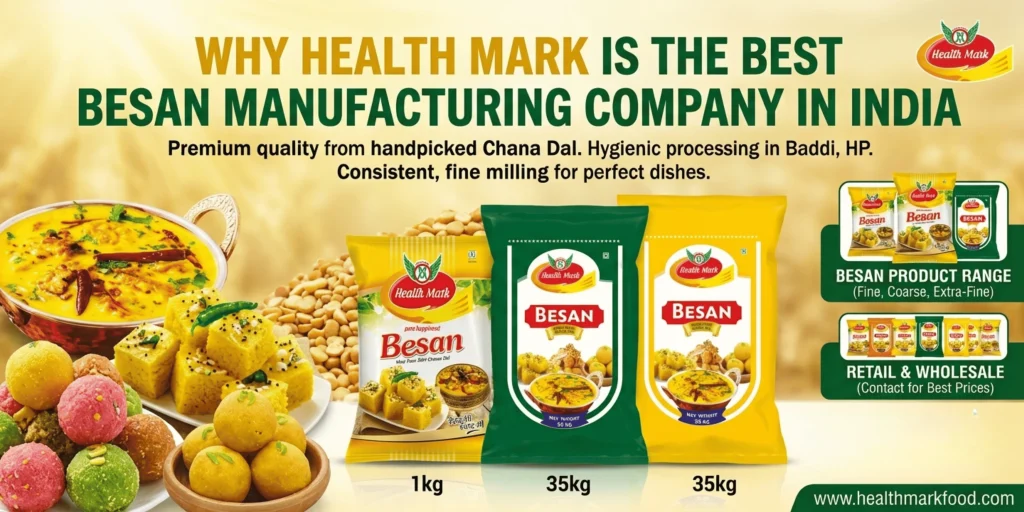
Multiple pack sizes 55gm, 200gm, 500gm and 1kg to suit households as well as bulk kitchens.
What Makes Health Mark the No. 1 Besan Brand in India
There is no shortage of besan on the market loose flour at the local kirana store, unbranded wholesale sacks, and dozens of packaged options. Here is what actually sets a best besan brand in India apart from the rest, and why Health Mark checks each of these boxes.
1. Premium Quality Besan From Handpicked Chana Dal
Every batch begins with carefully selected chana dal, which is what gives Health Mark besan its characteristic rich, nutty flavour and smooth, fine texture the two things that matter most once the flour hits your kadhai.
2. Hygienic Processing and Packaging
Processing and packing are handled to protect freshness from the mill to your kitchen shelf, which matters enormously for a flour that can pick up moisture, odour, or pests if handled carelessly.
3. A Full Besan Product Range, Not Just One SKU
Health Mark doesn’t sell a single generic besan it offers a curated range built for different cooking needs, covering everything from fine sweet-making flour to the coarser grind used for namkeen and boondi.
4. Best Besan Price for the Quality Delivered
Because production, milling, and packaging all happen in-house at the Baddi facility, Health Mark is able to offer a genuinely competitive best besan price without cutting corners on the raw material a balance many smaller, unbranded sellers struggle to match consistently.
5. A Trusted Besan Supplier in North India
With its base in Baddi and strong reach across Chandigarh, Panchkula, Ludhiana, and the wider Punjab–Himachal belt, Health Mark functions as both a besan manufacturer and a dependable regional supplier for retailers, sweet shops, and institutional buyers.
6. Easy Ordering Retail and Wholesale
Buyers can order small retail packs for home use or reach out directly for best wholesale besan quantities, making Health Mark equally useful for a household kitchen and a commercial one.
Health Mark’s Besan Product Range, Explained
Health Mark’s besan category isn’t a single product it’s a small, purpose-built range. Here’s how the four variants differ:
| Product | Texture | Best Used For | Pack Sizes |
| Besan (Standard) | Fine, smooth grind | Pakoras, kadhi, dhokla, everyday cooking | 55gm / 200gm / 500gm / 1kg |
| Bareek Besan | Extra-fine milled | Sweets, ladoo, delicate batters | As per pack listing |
| Motichur / Mota Besan | Coarser grind | Motichur ladoo, boondi, traditional sweets | As per pack listing |
| Powder Besan | Ultra-fine powder | Baking mixes, smooth batters, quick cooking | As per pack listing |
Having this range under one roof is a big reason Health Mark is often searched as a top selling besan in India buyers don’t need to switch brands depending on whether they’re making pakoras or ladoos.
Health Mark vs. Typical Local Besan Brands
Here’s a straightforward comparison to help you see where a branded, quality-controlled besan manufacturer in India differs from loose or unbranded stock:
| Parameter | Health Mark Besan | Typical Loose / Unbranded Besan |
| Raw material sourcing | Carefully selected chana dal | Often mixed-grade, unverified |
| Texture consistency | Uniform, fine grind every batch | Varies batch to batch |
| Hygiene & packaging | Hygienically processed and sealed | Frequently sold loose, exposed to air/dust |
| Product variety | Standard, Bareek, Mota, Powder besan | Usually one generic option |
| Traceability | Branded, manufacturer-backed | No manufacturer accountability |
| Best for | Home cooking, sweet shops, wholesale, retail | Small, immediate local use only |
Why Besan Deserves a Permanent Spot in Your Kitchen
Beyond taste and texture, besan is genuinely useful from a nutrition standpoint. Made from chana dal, it is naturally rich in plant-based protein and dietary fibre, and it is a naturally gluten-free flour, which makes it a popular choice for people avoiding wheat-based flours. It also has a lower glycaemic impact than many refined flours, which is part of why it’s used in everything from savoury snacks to skin-care face packs in Indian households.
How to Choose the Best Besan Brand in India: A Practical Buying Guide
Not sure how to tell premium besan from an average pack on the shelf? Use this checklist.
Step 1: Check the Colour and Texture
Good besan is uniformly pale yellow, feels fine between your fingers, and has no visible lumps, husk fragments, or discolouration.
Step 2: Smell Before You Buy
Fresh besan has a mild, nutty aroma. A sour, musty, or flat smell usually means the flour is old or has been stored poorly.
Step 3: Read the Packaging and Manufacturing Date
Always prefer sealed, hygienically packed besan over open, loose stock, and check that the packaging clearly states manufacturing details rather than being generic or unmarked.
Step 4: Compare Price Against Quality, Not Just the Number
The cheapest pack on the shelf isn’t automatically the best besan price factor in grind consistency, hygiene, and how much you’ll actually use before it goes stale. A slightly higher price from an established besan manufacturer in India is usually the better long-term value.
Step 5: Prefer FSSAI-Registered, Branded Manufacturers
Buying from an FSSAI-compliant, branded manufacturer gives you traceability and accountability that loose, unbranded stock simply cannot offer.
Common Mistakes People Make When Buying Besan
Buying in bulk from an unfamiliar seller purely because it looks cheaper.
Ignoring smell and colour and judging quality by packaging alone.
Storing besan in a humid or warm spot, which shortens its shelf life fast.
Using the same besan grade for both sweets and savoury snacks, when a Bareek or Motichur grind would perform far better.
Not checking whether the brand offers a fair best besan price on wholesale quantities before placing a large order.
Where to Buy Health Mark Besan: Retail and Wholesale Options
Best Besan Brand in Chandigarh, Panchkula, and the Tricity Region
Thanks to its Baddi manufacturing base, Health Mark has strong distribution across the Chandigarh–Panchkula–Baddi–Ludhiana corridor, which is a big part of why it’s frequently searched as the best besan brand in Chandigarh and across neighbouring Punjab towns.
Searching “Besan Seller Near Me”? Here’s How to Order
You can browse and order the full besan range directly from the Health Mark website, or reach the sales team directly for retail and wholesale enquiries:
Sales / Enquiry: +91 93188 96005, +91 92185 87660, +91 98828 96000
Manufacturing Address: Plot No. 60, Industrial Township, Bhatoli Kalan, Baddi, Himachal Pradesh – 173205
Browse the full besan range here: Health Mark Besan Category
View the standard Besan product page here: Health Mark Besan Product Page
Explore the complete Health Mark product catalogue here: Health Mark – Home
Expert Tips for Cooking With Besan
For crisp pakoras, whisk the batter with cold water and a pinch of rice flour or hot oil for extra crunch.
For dhokla and khaman, sieve the besan before mixing to avoid lumps and ensure an even rise.
For kadhi, whisk besan into yogurt thoroughly before heating to prevent splitting.
For besan ladoo, use a finer grind such as Bareek Besan for a smoother, melt-in-the-mouth finish.
Always store besan in an airtight container away from moisture and direct sunlight to preserve its aroma and shelf life.
Why You Can Trust Health Mark
Health Mark operates as an established food manufacturing brand with a dedicated production facility in Baddi and a product range spanning atta, besan, pulses, rice, spices, dry fruits, and more not a single-product operation. Its besan line specifically focuses on controlled sourcing of chana dal, consistent milling, and hygienic packaging, backed by a real manufacturing address, verifiable contact numbers, and a multi-channel presence (website, WhatsApp ordering, and active social profiles). For buyers comparing a besan manufacturer in India on trust and transparency not just price that combination of a fixed facility, a named product range, and direct sales access is exactly what separates an accountable brand from an anonymous local supplier.
FAQ
Why is Health Mark considered the best besan manufacturing company in India?
Health Mark combines carefully sourced chana dal, consistent fine milling, and hygienic packaging with a dedicated manufacturing facility in Baddi, Himachal Pradesh, and strong distribution across North India a combination that gives it both product quality and genuine accessibility for retail and wholesale buyers.
What is the difference between Besan, Bareek Besan, and Motichur/Mota Besan?
Standard Besan has a fine, all-purpose grind suited to everyday cooking. Bareek Besan is milled even finer, ideal for sweets and delicate batters. Motichur or Mota Besan has a coarser texture, traditionally used for motichur ladoo and boondi.
Is Health Mark besan suitable for both sweets and savoury dishes?
Yes. Because Health Mark offers multiple grinds standard, Bareek, and Mota you can pick the right texture for pakoras and kadhi as well as for ladoos and other sweets, rather than using one generic flour for everything.
Where is Health Mark besan manufactured?
Health Mark’s besan is manufactured at its facility in the Industrial Township, Bhatoli Kalan, Baddi, Himachal Pradesh, giving it efficient reach across Chandigarh, Panchkula, Ludhiana, and the wider Punjab–Himachal region.
How can I buy Health Mark besan in bulk or wholesale?
You can contact the Health Mark sales team directly at +91 93188 96005, +91 92185 87660, or +91 98828 96000 to discuss wholesale besan quantities, pricing, and delivery.
What pack sizes does Health Mark besan come in?
Health Mark besan is available in 55gm, 200gm, 500gm, and 1kg packs, suiting both small household needs and larger family or commercial use.
Is besan gluten-free?
Yes, besan is naturally gluten-free since it is milled purely from chana dal (Bengal gram), which makes it a popular alternative for people avoiding wheat-based flours.
How should I store besan to keep it fresh for longer?
Store besan in a clean, airtight container in a cool, dry place away from direct sunlight and moisture. Properly sealed, hygienically packed besan like Health Mark’s retains its aroma and texture significantly longer than loose, exposed stock.
What should I check before buying any besan brand?
Check the colour (should be uniformly pale yellow), the smell (should be mildly nutty, not sour or musty), the texture (fine, no lumps), and whether it comes in sealed, hygienically packed, branded packaging rather than loose stock.
Does Health Mark besan work well for making pakoras and dhokla?
Yes. Health Mark besan is milled specifically for a smooth, fine texture, which helps pakora batter fry up crisp and helps dhokla or khaman batter rise evenly without turning dense.
Conclusion: Choose Besan You Can Actually Rely On
Besan is one of those ingredients that quietly makes or breaks a dish and once you’ve cooked with a genuinely premium quality besan, it’s hard to settle for anything less. Health Mark earns its place as a leading besan manufacturer in India by controlling what matters most: the chana dal it starts with, the fineness and consistency of its milling, and the hygiene of its packaging all backed by a real manufacturing facility in Baddi and a product range built for how Indian kitchens actually cook, from crisp pakoras to smooth besan ladoo.