If you’ve grown up in an Indian household, chances are your morning has started with the comforting smell of poha sizzling in a kadhai mustard seeds crackling, curry leaves releasing their aroma, and turmeric-coated flattened rice filling the kitchen with colour. Poha isn’t just a dish; it’s a ritual, and for millions of Indians it remains the easiest way to eat something wholesome without spending an hour cooking.
But here’s the catch: not all poha is created equal. The dish you love depends entirely on the quality of the flattened rice you start with. Thin, brittle poha that turns to mush the moment water touches it, or poha packed with broken grains and dust, can ruin even the best recipe.
This is exactly where the difference between an average supplier and a genuine high quality Poha in India manufacturer becomes obvious. In this guide, we’ll unpack what actually makes poha “high quality,” what to check before you buy, and what makes Health Mark a top Poha manufacturer trusted by households and retailers across Punjab, Chandigarh, Panchkula, Baddi, Ludhiana, and beyond.
What Is Poha, Exactly?
Poha, also called flattened rice, chivda, or avalakki depending on the region, is made by parboiling paddy and then flattening the grains under pressure. The process leaves behind a light, flaky product that cooks in minutes because most of the hard work is already done at the manufacturing stage.
It’s naturally gluten-free, low in fat, and easy to digest, which is exactly why it has remained a breakfast staple from Maharashtra to Punjab and Madhya Pradesh to Karnataka for generations. Whether you know it as poha, aval, or chivda, the underlying grain flattened rice is the same humble hero of the Indian kitchen.
Why Poha Remains India’s Favourite Breakfast
Ask ten Indian households why poha is on their weekly breakfast rotation, and you’ll get remarkably similar answers:
• It cooks in under 15 minutes, making it ideal for busy mornings.
• It’s extremely versatile kanda poha, batata poha, dahi poha, and Indori poha are all built on the same base.
• It’s light on the stomach, so it doesn’t leave you feeling heavy before work, school, or a workout.
• It’s budget-friendly compared to many other breakfast staples.
• It pairs beautifully with peanuts, sev, curry leaves, lemon, and fresh vegetables.
• It works equally well as breakfast, an evening snack, or a light dinner.
What Actually Makes Poha “High Quality”?
The word “premium” gets used loosely in food marketing, so it helps to know exactly what separates genuinely high quality Poha from an average bag on a store shelf.
Grain Selection & Flattening Process
High quality Poha starts with well-matured, properly parboiled paddy. The flattening process needs to be uniform: grains that are too thin turn mushy the moment they touch water, while grains that are unevenly flattened cook inconsistently, leaving some flakes soggy and others hard.
Hygiene & Processing Standards
A clean, controlled manufacturing environment prevents contamination, pest activity, and moisture damage. Reputable manufacturers follow FSSAI-compliant food safety practices at every stage from raw material intake to final packing.
Packaging That Preserves Freshness
Poha is naturally absorbent, which means poor packaging lets in moisture and odour from the surrounding environment. Airtight, food-grade packaging protects the crunch and natural aroma of the flakes until the pack is opened at home.
Nutritional Integrity
Genuinely high-quality poha isn’t over-processed or artificially whitened. It retains its natural off-white to pale-yellow colour and characteristic texture, an honest visual cue that nothing has been done to mask lower-grade grain.
Signs of High-Quality vs. Low-Quality Poha
| Parameter | High-Quality Poha | Low-Quality Poha |
| Texture | Light, flaky, uniform thickness | Uneven, brittle, or overly thick |
| Colour | Natural off-white / pale yellow | Overly bright white (bleached) or dull grey |
| Cooking Behaviour | Softens evenly in a quick rinse | Turns mushy or stays hard in patches |
| Smell | Mild, natural rice aroma | Musty, stale, or chemical odour |
| Packaging | Sealed, labelled, batch/date marked | Loose, unmarked, or poorly sealed |
| Shelf Life | Stays fresh and crisp for months when sealed | Turns stale or attracts moisture quickly |
Health Mark: A Name Built on Trust in India’s Food Industry
Health Mark is an FMCG food brand headquartered at Plot No. 60, Industrial Township, Bhatoli Kalan, Baddi, India a manufacturing hub strategically positioned to serve Chandigarh, Panchkula, Ludhiana, and the wider North Indian market. The brand’s approach to food, as reflected on its own About Us page, centres on transparency, hygienic processing, and sourcing that avoids synthetic shortcuts wherever possible values that carry directly into how its Poha is produced and packed.
Sourcing & Processing Philosophy
Health Mark selects flattened rice that meets consistent quality benchmarks before it ever reaches the packing line. The goal isn’t just to produce poha that looks acceptable on a shelf it’s to produce poha that behaves the way a home cook expects it to: quick to rinse, quick to cook, and true to taste.
Quality You Can See and Taste
According to Health Mark’s own product listing, its Poha is described as being made from premium quality flattened rice, offering a light texture and authentic taste, and is hygienically processed and packed to preserve freshness. It’s designed to cook quickly and absorb the flavours of onions, spices, and tempering the exact qualities that separate a satisfying plate of poha from a disappointing one.
Compliance & Food Safety Orientation
As a food manufacturer operating in India, Health Mark processes are expected to align with the food safety framework set by the Food Safety and Standards Authority of India (FSSAI), the apex regulatory body governing food manufacturing, packaging, and labelling standards in the country. Buyers evaluating any Poha brand Health Mark included should always check the FSSAI licence number printed on the pack as a baseline trust signal.
What Makes Health Mark a Top Poha Manufacturer in India?
There’s no shortage of poha brands on Indian shelves, but a genuinely top Poha manufacturer needs to consistently deliver on quality, hygiene, availability, and trust. Here’s what sets Health Mark apart:
1. Premium Quality Flattened Rice
Every batch is made from carefully selected rice grains, flattened and processed under hygienic conditions to deliver a soft, consistent texture, the foundation of what buyers are really searching for when they look for the best Poha or premium high quality Poha.
2. Consistent Taste & Texture, Batch After Batch
One of the biggest complaints against unbranded or loose poha is inconsistency: one bag cooks perfectly, the next turns to paste. Health Mark’s controlled processing aims to keep texture and cooking behaviour consistent across batches, which is exactly what repeat buyers and retailers value most.
3. Multiple Pack Sizes for Every Need
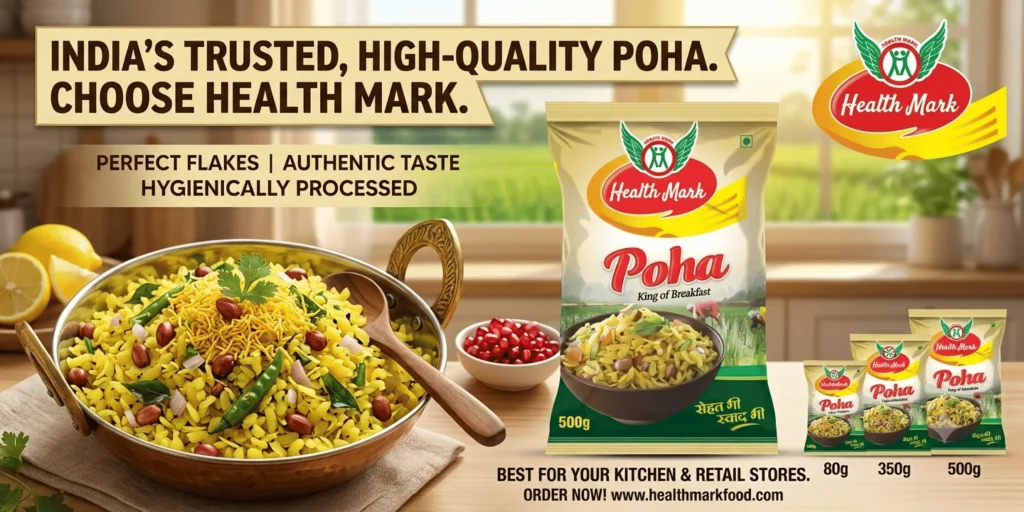
Health Mark Poha is available in 80gm, 350gm, and 500gm packs covering everything from a first-time trial purchase to regular family stock-up quantities, making it easier for both individual households and retailers to buy Poha in the size that suits them.
4. Strong Wholesale & Bulk Supply Capability
Beyond retail packs, Health Mark caters to distributors, kirana stores, and institutional buyers looking for a reliable Poha wholesaler in India. This makes the brand a practical option for anyone searching for a top Poha supplier capable of handling recurring bulk orders rather than one-off purchases.
5. Local Reputation Across Punjab & Himachal Pradesh
Being based in the Baddi–Chandigarh–Panchkula–Ludhiana industrial and retail corridor gives Health Mark an on-ground presence that many national-only brands lack. For anyone searching for the best Poha seller in Chandigarh or a top Poha seller near them in this region, a locally manufactured, hygienically packed option is a meaningful advantage. Shorter supply chains generally mean fresher stock reaching the shelf.
6. Part of a Wider Trusted Snacks & Staples Range
Health Mark doesn’t manufacture Poha in isolation; it sits within a broader Snacks category that includes roasted chana and papad, reflecting a manufacturing operation built around everyday Indian breakfast and snacking staples rather than a single, isolated product line.
Health Mark Poha vs. Typical Local/Unbranded Poha
| Parameter | Health Mark Poha | Typical Loose / Unbranded Poha |
| Grain Consistency | Uniform thickness, batch-controlled | Often mixed grades, inconsistent |
| Hygiene & Packing | Hygienically processed and sealed | Frequently sold loose, exposed to dust/moisture |
| Traceability | Branded, labelled, contactable manufacturer | Little to no traceability |
| Pack Size Options | 80gm / 350gm / 500gm | Usually sold by loose weight only |
| Bulk / Wholesale Supply | Available for distributors & retailers | Limited or informal supply chains |
| Regional Availability | Strong presence in Chandigarh, Panchkula, Baddi, Ludhiana | Varies by local vendor |
Health Benefits of Eating Poha Regularly
Beyond convenience, poha earns its place on the breakfast table because of its nutritional profile. A few reasons dietitians and home cooks alike continue to recommend it:
• Light and easy to digest is a good choice for mornings, post-workout meals, or when you want something gentle on the stomach.
• Naturally gluten-free, making it suitable for people avoiding wheat-based breakfasts.
• Low in fat when prepared with minimal oil, especially compared to fried breakfast options.
• A quick source of carbohydrate energy to start the day.
• Pairs well with peanuts and vegetables, which adds protein, fibre, and micronutrients to the final dish.
• Cooking poha with a squeeze of lemon adds vitamin C, which can support the absorption of iron already present in the dish.
How to Cook Perfect Poha at Home (Step-by-Step)
1. Rinse the poha briefly under running water for a few seconds, do not soak it for long, or it will turn mushy. Set it aside to soften on its own for 5 minutes.
2. Heat oil in a pan and add mustard seeds. Once they crackle, add curry leaves, chopped onion, and green chilli.
3. Sauté until the onion turns translucent, then add turmeric powder and salt.
4. Add the softened poha and gently toss to combine to avoid heavy stirring, which breaks the flakes.
5. Cover and cook on low heat for 2 minutes so the flavours settle in evenly.
6. Finish with a squeeze of fresh lemon juice, chopped coriander, and a handful of roasted peanuts or sev for crunch.
Popular Poha Recipes to Try
Kanda Poha (Maharashtra-style): The classic version with onions, mustard seeds, curry leaves, and a finishing squeeze of lemon.
Indori Poha: Topped with sev and a sprinkle of jeeravan masala for a spicier, more textured bite.
Batata Poha: Diced potatoes are sautéed along with the onions for a heartier, more filling meal.
Dahi Poha: A no-cook version mixed with fresh curd, ideal for hot weather or a light evening snack.
Poha Chivda: A roasted, spiced snack mix made from thicker poha perfect alongside tea or for festive gifting.
How to Identify Genuine High-Quality Poha Before You Buy
Whether you’re a home cook picking up a pack for the week or a retailer sourcing in bulk, a few checks go a long way in avoiding a disappointing purchase:
• Check the flake thickness. It should look uniform, not a mix of very thin and very thick pieces.
• Looking at the colour natural off-white to pale yellow is normal; unnaturally bright white can indicate bleaching.
• Check the packaging date and shelf life printed on the pack.
• Confirm the FSSAI licence number is visible on the packaging.
• Smell the product if the pack is transparent it should have a mild, natural rice aroma, not a musty or chemical smell.
• Research the brand’s reputation and established manufacturers with an online presence and verifiable contact details are generally more accountable than anonymous local packers.
• Compare the best Poha price across a few sellers, but treat price as one factor among several, not the only one.
Common Mistakes to Avoid When Buying or Cooking Poha
• Over-soaking the poha in water, which causes it to turn into a sticky paste.
• Buying loose, unbranded poha with no visible hygiene or packaging information.
• Ignoring pack size, buying a small trial pack for bulk household or business use, or a large pack when only occasional use is needed.
• Skipping the packaging/manufacturing date check, especially for loose stock sold from open sacks.
• Choosing the cheapest option purely on price while ignoring grain quality, hygiene, and consistency.
Where to Buy High-Quality Poha in India
For households looking to buy Poha online, Health Mark’s Poha product page allows direct ordering along with details on available pack sizes. Buyers can also browse the wider Snacks category to explore complementary products such as roasted chana and papad that pair naturally with a poha-based breakfast spread.
For retailers, distributors, and institutional buyers searching for a dependable Poha wholesaler in India or a top Poha supplier for recurring orders, Health Mark manufacturing base in Baddi is positioned to serve the Chandigarh, Panchkula, Baddi, and Ludhiana belt efficiently, alongside pan-India dispatch.
Health Mark Poha Pack Sizes & How to Order
| Pack Size | Best Suited For |
| 80 gm | First-time buyers wanting to try the quality before committing to a larger pack |
| 350 gm | Regular household / family weekly use |
| 500 gm | Bulk household stock-up, small retailers, and HORECA (hotel/restaurant/catering) use |
Health Mark keeps its pricing structured around pack size and order volume, so the best Poha price for your needs depends on whether you’re ordering for personal use or in bulk. For current pricing, place a product enquiry, or reach out directly:
• Call / WhatsApp: +91 93188 96005
• Call: +91 92185 87660
• Call: +91 98828 96000
• Address: Plot No. 60, Industrial Township Bhatoli Kalan, Baddi, India 173205
Why Choose Health Mark Over Local Poha Sellers
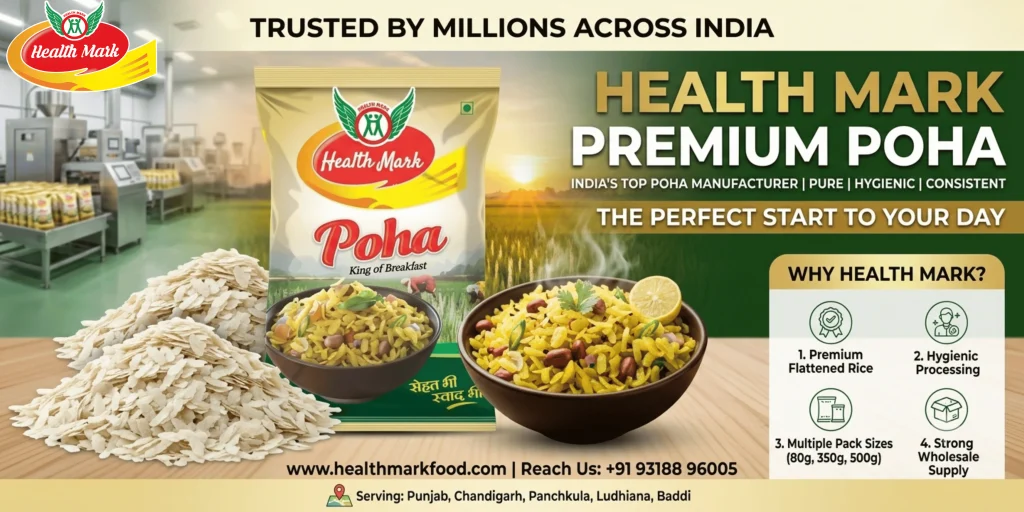
• Consistent, hygienically processed grain quality batch after batch.
• Multiple pack sizes suited to households, retailers, and bulk buyers alike.
• A traceable, contactable manufacturer rather than an anonymous local packer.
• Established presence across Chandigarh, Panchkula, Baddi, and Ludhiana, with pan-India ordering support.
• Part of a wider trusted food manufacturing operation spanning atta, besan, pulses, rice, spices, and snacks reflecting operational scale and accountability.
FAQ
Q1. What is the difference between regular poha and high-quality poha?
High-quality poha is made from well-selected, evenly flattened rice grains, processed hygienically, and packed in airtight conditions to preserve freshness. Regular or low-grade poha is often inconsistent in thickness, may contain broken grains, and is more likely to be handled or stored poorly.
Q2. Is Health Mark Poha suitable for daily use?
Yes. Health Mark Poha is designed to cook quickly and deliver a light, soft texture, making it suitable for everyday breakfast or snack preparation.
Q3. What pack sizes does Health Mark offer for Poha?
Health Mark Poha is available in 80gm, 350gm, and 500gm packs, catering to trial purchases, regular household use, and bulk requirements.
Q4. How can I place a bulk or wholesale order for Poha?
Bulk and wholesale buyers can contact Health Mark directly via phone or WhatsApp at +91 93188 96005, +91 92185 87660, or +91 98828 96000, or submit a product enquiry through the website.
Q5. Is poha a healthy breakfast option?
Poha is generally considered light, easy to digest, and naturally gluten-free. When prepared with vegetables, peanuts, and minimal oil, it can be part of a balanced breakfast. For personalized dietary advice, consult a qualified nutritionist.
Q6. How do I know if poha is fresh before buying?
Check the packaging date, look for a natural off-white to pale-yellow colour, confirm the FSSAI licence number is printed on the pack, and, where possible, check for a mild, natural rice aroma rather than a musty or stale smell.
Q7. Does Health Mark deliver Poha across India?
Health Mark serves customers primarily across Chandigarh, Panchkula, Baddi, and Ludhiana, with the ability to support wider pan-India orders especially for bulk and wholesale buyers. Contact the team directly to confirm delivery to your location.
Q8. Why does poha turn mushy after cooking?
This usually happens due to over-soaking the poha in water before cooking, or because the poha itself is made from very thin, low-quality flattened rice that breaks down quickly on contact with moisture.
Q9. What makes Health Mark a trusted Poha brand in India?
Health Mark combines hygienic processing, consistent grain quality, multiple pack sizes, and an established regional presence in Punjab and Himachal Pradesh, backed by a wider portfolio of food staples and transparent contact and ordering channels.
Q10. Can I use Health Mark Poha for recipes other than the traditional kanda poha?
Yes. The same pack works well for batata poha, dahi poha, Indori-style poha, and even roasted poha chivda, since the base ingredient flattened rice remains the same across recipes.
Conclusion
Poha’s charm lies in its simplicity but that simplicity only shines through when the base ingredient is genuinely good. Uneven grains, poor hygiene, or careless packaging can turn a five-minute breakfast into a frustrating one. That’s precisely the gap that a quality-focused manufacturer like Health Mark aims to close: premium flattened rice, hygienic processing, thoughtful pack sizing, and a supply chain built to serve homes, retailers, and bulk buyers alike.
If you’re looking for high quality Poha in India whether it’s a single 80gm trial pack for your kitchen or a recurring wholesale order for your store, Health Mark Poha is worth adding to your shortlist.