
Walk into any wholesale mandi in Haryana whether it’s Ambala, Karnal, Panipat, Kurukshetra, or Gurugram and you’ll notice something: besan sacks move faster than almost any other pulse-based flour on the shelf. That’s not a coincidence. Haryana sits at the crossroads of Punjab, Delhi NCR, Himachal Pradesh, and Rajasthan, which makes it a natural distribution hub for FMCG food products, including gram flour.
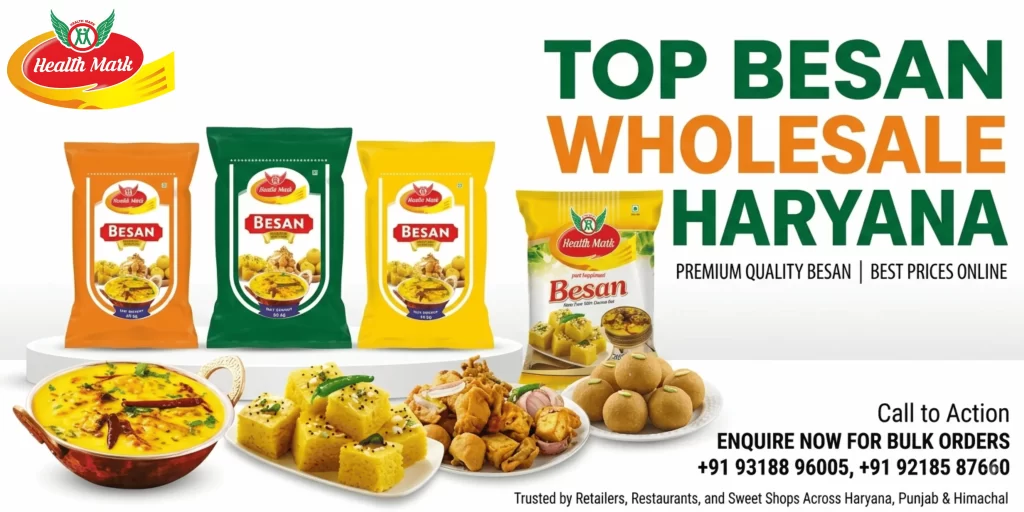
Retailers, sweet shops, restaurants, caterers, and snack manufacturers across the state need a dependable, high-volume source of besan not just any besan, but one that holds its colour, aroma, and binding quality batch after batch. That demand is exactly why “top besan wholesale in Haryana” has become such a common search among distributors, kirana store owners, and HoReCa (hotel, restaurant, catering) buyers looking to lock in a reliable supplier before festival season or wedding season hits.
This guide breaks down everything a serious bulk buyer needs to know: how to judge besan quality, what actually moves the besan price up or down, the mistakes that cost distributors money, and how a manufacturer like Health Mark fits into that supply chain.
What Exactly Is Besan And Why Quality Varies So Much
Besan, also called gram flour or chickpea flour, is made by milling chana dal (split Bengal gram) into a fine powder. It’s a staple across Indian households and food businesses because it’s naturally gluten-free, protein-dense, and endlessly versatile equally at home in a crispy pakora batter, a soft dhokla, a tangy kadhi, or a festive ladoo.
But here’s the catch: not all besan is created equal. The final product depends heavily on three variables the quality of chana dal used, the fineness of the grind, and how hygienically the flour is processed, stored, and packed. Two bags labelled “besan” can behave completely differently in a fryer or a mixing bowl, which is exactly why sourcing from the best Besan seller matters more than most buyers realise until they’ve been burned by an inconsistent batch.
Common Besan Varieties You’ll See in the Wholesale Market
Fine Besan (Powder Besan) – smooth, superfine texture ideal for sweets, ladoos, and batters that need a silky finish.
Bareek Besan – a slightly coarser fine grind, popular for everyday cooking and quick-mixing recipes.
Motichur / Mota Besan – a coarser grind traditionally used for motichur ladoo and boondi, where texture and bite matter.
Standard Besan – the everyday, all-purpose grade used across pakoras, kadhi, curries, and snacks.
What Makes a Brand the “Best Besan Brand in India”? A Buyer’s Checklist
Every packet on a wholesaler’s shelf claims to be premium quality Besan. The real test is what happens when you actually cook with it does it clump, does it smell musty, does the colour turn dull after a few weeks of storage? Before you commit to a bulk order, run any potential supplier through this checklist.
1. Source Chana Dal Quality
The best Besan starts with the best raw material. Chana dal that’s been cleaned, sorted, and stored correctly produces flour with a naturally golden colour and a rich, nutty aroma. Poor-quality or old dal produces flour that tastes flat and turns bitter when fried.
2. Grind Consistency and Texture
A top selling Besan in India is almost always ground to a consistent particle size. Inconsistent grinding leads to lumpy batters, uneven frying, and wasted product a real problem when you’re buying in 25kg or 50kg sacks for a commercial kitchen.
3. Hygiene, Processing & Packaging
Bulk buyers should ask how the besan is milled, sieved, and packed. Moisture control is critical besan that isn’t packed correctly develops a stale smell and attracts pests far faster than properly sealed stock.
4. Supply Consistency
A besan manufacturer in India that can guarantee the same taste, colour, and texture across every batch month after month is worth far more to a distributor than one that’s occasionally cheaper but inconsistent. For retailers and caterers, predictability is what protects their own reputation with customers.
5. Transparent Besan Price and Communication
The best Besan supplier will quote wholesale besan price clearly, based on quantity slabs, packaging size, and delivery location, without hidden charges tacked on after the order is confirmed.
Before finalising any bulk order, request a small sample pack. Fry a test batch of pakoras or prepare a simple besan chilla texture, colour, and aroma will tell you more in five minutes than any sales pitch.
Meet Health Mark: A Besan Manufacturer Built for Bulk Buyers
Health Mark is a food manufacturing company built around one simple idea: everyday staples like atta, besan, pulses, and spices should be as pure as home-ground. Health Mark Besan is made from carefully selected chana dal, finely milled to deliver a smooth texture and a rich, nutty flavour that holds up whether it’s going into a savoury pakora or a sweet ladoo. You can explore the complete range on the official Besan category page or view full product specifications on the Health Mark Besan product page.
What makes Health Mark relevant to buyers searching for the best health mark Besan and “top besan wholesale in Haryana” isn’t just the product it’s the positioning. The company’s operations are centred in the Chandigarh–Panchkula–Baddi–Ludhiana belt, placing it within comfortable reach of Haryana’s major wholesale markets, distributors, and retail chains across the tricity region and beyond.
Why Distributors Are Considering Health Mark as a Top Besan Supplier
• Made from premium quality chana dal, sourced and milled for a consistent, smooth texture.
• Multiple product formats Besan, Bareek Besan, Motichur/Mota Besan, and Powder Besan to match different commercial use-cases.
• Hygienically processed and packed to protect freshness through transit and storage.
• Flexible pack sizes (55gm, 200gm, 500gm, 1kg) that suit both retail shelf stocking and institutional buying.
• Direct enquiry and WhatsApp ordering, which shortens the usual back-and-forth of traditional wholesale sourcing.
For a retailer or caterer specifically hunting for besan seller near me options with real production backing rather than just a reseller, that combination of product range and direct manufacturer access is exactly what shortens the sourcing process.
Besan Price in India: What Really Drives Wholesale Rates
Besan price is rarely static it moves with the chana (chickpea) crop cycle, monsoon performance, and mandi demand. Understanding the underlying drivers helps a wholesale buyer negotiate smarter and time bulk purchases better, instead of reacting to a single day’s rate.
| Factor | Impact on Besan Price |
| Chana dal crop yield | A strong harvest usually softens raw material cost; a weak monsoon or lower sowing tightens supply and pushes rates up. |
| Seasonal demand | Prices typically firm up ahead of festivals (Diwali, Holi) and wedding season, when sweet and snack production spikes. |
| Order quantity / slab | Larger bulk orders (bags, cartons, pallet quantities) generally unlock better per-kg wholesale besan rates than small-lot buying. |
| Packaging format | Loose/bulk sacks are usually more economical per kg than smaller retail-ready pouches, which carry extra packaging and branding cost. |
| Freight & delivery distance | Transport cost to your city or mandi within Haryana, Punjab, HP, or Chandigarh factors into the final landed price. |
| Milling grade | Superfine Powder Besan generally commands a slightly different price point than standard or Motichur-grade besan due to processing time. |
Because rates shift with these variables, the most reliable way to get an accurate, current besan price for your required quantity is to speak directly with the supplier’s sales team. For Health Mark current wholesale quotes, you can call or WhatsApp +91 93188 96005, +91 92185 87660, +91 98828 96000 and ask for a slab-wise rate card.
How to Choose the Best Besan Seller Near You
If you’re typing “besan seller near me” into a search bar, you’re probably trying to solve for two things at once: proximity and reliability (so you’re not gambling on quality every time you restock). Here’s a practical, step-by-step approach.
Shortlist manufacturers, not just traders a besan manufacturer in India controls quality from milling to packing, while a pure trader is only as good as whoever supplied them.
Check product range a supplier offering Besan, Bareek Besan, Motichur Besan, and Powder Besan in one place saves you from juggling multiple vendors.
Ask for pack-size flexibility confirm they can supply both small retail packs and bulk quantities depending on your business type.
Request a sample before a large order texture, colour, and smell are non-negotiable quality signals.
Compare delivery reach a supplier based in the Chandigarh–Panchkula–Baddi–Ludhiana belt, for instance, is well positioned to serve Haryana, Punjab, and Himachal Pradesh efficiently.
Confirm communication channels a direct enquiry line or WhatsApp ordering option (like Health Mark’s) speeds up reorders significantly.
Manufacturer vs Middleman: Why Buying Direct Changes the Math
Many retailers still buy besan through two or three layers of middlemen without realising how much margin and how much quality control gets lost along the way. Buying from a besan manufacturer in India directly changes both sides of that equation.
| Factor | Buying via Middlemen | Buying Direct from a Manufacturer |
| Pricing transparency | Multiple margins stacked, harder to verify | Direct rate card, clearer wholesale besan price |
| Quality consistency | Depends on which mill supplied the trader that week | Controlled milling process, consistent batches |
| Order flexibility | Limited to what’s in the trader’s current stock | Can request specific grades (fine, bareek, motichur) |
| Communication | Often slower, multiple intermediaries | Direct enquiry / WhatsApp with the supplier |
| Traceability | Difficult to trace back to source | Manufacturer accountable for entire process |
Where Besan Goes to Work: Uses Across Kitchens & Food Businesses
Understanding where besan actually gets used helps bulk buyers estimate order volumes and pack-size mix more accurately.
• Snacks & street food: pakoras, bhajiyas, kachori fillings, and namkeen production.
• Sweets: besan ladoo, mysore pak, and other traditional Indian mithai.
• Everyday cooking: kadhi, gatte ki sabzi, besan chilla, and thickening agents for curries.
• Steamed snacks: dhokla and khaman, where fine-grade besan is essential for a light, airy texture.
• Bakery & fusion products: gluten-free baking blends increasingly use besan as a base or supporting flour.
This breadth of use is exactly why demand for top selling Besan in India stays strong through the year, with predictable spikes around festivals and wedding season a pattern worth planning your wholesale purchase calendar around.
Comparison Table: Health Mark’s Besan Product Range
Full specifications and enquiry options are available on the Health Mark Besan category page.
| Product | Grind / Texture | Best Suited For | Pack Sizes |
| Besan | Standard, all-purpose fine grind | Everyday cooking, pakoras, kadhi | 55gm, 200gm, 500gm, 1kg |
| Bareek Besan | Fine, smooth grind | Batters, quick-mix recipes | As per order / bulk enquiry |
| Motichur / Mota Besan | Coarser grind | Motichur ladoo, boondi, festive sweets | As per order / bulk enquiry |
| Powder Besan | Superfine powder texture | Sweets, ladoos, silky-finish batters | As per order / bulk enquiry |
Common Mistakes Bulk Buyers Make (And How to Avoid Them)
Mistake 1: Chasing the Lowest Besan Price Without Checking Quality
The cheapest quote per kg often hides a lower chana dal grade or inconsistent milling. A slightly higher price from a best Besan brand in india with consistent quality usually saves money in the long run through less wastage and fewer customer complaints.
Mistake 2: Not Sampling Before a Bulk Order
Skipping the sample step is the single most common regret distributors mention after a bad bulk purchase. A small test order costs little and protects a much larger investment.
Mistake 3: Ignoring Packaging and Storage Conditions
Besan absorbs moisture and odours easily. Even premium quality Besan can spoil quickly if stored in a humid warehouse or transported in poorly sealed packaging.
Mistake 4: Relying on a Single Supplier With No Backup
Supply gaps happen crop shortages, transport delays, festival-season demand spikes. Having a reliable second option, or a manufacturer with strong production capacity, protects your business from stockouts.
Mistake 5: Overlooking Pack-Size Flexibility
A supplier that only offers one pack format forces you to repackage stock yourself, adding labour cost. Choosing a besan manufacturer in India offering multiple sizes from 55gm retail sachets to 1kg and bulk sacks simplifies your entire inventory chain.

How to Place a Wholesale Besan Order With Health Mark
1. Browse the range on the Besan category page to shortlist the grades and quantities you need.
2. Check product details on the Besan product page, including pack sizes and description.
3. Reach out directly for a wholesale quote by phone or WhatsApp.
4. Share your required quantity, pack size preference, and delivery location for an accurate besan price.
5. Confirm the order and delivery timeline for your region Haryana, Punjab, Chandigarh, Himachal Pradesh, and neighbouring states.
Call or WhatsApp: +91 93188 96005, +91 92185 87660, +91 98828 96000 | Website: healthmarkfood.com
FAQ
1. Which is the best Besan brand in India for wholesale buyers?
The best Besan brand for wholesale depends on consistency, hygiene standards, and supply reliability rather than just price. Health Mark positions itself as a strong option for distributors in Haryana and neighbouring states, offering multiple besan grades made from premium quality chana dal with flexible pack sizes for bulk buyers.
2. What is the current Besan price for bulk orders?
Besan price fluctuates with chana dal crop cycles, seasonal demand, and order quantity, so there isn’t a single fixed rate. The most accurate way to get current wholesale besan price is to contact the supplier directly with your required quantity and delivery location.
3. How do I find a reliable besan seller near me?
Start by shortlisting manufacturers rather than resellers, since manufacturers control quality from milling to packing. Request a sample, compare pack-size flexibility, and check how quickly the supplier responds to enquiries direct WhatsApp ordering, like Health Mark offers, is a good sign of a responsive besan seller.
4. What’s the difference between Bareek Besan, Motichur Besan, and regular Besan?
Bareek Besan has a fine, smooth grind suited to batters and everyday cooking. Motichur or Mota Besan is coarser and traditionally used for motichur ladoo and boondi. Regular or standard Besan is the everyday, all-purpose grade used across pakoras, kadhi, and general recipes.
5. Is besan the same as gram flour or chickpea flour?
Yes. Besan, gram flour, and chickpea flour all refer to the same product flour milled from chana dal (split Bengal gram). It’s naturally gluten-free and higher in protein and fibre than refined wheat flour, based on nutritional data referenced on Wikipedia.
6. How can I check if besan is of premium quality before buying in bulk?
Check the colour (a natural golden-yellow, not dull or greyish), the aroma (fresh and nutty, not musty), and the texture (fine and free-flowing, not clumpy). Requesting a small sample and test-frying or test-cooking with it before committing to a bulk order is the most reliable check.
7. Does Health Mark supply besan to Haryana and nearby states?
Health Mark’s operations are centred in the Chandigarh–Panchkula–Baddi–Ludhiana belt, which places it within easy reach of Haryana, Punjab, and Himachal Pradesh. For delivery availability and timelines specific to your city, it’s best to confirm directly with the sales team on the contact numbers listed on the website.
8. What pack sizes are available for retailers versus bulk distributors?
Health Mark Besan is available in 55gm, 200gm, 500gm, and 1kg packs for retail and regular household or small-business use, with bulk and wholesale quantities available on enquiry for distributors, caterers, and food manufacturers.
9. Why does besan price vary so much between suppliers?
Price differences usually come down to raw material grade, milling quality, packaging cost, and freight distance. A lower price sometimes reflects a lower-grade chana dal or less consistent processing, which is why comparing quality alongside price matters more than comparing price alone.
10. How do I place a wholesale enquiry with Health Mark?
You can enquire directly through the Besan product page, via WhatsApp, or by calling +91 93188 96005, +91 92185 87660, +91 98828 96000 to share your required quantity, grade, and delivery location for a wholesale quote.
Final Word
Sourcing besan in bulk isn’t just about finding the lowest besan price it’s about finding a supplier whose quality doesn’t waver, whose supply doesn’t dry up during festival season, and who treats your reorder call as seriously as your first order. Whether you’re a retailer in Ambala, a caterer in Panipat, or a distributor covering Haryana more broadly, the fundamentals stay the same: check the raw material, sample before you commit, and buy as close to the manufacturer as you can.
If you’re ready to explore a dependable, direct source of premium quality Besan, browse the full range on the Health Mark Besan category page, check specifications on the Besan product page, or simply call or WhatsApp the team at +91 93188 96005, +91 92185 87660, +91 98828 96000 to request your wholesale quote today.