
Choosing the right besan is essential for sweet shops, halwais, namkeen manufacturers, and catering businesses that want to maintain consistent taste and quality. Whether preparing traditional motichur laddoos, crispy boondi, or other Indian sweets, the texture, freshness, and quality of besan can significantly influence the final result.
Finding a reliable motichur besan wholesale seller near me is therefore an important consideration for businesses that regularly purchase gram flour in bulk. High-quality mota besan, with its distinctive coarse texture, is particularly suitable for traditional sweet preparations where the right consistency matters.
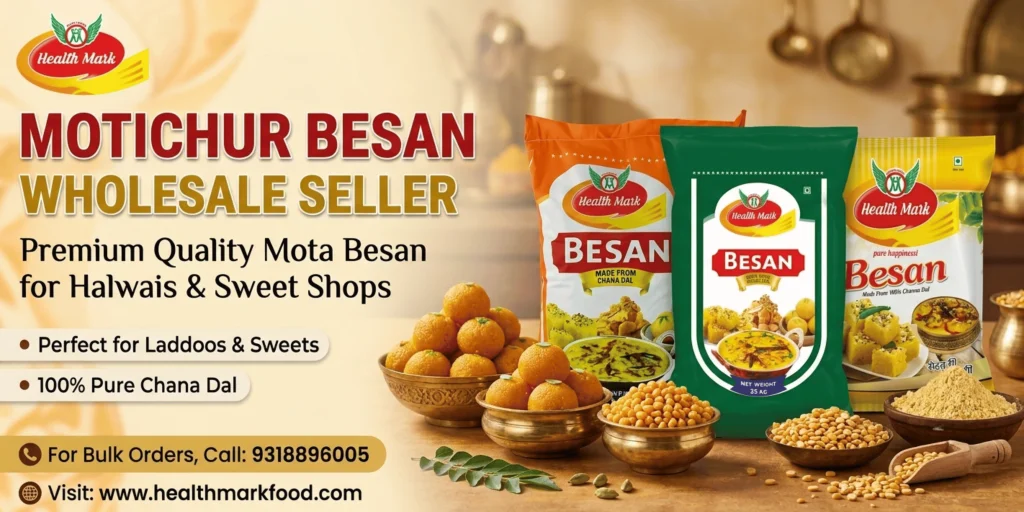
However, selecting a wholesale supplier involves more than comparing prices. Businesses should consider the quality of raw materials, consistency of grinding, freshness, packaging, and availability before placing bulk orders.
For sweet shops, food manufacturers, and wholesalers in Chandigarh, Panchkula, Baddi, and nearby regions, Health Mark offers motichur besan and other gram flour varieties for different commercial cooking requirements.
What Is Motichur Besan (Mota Besan)?
Besan is gram flour, made by milling chana dal (split Bengal gram). It is one of the most used flours in Indian kitchens, from pakora and kadhi to ladoo and namkeen.
Mota besan simply means coarse-ground besan. You may also hear it called dara besan or coarse gram flour. The particles are visibly larger than regular besan, so the flour feels slightly grainy between your fingers.
The word motichur comes from the famous ladoo made of tiny, pearl-like boondi. Sweet makers often reach for a coarser grind for these preparations because it gives better texture and a more traditional bite. Health Mark’s own product, Motichur / Mota Besan, is described as coarsely ground gram flour for recipes that need a slightly grainy texture.
How it looks and feels
- Colour: warm pale yellow, never grey or dull
- Texture: sandy and granular, not powdery
- Aroma: mild, nutty, clean
- Behaviour: absorbs water more slowly, gives structure to batter and roasted mixtures
Mota Besan vs Bareek Besan vs Powder Besan
Many buyers order the wrong grind simply because the names sound similar. This table clears it up.
| Feature | Mota (coarse) besan | Regular / bareek besan | Very fine powder besan |
| Particle size | Large, granular | Medium to fine | Very fine, silky |
| Texture in food | Grainy, rich bite | Smooth | Very smooth, soft |
| Best for | Besan ladoo, boondi-based sweets, mohanthal-style mixtures, halwa | Pakora, kadhi, chilla, general cooking | Batter coatings, fine namkeen, sev |
| Roasting behaviour | Roasts evenly, releases nutty aroma | Can brown quickly | Can burn if heat is high |
| Common buyer | Halwais, sweet manufacturers | Households, restaurants | Snack factories |
The takeaway is simple: do not buy by name alone. Ask for a small sample, rub it between your fingers and cook a test batch.
Why the Right Besan Decides Your Ladoo
A ladoo is only as good as its base. Sugar, ghee and cardamom get the credit, but besan does the heavy lifting.
1. Texture. A coarse grind gives the ladoo that sandy, melt-in-the-mouth quality people remember. Too fine and the ladoo turns pasty. Too coarse and it feels gritty.
2. Roasting time and aroma. Good coarse flour roasts slowly in ghee and develops a deep, toasty fragrance. Old or poorly stored flour smells flat and can taste faintly bitter after roasting.
3. Binding. The right particle size lets the mixture hold shape without too much ghee. That saves cost over hundreds of kilos.
4. Consistency between batches. If the grind changes every delivery, your product changes too. Regular customers notice.
For anyone who sources besan for sweets manufacturing, consistency is worth as much as the price per kilo. A cheap lot that behaves differently each time costs more in wasted ghee, labour and rejected trays.
How to Judge Premium Quality Besan
You do not need a lab. A trained eye, nose and a few simple tests will tell you most of what you need.
The 7-point quality check
- Colour: Uniform, bright, light yellow. Patchy or greyish shades can suggest old stock or poor raw material.
- Smell: Fresh and slightly nutty. Musty, sour or oily smells are red flags.
- Feel: Rub a pinch between thumb and finger. Mota besan should feel granular and dry, not damp or sticky.
- Grind uniformity: Spread a spoonful on a dark plate. Very large lumps or a mix of dust and chunks mean uneven milling.
- Taste: Chew a tiny pinch. It should taste mildly sweet and clean, with no bitterness.
- Batter test: Mix with water. Good flour forms a smooth, workable batter and does not separate quickly.
- Pack condition: Clean, sealed, properly labelled sacks with batch details and no moisture marks.
What “premium quality chana” means
The starting grain matters more than any marketing line. Premium besan begins with well-cleaned, graded chana, free from stones, husk and discoloured grains. Health Mark lists premium quality chana and hygienic packing among the reasons to choose its Motichur / Mota Besan, which is the right order of priorities: raw material first, packing second.
Nutrition at a glance
Gram flour is naturally gluten-free and valued for its plant protein and fibre. Nutrient databases such as the USDA FoodData Central list chickpea flour as a good source of protein and dietary fibre compared with refined wheat flour. Exact values vary by product, so check the pack label for specifics.
Best Uses | Sweets, Namkeen and Pakora
Besan for ladoo making
Coarse besan is the classic choice for traditional besan ladoo. You roast it in ghee on a low flame until it turns golden and aromatic, then bind it with powdered sugar. The grainy texture is what makes the ladoo feel authentic rather than dense.
Besan for motichur ladoo
Motichur ladoo depends on tiny, even boondi. Batter consistency, flour quality and frying temperature all play a part. Grind preferences vary from one halwai to another, so it pays to test two or three grades before committing to a bulk order.
Besan for namkeen manufacturing
Sev, bhujia, boondi and other fried snacks need flour that gives crispness without absorbing too much oil. Namkeen units usually blend grinds, and many keep coarse and fine besan in stock to adjust texture.
Besan for pakora
For pakora, most cooks prefer a regular smooth grind, though a small share of coarse besan adds a pleasant crunch to the coating. It is a simple trick for restaurants that want crunchier results without extra rice flour.
Other uses
- Besan halwa and mohanthal-style sweets
- Besan chakki and burfi
- Kadhi and savoury cheela
- Coating for bhaji and tikki
Step-by-Step: Run a Trial Before You Place a Bulk Order
Any reputable supplier should be happy for you to test before you commit. Here is a simple method.
- Ask for a sample of the exact grade you plan to buy, from a current batch.
- Inspect it using the 7-point check above.
- Roast 1 kg in ghee on low heat and note how long it takes to turn aromatic.
- Taste the roasted flour before adding sugar. Bitterness shows up clearly at this stage.
- Make a small batch of ladoo and let it rest overnight. Check shape, texture and flavour the next morning.
- Make a boondi or namkeen test if that is your use case.
- Compare against your current supplier on yield, texture and cost per finished kilo, not just price per kilo of flour.
- Place a small first order and repeat the test on the delivered stock to confirm consistency.
Common Buying Mistakes
| Mistake | Why it hurts | Better approach |
| Choosing only on lowest price | Poor yield, bitterness, rejected batches | Compare cost per finished kilo |
| Not testing a sample | Surprises after a full order | Always test first |
| Mixing up grinds | Wrong texture in sweets | Specify coarse / mota in writing |
| Ignoring packing date | Stale flour with weak aroma | Ask for the batch and packing date |
| Buying more than you can store | Moisture and pests | Order in cycles that match usage |
| Relying on a middleman | Weak accountability | Prefer a manufacturer or direct supplier |
Storage and Handling in Bulk
Even excellent flour deteriorates if stored badly. Follow these basics:
- Keep sacks on pallets or raised racks, away from walls and floors
- Store in a cool, dry, well-ventilated room
- Keep away from strong-smelling items such as spices, pickles and oils
- Use older stock first (FIFO)
- Once a sack is opened, transfer the contents to a clean, airtight bin
- Check regularly for lumps, odours or insect activity, especially in the monsoon
For food businesses, it is also wise to follow the licensing and labelling expectations set by the Food Safety and Standards Authority of India (FSSAI). Always confirm current requirements on the official FSSAI website.
How to Choose a Wholesale Supplier
When you search for a wholesale gram flour source, price is only one line on the checklist. Use these questions.
Questions to ask any supplier
- Are you a manufacturer or a trader?
- Which grinds do you offer (coarse, regular, fine)?
- What pack sizes are available for bulk orders?
- Can I get a sample before ordering?
- How do you control quality and hygiene during milling and packing?
- What are your delivery timelines to my city?
- Can you supply regularly, not just once?
Why location matters
A nearby supplier means faster restocking, lower freight, fresher flour and easier follow-up if something goes wrong. If you are in the tricity, a besan supplier in Chandigarh or a besan supplier in Panchkula with a nearby production base can usually deliver quicker than one based hundreds of kilometres away.
Manufacturer vs trader
A besan manufacturer in India with its own processing unit has direct control over raw material, grind and packing. That control is what protects you from sudden quality swings. Traders may offer many brands, but they depend on someone else’s consistency.
What Makes the Best Besan Brand in India?
Choosing the best besan brand in India involves more than comparing prices or brand popularity. Quality, freshness, consistent texture, hygienic packaging, and reliable availability are important factors for retailers, sweet shops, restaurants, and food manufacturers.
A dependable besan brand should offer products that meet different cooking requirements while maintaining consistent quality across purchases. Whether you need fine besan for smooth batters or mota besan for traditional sweets like motichur laddoos, selecting the right variety can improve your cooking results.
When comparing the best besan options, consider product freshness, grinding consistency, packaging quality, and supplier reliability. Health Mark offers different besan varieties for household and commercial requirements, making it an option worth exploring for businesses seeking quality gram flour in bulk.
Health Mark Motichur / Mota Besan: A Closer Look
Health Mark is a food company in Baddi, Himachal Pradesh, in the Baddi-Barotiwala industrial belt, close to Panchkula and Chandigarh. It supplies a range of FMCG food products including atta, pulses, rice, spices, oils, snacks and Health Mark Besan in several grinds.
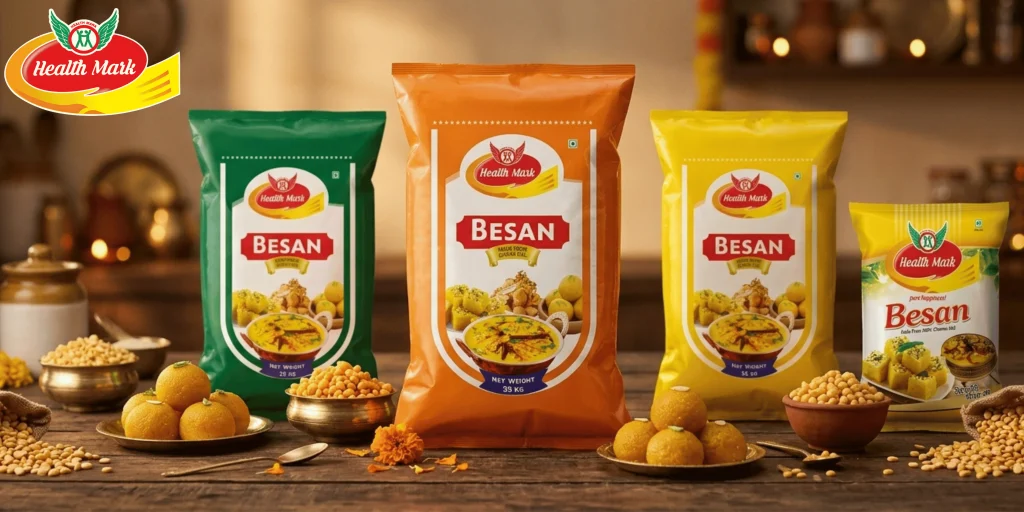
The Motichur / Mota Besan is made for recipes that need coarse texture.
Key details
| Detail | Information |
| Product | Motichur / Mota Besan (coarse gram flour) |
| Pack size listed | 35 kg |
| Best for | Ladoo, boondi, traditional sweets and snacks |
| Highlights | Coarse texture, rich natural flavour, premium quality chana, hygienic packing |
| Category | Besan |
| Location | Plot No. 60, Industrial Township, Bhatoli Kalan, Baddi, India 173205 |
Who is it for?
- Halwais and sweet shops that make ladoo and boondi daily
- Namkeen and snack units needing a coarse component for texture
- Caterers preparing festive sweets in volume
- Retailers and distributors looking for bulk besan for halwais and sweet shops
Because the pack is a 35 kg bulk size, it suits businesses that go through flour regularly. You can view the full product page here: Motichur / Mota Besan and compare other grinds in the Besan category.
How to order
Call or WhatsApp the sales team:
- +91 93188 96005
- +91 92185 87660
- +91 98828 96000
Explore the full range at healthmarkfood.com and request a sample or quotation for your volume.
FAQ
1. What is motichur besan?
Motichur besan is coarsely ground gram flour used for traditional sweets such as besan ladoo and boondi-based preparations. Its granular texture gives a richer bite than fine flour.
2. What is the difference between mota besan and regular besan?
Mota besan has larger particles and a grainy feel. Regular besan is smooth and finer, and is better for batter-based dishes like pakora and kadhi.
3. Which besan is best for ladoo making?
Most halwais prefer coarse or medium-coarse besan for ladoo because it roasts evenly and gives a sandy, melt-in-the-mouth texture.
4. How do I check if besan is fresh and pure?
Look for uniform pale yellow colour, a clean nutty smell, a dry granular feel and no bitterness when tasted. Check the packing date and batch details on the sack.
5. Can I use mota besan for pakora?
Yes, though many cooks prefer regular besan for pakora. Adding a little coarse besan can give extra crunch.
6. What pack size is available for bulk buying at Health Mark?
The Motichur / Mota Besan product page lists a 35 kg pack. For other quantities, contact the sales team directly.
7. Where can I find a besan supplier in Chandigarh or Panchkula?
Health Mark operates from Baddi, close to the tricity, and supplies besan to sweet shops, namkeen units and distributors in the region. Call the sales numbers above for availability and delivery details.
8. How should I store besan in bulk?
Keep it in a cool, dry, ventilated space on raised racks, away from strong odours, and use older stock first. Transfer opened sacks to airtight containers.
9. Is besan gluten-free?
Pure gram flour is naturally gluten-free because it comes from chickpeas. If you have a strict medical need, check the label for cross-contact information.
10. Does besan go bad?
Yes. Over time it can turn stale, bitter or attract pests, especially in humid conditions. Buy in quantities you can use within a reasonable period and store it properly.
Conclusion
Choosing the right besan supplier is essential for sweet shops, namkeen manufacturers, caterers, and food businesses that depend on consistent quality and taste. High-quality motichur or mota besan plays an important role in achieving the desired texture, flavour, and appearance of traditional Indian sweets such as laddoos and boondi.
When selecting a motichur besan wholesale supplier, businesses should consider freshness, grinding consistency, hygienic packaging, product quality, and reliable availability. These factors help maintain consistent cooking results and build long-term customer satisfaction.
For businesses looking for premium quality mota besan in Chandigarh, Panchkula, Baddi, and nearby regions, Health Mark offers besan varieties suitable for different commercial and traditional cooking requirements. Choosing quality ingredients from a dependable supplier can help businesses maintain product standards and deliver an enjoyable food experience to their customers.