
Whether you run a sweet shop in Ludhiana, a roadside dhaba along Punjab’s GT Road, a catering business in Amritsar, or a grocery store in Jalandhar, the quality of besan plays an important role in your food preparations. From crispy pakoras and traditional laddus to flavourful kadhi, choosing fresh, quality gram flour helps maintain consistent taste, texture, and customer satisfaction.
For food businesses, besan is more than just an everyday ingredient. It is an essential part of many traditional Indian recipes. Choosing a reliable supplier can make a real difference in product consistency, ingredient quality, and overall business operations.
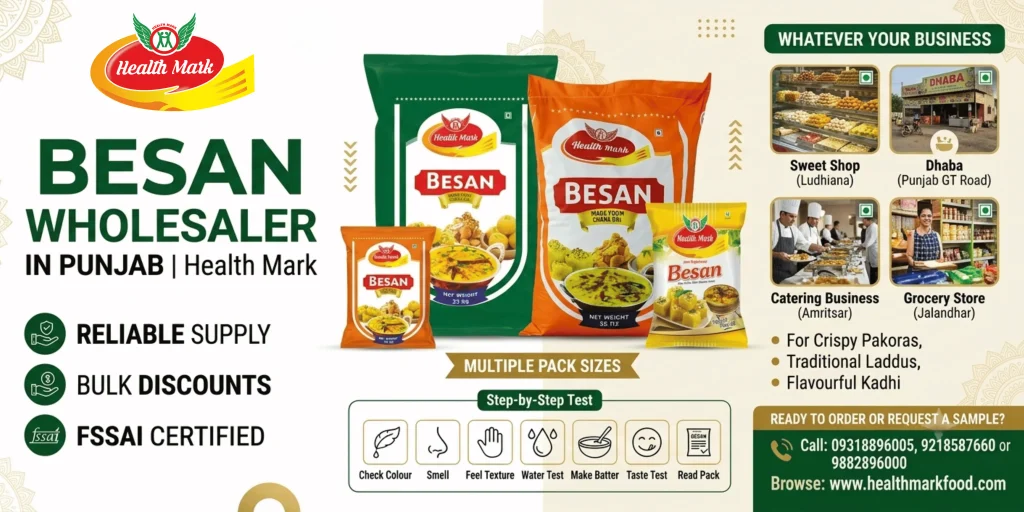
If you are searching for a dependable besan wholesaler in Punjab, this guide will help you understand how gram flour is made, what determines its quality, how wholesale pricing works, and what to consider before placing a bulk order. We will also introduce Health Mark, a food brand based in Baddi, Himachal Pradesh, and explain how businesses across Punjab can explore its besan products for their commercial requirements.
What Is Besan and Why Bulk Buyers Care About Its Quality
Besan, also called gram flour, chana flour or chickpea flour, is made by milling chana dal (split Bengal gram). It is a staple across Indian kitchens, used in pakoras, bhajiyas, dhokla, kadhi, laddu, mysore pak, boondi, chilla and countless batters.
For a household, a slightly off packet is an annoyance. For a business, it is a recurring loss. Think about what a quality slip does at scale:
- A sweet shop that uses inconsistent besan gets laddus that vary in colour and binding from one tray to the next.
- A namkeen unit sees uneven frying, because moisture levels differ between lots.
- A caterer ends up with lumpy batter at a wedding with 500 guests waiting.
This is why serious buyers treat their gram flour source as a long-term partnership rather than a one-off purchase.
Why Punjab Is Such a Strong Market for Gram Flour
Punjab’s food culture leans heavily on besan. Think of pakoras with evening chai, kadhi pakora on Sunday afternoons, besan chilla at breakfast, besan laddu at gurdwara langar and festival sweet counters. Add the state’s dense network of dhabas, halwai shops, restaurants, hostels, caterers and packaged-snack units, and you get steady, year-round demand.
A few practical reasons buyers here are particular:
- Winter spikes. Demand for pakoras, kadhi and besan sweets rises sharply in the cold months, so supply continuity matters.
- Festival peaks. Lohri, Baisakhi, Diwali and wedding seasons push bulk orders up in short windows.
- Taste expectations. Punjabi customers are used to a rich, slightly nutty flavour and a smooth batter that clings well.
- Competitive pricing. Margins on snacks are thin, so wasted stock hurts quickly.
Because of this, a good supplier needs to deliver on three fronts together: quality, price and punctuality.
Types of Besan and Where Each One Works Best
Not every recipe wants the same grind. Health Mark’s besan category currently lists four variants: Besan, Bareek Besan, Motichur / Mota Besan and Powder Besan. Here is how the grind styles generally map to uses across the trade.
| Type | Texture | Typical Uses |
| Regular Besan | Smooth, all-purpose | Pakoras, kadhi, chilla, dhokla, everyday cooking |
| Bareek (Fine) Besan | Very fine, silky | Smooth batters, sev, delicate sweets, thin coatings |
| Motichur / Mota (Coarse) Besan | Slightly granular | Motichur laddu, boondi, mysore pak-style sweets, texture-forward recipes |
| Powder Besan | Fine powder form | Quick mixes, coatings, bulk kitchen use |
You can view all four options on the Health Mark Besan category page.
How to Identify Best Quality Besan: A Step-by-Step Test
Before signing a supply deal, put the sample through a simple check. You do not need a lab for this. You need ten minutes and a clear kitchen counter.
Step 1: Check the colour
Good gram flour has an even, pale yellow shade. Patchy colour, grey tinge or dull dark spots can point to poor raw material, old stock or mixing with other flours.
Step 2: Smell it
Fresh besan has a mild, nutty, slightly sweet aroma. A musty, sour or oily smell suggests age or moisture exposure.
Step 3: Feel the texture
Rub a pinch between your fingers. It should feel smooth and dry, not damp or gritty (unless you bought the coarse grade on purpose).
Step 4: Do the water test
Mix a spoonful in water. Good flour disperses evenly and forms a uniform paste. Large gritty particles or a layer of residue at the bottom can indicate impurities.
Step 5: Make a small batter
Whisk a thick batter with water and a pinch of salt. It should turn smooth without stubborn lumps and hold together when fried. Observe how much oil the pakoras absorb and how crisp they stay after ten minutes.
Step 6: Taste test
Taste a small portion of cooked batter or a roasted pinch. Raw, bitter or acrid notes are a warning sign.
Step 7: Read the pack
Look for the manufacturing date, batch number, ingredients, net weight and FSSAI licence number. If any of these is missing, ask why before ordering.
A supplier who happily lets you run these checks is usually confident about their product. That confidence is a good sign.
Ten Questions to Ask Before You Choose a Supplier
Before you commit to a besan seller near me style local search result, ask these questions directly:
- Do you mill the flour yourselves or resell from another unit?
- Which raw material do you use, and how do you screen it before milling?
- How often do you mill, and how fresh will my stock be on arrival?
- Can I get a free or low-cost sample before the bulk order?
- What pack sizes and bulk bags are available?
- Do you hold a valid FSSAI licence and can you share the number?
- What is your minimum order quantity?
- How do you handle a quality complaint or a rejected batch?
- What are your delivery timelines to my city?
- Do you supply other staples, so I can consolidate orders?
The last question is more important than it looks. A supplier that also stocks atta, pulses, rice, spices and oils can save you freight cost, paperwork and follow-up calls.
Local Trader vs Mill vs Manufacturer: A Comparison
| Factor | Small Local Trader | Local Chakki / Mill | Manufacturer-Direct Supplier |
| Batch consistency | Varies, depends on source | Fair, depends on raw material | Higher, process-controlled |
| Packaging and labelling | Often loose or unbranded | Basic | Branded, labelled, sealed |
| Traceability | Low | Medium | Higher |
| Price transparency | Several margins in chain | Moderate | Fewer layers |
| Range of products | Narrow | Narrow | Broader FMCG range possible |
| Bulk and repeat supply | Unpredictable | Limited capacity | Planned, scalable |
There is nothing wrong with a good local trader. But if your business depends on repeatable results, going closer to the source usually reduces surprises.
Understanding Besan Pricing
Every buyer asks about the best besan price, and every buyer is a little disappointed by the honest answer: there is no single number. The rate changes with the market. What you can control is how you compare.
What drives the price of besan
- Chana dal rates. Raw material is the biggest component and moves with crop size, mandi arrivals and demand.
- Grade and grind. Fine and specialty grinds can cost more than regular.
- Packaging. A 55 g retail pouch and a 1 kg pack have very different cost structures per kilo.
- Freight and distance. Transport to your city adds to the landed cost.
- Order volume. Larger, repeat orders generally earn better rates.
- Season. Winter and festival periods tighten supply.
How to compare quotes fairly
- Ask for the price per kilo, delivered to your door.
- Confirm the pack size, grade and grind in writing.
- Compare shelf life and milling date, not just price.
- Factor in rejection risk. A cheaper lot that gets thrown away is more expensive than a fair-priced one that works.
For current rates and bulk slabs, it is best to call the sales team directly rather than rely on an outdated online number.
Common Mistakes Wholesale Buyers Make
- Choosing on price alone. The cheapest quote often hides old stock, mixed flour or poor packaging.
- Skipping the sample. Never place a large first order without testing the product in your own recipe.
- Ignoring the manufacturing date. Gram flour has natural oils and does not age gracefully.
- Using one grind for everything. Fine, regular and coarse each have a job.
- Storing it wrongly. Even excellent besan gets spoiled by humidity and heat.
- Not checking licences. A legitimate supplier will share an FSSAI number without hesitation.
- Depending on a single source. Keep a backup supplier for festival peaks.
Nutrition and Health Value of Gram Flour
Part of besan’s appeal is that it is more than a frying ingredient. Made from chickpeas, it is naturally rich in plant protein and dietary fibre compared with refined wheat flour, and it is naturally free of gluten-containing grains.
Approximate values for chickpea flour per 100 g (based on food composition databases such as USDA FoodData Central and the Indian Food Composition Tables; always check your own pack’s label):
| Nutrient | Approximate Value per 100 g |
| Energy | 380 to 390 kcal |
| Protein | 20 to 22 g |
| Dietary fibre | About 10 g |
| Carbohydrates | About 58 g |
| Fat | About 6 to 7 g |
Why this matters for your menu:
- Customers looking for protein-forward vegetarian food find besan dishes appealing.
- Chilla, cheela wraps and baked besan snacks fit health-conscious menus well.
- Naturally gluten-free ingredients help when serving guests with grain sensitivities. If you cater to people with coeliac disease, confirm that your supplier’s facility avoids cross-contact.
A note on honesty: besan is nutritious, but a deep-fried pakora is still a deep-fried pakora. Pair it with lighter cooking methods where your customers want them, and you can market both indulgent and wholesome options.
Who Buys Besan in Bulk and What They Need
| Buyer Type | What They Care About Most |
| Sweet shops (halwai) | Colour, binding, aroma, coarse and regular grades |
| Namkeen and snack units | Moisture control, batch uniformity, steady supply |
| Restaurants and dhabas | Smooth batter, consistent taste, quick delivery |
| Caterers and event cooks | Large quantities, short notice delivery, reliability |
| Kirana and retail stores | Branded packs in small sizes, shelf appeal, margins |
| Institutional kitchens (hostels, canteens) | Hygiene, bulk packing, predictable pricing |
Each of these buyers needs something slightly different. A good supplier listens to the use case first and then recommends the grade and pack size, instead of pushing whatever is in the godown.
Storage Practices That Protect Your Stock
Even premium high quality besan can spoil if it is stored carelessly. Follow these habits:
- Keep it cool and dry. Heat and humidity are the main enemies.
- Use airtight containers once a bag is opened. Food-grade plastic or steel bins work well.
- Store off the floor on pallets or racks, away from walls and damp corners.
- Follow FIFO (first in, first out) so older stock gets used first.
- Keep away from strong odours such as spices, pickles and cleaning chemicals; flour absorbs smells.
- Never use a wet scoop. One damp spoon can start clumping and mould.
- Check the best-before date on every lot at receiving time.
- Inspect regularly. If you notice a sour or musty smell, discoloration or insects, discard the affected stock.
If you buy large volumes, plan orders so stock turns over within the pack’s printed shelf life rather than sitting for months.
Why Buyers Choose Health Mark
Health Mark is a food company based at Plot No. 60, Industrial Township, Bhatoli Kalan, Baddi, Himachal Pradesh, supplying staples to families, retailers and businesses across the region. For buyers who want a besan manufacturer in India with a practical, manufacturer-direct approach, here is what stands out on the brand’s own besan listings:
- Made from selected chana dal. The product page describes carefully selected chana dal, finely ground for a smooth texture and a rich, nutty flavour.
- Hygienically processed and packed. Freshness and purity are central to the brand’s positioning.
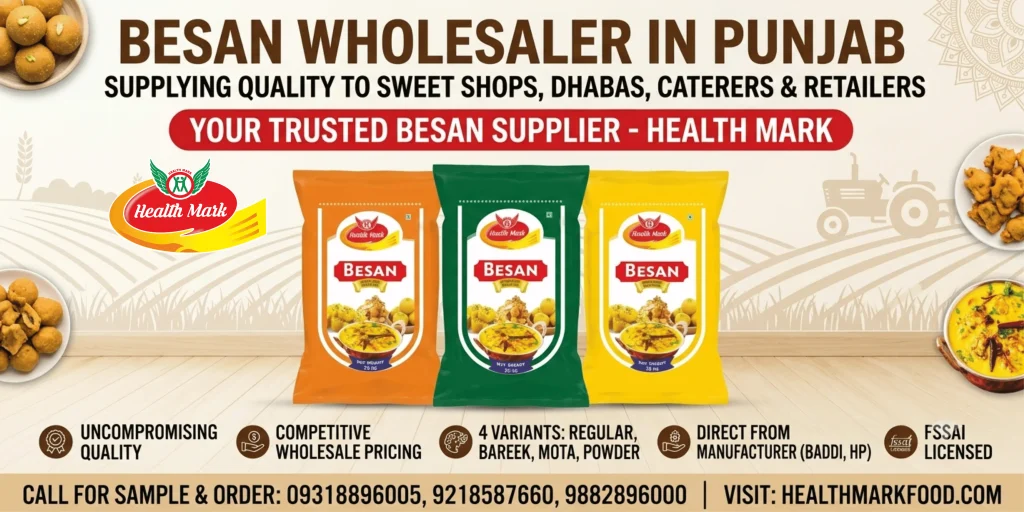
- Four variants. Besan, Bareek Besan, Motichur / Mota Besan and Powder Besan cover snacks, sweets and everyday cooking.
- Flexible pack sizes. The regular Besan is listed in 55 g, 200 g, 500 g and 1 kg packs, useful for both retail shelves and kitchen use.
- Broad staples range. Beyond gram flour, Health Mark lists atta, pulses, rice, oils, spices, sauces, snacks and more, so one supplier can cover many purchase lines. As an FMCG supplier in Himachal, that makes consolidated ordering easier for distributors and retailers in the neighbouring Punjab belt.
- Direct contact. Sales calls and WhatsApp enquiries go straight to the team, with no long forms in the middle.
The brand’s own category description positions its gram flour as pure chana dal besan with rich taste, high protein and freshness, suited to pakoras, sweets and daily cooking.
A word on rankings: you will see search phrases like “No 1 besan brand” and “top selling Besan in india” all over the internet. Those labels are usually marketing language rather than audited facts. A better test is the one you can run yourself: request a sample, cook with it, and compare it against your current supplier. We are confident enough in the product to suggest exactly that.
If you are comparing options to buy Besan in volume, explore the full Health Mark Besan range and ask for a sample of the grade that suits your recipe.
How to Place a Wholesale Enquiry
Getting started is simple. Here is the process most business buyers follow:
- Decide your requirement. Note the grade (regular, fine, coarse or powder), pack size and approximate monthly quantity.
- Contact the sales team. Call 09318896005, 9218587660 or 9882896000, or use the WhatsApp button on the product pages.
- Request a sample. Test it in your own recipe, at your own counter.
- Share your location. Ask about delivery timelines and freight for your city in Punjab.
- Confirm pricing in writing. Get the per-kilo landed rate, pack details and payment terms.
- Place a trial order. Start with a manageable lot, review quality and delivery, then scale up.
You can also visit the Health Mark homepage to browse the wider product catalogue and download the brochure.
Expert Tips
- Sieve before use. Even clean besan benefits from sieving for a silky batter.
- Rest the batter. Ten to fifteen minutes of resting hydrates the flour and improves texture.
- Roast gently for sweets. Slow roasting on low heat brings out the nutty aroma that makes laddus special.
- Match grind to recipe. Coarse for motichur and boondi, fine for sev and smooth batters.
- Track your wastage. If you notice more rejected batches, revisit your supplier and storage.
- Plan for winter and festivals. Place larger orders earlier than you think you need them.
- Build a relationship. Suppliers prioritise buyers who give notice, pay predictably and share feedback.
FAQ
Who is a reliable besan wholesaler in Punjab?
A reliable supplier is one that offers consistent quality, clear labelling, a valid FSSAI licence, sample availability and dependable delivery. Health Mark, based in Baddi, supplies besan in four variants and welcomes bulk enquiries on 09318896005, 9218587660 and 9882896000.
What is the best way to buy besan in bulk?
Decide your grade and monthly quantity, request samples from two or three suppliers, test them in your own recipe, compare the landed price per kilo and then place a trial order before committing to larger volumes.
How can I check if besan is pure?
Check for an even pale yellow colour, a fresh nutty smell, a smooth dry texture and a clean dispersion in water. Also read the label for ingredients, manufacturing date and FSSAI number.
Which besan is best for pakoras and which for laddu?
Regular or fine besan works well for pakoras, kadhi and batters. Coarse (mota or motichur) besan is traditionally preferred for motichur laddu and boondi, where a granular texture is desired.
What pack sizes does Health Mark Besan come in?
The regular Besan on the Health Mark website is listed in 55 g, 200 g, 500 g and 1 kg packs. For bulk requirements and other variants, contact the sales team to confirm available packing.
How long can besan be stored?
Follow the best-before date printed on the pack. Store it in a cool, dry place in an airtight container, away from moisture and strong odours, and use older stock first.
Is besan gluten-free and high in protein?
Chickpea flour is naturally free of gluten-containing grains and provides roughly 20 to 22 g of protein per 100 g. If you serve people with coeliac disease, ask the supplier about cross-contact in processing.
What affects the wholesale price of besan?
The main factors are chana dal market rates, grade and grind, pack size, transport distance, order volume and seasonal demand. Always compare delivered price per kilo.
Does Health Mark supply to Punjab cities like Ludhiana, Chandigarh-region towns and beyond?
Health Mark operates from Baddi and serves buyers across the Himachal, Chandigarh and Punjab belt. Call the sales team with your city name to confirm delivery coverage and timelines.
How do I place a bulk or wholesale enquiry?
Call 09318896005, 9218587660 or 9882896000, message on WhatsApp from the product page, or fill in the Product Enquiry form on the website. Mention the variant, pack size and quantity you need.
Conclusion
Choosing a besan wholesaler in Punjab is not about finding the loudest advertisement or the lowest number on a quotation. It is about finding a partner who delivers the same smooth, fresh, well-packed gram flour on the first order and the fiftieth, in winter rush and summer lull alike.
Use the checks in this guide: look at colour, aroma and texture, run a small batter test, read the label, compare landed prices, and ask direct questions about milling, licences and delivery. A good supplier will welcome every one of them.
If you are ready to test a better option, Health Mark’s team is a phone call away.
Ready to order or request a sample? Call 09318896005, 9218587660 or 9882896000 Browse the range: Health Mark Besan | Visit: healthmarkfood.com Address: Plot No. 60, Industrial Township, Bhatoli Kalan, Baddi, India 173205