
Ask any experienced namkeen maker what ruins a batch of sev, and the answer is rarely the oil or the masala. It is the flour. A besan that soaks up too much oil, turns the dough sticky, or carries a faint stale smell can undo a full day of production, and the customer who bites into that bhujia will remember the disappointment, not your recipe.
That is why finding a dependable besan supplier for namkeen manufacturers is closer to choosing a production partner than buying a commodity. The right partner gives you the same texture, the same colour and the same frying behaviour in January as in July. The wrong one leaves you adjusting your recipe every few weeks.
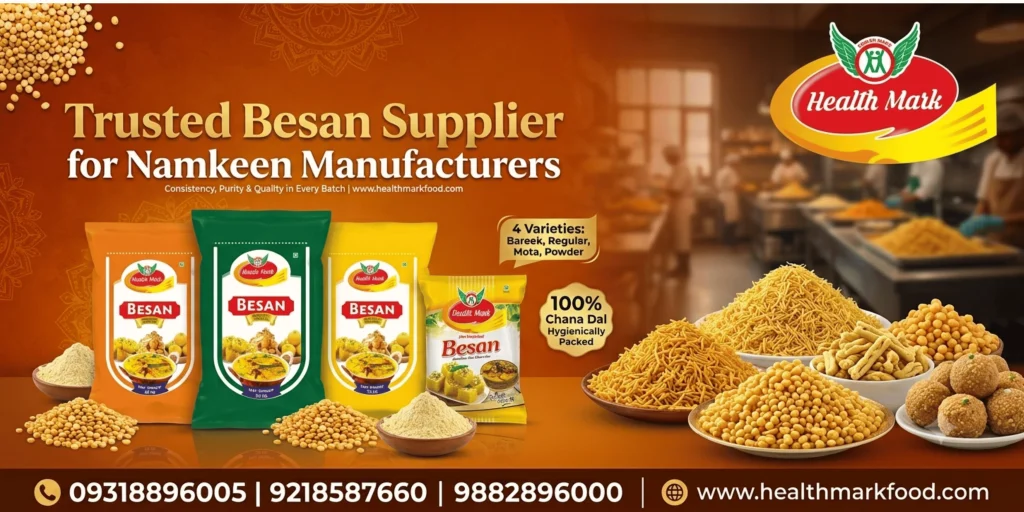
This guide is written for namkeen unit owners, sweet-shop operators, snack start-ups, caterers and procurement managers. You will learn what to look for in gram flour, which grade suits which snack, how to run a simple trial in your own kitchen, what to ask before you place a bulk order, and the mistakes that quietly raise your costs. We have also explained how Health Mark, a food company based in Baddi, Himachal Pradesh, approaches besan so you can compare it against any other option you are considering.
Why Besan Makes or Breaks Your Namkeen
In most sev, bhujia, boondi, gathiya and papdi recipes, besan is the main ingredient by weight. Spices, oil and salt shape the flavour, but the flour decides the structure. Three things in the flour do most of the work.
Protein and starch balance. These control how the dough or batter holds together, how it stretches through the sev jhara, and how crisp the snack turns out after frying.
Moisture. Flour that is even slightly damp clumps in the bag, ferments faster and shortens the shelf life of your finished product. Dry, well-stored flour behaves predictably.
Freshness. Chickpeas naturally contain some fat. Flour that has sat for too long, or been stored in warm, humid conditions, can develop an off smell that comes through strongly in fried snacks.
So when you search for the best Besan for your unit, you are really searching for a flour that behaves the same way every time you open a new bag.
What a Good Besan Supplier for Namkeen Manufacturers Should Offer
Price is the first thing most buyers compare, and it is the least useful thing to compare first. These are the factors that actually protect your margins.
Careful sourcing of chana dal
Besan is only as good as the dal it is milled from. A reliable besan manufacturer in India selects, cleans and grades the dal before milling, removing stones, husk and damaged grains. Ask the supplier how they source and clean their raw material. A confident answer is a good sign.
Fine, even milling
Uneven grinding gives you flour with both coarse particles and over-fine dust in the same bag. That shows up as inconsistent texture in sev and speckled surfaces in gathiya. Smooth, uniform milling is what you are paying for when you choose premium quality Besan.
Hygienic processing and packing
Food-contact surfaces, clean packing areas and sealed, moisture-resistant bags are not extras. They directly affect shelf life. Health Mark describes its besan as hygienically processed and packed to maintain freshness and purity, and that is the standard you should expect from anyone supplying a food business.
Consistency across batches
This is the real test of quality besan. One good sample means little. Ask whether the supplier follows the same specification for every lot, and request samples from different dispatches if you can.
Reliable supply and clear communication
A namkeen unit cannot stop production because the flour has not arrived. Look for a supplier who gives clear lead times, answers calls and messages promptly, and tells you in advance when there is a delay.
Besan Grades Explained: Which One for Which Snack
One of the most common reasons for poor results is using a single type of besan for everything. Different grinds suit different products. The table below shows how the besan varieties in Health Mark’s range are commonly used in the trade. Always confirm the exact specification with the supplier and test it against your own recipe.
| Besan Type | Texture | Commonly Used For |
| Bareek Besan | Very fine, silky | Fine sev, bhujia, thin snacks that need a smooth dough |
| Regular Besan | Fine, balanced | Boondi, gathiya, pakora-style mixes, dhokla, kadhi |
| Motichur / Mota Besan | Coarse, granular | Motichur laddu, mohanthal and other textured traditional sweets |
| Powder Besan | Very fine powder | Batter coatings, premixes, recipes needing smooth dispersion |
Practical example: A unit making thin ratlami-style sev often struggles when it uses a general-purpose flour, because coarse particles clog the jhara and the strands break while frying. Moving to a finer grind usually gives smoother strands and fewer rejects. Meanwhile, a sweet shop making motichur laddu needs the opposite, since a fine flour gives a pasty, dense laddu instead of the granular bite customers expect.
You can browse all four types on the Health Mark Besan category page.
How to Test Quality Besan in Your Own Unit (Step by Step)
You do not need a laboratory to run a meaningful first check. Follow this routine with every new supplier sample.
- Check the look and smell. Open the pack and smell it. Good besan smells mildly nutty and fresh. A sour, musty or oily smell is a warning sign.
- Feel the texture. Rub a pinch between your fingers. It should feel smooth and even, not gritty or lumpy.
- Do a sieve comparison. Sieve 100 g of the sample and compare the residue with your current flour. It gives you a quick idea of grind consistency.
- Make your standard dough or batter. Use your exact recipe and note how much water it takes and how it handles. Sticky or unusually stiff dough means the flour differs from what you are used to.
- Fry a small test batch. Watch the colour, the crunch and how much oil the snack holds. Blot a few pieces on paper and compare the oil spots with your usual batch.
- Taste it plain. Raw or off flavours show up clearly in a plain, lightly salted sample.
- Check crispness after 24 hours. Store the sample in an airtight container and test it the next day. Soft or chewy snacks suggest moisture or oil-absorption problems.
- Repeat with a second lot. Ask for a sample from a different batch. If the results match, you have found consistency.
Spotting Poor or Adulterated Besan
Gram flour is a high-volume product, so shortcuts are tempting for careless sellers. Here is what to watch for.
Unnatural, very bright yellow colour. Natural besan has a soft cream-yellow tone. FSSAI’s definition of besan states that it must not contain any added colouring matter.
Mixing with cheaper flours or dals. Texture, aroma and cooking behaviour change noticeably. FSSAI has even published a laboratory method for detecting kesari dal in besan, which shows how seriously the regulator treats this issue.
Lumps and a damp feel. Moisture is a sign of poor storage or weak packaging.
Stale or bitter smell. Old stock or poor storage conditions.
No clear label details. Missing batch number, packing date, FSSAI licence number or manufacturer address should make you cautious.
Trusted reference: The official FSSAI standard for besan is part of the Food Safety and Standards (Food Products Standards and Food Additives) Regulations, 2011, under the cereals and cereal products chapter. You can read it on the FSSAI website.
Buying Bulk Besan: What to Ask Before You Order
Once a sample passes your trial, the conversation moves to volume. Whether you plan to buy Besan by the sack or by the truckload, these questions separate serious suppliers from casual traders.
- Which pack sizes are available for bulk orders? Confirm the exact weights and the type of bag or sack.
- What is the minimum order quantity? This matters for smaller units that are scaling up.
- What is the usual lead time, and how reliable is it? Ask for a realistic range, not a best-case promise.
- Is the packing date or best-before date printed on every bag? You need it to rotate stock properly.
- Can you share the FSSAI licence number and any test reports? A genuine manufacturer will not hesitate.
- Will the next lot match the sample? Ask what controls they follow to keep the specification consistent.
- How is the flour packed and transported? Moisture-resistant packing and covered transport protect quality on the road.
- What are the delivery and payment terms? Clear terms in writing save arguments later.
For a growing namkeen business, bulk besan from one dependable source usually works out better than hopping between traders each month. A steady relationship also makes it easier to negotiate when your volumes grow, which is how many units end up with the best wholesale besan terms in their region.
Understanding the Best Besan Price (What Really Drives Cost)
Everyone wants the best Besan price, but the lowest quote on paper is not always the lowest cost in your kitchen. Here is what moves the number.
| Factor | Why It Affects Price or Cost | What You Should Do |
| Chana dal market rate | The raw material moves with crop size, demand and government policy, so besan prices change through the year. | Ask when the quote is valid and whether rates are fixed for a period. |
| Grind type | Very fine or specially graded flour takes more processing. | Pay for the grind your product genuinely needs, no finer. |
| Pack size | Larger packs usually cost less per kilo to pack and move. | Order the largest pack you can store properly. |
| Freight and location | Transport can add a meaningful share to the delivered cost. | Compare delivered prices, not ex-factory rates. |
| Quality and consistency | Poor flour raises oil use, rejects and returns. | Calculate real cost per finished kilo of snack. |
A simple way to think about it: The actual cost of besan goes beyond its purchase price. Factors such as oil consumption during frying, product wastage, rejected batches, and storage conditions can affect overall expenses. Choosing good-quality flour that delivers consistent results may offer better long-term value, even if its initial price is slightly higher. This is why many commercial buyers prefer premium quality besan over simply choosing the cheapest available option.
Local Mill, Trader or Manufacturer: Who Should You Buy From?
The three sources look similar from outside but behave very differently once you place a regular order.
| Point of Comparison | Small Local Mill | Trader / Distributor | Brand Manufacturer |
| Consistency | Varies with each dal lot | Depends on who they buy from | Typically follows a fixed process |
| Traceability | Limited | Often unclear | Batch details and licence on pack |
| Hygiene standards | Varies widely | Not in their control | Controlled in their own facility |
| Supply reliability | Limited capacity | Depends on their stock | Planned production capacity |
| Pack and label compliance | Often basic | Varies | Standard retail and bulk packaging |
| Best suited for | Very small, local needs | Occasional top-ups | Regular, growing production |
If your unit runs daily and plans to grow, buying from a manufacturer-led brand is usually the safer route.
How to Choose the Best Besan Brand for Your Business
When searching for the No. 1 besan brand or top-selling besan in India, buyers should look beyond promotional claims and focus on product quality, consistency, and reliability. A brand that performs well in retail markets may not always meet the specific requirements of restaurants, sweet shops, or food manufacturers.
Before choosing a supplier, consider factors such as product samples, quality standards, batch consistency, packaging, and customer support. Evaluating these aspects can help you identify the best besan seller for your business needs and make confident purchasing decisions.
Why Location Matters: Sourcing from Himachal
If you run a unit in Punjab, Haryana, Chandigarh, Uttarakhand, Delhi NCR or nearby, sourcing from a nearby producer can shorten transit time and reduce handling. Fewer days on the road generally means fresher flour reaching your store room.
Health Mark operates from Baddi, in Himachal Pradesh, one of northern India’s established industrial belts. As an FMCG supplier in Himachal, it sits close to many of the region’s namkeen and sweet-making clusters. Many buyers type besan seller near me into Google before anything else, and proximity is a fair thing to value. Just remember to confirm delivery terms and timelines for your exact location before you commit.
Where Health Mark Besan Fits In
Health Mark is a food company with a wide range covering atta, pulses, rice, oils, spices, pickles, snacks and more, so besan sits within a team that already works with staples at volume. Here is what the company states about its besan and range.
- Made from carefully selected chana dal, finely ground for a smooth texture and a rich, nutty flavour.
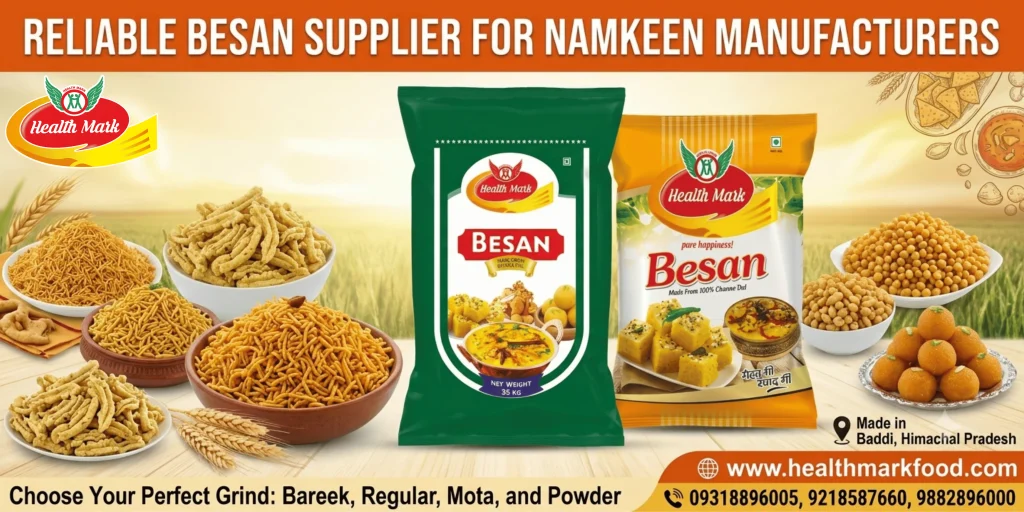
- Four varieties: Bareek Besan, regular Besan, Motichur / Mota Besan and Powder Besan, so you can match the grind to the snack.
- Hygienically processed and packed to maintain freshness and purity.
- Retail pack sizes of 55 g, 200 g, 500 g and 1 kg are listed for the regular Besan. For bulk quantities, speak to the sales team directly.
- Manufacturing base: Plot No. 60, Industrial Township, Bhatoli Kalan, Baddi, Himachal Pradesh 173205.
If you want to evaluate Health Mark Besan for your production line, the practical route is simple: request samples of the grades you use, run the eight-step trial from Section 4, and compare the results with your current flour. Browse the full range on the Besan category page or visit the Health Mark homepage to see the wider product range.
Common Mistakes Namkeen Makers Make with Besan
- Choosing on price alone. The cheapest quote often costs more once oil use and rejects are counted.
- Using one grind for every product. Sev, boondi and motichur each need a different texture.
- Skipping sample trials. A pack that looks fine can fry poorly.
- Storing flour on the floor or near a wall. Damp rises from the floor and walls; use pallets and keep a gap from the wall.
- Ignoring first-in, first-out. Old bags at the back of the store quietly lose freshness.
- Buying more than you can store properly. A huge discount is no bargain if half the stock turns stale.
- Not recording lot numbers. If a problem appears, you cannot trace it.
- Switching suppliers mid-season without retesting. Small changes in flour can change your whole product.
Expert Tips for Consistent Batches
Rest the flour before use in humid weather. Sieve it and let it sit in the room for a short while so it matches the room conditions.
Keep a fixed water-to-flour ratio and adjust only when the lot changes.
Store in a cool, dry, well-ventilated space, in closed bags, away from strong-smelling items such as spices.
Re-test whenever you change the grade, the lot or the supplier.
Keep a small reference sample from each approved lot. If a customer complains, you can compare.
Use besan’s natural story on your own label. Chickpea flour is naturally gluten-free and typically provides around 20–22 g of protein per 100 g, so check the pack label for exact values. Health-conscious shoppers notice this, and it supports a clean-label message for your snacks.
FAQ
1. What is the best besan for making namkeen?
It depends on the product. Bareek (very fine) besan suits sev and bhujia, regular besan suits boondi and gathiya, and coarse besan suits motichur-style sweets. Choose the grade that matches your recipe, then confirm with a sample trial.
2. How do I choose a reliable besan supplier for my namkeen unit?
Look at hygiene, consistency across lots, clear labelling with FSSAI details, realistic lead times and willingness to provide samples and test reports. A supplier who welcomes questions is usually one who has nothing to hide.
3. What is the difference between bareek besan and mota besan?
Bareek besan is ground very fine and gives a smooth dough, which suits thin sev and bhujia. Mota (motichur) besan is coarse and granular, which suits laddu and other sweets that need a textured bite.
4. Can I buy besan in bulk directly from a manufacturer?
Yes. Buying from a manufacturer often gives better traceability and consistency than buying through several middlemen. Contact the sales team for bulk pack sizes, minimum order quantities and delivery terms.
5. How can I check whether besan is pure?
Check for a natural cream-yellow colour, a fresh nutty smell, a smooth texture and a complete label. Home tests are only indicators, so for large orders ask for lab reports or get a sample tested at an accredited laboratory. FSSAI states that besan must not contain added colouring matter.
6. How long can besan be stored?
Follow the best-before date on the pack. Store it in a cool, dry place in an airtight container or sealed bag, away from moisture and strong odours. Poorly stored flour can go stale well before its date.
7. What affects the best Besan price?
Chana dal market rates, the type of grind, pack size, freight and payment terms all play a part. Compare delivered prices and calculate your real cost per finished kilo of snack, not just the quote per kilo of flour.
8. Is besan gluten-free?
Besan is made from Bengal gram, which does not contain gluten. However, anyone with coeliac disease should check the pack and the manufacturer’s handling practices, as cross-contact can occur in shared facilities.
9. Which is the top-selling besan brand in India?
There is no single answer that holds for every region and channel. Rather than relying on a ranking, evaluate brands on sample quality, consistency, hygiene, supply reliability and service.
10. How do I order or find a besan seller near me?
If you are in northern India, Health Mark in Baddi, Himachal Pradesh is a practical option to evaluate. Call the sales team on 09318896005, 9218587660 or 9882896000, or use the product enquiry details on the Health Mark website to request samples and bulk pricing.
Conclusion: Choose a Partner, Not Just a Price
Your namkeen is only as dependable as the flour it starts with. The right besan supplier for namkeen manufacturers gives you a grind that suits each product, flour that stays fresh, packing that protects it, and supply you can plan around. Test every sample properly, ask the hard questions about consistency and documentation, and judge the true cost per finished kilo instead of the quote on the invoice.
If you are ready to compare, Health Mark would be glad to support your trial. Request samples of Bareek, regular, Motichur or Powder Besan, run them through your own recipe and see the difference in your fryer and on your shelf.
Call or WhatsApp the Health Mark sales team today: 09318896005 | 9218587660 | 9882896000
Explore the full range here: Health Mark Besan