
Open almost any Indian kitchen cupboard and you’ll find a packet of Poha tucked next to the rice and pulses. It’s the dish grandmothers swear by, the recipe new cooks learn first, and the breakfast that somehow works whether you’re rushing to catch a 9 a.m. train or hosting friends for a lazy Sunday brunch. But here’s the thing most people don’t think about until they’re standing in a shop, confused: not all Poha is created equal, and the best Poha brand for your everyday breakfast bowl is not always the right choice for a hotel kitchen, a canteen, or a retail shelf that needs consistent, bulk supply.
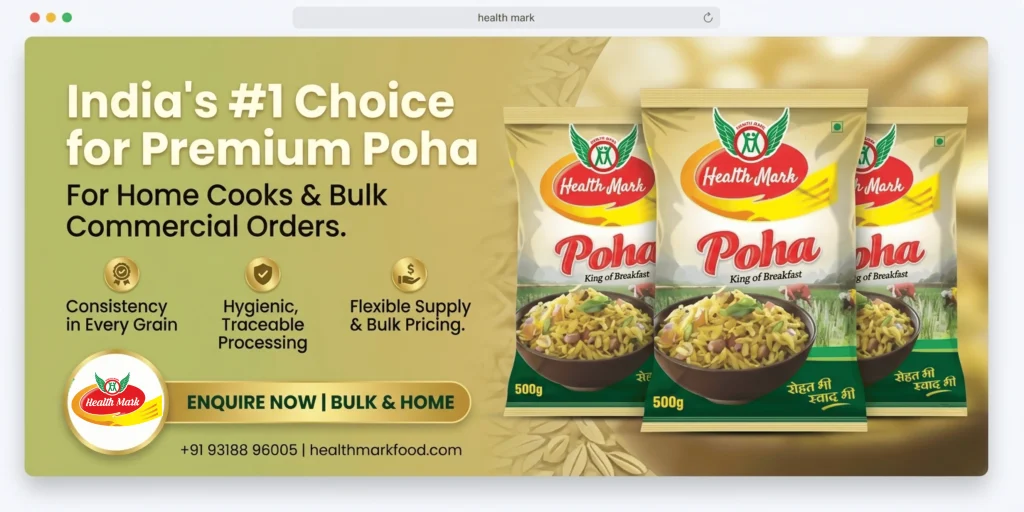
This guide walks through exactly how to evaluate a Poha brand whether you’re a home cook picking up a 500-gram pack or a business owner sourcing Poha wholesalers in India for hundreds of kilos a month. Along the way, we’ll look at what Health Mark, a Baddi-based FMCG brand known for its Poha and wider snacks range, brings to the table for both segments of buyers.
Why Poha Deserves a Permanent Spot in Every Indian Kitchen
Poha flattened rice made by parboiling paddy, flattening it under rollers, and drying it has been part of the Indian plate for generations. It’s light, it cooks in minutes, and it takes on the flavour of whatever you cook it with, from onions and peanuts in Maharashtra’s kanda poha to the tangy, sev-topped Indori version. Search interest around terms like buy Poha and top selling Poha in india has climbed steadily as more urban households shift toward quick, homemade breakfasts instead of packaged cereal or ordering in.
A few reasons Poha has stayed relevant across decades and regions:
It cooks in under 10 minutes with minimal oil, making it a practical weekday breakfast.
It pairs with vegetables, peanuts, curry leaves, and spices, so it never gets boring.
It’s naturally light on the stomach, which is why it’s often recommended for a gentle start to the day.
It works at every scale a single household bowl, a hostel mess, a wedding buffet, or a retail shelf.
What Actually Makes a Poha Brand “the Best”?
Search for the best Poha brand in India and you’ll find dozens of names claiming the title. In reality, “best” isn’t a single attribute it’s a combination of factors that matter differently depending on whether you’re buying for your kitchen or your business.
Grain Quality and Thickness
Good high quality Poha starts with the paddy variety. Thin poha cooks faster and suits light dishes like chivda, while medium-thick poha holds its shape better for kanda poha or upma-style preparations. A brand that controls grain sourcing tends to deliver a more consistent bite, batch after batch.
Processing Hygiene
Flattened rice is processed in mills where humidity, storage, and handling directly affect shelf life and taste. A best Poha seller will process and pack under hygienic, controlled conditions rather than relying on loose, unbranded supply chains.
Packaging and Shelf Life
Moisture is Poha’s biggest enemy it turns stale or musty quickly if packaging isn’t airtight. Brands offering sealed, multi-layer packaging in various pack sizes (like 80 gm for trial, 350 gm and 500 gm for regular home use) tend to perform better on freshness.
Consistency at Scale
This is where many otherwise-good local brands fall short. A top Poha supplier for bulk or wholesale buyers needs to guarantee the same grain quality, weight accuracy, and packaging standard across a 5 kg order as it does across a 500 gm retail pack.
Pricing Transparency
Finally, best Poha price isn’t about who’s cheapest it’s about who offers fair, transparent pricing relative to quality, with clear bulk-order slabs for institutional buyers.
Meet Health Mark: A Poha Brand Built for Homes and Businesses
Based out of an industrial unit in Baddi, Himachal Pradesh a well-known FMCG manufacturing belt bordering Punjab Health Mark positions itself as an organic and quality-first food company rather than a purely commodity Poha trader. Its Poha product line is made from what the brand describes as carefully selected, premium-quality flattened rice, processed under hygienic conditions and packed to preserve freshness.
A few points that stand out about Health Mark’s approach to Poha:
Premium-grade flattened rice sourced with attention to grain quality.
Hygienic processing and sealed packaging aimed at preserving freshness and taste.
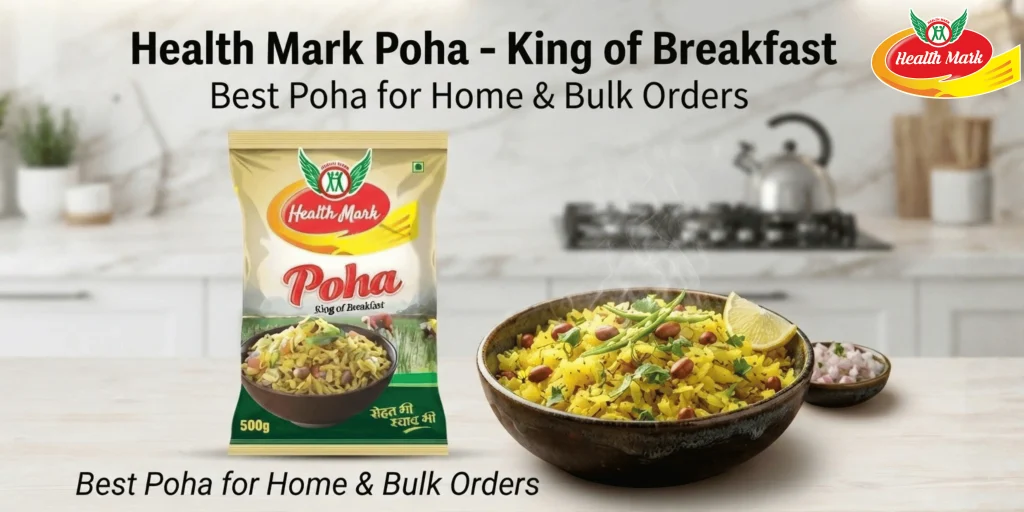
Multiple pack sizes 80 gm, 350 gm, and 500 gm covering both trial buyers and regular households.
A wider snacks and grocery catalogue (atta, besan, pulses, rice, spices, dry fruits, pickles, and more), which matters for retailers who prefer consolidating orders with one best Poha manufacturing partner instead of juggling multiple vendors.
For home buyers, this translates into a light, easy-to-cook Poha that behaves predictably in the kadhai. For best health mark Poha searchers specifically looking into the brand’s credibility, the company also publishes its accreditation details and background on its About Us page, which is a reasonable first stop for due diligence before placing a bulk order.
Nutritional Profile: Why Poha Is a Smart Everyday Choice
Flattened rice is a simple, easily digestible carbohydrate source. While exact values vary slightly by brand and processing method, here’s a general nutritional snapshot per 100 grams of raw Poha, useful for anyone comparing packaged options:
| Nutrient | Approx. Value (per 100g raw Poha) | Why It Matters |
| Energy | 350–370 kcal | Provides quick, usable energy for the day ahead |
| Carbohydrates | 76–78 g | Primary energy source; easy to digest |
| Protein | 6–7 g | Modest protein contribution; pairs well with peanuts/sprouts |
| Fat | 1–1.5 g | Naturally low-fat before cooking oil is added |
| Iron | Varies by fortification | Some brands fortify Poha with iron and folic acid |
| Fibre | Low–moderate | Improves with added vegetables and sprouts |
Because Poha is light and cooks with minimal oil, nutritionists frequently mention it as a reasonable breakfast option for people watching their weight or looking for something gentler than fried snacks. Loading it with peanuts, vegetables, and a squeeze of lemon rounds out the micronutrient profile without adding much cooking time.
Home Orders vs Bulk & Wholesale Orders: What Changes?
A household buying a couple of packs a month has very different priorities from a hotel, canteen, or retailer ordering in quintals. Understanding this distinction is key to identifying the best Poha brand for your specific situation.
| Factor | Home / Retail Buyer | Bulk / Wholesale Buyer |
| Typical quantity | 80g – 500g packs | 5 kg, 25 kg, or custom bulk sacks |
| Priority | Freshness, taste, easy cooking | Consistency, price per kg, supply reliability |
| Packaging need | Resealable, shelf-ready pouches | Bulk sacks or private-label packaging options |
| Buying frequency | Monthly or as needed | Recurring contracts, monthly/quarterly supply |
| Key question to ask | “Is this the best Poha for daily home cooking?” | “Can this best Poha manufacturing partner sustain volume and quality?” |
| Ideal contact method | Online store / nearby retailer | Direct enquiry to sales team or B2B product enquiry form |
For home cooking, Health Mark’s 80 gm, 350 gm, and 500 gm packs map neatly onto typical household consumption. For businesses exploring Poha wholesalers in india for canteen, hotel, or retail-shelf supply, the practical route is to reach out directly through the brand’s Product Enquiry page or sales lines to discuss volume pricing and delivery timelines.
How to Choose the Best Poha Manufacturer or Supplier in India
Whether you’re comparing a handful of local brands or evaluating a manufacturer for a long-term wholesale contract, run through this checklist:
1. Check the ingredient sourcing is the flattened rice made from a consistent, identified paddy variety, or is it an unlabelled generic supply?
2. Look for hygiene and processing standards mentioned on the brand’s website or packaging.
3. Confirm pack size flexibility does the brand offer both small retail packs and bulk formats?
4. Ask for a sample before committing to a large wholesale order.
5. Verify the manufacturer’s registered address and contact details a real industrial address and working phone lines are a basic trust signal.
6. Compare price per kilogram across at least three suppliers, not just the first best Poha price you find online.
7. Read the return/replacement policy for damaged or delayed bulk shipments.
Quality, Hygiene & Accreditation: What to Verify Before You Buy
Food safety in India is governed by the Food Safety and Standards Authority of India (FSSAI), and any packaged food brand including Poha manufacturers is expected to comply with FSSAI licensing and labelling norms. Before placing either a home or bulk order, it’s worth checking:
Whether the pack carries a valid FSSAI license number.
Whether the manufacturer publishes accreditation or certification information (Health Mark, for instance, maintains a dedicated accreditation page).
Whether the batch/manufacturing and best-before dates are clearly printed.
Whether the packaging looks tamper-proof and free from punctures or moisture damage on arrival.
For a deeper look at how Health Mark communicates its standards, its Accreditation page and About Us page outline the brand’s sourcing philosophy, including its emphasis on ingredients drawn from certified, sustainably managed farms.
Best Poha Seller in Chandigarh, Punjab & North India
If you’re specifically searching for the best Poha seller in Chandigarh or a Poha seller near me across Punjab, Chandigarh, Panchkula, or the broader Baddi–Ludhiana industrial corridor, proximity to manufacturing matters. A shorter supply chain generally means fresher stock reaching the shelf faster, less time in transit, and quicker turnaround on bulk reorders.
Health Mark’s manufacturing base at Bhatoli Kalan, Baddi (Himachal Pradesh), sits close to Chandigarh, Panchkula, and Ludhiana, which is relevant for:
Retailers and kirana stores across Punjab and Chandigarh looking for a top Poha seller for regular shelf stocking.
Hotels, canteens, and caterers in the tricity region (Chandigarh–Mohali–Panchkula) wanting shorter delivery lead times for bulk orders.
Home buyers in North India who prefer sourcing from a brand with a nearby manufacturing footprint rather than one shipping from far outside the region.
If you fall into any of these categories, the most direct route is to call the brand’s sales team and confirm current stock, delivery timelines, and minimum order quantities for your area.
How to Place a Home or Bulk Poha Order
For Home Buyers
Visit the Poha product page and check available pack sizes (80 gm, 350 gm, 500 gm).
Use the WhatsApp enquiry option for quick order confirmation and delivery details.
Ask about the manufacturing date and shelf life before confirming your order.
Store the pack in a cool, dry place after delivery to maintain freshness.
For Bulk & Wholesale Buyers
Submit a request through the Product Enquiry page with your required quantity and delivery location.
Alternatively, call the sales team directly to discuss volume pricing.
Request a sample batch for quality approval before signing a recurring supply agreement.
Clarify packaging format (loose bulk sacks vs branded bulk packs) based on whether you’re reselling or using it internally.
Confirm payment terms, delivery frequency, and replacement policy for any damaged stock.
Direct contact for home and bulk Poha inquiries:
Sales: +91 93188 96005 | +91 92185 87660 | +91 98828 96000
WhatsApp order enquiry: Message Health Mark on WhatsApp (mention “Poha” and your required quantity)
● Bulk/business enquiry form: healthmarkfood.com/product-Enquiry
Common Mistakes Buyers Make When Choosing a Poha Brand
Buying purely on price, without checking grain thickness or freshness the cheapest Poha per kg often means older stock or poorer processing.
Ignoring pack size mismatch bulk buyers ordering small retail packs end up paying more per kilogram than a proper wholesale slab would cost.
Not checking the FSSAI license or manufacturing date before a large order.
Assuming all Poha brands taste and cook the same grain thickness genuinely changes cooking time and final texture.
Skipping a sample order before committing to a long-term wholesale contract.
Storing Poha in humid conditions after delivery, which shortens shelf life regardless of how good the brand is.
Expert Tips: Cooking, Storing & Getting the Most Out of Your Poha
Cooking Tips
Rinse Poha briefly under running water instead of soaking it for long over-soaking makes it mushy.
Let rinsed Poha rest for 2–3 minutes so it softens evenly before you add it to the pan.
Add peanuts, curry leaves, and mustard seeds early in the tempering for maximum flavour.
Finish with fresh coriander and a squeeze of lemon just before serving to keep the dish light and fresh.
Storage Tips
Keep unopened packs in a cool, dry pantry away from direct sunlight.
Once opened, transfer Poha to an airtight container rather than clipping the original bag.
Use opened packs within 3–4 weeks for the best texture and taste.
For bulk sacks, store on pallets off the floor in a ventilated, moisture-free storage area.
Poha Price in India: What Affects the Cost
There’s no single fixed best Poha price across India cost depends on several variable factors:
| Factor | Impact on Price |
| Grain thickness/variety | Thicker, premium-grade flattened rice generally costs more |
| Pack size | Smaller retail packs (80g) cost more per kg than bulk packs |
| Order volume | Wholesale/bulk orders typically unlock lower per-kg pricing |
| Region & transport | Proximity to the manufacturing unit reduces logistics cost |
| Packaging quality | Sealed, multi-layer packaging adds a small cost but improves shelf life |
| Seasonal paddy prices | Raw material cost fluctuations can shift pricing periodically |
The most reliable way to get current, accurate pricing for either a single home pack or a wholesale order is to check directly with the seller rather than relying on outdated listings, since raw material and packaging costs shift over time.
Health Mark vs Other Poha Brands: A Quick Comparison
| Parameter | Health Mark Poha | Typical Local/Unbranded Poha |
| Grain sourcing | Premium, quality-checked flattened rice | Often unspecified or mixed-grade |
| Packaging | Sealed, freshness-focused, multiple pack sizes | Loose or basic packaging, fewer size options |
| Bulk order support | Dedicated enquiry channel & sales team | Informal, inconsistent supply |
| Product range | Wide FMCG catalogue for one-stop sourcing | Usually single-category, limited catalogue |
| Regional accessibility | Strong presence across Punjab, Chandigarh, Baddi belt | Varies widely by local vendor |
| Transparency | Published accreditation & company information | Often limited public information |
FAQ
Q1. Which is the best Poha brand for daily home use in India?
The best Poha brand for home use is one that combines consistent grain quality, hygienic processing, and freshness-focused packaging in convenient pack sizes. Health Mark, for example, offers 80 gm, 350 gm, and 500 gm packs designed specifically for regular household cooking.
Q2. How do I find a reliable Poha seller near me?
Start by checking whether the brand has a local or regional manufacturing base, published contact details, and an FSSAI license. Brands with a manufacturing unit closer to your city, such as Health Mark’s Baddi facility serving Punjab and Chandigarh, typically offer fresher stock and faster delivery.
Q3. What is the difference between buying Poha for home use and for bulk/wholesale orders?
Home buyers prioritise freshness, taste, and small resealable packs, while bulk buyers focus on price per kilogram, supply consistency, and reliable delivery schedules. Wholesale orders are usually placed directly with the manufacturer’s sales or enquiry team rather than through retail packs.
Q4. How can I place a bulk or wholesale Poha order with Health Mark?
You can submit your requirement through the Product Enquiry page on healthmarkfood.com or contact the sales team directly at +91 93188 96005, +91 92185 87660, or +91 98828 96000 to discuss quantity, pricing, and delivery.
Q5. Is Health Mark Poha suitable for retail shelf stocking?
Yes. Health Mark’s Poha is packed in multiple sizes and falls under the brand’s broader snacks category, making it suitable for kirana stores, supermarkets, and retail outlets looking for a consistent supply partner.
Q6. What should I check before choosing a Poha manufacturer for bulk supply?
Verify the manufacturer’s FSSAI license, ask for a sample batch, confirm packaging options for bulk quantities, check pricing transparency, and clarify delivery timelines and replacement policies before signing a long-term agreement.
Q7. Does thicker or thinner Poha matter for cooking?
Yes. Thinner Poha cooks faster and suits light snacks like chivda, while medium-thick Poha holds its shape better for traditional kanda poha or upma-style dishes. Checking grain thickness helps match the product to your intended recipe.
Q8. How should Poha be stored to keep it fresh for longer?
Store unopened packs in a cool, dry place away from sunlight, and transfer opened packs into an airtight container. This helps prevent moisture absorption, which is the main reason Poha turns stale or develops an off smell.
Q9. Is Poha a healthy breakfast option?
Poha is a light, easily digestible source of carbohydrates and, when prepared with vegetables, peanuts, and sprouts, can form part of a balanced breakfast. However, specific dietary suitability should be confirmed with a nutritionist, especially for people managing conditions like diabetes.
Q10. What makes Health Mark different from other Poha brands in India?
Health Mark combines a quality-first sourcing approach with a wide FMCG product catalogue, published accreditation information, and dedicated support for both retail and bulk/wholesale buyers, which allows businesses to consolidate multiple grocery categories with one supplier.
Final Word: Choosing a Poha Brand You Can Rely On
Whether you’re refilling your kitchen shelf or sourcing Poha for a retail counter, hotel kitchen, or wholesale distribution line, the decision really comes down to three things: consistent grain quality, transparent sourcing, and a supplier who can scale with you. A brand that gets the small 80 gm home pack right and can also fulfil a serious bulk order without cutting corners on either is genuinely rare.
If you’re evaluating Health Mark’s Poha or exploring its broader snacks and grocery range for either home consumption or business supply, the most reliable next step is a direct conversation with their team.
Ready to Order?
Browse the Poha product page for home packs, or explore the full Snacks category for related products. For bulk and wholesale pricing, call +91 93188 96005, +91 92185 87660, or +91 98828 96000, or submit your requirement via the Product Enquiry form.