
Every kitchen that makes gathiya has a story about the batch that went wrong. The dough looked perfect, the oil was hot, the family was waiting, and the gathiya came out hard, greasy or broken into crumbs. Most people blame the recipe, the oil or the sev maker.
Often, the real culprit is sitting in the flour bin. If you are searching for the best besan for gathiya, the good news is that you do not need a food-science degree. You only need to know what fresh, well-milled besan looks, smells and feels like, and how to match the grind to the kind of gathiya you want.
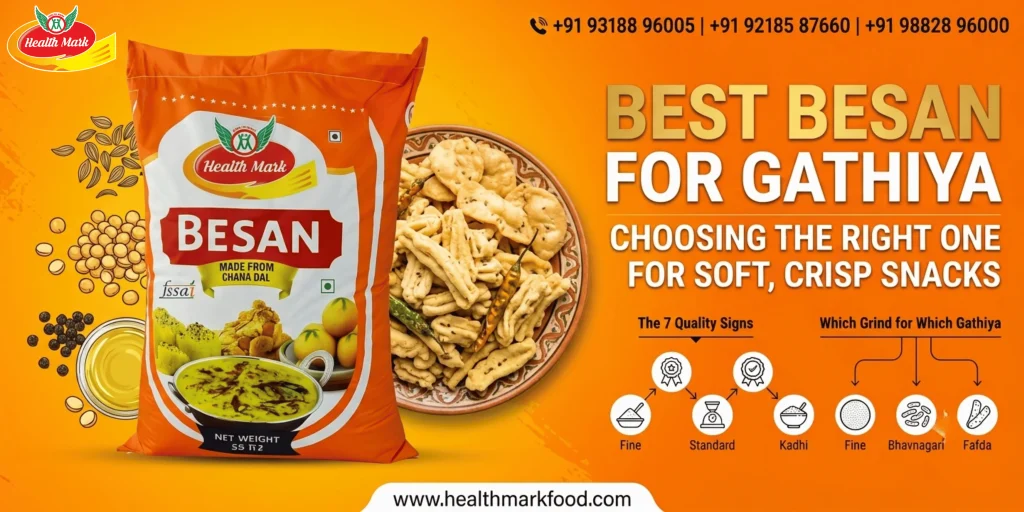
This guide walks you through exactly that. You will learn how to judge quality in your hand, how to read a pack, which grind suits which gathiya, how to think about price and bulk buying, and how to make a reliable batch at home.
Why the Besan You Choose Decides Your Gathiya
Gathiya is a humble snack with only a handful of ingredients: besan, oil, water, salt, ajwain and a raising agent such as papad khar. When the ingredient list is that short, the main ingredient does most of the work. There is nowhere for weak flour to hide.
Here is what your besan quietly controls:
Dough smoothness. Finely milled flour hydrates evenly, so the dough turns silky instead of grainy. Grainy dough tears as it passes through the sev plate.
Softness inside, crispness outside. Good besan holds enough natural starch and protein to give gathiya structure. Stale or overheated flour tends to make hard, dense gathiya.
Oil absorption. Damp or coarse flour soaks up more oil, which makes gathiya greasy and heavy.
Flavour. Fresh besan has a gentle, nutty sweetness. Old flour picks up a bitter, stale note that no amount of masala can hide.
Colour. Gathiya made from good chana dal flour fries to an even, light golden shade.
In other words, choosing well saves you oil, time and disappointment. It is also the cheapest way to improve your recipe, because you change nothing except what you buy.
What Is Besan, and How Is It Different from Other Flours?
Besan is flour ground from Bengal gram, the small brown chickpea that is split and husked to make chana dal. In English it goes by gram flour, chickpea flour or chana flour. All of these terms point to the same everyday ingredient in Indian cooking.
It is naturally gluten-free and behaves very differently from wheat flour. Wheat builds stretchy gluten. Besan builds a sticky, starchy paste that fries into a crisp, tender snack. That is why it is the backbone of pakoras, dhokla, kadhi, sev, boondi, fafda and, of course, gathiya.
Besan versus roasted or coarse flours
Not every yellow flour in the market is the same thing. Some brands sell coarse grades meant for laddoos, and roasted versions meant for certain sweets. For gathiya, you want raw, finely milled besan. Roasted or very coarse flour will not bind properly and can make the dough crumble.
7 Signs of Premium Quality Besan
Best quality besan reveals itself to your eyes, nose and fingertips, so you do not need a laboratory to judge it.
1. A natural, even colour
Good besan ranges from pale to warm yellow, depending on the dal. A dull grey or brownish tinge suggests age or poor storage. An unnaturally bright, almost neon shade should make you cautious, because it can point to added colour.
2. A fresh, nutty aroma
Open the pack and smell it. Fresh besan smells mildly sweet and nutty. If you catch a sour, musty or crayon-like odour, the natural oils in the flour have started to turn rancid. Skip it.
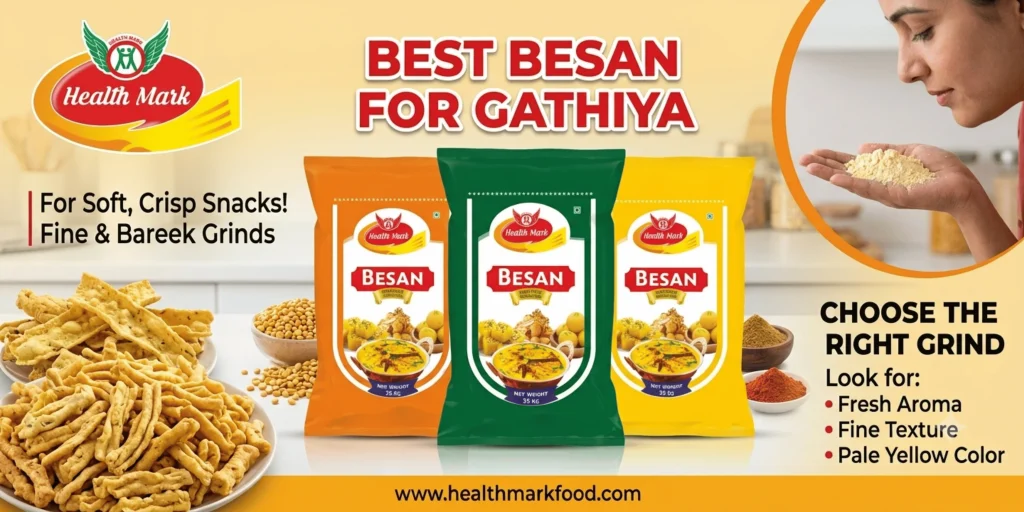
3. A silky, powdery feel
Rub a pinch between your thumb and finger. It should feel smooth and almost slippery, with no grit. Any gritty patch means uneven milling, which will show up as rough gathiya.
4. Dry and free of lumps
Squeeze a small handful in your fist and open your hand. Dry flour holds a loose shape and then crumbles. Sticky, damp clumps that refuse to break up mean moisture, and moisture is the enemy of shelf life.
5. A clear manufacturing and best-before date
Besan is not a flour you want to buy from the bottom of a year-old pile. Look for a printed batch number and a recent manufacturing date. Fresh stock is the single biggest quality lever you control.
6. A short, honest ingredient list
The label should say besan or gram flour made from chana dal, and nothing more. Vague descriptions or unexplained additives are red flags.
7. Clean, sealed packaging with proper certifications
Look for a well-sealed, multi-layer pack, a visible FSSAI licence number and, ideally, recognised food-safety certifications such as ISO 22000 or HACCP. These do not guarantee taste, but they tell you the manufacturer works within a documented safety system.
Quick home-test table
| Test | How to do it | Good sign | Red flag |
| Colour | Spread a spoonful on a white plate | Even pale-to-warm yellow | Dull grey, brown or neon-bright |
| Smell | Open the pack and smell it | Mild, sweet, nutty | Sour, musty or oily |
| Touch | Rub a pinch between fingers | Silky, powdery, no grit | Gritty or rough patches |
| Squeeze | Press a handful in your fist | Loose shape that crumbles | Damp, sticky clumps |
| Dough | Mix a spoonful with a little water | Smooth, cohesive paste | Grainy, bitter or grassy taste |
For deeper adulteration checks, FSSAI has published simple rapid-test guidance for consumers, and it is worth bookmarking if you buy in large quantities.
Which Grind Works Best for Each Type of Gathiya?
Besan is sold in different grinds, and this is where many home cooks go wrong. A coarse grind is perfect for one recipe and a poor match for another. Use the table below as a general guide, and adjust to your family recipe.
| Gathiya or snack | Best grind | Why it works |
| Bhavnagari / nylon gathiya (soft and thin) | Fine (bareek) | Silky dough passes through the plate without tearing and fries up soft |
| Papdi gathiya | Fine to standard | Holds a flat shape and gives a tender bite |
| Tikha (spicy) gathiya | Fine to standard | Absorbs spices evenly and fries crisp |
| Fafda | Fine | Starchy, smooth dough that rolls and stretches cleanly |
| Vanela (hand-rolled) gathiya | Standard | Balances softness with a slight bite |
| Motichur or boondi laddoo (for contrast) | Coarse (mota) | Gives the grainy texture that sweets need |
If you are unsure, start with a fine grind. It is the safest choice for gathiya. Health Mark’s Besan range lists regular, powder, bareek and mota options, so you can pick by recipe instead of guessing.
How to Read a Besan Pack Before You Buy
A few seconds with the label can save a whole batch. Here is what to check:
1. Ingredient statement: it should read 100% chana dal or Bengal gram flour.
2. Manufacturing and best-before dates: choose the freshest pack on the shelf.
3. FSSAI licence number: a legitimate seller prints it clearly.
4. Storage instructions: good brands tell you how to keep the flour fresh after opening.
5. Certifications: ISO 22000, ISO 9001, GMP, GHP or HACCP signal a systematic approach to hygiene.
6. Pack size: buy what you will finish within a couple of months, not what looks cheapest per kilo.
Where to Buy Besan: Online, Local Shops and Wholesale
Once you know what good besan looks like, the next question is where to get it. Each route has trade-offs.
Buying from a local store
Typing “besan seller near me” into a search bar is a fine starting point, and a busy neighbourhood shop can be a good source because the stock turns over quickly. The catch is that loose besan sold from open sacks is exposed to humidity and air, and you cannot check the batch date. If you go local, prefer sealed, branded packs.
Choosing a trustworthy seller online
When you buy besan online, use the same checklist you would use in a shop: clear photos of the pack, a visible ingredient list, dates, certifications and a way to contact the seller. The best besan seller is the one who answers your questions plainly. Brands that publish phone numbers and a manufacturing address are easier to trust than anonymous listings.
Working with a manufacturer or supplier
If you cook gathiya at festival scale, run a namkeen counter or supply a catering business, the smartest move is often to speak to a besan manufacturer in India directly. A manufacturer can offer batch-to-batch consistency, which matters more than a small price difference, because your recipe stays predictable.
When you compare a top Besan supplier against alternatives, ask for a sample, check the grind and freshness yourself, and confirm delivery timelines. For best wholesale besan, look for a partner that handles both retail packs and larger quantities under the same quality system.
How to think about price
The best Besan price is not the lowest number on the pack. Compare the price per kilogram, then weigh it against freshness and yield. Cheaper flour with high moisture or older stock can cost you more in ruined batches, extra oil and wasted time. Buy a small pack first, run a trial batch, and only then scale up.
What “top selling” and “No 1” really mean
You will see plenty of claims about the top selling Besan in India and the No 1 besan brand. Treat them as a prompt to investigate, not as proof. Sales rankings change by region and channel, and a badge on a pack says little about the flour inside. The reliable test is simple: sample it, smell it, knead it, fry a small batch. Let the gathiya decide.
Health Mark describes itself as North India’s No1 Brand on its homepage. The best way to confirm whether that claim holds up for your kitchen is to try the flour yourself.
Why Health Mark Besan Is Worth Trying for Gathiya
Here is what the manufacturer says about its product, and why those details matter for gathiya.
Health Mark Besan is made from carefully selected chana dal and finely ground for a smooth texture and a rich, nutty flavour. That fine texture and natural aroma are exactly the qualities you want when kneading gathiya dough. The brand also states that the flour is hygienically processed and packed to maintain freshness and purity.
• Made from chana dal: the raw material that gram flour should be made from.
• Smooth, fine texture: helpful for soft dough and clean shaping.
• Rich nutty flavour: a good sign of fresh, properly milled flour.
• Versatile: suited to gathiya, pakoras, dhokla, kadhi, sweets and everyday recipes.
• Food-safety accreditation: the company lists ISO 22000, ISO 9001, GHP, GMP and HACCP on its site.
• Pack sizes for every need: 55 g, 200 g, 500 g and 1 kg.
| Pack size | Best for |
| 55 g | Sampling and quick trials |
| 200 g | A small test batch or occasional cooking |
| 500 g | A family batch of gathiya or farsan |
| 1 kg | Festival cooking, sharing and regular use |
For gathiya specifically, the fine and bareek options are the natural fit, while the mota option belongs in your laddoo kitchen. You can see every variant on the Besan category page. If you run a shop, a hostel kitchen or a small namkeen unit, the team also handles wholesale and retail enquiries from its base in Baddi, Himachal Pradesh.
Trying premium quality Besan from a manufacturer that publishes its certifications and contact details is a low-risk way to test whether it lifts your gathiya. It is also the easiest way to judge premium high quality besan for yourself instead of relying on labels.
Step-by-Step Gathiya Recipe
Here is a dependable base recipe for soft, crisp gathiya. It uses 250 g of besan and makes a generous plate. Feel free to add chilli powder for a tikha version.
Ingredients
• 250 g fine besan (about 2½ cups), sifted
• 4 tablespoons oil for the dough, plus oil for deep frying
• ½ cup (120 ml) water, plus a little extra if needed
• ½ teaspoon papad khar (or a small pinch of baking soda)
• 1 teaspoon salt, adjusted to taste
• ½ teaspoon ajwain, lightly crushed
• ½ teaspoon coarsely crushed black pepper
• A pinch of hing (asafoetida)
• Optional: 1 teaspoon red chilli powder and a pinch of black salt for sprinkling
Method
Sift the besan. Sift it into a wide bowl and mix in the ajwain, pepper and hing. Sifting adds air and removes tiny lumps.
Make the emulsion. Dissolve the papad khar and salt in the water, add the oil, and whisk until the liquid turns thick, pale and milky.
Bring the dough together. Pour the emulsion into the besan in stages and mix. The dough will feel stiff at first, which is normal.
Knead well. Wet your hands with a few drops of water and knead for four to five minutes until the dough turns smooth and lightly glossy. It should be soft but hold its shape.
Rest the dough. Cover it and rest for 10 to 15 minutes. This gives the papad khar time to work.
Heat the oil. Warm the frying oil on medium heat. Drop in a pinch of dough. If it rises steadily without browning instantly, the oil is ready.
Shape. Grease your sev maker with a thick plate, fill it with dough and press circular strands straight into the oil. For papdi gathiya, use a flat plate or press the dough through a jhara.
Fry gently. Cook in small batches on medium-low heat, turning once, until the bubbling calms down and the gathiya turn light golden and crisp.
Drain, cool and season. Lift onto absorbent paper, let them cool completely, break into pieces and sprinkle with chilli and black salt if you like.
Serve with green chutney, fried chillies and raw papaya sambharo, or alongside a hot cup of tea. It is a classic Gujarati tea-time combination.
Expert Tips and Common Mistakes
Tips that make a real difference
• Use fresh oil. Old, reused oil leaves a stale smell on delicate snacks.
• Keep the measurements consistent. If a batch works, note the oil-to-water ratio and repeat it.
• Do not overdo the raising agent. Half a teaspoon of papad khar is enough for 250 g of besan. More makes the gathiya bitter and hard.
• Fry in small batches. Crowding drops the oil temperature and causes soggy, oily gathiya.
• Cool fully before storing. Warm gathiya trap steam and turn soft in the jar.
• Match the grind to the recipe. Fine besan for soft gathiya, standard for a slightly firmer bite.
Common mistakes and their fixes
| Mistake | What happens | Fix |
| Using old or stale besan | Bitter taste, hard gathiya | Buy fresh, check the date and smell before use |
| Choosing a coarse grind | Crumbly dough that tears | Switch to fine or bareek besan |
| Too much papad khar | Bitter taste, hard texture | Limit to about ½ tsp per 250 g |
| Skipping the rest time | Uneven softness | Rest the dough for 10 to 15 minutes |
| Oil too cool or too hot | Greasy or raw-centred gathiya | Test with a pinch of dough and keep heat medium |
| Storing while warm | Gathiya turn soft | Cool completely, then use an airtight jar |
How to Store Besan and Gathiya
Besan contains natural oils, so it does not love heat, light or humidity. A few habits protect your investment:
• Transfer opened besan into a clean, dry, airtight container.
• Keep it in a cool, dark cupboard away from the stove and the sink.
• Use a dry spoon every time. A single wet spoon can start spoilage.
• Buy sizes you will finish within a couple of months.
• If the flour smells sour or bitter, discard it rather than risk a whole batch.
Finished gathiya keep well when they are completely cool and sealed in an airtight jar. Many home cooks report that they stay crisp for a month or two, though freshly made gathiya always tastes best in the first few weeks.
A Quick Look at Besan Nutrition
Besan is a protein-rich, fibre-rich flour. According to USDA FoodData Central, chickpea flour provides roughly 20 to 22 grams of protein and around 10 grams of fibre per 100 grams, though exact values vary by product. It is also naturally gluten-free.
That said, gathiya is a fried snack, so enjoy it as a treat rather than a daily staple. Fresh oil, correct frying temperature and proper draining all help keep it lighter. If you cook for someone with a medical condition or a special diet, check with a qualified doctor or dietitian first.
FAQ
Which is the best besan for gathiya?
The best besan for gathiya is fresh, finely ground, pale-yellow flour made from 100% chana dal. It should smell nutty rather than musty, feel silky between your fingers and be free of lumps. A fine (bareek) grind gives the smoothest dough and the softest bite.
Should I use fine or coarse besan for gathiya?
Use fine besan for most gathiya types, especially soft Bhavnagari or nylon gathiya, papdi gathiya and fafda. Fine flour makes a smooth dough that passes through the sev plate without tearing. Coarse (mota) besan is better suited to motichur boondi laddoo than to gathiya.
Why do my gathiya turn hard instead of soft?
Hard gathiya usually come from a stiff dough, too much papad khar, over-frying, or old besan that has dried out. Add water in small splashes, keep papad khar to about half a teaspoon per 250 g of besan, rest the dough for 10 to 15 minutes and fry on medium-low heat.
Why do my gathiya break or soak up oil in the kadhai?
Breaking usually points to a dough that is too soft or unevenly kneaded, while heavy oil absorption points to oil that is not hot enough. Test the oil with a pinch of dough, knead until the dough is smooth and only slightly sticky, and fry in small batches.
Are besan and gram flour the same thing?
Yes. Besan, gram flour, chana flour and chickpea flour all describe flour ground from Bengal gram (chana dal). Labels and regional names differ, but in Indian kitchens besan almost always means flour made from split, husked Bengal gram.
How can I check if besan is pure at home?
Check colour, smell and texture. Pure besan is pale to warm yellow, smells mildly nutty and feels fine and dry. Avoid flour that looks unnaturally bright, smells sour or musty, or forms damp clumps. Buying from a certified brand with a clear FSSAI licence number on the pack adds a further layer of safety.
Do I really need papad khar for gathiya?
Papad khar gives gathiya their classic soft-yet-crisp bite, but it is not compulsory. A small pinch of baking soda can do a similar job. Whichever you choose, use it sparingly, because too much makes the gathiya taste bitter and turn hard.
How long does besan stay fresh?
Stored in an airtight container in a cool, dry place, besan stays fresh for a few months. Once a pack is opened, use it as early as you can, because besan contains natural oils that slowly turn stale. If it smells sour or bitter, discard it.
Where can I buy besan in bulk or at wholesale rates?
You can buy wholesale besan directly from an established manufacturer or supplier. Health Mark supplies besan for both retail and wholesale needs, and you can enquire through the Besan product page or by calling +91 93188 96005, +91 92185 87660 or +91 98828 96000.
What pack sizes does Health Mark Besan come in?
Health Mark Besan is listed in 55 g, 200 g, 500 g and 1 kg packs on the official product page. The 500 g and 1 kg packs suit family gathiya batches, while the smaller packs work for trials and everyday cooking.
Final Thoughts
Great gathiya begins long before the oil heats up. It begins with a fresh, finely milled, honestly labelled flour. Look at the colour, smell the aroma, feel the texture, read the pack, match the grind to your recipe and buy from a source you can contact. Do that, and the best besan for gathiya will stop being a mystery.
If you would like to try a fine, hygienically processed option, explore Health Mark Besan or browse the full Besan collection on Health Mark. For sample requests, pack sizes or bulk enquiries, call +91 93188 96005 | +91 92185 87660 | +91 98828 96000.