
Ask any experienced halwai what makes or breaks a tray of motichur ladoo, and you will rarely hear about the sugar syrup or the ghee first. You will hear about the besan. Get the flour wrong and the boondi turns out flat, pasty or too fine to hold its pearl shape. Get it right and every tiny droplet fries up round, crisp and ready to soak syrup.
If you run a sweet shop, a catering unit or a snack factory, finding a dependable motichur besan wholesale supplier is not a small purchasing decision. It affects your taste, your yield, your wastage and, over months, your reputation with customers.
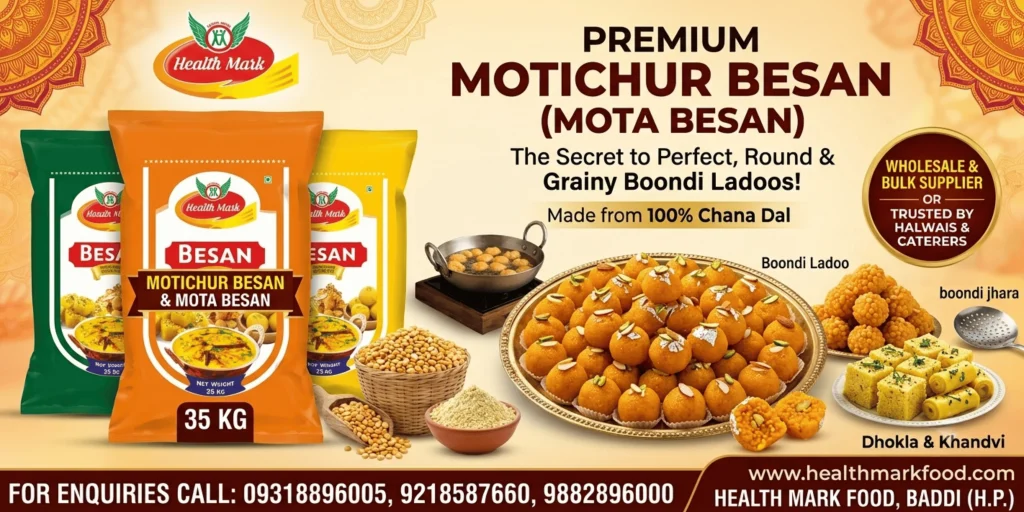
This guide explains what motichur besan really is, how to judge quality before you place a bulk order, how to use it for ladoo, sweets, namkeen and pakora, and what to ask any supplier before you commit. It is written for halwais, sweet shop owners, namkeen manufacturers, caterers and small food businesses across North India.
What Is Motichur Besan (Mota Besan)?
Besan is flour ground from chana dal, the split and husked kernel of Bengal gram. Most households know the smooth, pale-yellow version used for kadhi, chilla and pakoda batter.
Motichur besan is a coarser grind of the same ingredient. Sellers also label it mota besan, and some trade circles call it ladoo besan or boondi besan. The grains feel slightly gritty between your fingers, almost like very fine semolina, rather than silky like talcum powder.
That grit is deliberate. When a batter made from this flour drips through the boondi jhara into hot oil, the coarse particles help each droplet set into a distinct, round bead instead of spreading or clumping.
Where it is typically used
- Motichur ladoo
- Boondi ladoo and plain boondi
- Mixed boondi for raita
- Certain mathri, sev and namkeen recipes that need a bit of body
- Some traditional halwa and barfi preparations
Fine Besan vs Mota Besan | Key Differences
| Feature | Fine Besan | Mota Besan (Motichur Besan) |
| Texture | Smooth, powdery | Coarse, granular |
| Best for | Pakora, kadhi, chilla, sev, batter coatings | Motichur ladoo, boondi, certain sweets |
| Batter behaviour | Smooth, flows evenly | Slightly grainy, holds droplet shape |
| Boondi result | Flat or merged beads | Round, separate pearls |
| Water absorption | Quicker | Slower, needs resting time |
| Typical buyer | Households, namkeen units, restaurants | Halwais, sweet manufacturers, caterers |
If you make both sweets and snacks, you will likely keep both grades on the shelf. A reliable supplier should be able to offer both under one roof.
Why Texture Matters So Much in Motichur Ladoo
A motichur ladoo is built from thousands of tiny boondi beads. Each bead must be small, hollow enough to absorb syrup and firm enough not to dissolve.
Three things depend on grind size:
- Bead definition. Coarser particles resist spreading in oil, so the bead stays round.
- Syrup absorption. A slightly porous bead drinks syrup evenly without turning mushy.
- Mouthfeel. The ladoo should feel soft but granular, not sticky or dough-like.
Using very fine flour for this job is one of the most frequent reasons sweet makers see broken, tailed or pasty boondi. Switching to the right mota besan often solves the problem without any change in recipe.
How to Judge Premium Quality Besan Before Buying in Bulk
Every supplier says they sell premium quality besan. Here is how to check the claim yourself, using tests any shop owner can do in ten minutes.
1. Colour and aroma
Good besan is a natural, even pale yellow. Dull grey, dark patches or an artificially bright shade can point to old stock, mixing or poor raw material. Fresh besan has a mild, nutty, slightly sweet smell. Musty, sour or oily odours are red flags.
2. Texture check
Rub a pinch between thumb and forefinger. Fine besan should feel uniformly smooth. Mota besan should feel evenly granular, with no mix of dust and large chunks. Uneven grind causes uneven frying.
3. Moisture and freshness
Flour that feels damp or clumps in your palm has absorbed moisture. In bulk packs this leads to lumps, insect infestation and a shorter shelf life.
4. Purity
Besan should be made from chana dal alone. Adulteration with cheaper flours such as maize or yellow pea flour is a known industry concern. A simple home check is the batter test: pure chana dal flour gives a distinctive nutty aroma when fried and a firm bite, while adulterated flour often fries soft and bland.
5. Frying performance
This is the real test. Make a small batch of batter, fry a few boondi or pakoras, and look at three things: shape retention, oil absorption and crunch after cooling. Ask any supplier for a trial sample before a large order.
6. Regulatory and packaging details
A genuine food manufacturer prints batch number, manufacturing and best-before dates, ingredients and an FSSAI licence number on every pack. You can verify licence details through the official FSSAI portal (fssai.gov.in).
Besan for Motichur Ladoo | A Practical Walkthrough
This is a general method used in many sweet kitchens. Quantities and timings vary by recipe, so treat it as a guide and adjust to your own standard.
What you need
- Mota besan (motichur besan)
- Water, with a pinch of food-grade colour if your recipe uses it
- Refined oil or ghee for frying
- Sugar syrup (usually one-string consistency, flavoured with cardamom)
- Dry fruits and edible silver or kesar for finishing, as preferred
Steps
- Make the batter. Add water gradually to the besan and whisk in one direction to a smooth, flowing batter. Rest it for 10 to 15 minutes, as coarse flour needs time to hydrate.
- Check consistency. The batter should fall from the spoon in a steady ribbon, neither watery nor thick like dosa batter.
- Heat the oil. Keep it at a steady medium heat. A tiny drop of batter should rise slowly, not burn or sink.
- Fry the boondi. Hold the jhara a little above the oil and tap batter through. Fry until the beads are pale golden and the sizzling quietens.
- Drain and soak. Lift the boondi, drain briefly and drop it into warm syrup for a short soak.
- Shape the ladoo. Add dry fruits, then press and roll while the mix is still warm.
Troubleshooting
| Problem | Likely cause | Fix |
| Boondi has tails | Batter too thick | Add a little water and re-whisk |
| Beads merge together | Oil too hot or batter too thin | Lower heat, thicken batter slightly |
| Ladoo will not bind | Syrup too thin or boondi over-dried | Adjust syrup consistency |
| Hard, dense ladoo | Over-fried boondi | Fry only to pale gold |
| Pasty bite | Flour too fine for the recipe | Switch to proper mota besan |
Besan for Ladoo Making and Other Sweets
If you are choosing besan for ladoo making beyond motichur, the right grade depends on the sweet.
- Besan ladoo (roasted): Medium-coarse or fine besan, slow-roasted in ghee until aromatic. Coarser grinds give a more granular, traditional texture.
- Boondi ladoo: Mota besan, as with motichur.
- Mysore pak: Fine besan for a smooth, melt-in-mouth set.
- Besan barfi and halwa: Fine to medium grind, depending on the mouthfeel you want.
- Soan papdi: Fine besan, roasted and stretched with sugar syrup.
A good rule is to match grind to final texture. Granular sweets use coarser flour and smooth sweets use finer flour.
Besan for Sweets Manufacturing and Sweet Shops
When you scale up from a single kadhai to daily production, besan stops being just an ingredient and becomes a cost line, a consistency risk and a supply-chain question.
What commercial kitchens need from their besan
- Batch-to-batch consistency. Customers notice when their favourite ladoo tastes different in festival season.
- Predictable yield. The same quantity of flour should give the same output each time.
- Reliable availability. Running out of flour before Diwali, Raksha Bandhan or wedding season is expensive.
- Clean, sealed packaging. Easy to store, count and rotate.
For besan for sweet shops, buying in bulk packs is usually more economical than small retail bags, provided your storage is sound and you rotate stock properly.
Planning ahead for peak season
Sweet demand in North India spikes sharply around Diwali, Dussehra, Holi, Raksha Bandhan and the wedding months. Experienced owners place bulk orders two to four weeks early, confirm delivery dates in writing and keep a buffer stock rather than depending on last-minute purchases.
Besan for Namkeen Manufacturing and Pakora
For snack makers, the priorities shift. Where sweet makers care about bead shape, namkeen makers care about crispness, colour and shelf life.
Besan for namkeen manufacturing
Fine and medium grades are common for sev, bhujia, gathiya, mathri and coated snacks. What matters most:
- Uniform grind, so dough or batter behaves the same each shift
- Low moisture, so snacks stay crisp for longer on the shelf
- Clean flavour, since there is little else to hide behind in a simple sev
- Good water absorption, so extruded dough holds its shape
Besan for pakora
For home cooks, caterers and restaurants, besan for pakora should be fine and fresh. A tablespoon of rice flour or a pinch of baking soda is a common trick for extra crunch. Let the batter rest briefly, keep it thick enough to cling to vegetables and fry at steady heat so the coating crisps before the filling turns soggy.
A note on nutrition
Besan is naturally gluten-free and is generally described as a good plant protein source, with food composition databases listing roughly 20 to 22 grams of protein per 100 grams. It is also fibre-rich compared with refined wheat flour. Since fried products add oil and sugar-based sweets add sugar, it is best to present besan as a quality ingredient rather than make health claims about finished products.
How to Choose a Wholesale Gram Flour Supplier
Choosing a wholesale gram flour partner is about more than comparing rates per kilo. Use this checklist.
| Question to ask | Why it matters |
| Are you a manufacturer or a trader? | A direct manufacturer can control quality and answer questions about raw material |
| Do you hold a valid FSSAI licence? | Legal compliance and food safety |
| Can you supply both fine and mota grades? | Convenience for businesses making sweets and snacks |
| Will you give a trial sample? | Lets you test frying performance before committing |
| What pack sizes do you offer? | Matches your storage space and monthly use |
| How do you handle consistency across batches? | Protects your product’s taste |
| What are your delivery timelines and coverage? | Prevents stock-outs in peak season |
| How do you pack and seal the product? | Reduces moisture and pest risk in transit |
A supplier that answers these questions clearly and without hesitation is usually one you can trust over the long term.
Why direct manufacturer relationships help
When you deal with a besan manufacturer in India directly, you often get better pricing clarity, faster responses to quality complaints and a single point of accountability. Middlemen can add cost and distance between you and the people who actually make the product.
Common Mistakes Buyers Make
- Choosing only on price. A cheaper bag that wastes oil, breaks boondi or spoils early costs more in the end.
- Using the wrong grind. Fine flour for motichur or coarse flour for smooth sweets leads to avoidable failures.
- Skipping trial samples. Always fry before you buy tonnes.
- Ignoring packaging dates. Old stock loses aroma and absorbs moisture.
- Storing on bare floors. Floor contact and damp walls invite moisture and pests.
- Mixing batches without testing. Combining flours from different lots can create inconsistent batter.
- Ordering at the last minute. Festival season shortages push rates up and quality down.
- Not documenting supplier details. Keep licence numbers, batch records and invoices on file.
Storage and Handling Tips for Bulk Besan
Besan is a dry, protein-rich flour, so it is prone to moisture and pests if handled carelessly.
- Store in a cool, dry, well-ventilated room away from direct sunlight
- Keep sacks on wooden pallets, away from walls
- Follow first-in, first-out so older stock is used first
- Reseal opened bags tightly or transfer to airtight food-grade containers
- Keep strong-smelling items such as spices, pickles and cleaning agents away, since flour absorbs odours
- Check periodically for lumps, off smells or insects
- Use clean, dry scoops every time
Besan Supply in Chandigarh, Panchkula and Baddi
North India’s tricity belt and the industrial hub of Himachal Pradesh are home to thousands of sweet shops, bakeries, caterers and snack units. For them, local availability matters as much as quality.
If you are searching for a besan supplier in Chandigarh or a besan supplier in Panchkula, a nearby source helps with shorter transit, faster restocking and easier follow-up when you need an urgent top-up before a wedding order or festival rush.
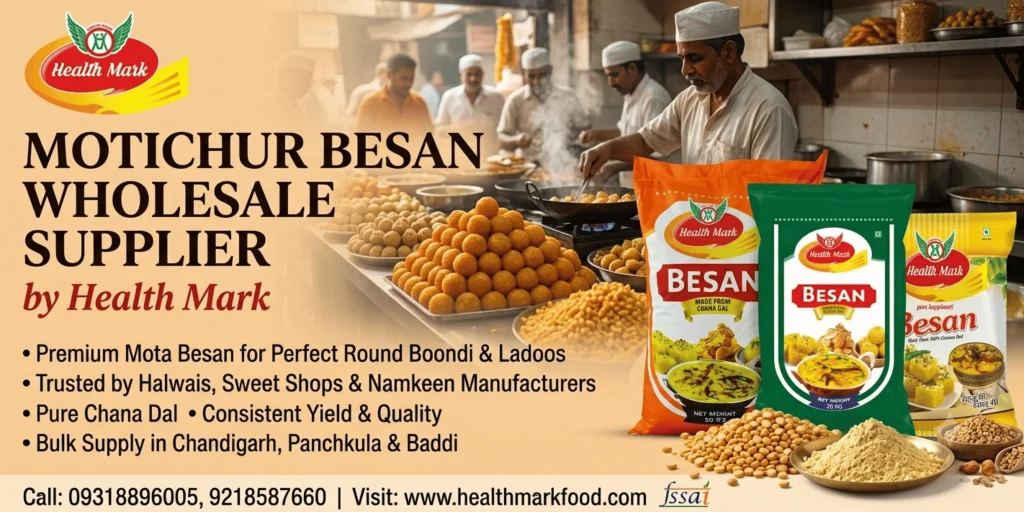
Health Mark Food is a food company in Baddi, Himachal Pradesh, within easy reach of Chandigarh, Panchkula, Mohali and the wider region. This proximity makes it practical for local businesses to arrange regular supply.
About Health Mark Food
Health Mark Food works in the packaged staples space and offers a range of FMCG food products, including its besan range sold under the Health Mark Besan name. Its product range is built around everyday pantry staples that households, halwais and food businesses rely on.
For sweet makers, the dedicated Motichur Mota Besan is designed for boondi-based sweets and ladoo preparation. You can view it here: Motichur Mota Besan. To browse the full range, visit the Besan category page, or explore the main site at healthmarkfood.com.
If you are comparing options for bulk besan for halwais, the best approach is simple: request a sample, run your own frying test and compare results against your current supplier.
How to place a bulk enquiry
- Note the grade you need (mota besan, fine besan or both)
- Estimate monthly or festival-season volume
- Mention your delivery location
- Call or message the team on 09318896005, 9218587660 or 9882896000
- Ask for a sample, pack-size options and delivery timeline
FAQ
1. What is motichur besan?
Motichur besan, also called mota besan, is a coarsely ground flour made from chana dal. Its granular texture helps boondi hold a round shape, which is why it is used for motichur ladoo and similar sweets.
2. Can I use normal besan for motichur ladoo?
You can, but results are often poorer. Fine besan tends to produce flat, tailed or merged boondi. Mota besan gives better bead definition and a more authentic texture.
3. What is the difference between besan and mota besan?
The difference is grind size. Regular besan is smooth and powdery, suited to pakora, kadhi and sev. Mota besan is coarse and granular, suited to boondi and certain traditional sweets.
4. How do I identify good quality besan?
Look for even pale-yellow colour, a fresh nutty smell, uniform texture, no lumps or musty odour and clear labelling with FSSAI details. Always do a small frying test before bulk purchase.
5. Which besan is best for pakora?
Fine, fresh besan is best for pakora. It makes a smooth batter that coats vegetables evenly and fries crisp.
6. How should I store besan in bulk?
Keep it in a cool, dry, ventilated place, off the floor and away from strong odours. Reseal opened bags, use older stock first and inspect regularly for moisture or insects.
7. Do you supply besan in Chandigarh and Panchkula?
Health Mark Food is based in Baddi and serves businesses in the region. Call 09318896005, 9218587660 or 9882896000 to confirm supply options for your location.
8. How can I order wholesale besan?
Contact the Health Mark Food team by phone with your required grade, quantity and delivery location. You can also start from the Besan category page.
Conclusion
The right flour will not fix a poor recipe, but the wrong flour can ruin a good one. For motichur ladoo and boondi sweets, texture is everything, and that makes the choice of mota besan and the choice of supplier equally important.
Before placing your next big order, test samples, check labels, ask about consistency and plan for the festival rush early. A dependable partner saves you money, wastage and sleepless nights.
If you are ready to talk bulk supply, call 09318896005, 9218587660 or 9882896000, or visit the Motichur Mota Besan product page to learn more about Health Mark Besan.