
Every spice seller claims to be number one. Walk through any mandi, and you will hear it at every second shop. So what does the title actually mean when you are the one writing the check?
For a wholesale buyer, a No.1 spices brand has to pass a much tougher test than a retail shopper applies. A home cook can forgive one slightly dull batch of haldi. A shopkeeper with 200 repeat customers cannot. If the red chilli powder you sold last month was bright and fiery and this month’s is pale and bitter, your customers notice before you do.
So here is a practical definition you can use:
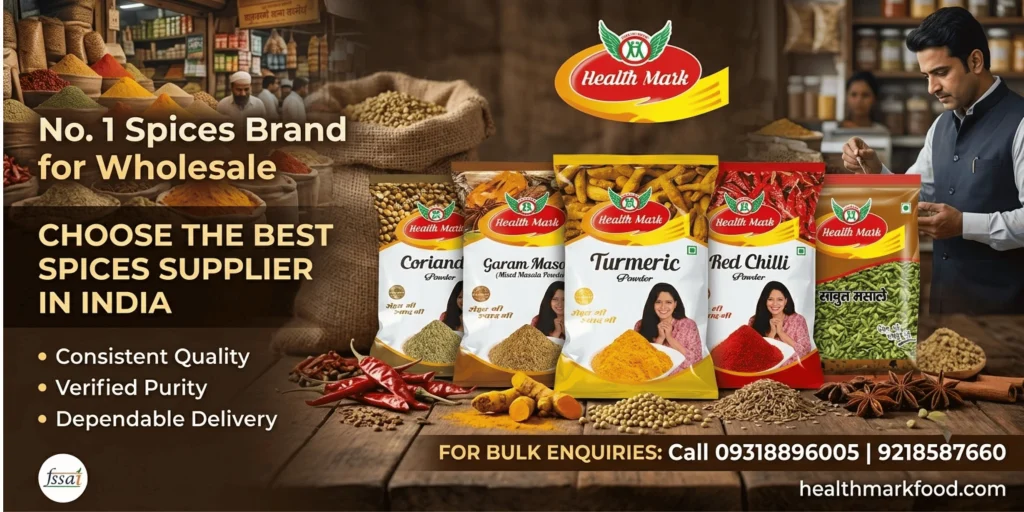
- Consistent colour, aroma and pungency across batches
- Verified purity with no added colour, starch, sawdust or artificial filler
- Food-safety systems in the factory, not just a nice label
- Fair, transparent bulk pricing that does not change without notice
- Dependable supply and delivery so your shelves never run empty
Brands that meet all five are the ones worth calling the best spices brand in India for your business. Everything else is marketing.
A quick note on claims: Health Mark describes itself on its website as “North India’s No1 Brand” in wholesale and retail consumer goods. That is the brand’s own positioning. As a buyer, treat any such claim as a starting point and verify it with samples, certificates and references, which is exactly what this guide will help you do.
What Wholesale Buyers Actually Search For
When someone types “spices seller near me” or “best wholesale spices supplier” into Google, they usually fall into one of these groups:
| Buyer type | What they need | Typical order |
| Kirana and general store owners | Fast-moving packs, good margins, steady supply | Cartons of 100 g to 500 g packs |
| Restaurants, dhabas and caterers | Strong flavour, consistent colour, economical bulk packs | 1 kg to 25 kg |
| Distributors and dealers | Brand pull, credit terms, wide range | Pallet or truckload |
| Sweet shops and food processors | Specific grind size, hygiene records | Large recurring orders |
| Home businesses and tiffin services | Quality at a fair price, small bulk quantities | 5 kg to 50 kg |
The search intent behind these queries is mostly commercial investigation: “I want to buy, but I need to be sure I am choosing well.” That is why this guide focuses on how to evaluate a supplier rather than simply listing brand names.
Top Selling Spices in India: What Moves Fastest
If you are stocking a shop or building a distribution business, start with demand. Across Indian households and commercial kitchens, these spices consistently form the core of sales:
- Turmeric powder (haldi): daily-use staple, high repeat purchase
- Red chilli powder (lal mirch): the volume leader in most markets
- Coriander powder (dhania): the base of most North Indian gravies
- Cumin (jeera), whole and powder: high-value, high-frequency
- Garam masala: premium blend with strong margins
- Black pepper (kali mirch): valued for aroma and used in many households
- Cardamom (elaichi), cloves (laung), cinnamon (dalchini): festive and sweet-making staples
- Mustard seeds, fennel (saunf), fenugreek (methi), bay leaf (tej patta)
- Kitchen King, sabzi masala, chaat masala, chole masala and other blends
India is among the world’s leading producers, consumers and exporters of spices, according to the Spices Board of India, which is why the domestic wholesale market is both enormous and competitive. That competition is good news for buyers, but it also means quality varies widely.
Powder Masale vs Sabut Masale | What Should You Stock?
Most wholesale buyers need both. Here is how they differ.
Powder Masale (Ground Spices)
Ground spices are the convenience category. Customers buy them for daily cooking because they are ready to use. The trade-off is that ground spices lose aroma faster than whole ones, so freshness, grinding method and packaging matter a lot.
Best for: high-turnover retail, restaurants that want quick prep, ready-to-cook blends.
You can explore the range at Health Mark’s Powder Masale category.
Sabut Masale (Whole Spices)
Whole spices keep their essential oils locked inside until they are crushed, so they hold flavour longer. They are the choice for tempering (tadka), pickling, biryani and slow-cooked dishes. Buyers who value authenticity often prefer to grind whole spices fresh.
Best for: long storage, premium positioning, customers who like to check quality by eye.
Browse the range at Health Mark’s Sabut Masale category.
Quick Comparison
| Factor | Powder Masale | Sabut Masale |
| Convenience | Very high | Medium (needs grinding or tempering) |
| Shelf life | Shorter once opened | Longer |
| Aroma retention | Depends on packaging | Excellent |
| Adulteration risk | Higher, as powders hide impurities | Lower, as defects are visible |
| Typical margin | Steady, high volume | Often premium |
| Best sold to | Households, restaurants | Cooking enthusiasts, caterers, pickle makers |
The 12-Point Checklist for Choosing the Best Wholesale Spices Supplier
This is the heart of the guide. Run every potential supplier through these checks before you commit.
1. Is the Seller a Manufacturer or a Trader?
A manufacturer controls sourcing, cleaning, grinding and packing. A trader buys from someone else and relabels. Both can be fine, but manufacturers generally offer better traceability and pricing. Ask directly: “Do you grind and pack in your own facility?”
2. Does the Facility Hold Recognised Certifications?
Look for an FSSAI licence at a minimum. Stronger suppliers also hold ISO 22000 (food safety management), ISO 9001 (quality management), HACCP (hazard control), GMP (good manufacturing practice) and GHP (good hygiene practice). Health Mark displays ISO 22000, ISO 9001, GHP, GMP and HACCP logos on its website, and you can ask for copies of the certificates with their validity dates.
3. Can You Get Samples Before Ordering?
Never place a large order blind. Ask for 100 g to 250 g samples of each spice you plan to stock, then evaluate colour, aroma, grind and taste.
4. Is Batch Consistency Proven?
Ask to see the product again after a month. A reputable manufacturer should match the earlier sample closely.
5. What Is the Packaging Quality?
Spices fear moisture, light and air. Good packaging is multi-layer, properly sealed, and clearly labelled with batch number, manufacturing date, expiry or best-before date, net weight, MRP and FSSAI number.
6. Is the Price Transparent?
The best spices price is not the lowest price. If a quote is far below the market, ask why. Common reasons include inferior raw material, added filler or short weight. Ask for a written rate list and GST invoice terms.
7. What Are the Minimum Order Quantity and Payment Terms?
A flexible MOQ helps new retailers start small. Ask about credit terms, advance payment and how price changes are communicated.
8. How Reliable Is Delivery?
Ask about typical dispatch time, transport partners and coverage. Nationwide delivery matters if you are outside the manufacturer’s home region.
9. Is There a Product Range You Can Grow With?
A supplier who also offers atta, besan, pulses, rice and other staples can simplify your purchasing. Fewer vendors mean fewer invoices and a stronger negotiating position.
10. Is After-Sales Support Real?
Call the sales numbers before you buy. Do they answer? Do they respond to enquiries? A supplier who is slow before the sale will be slower after it.
11. Are There Reviews and Repeat Customers?
Ask for two or three references from other retailers. Check Google reviews and social presence, but weigh them with common sense.
12. Is the Brand Easy to Sell?
A brand your customers already recognise sells faster and protects your margin. Packaging design, shelf visibility and a clear brand promise matter more than most buyers expect.
How to Test Spice Quality Yourself (Simple Home and Shop Checks)
You do not need a laboratory to catch obvious problems. These quick checks help you screen samples, though they are indicative, not conclusive. For certainty, rely on lab testing by an accredited laboratory.
Visual and Smell Check
- Colour: Natural spices have rich but not neon colour. Overly bright powder can signal added colour.
- Aroma: Rub a pinch between your fingers. A strong, clean aroma is a good sign. A flat or musty smell is not.
- Texture: Powder should be uniformly fine, free of lumps and visible grit.
Simple Water Test (Indicative Only)
Sprinkle a small quantity of powder over a glass of clear water. Pure powders generally settle gradually and tint the water slowly, while some artificial colours streak quickly. Treat this as a hint only.
Moisture and Clumping
If a powder has clumped inside a sealed pack, moisture may have entered. High moisture reduces shelf life and encourages mould.
Taste Test
Taste a tiny quantity of whole spice or a cooked sample. Pungent should feel clean, not harsh, and never bitter with a chemical aftertaste.
When to Go Beyond Home Tests
The Food Safety and Standards Authority of India (FSSAI) publishes guidance on food safety and testing for adulteration. If you are a large buyer, ask your supplier for recent lab reports covering moisture, ash content, and contaminants.
Understanding the Best Spices Price in the Bulk Market
Price is the question everyone asks first and understands last. Here is why bulk spice prices move.
What Influences Wholesale Spice Prices
| Factor | Impact on price |
| Harvest and weather | A poor crop pushes prices up quickly (turmeric, chilli and cumin are well known for this) |
| Raw material grade | Premium grades cost more, and the difference shows in colour and aroma |
| Processing method | Cleaning, sterilising and grinding add cost |
| Packaging | Better barrier packaging costs more but protects flavour |
| Transport and distance | Closer sourcing reduces freight |
| Brand and certification | Audited facilities carry compliance costs |
Three Pricing Traps to Avoid
- The “too good to be true” quote. If someone offers premium spices at a price far below competitors, quality is usually where they cut.
- Short-weight packs. Weigh a few packs. A 10 g shortfall across a thousand packs is a real loss.
- Unfixed rates. Agree on a rate list in writing and confirm how long it stays valid.
For current rates, request a quote directly using Health Mark’s contact numbers listed at the end of this article.
Why “Near Me” Matters for Wholesale Buyers
Searching for a spices seller near me is smart for a few practical reasons:
- Lower freight cost and faster restocking
- Easier sampling and the option to visit the facility
- Quicker problem resolution if a batch has an issue
- Better fit with your regional taste, since North Indian kitchens, for example, favour specific chilli heat and garam masala profiles
That said, “near me” does not have to mean “in my city.” A manufacturer with a strong dispatch network can serve you reliably from further away. What matters is whether they can deliver on time, every time.
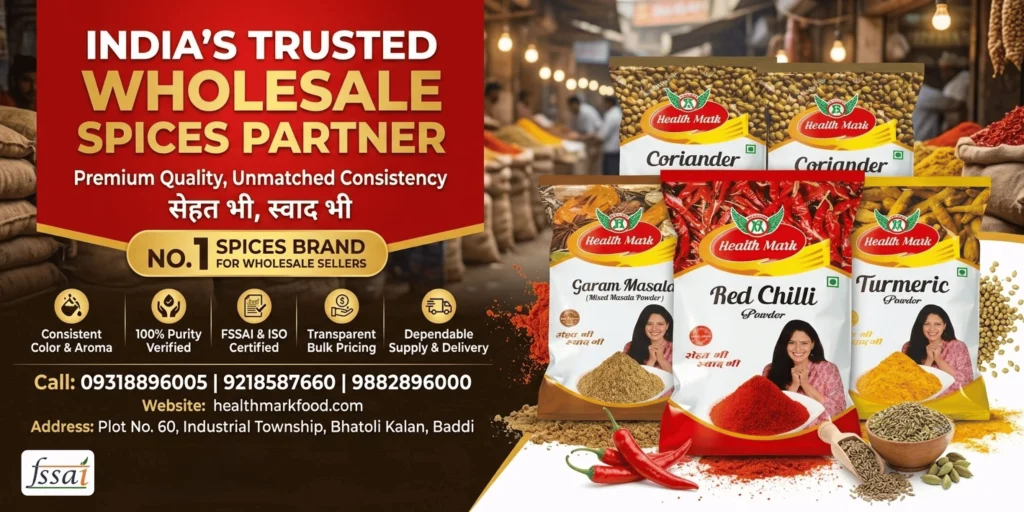
Health Mark operates from Plot No. 60, Industrial Township, Bhatoli Kalan, Baddi, India 173205. That puts it within practical reach of buyers across Himachal Pradesh, Chandigarh, Panchkula, Punjab, Haryana and Delhi NCR, and the brand states that it offers nationwide delivery.
Health Mark: A Spices Manufacturer and Wholesale Partner in North India
Health Mark positions itself as a quality-focused FMCG brand serving both wholesale and retail buyers, with the tagline (health and taste together). Its catalogue spans staples such as atta, besan, pulses and rice, alongside ground spices and whole spices.
What Buyers Can Expect
- A dedicated spices range: Powder Masale for everyday cooking and Sabut Masale for whole-spice needs
- Food-safety credentials: ISO 22000, ISO 9001, GHP, GMP and HACCP logos displayed on the website
- Wholesale and retail supply: suited to shopkeepers, distributors, caterers and institutional buyers
- A downloadable catalogue on the Health Mark website so you can review the product range before calling
- Direct sales support by phone for bulk enquiries
Why a Multi-Category Supplier Helps
Buying spices, atta, besan and pulses from one supplier can simplify logistics and billing. For a retailer, that means fewer purchase orders, one point of contact and better negotiating power.
Contact Health Mark for Bulk Spices
Sales numbers: 09318896005 | 9218587660 | 9882896000
Website: healthmarkfood.com
When you call, mention which spices you want, your approximate monthly quantity and your delivery location so the team can give you an accurate quote.
Common Mistakes When Buying Bulk Spices
| Mistake | Why it hurts | What to do instead |
| Choosing on price alone | Low price often means low quality | Compare cost per usable gram and test samples |
| Skipping samples | You discover problems after paying | Always sample before the first order |
| Ignoring packaging | Spices degrade fast in poor packs | Check seal, barrier and labelling |
| Over-stocking ground spices | Aroma fades, stock goes stale | Buy in cycles matched to sales speed |
| Storing near heat or humidity | Loses flavour and invites mould | Keep cool, dry and dark |
| Not reading the label | Missing FSSAI number or dates is a red flag | Check every label on delivery |
| Relying on one supplier with no backup | A delay can empty your shelf | Keep one reliable secondary source |
| Trusting claims without proof | Anyone can say “No. 1” | Ask for certificates, references and batch records |
Expert Tips for Retailers, Caterers and Distributors
For Retailers
- Place fast-moving spices (haldi, chilli, coriander) at eye level.
- Stock multiple pack sizes so that low-budget and family-size buyers both find a fit.
- Rotate stock using first in, first out.
For Restaurants and Caterers
- Standardise your recipes by weight, not by spoon, to cut waste.
- Buy whole spices for long-cooked dishes and powders for quick finishing.
- Order in a cycle so that no spice sits for more than a few months.
For Distributors
- Negotiate scheme-based pricing for quarterly volume.
- Insist on batch numbers on every carton to enable traceability.
- Build a small product mix to increase average invoice value.
Storage Best Practices (Applies to Everyone)
- Use airtight, food-grade containers once you open original packs.
- Keep spices away from stoves, sunlight and moisture.
- Use clean, dry spoons only.
- Label opening dates.
- Store whole spices separately from powders to protect aroma.
Step-by-Step: How to Place Your First Bulk Spices Order
- List your needs. Write down which spices, grades and pack sizes you want, plus estimated monthly volume.
- Shortlist two or three suppliers. Use the 12-point checklist above.
- Request the catalogue and rate list. Compare like with like.
- Order samples. Evaluate colour, aroma, grind and taste.
- Verify documents. Ask for FSSAI licence, ISO certificates and GST details.
- Negotiate terms. Confirm MOQ, price validity, payment and delivery time.
- Place a small trial order. Check packaging, weights and labels on arrival.
- Scale up. Once quality is proven, move to regular, larger orders.
FAQ
1. Which is the No. 1 spices brand for wholesale buyers in India?
There is no single official ranking, so “No. 1” depends on what you value. The best choice for a wholesale buyer is a brand that offers consistent quality, certified food-safety systems, fair pricing and reliable delivery. Health Mark positions itself as a leading North Indian brand and is worth evaluating through samples and certificates.
2. How do I find a reliable wholesale spices seller near me?
Search for manufacturers and wholesalers in your region, then verify them using an FSSAI licence, certifications, samples and references. Prefer suppliers who can dispatch quickly to your location and answer your calls promptly.
3. What are the top selling spices in India?
Turmeric, red chilli, coriander, cumin and garam masala lead most sales, followed by black pepper, cardamom, cloves, cinnamon, mustard seeds and fennel, as well as popular blends such as kitchen king and chaat masala.
4. How can I buy spices powder in bulk?
Contact a manufacturer or wholesaler, request a catalogue and samples, confirm minimum order quantity and price, and place a trial order. You can start by browsing Health Mark’s Powder Masale range and calling the sales team.
5. What is the difference between powder masale and sabut masale?
Powder masale means ground spices that are ready to use. Sabut masale means whole spices, which keep flavour longer and are used for tempering, pickling and fresh grinding.
6. How do I know if a spices supplier is genuine?
Check for a valid FSSAI licence, food-safety certificates, clear labels with batch and date details, sample consistency, written pricing and customer references.
7. What is the best spices price for wholesale buyers?
The best price balances quality and cost, not simply the lowest rate. Prices change with harvest, grade, packaging and freight. Request a current written quote from your shortlisted suppliers.
8. How long do ground spices stay fresh?
In sealed, good-quality packaging and cool, dry storage, ground spices typically stay at their best for several months, while whole spices generally keep flavour longer. Always follow the best-before date on the pack.
9. Can I get nationwide delivery on bulk spices?
Many manufacturers deliver across India. Health Mark states on its website that it offers nationwide delivery. Confirm transport time and charges for your location when you request a quote.
10. How do I contact Health Mark for wholesale spices?
Call the sales team on 09318896005, 9218587660 or 9882896000, or visit healthmarkfood.com to view the catalogue and send an enquiry.
Conclusion: Choose Consistency, Not Just a Claim
Finding the No. 1 spices brand for a wholesale seller near you is really about finding a partner you can rely on month after month. Judge every supplier on the same terms: certified processes, verified purity, consistent batches, honest pricing and dependable delivery. Ask for samples, check the paperwork, and start with a trial order.
If you are looking for a North India based manufacturer with a wide range of ground and whole spices, Health Mark is worth adding to your shortlist. Explore the Powder Masale and Sabut Masale ranges, or visit the Health Mark homepage to download the catalogue.
Ready to order in bulk? Call 09318896005, 9218587660 or 9882896000 to request samples and a wholesale quote today.