
If you run a sweet shop, a snack unit, a restaurant kitchen, or a retail grocery counter, you already know that besan is never just “one more ingredient” on your purchase list. It’s the base of your pakoras, the binder in your kebabs, the soul of your dhokla batter, and the reason your kadhi either turns out silky or lumpy. Which is exactly why finding the best Besan powder wholesaler in India matters so much more than most buyers realise until they’ve already been burned by a bad batch.
A lot of besan sold in loose wholesale markets is inconsistent sometimes gritty, sometimes stale, occasionally cut with cheaper flours to shave off a rupee or two per kilo. For a home cook, that might mean one disappointing batch of pakoras. For a business, it means wasted stock, unhappy customers, and a supply chain you can’t rely on.
This guide walks you through everything worth knowing before you place your next bulk order what actually separates premium besan from the average sack, how India’s besan supply chain works, what to check before you commit to a supplier, and why Health Mark has become a trusted name for buyers across Punjab, Himachal Pradesh, and North India.
What Is Besan and Why Does Quality Vary So Much?
Besan, also called gram flour or chana flour, is made by milling chana dal split, skinned Bengal gram into a fine powder. It’s a staple across Indian, Pakistani, Bangladeshi, Nepali, and even Caribbean kitchens, prized for its nutty flavour, natural binding ability, and versatility across sweet and savoury cooking.
But not all besan is created equal, and the differences come down to three things: the quality of the chana dal used, the milling process, and how carefully the flour is handled after grinding. Cheaper operations often use lower-grade or older dal, grind it coarsely with worn-out machinery, and pack it without controlling for moisture which is why some besan tastes bitter, clumps in storage, or has visible husk particles.
This is exactly why “besan” as a category has such a wide quality spread in Indian wholesale markets, and why sourcing from a premium quality Besan producer, rather than the cheapest sack available, actually pays off over a business’s supply cycle.
How Besan Is Made: From Chana Dal to Fine Flour
Understanding the production process helps you evaluate any supplier’s claims. Here’s the general journey, step by step:
- Sourcing the chana dal Bengal gram is procured from trusted grain markets, with an emphasis on cleanliness and grain uniformity.
- Cleaning and sorting Dal is passed through sieves and destoners to remove husk, dust, stones, and any foreign matter before it ever touches the mill.
- Milling The cleaned dal is ground using stone or roller mills. The fineness at this stage determines whether the output becomes standard besan, a coarser “mota” variety, or an ultra-fine powder grade.
- Sieving and grading The ground flour is sifted to achieve a consistent, uniform particle size, separating it into different grinds depending on end use.
- Quality checks Moisture content, colour, aroma, and purity are checked before packing, since even small moisture variance affects shelf life.
- Hygienic packing The flour is packed in sealed, food-grade packaging to lock in freshness and prevent contamination during transport and storage.
A wholesaler who controls this entire chain rather than simply repackaging flour bought from unknown third parties is generally in a far better position to guarantee consistency batch after batch.
Why Bulk Buyers Need a Dependable Besan Manufacturer in India
If you’re buying besan for a business rather than a household, your priorities shift. You’re no longer just asking “does this taste good?” You’re asking:
- Will this batch match the last one in taste, colour, and texture?
- Can this supplier handle recurring, scheduled bulk orders?
- Is the packaging suited for transport and long shelf storage?
- Does the supplier meet food safety norms my business needs to stay compliant?
- Can I actually reach someone when there’s an issue with an order?
This is where working with an established besan manufacturer in India, rather than an unregistered local trader, becomes a genuine business advantage. A manufacturer with its own processing unit controls sourcing, milling, and packing under one roof which means fewer surprises and a supply chain you can actually plan around.
What Makes Health Mark a Trusted Besan Supplier in North India
Health Mark operates out of an industrial manufacturing base in Baddi, Himachal Pradesh a well-established FMCG hub and serves buyers across Chandigarh, Panchkula, Ludhiana, and the wider North Indian belt. The brand’s approach centres on a few consistent principles:
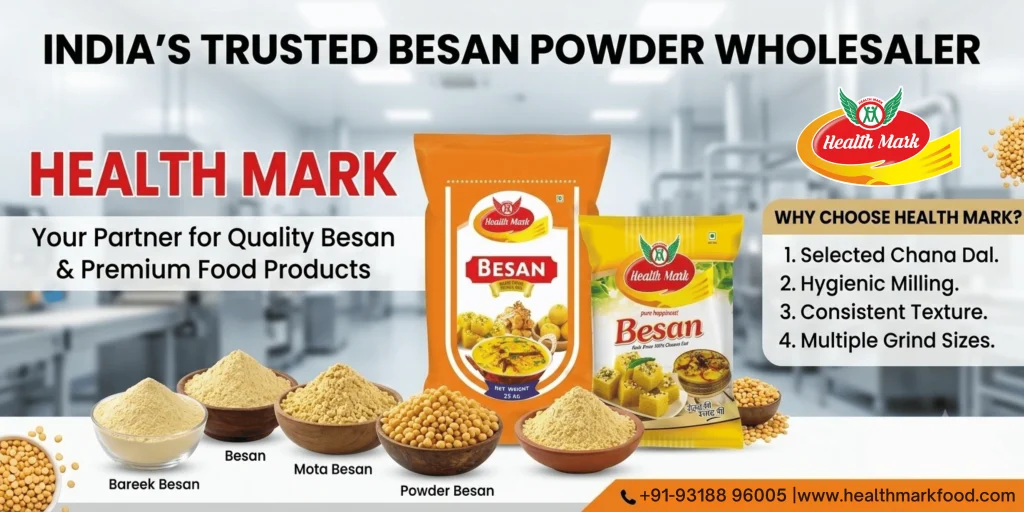
Chana dal selection: Only carefully selected Bengal gram goes into the mill, chosen for grain quality rather than the lowest price.
Fine, consistent milling: The grinding process is built to deliver a smooth, uniform texture batch after batch important for buyers who need their recipes to taste the same every single time.
Hygienic processing and packing: Flour is processed and packed under controlled, hygienic conditions to preserve freshness and purity from the mill to your kitchen.
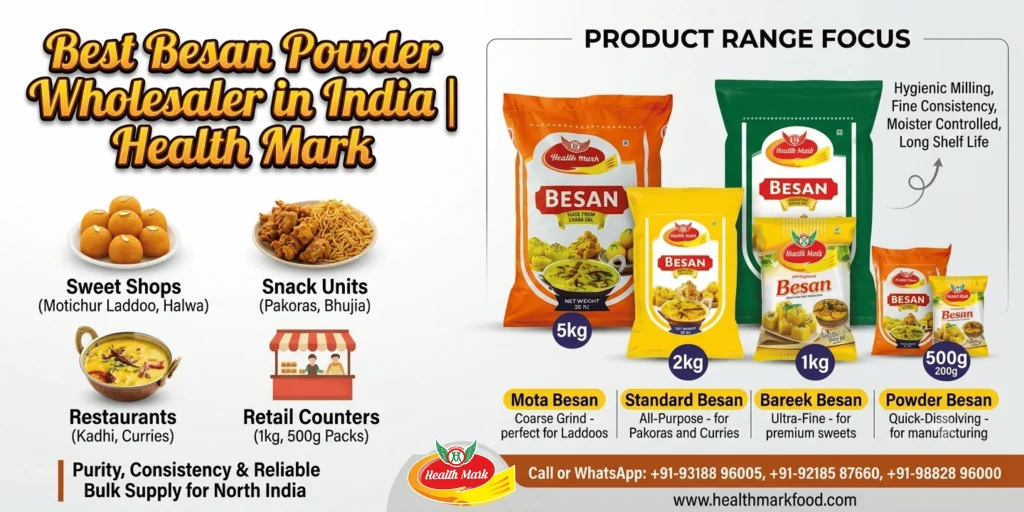
A full product range: Rather than offering one generic besan, Health Mark produces different grinds suited to different culinary and commercial needs.
Direct wholesale access: Bulk buyers can reach the sales team directly by phone or WhatsApp rather than going through layers of middlemen.
This combination is what buyers are usually referring to when they search for a health mark Besan supplier by name a known quantity they can reorder from with confidence.
Health Mark’s Besan Range: Choosing the Right Grind
One thing that separates a serious besan producer from a generic trader is range. Different recipes genuinely need different grinds, and Health Mark’s besan category reflects that:
| Product | Best Suited For | Texture |
| Besan | Everyday cooking, kadhi, chilla, curries | Fine, smooth, all-purpose |
| Bareek Besan | Sweets and delicate batters that need a very fine finish | Ultra-fine |
| Motichur / Mota Besan | Motichur laddoo and boondi, where a coarser grain gives the classic bead texture | Coarse |
| Powder Besan | High-volume snack and sweet manufacturing requiring fine, quick-dissolving flour | Fine powder |
If you’re a home cook, the standard besan pack usually covers every need. If you’re running a sweet shop or a snack manufacturing line, matching the grind to the recipe is what gives you the texture customers expect which is why it’s worth browsing the full Besan product category rather than assuming one type fits every dish.
Besan Nutrition: What You’re Actually Selling to Your Customers
Whether you’re a retailer stocking shelves or a food business using besan as an ingredient, it helps to know what you’re actually offering. Per 100 grams, besan typically provides:
| Nutrient | Approximate Value (per 100g) |
| Energy | ~387 kcal |
| Protein | ~22 g |
| Dietary Fibre | ~10–11 g |
| Total Fat | ~6 g |
| Carbohydrates | ~58 g |
| Iron | ~4.6–4.9 mg |
| Folate (Vitamin B9) | High, supports cell function |
Besan is naturally gluten-free and carries a comparatively low glycemic index next to refined wheat flours, which is a large part of why it’s increasingly positioned as a protein rich staple for health-conscious households, and why it holds appeal across both traditional and modern diets. Businesses selling to fitness-conscious or gluten-sensitive customers often find this a genuinely useful selling point, not just a nutrition footnote.
How to Identify the Best Besan Seller: A Practical Checklist
With so many wholesalers claiming to be the “top” or “No. 1” name in the market, buyers need a practical way to separate real quality from marketing noise. Before you commit to a supplier, check the following:
1. Colour and Aroma
Good besan has a bright, natural yellow colour and a mild nutty smell. A dull, greyish tone or a musty odour usually signals old stock or poor storage.
2. Texture Consistency
Rub a pinch between your fingers. It should feel smooth and uniform not gritty, not clumped, and free of visible husk specks.
3. Moisture Control
Besan with excess moisture cakes and forms lumps in the packet. Proper drying and sealed packaging prevent this.
4. Transparent Sourcing
A credible besan manufacturer in India should be able to tell you where the chana dal comes from and how it’s processed not just hand over a packet with a logo on it.
5. Certifications and Compliance
Look for FSSAI registration and basic food-safety compliance. This isn’t just a formality; it’s your assurance that the product meets India’s regulatory purity standards.
6. Packaging Options
A supplier offering multiple pack sizes from small retail packs to bulk sacks is generally better equipped to serve both retail shelves and commercial kitchens.
7. Responsiveness
Can you actually reach a real person to place a repeat order, ask about pricing, or resolve an issue? A supplier that answers calls and WhatsApp queries directly is worth far more than one hiding behind a generic contact form.
Health Mark Besan vs. Average Loose-Market Besan
| Parameter | Health Mark Besan | Typical Loose-Market Besan |
| Sourcing | Selected Bengal gram, quality-first sourcing | Often unverified, mixed-grade dal |
| Processing | Controlled milling and hygienic packing | Frequently open, unhygienic handling |
| Consistency | Uniform texture batch after batch | Varies significantly between batches |
| Packaging | Sealed, food-grade packs in multiple sizes | Often loose or poorly sealed |
| Traceability | Manufacturer-backed, direct contact available | Limited to no traceability |
| Shelf Life | Better retention due to moisture control | Shorter, prone to clumping |
This is the kind of comparison every serious buyer should be running mentally before choosing where to place a recurring wholesale order not just comparing the number printed on the price tag.
Common Mistakes Bulk Buyers Make When Sourcing Besan
Even experienced buyers fall into a few recurring traps when sourcing best besan wholesale:
Chasing the lowest price without checking quality. A slightly cheaper rate per kilo means little if it leads to product wastage, inconsistent recipes, or customer complaints.
Buying in bulk without testing a sample first. Always request or purchase a small trial pack before committing to a large order.
Ignoring packaging quality. Poorly sealed besan absorbs moisture fast, especially in humid storage conditions, shortening its usable life.
Overlooking grind type. Using standard besan where a finer or coarser grind is actually needed can quietly hurt product quality (think motichur laddoo made with the wrong grain size).
Not confirming supply consistency. A supplier who can deliver once but can’t guarantee the next batch isn’t a long-term partner it’s a gamble.
Skipping direct communication. Relying only on online listings without ever speaking to the supplier’s sales team makes it harder to negotiate pricing, quantities, or delivery schedules.
Besan Price: What Actually Drives the Cost Per Kilo
Buyers frequently search for the best Besan price, but price alone is a poor way to judge value. A few factors genuinely move the cost:
Raw material quality: Premium-grade chana dal costs more to procure but yields a better, more consistent final product.
Processing standards: Controlled milling, sieving, and hygienic packing add cost but reduce wastage and spoilage for the buyer.
Order volume: Larger, recurring bulk orders typically unlock better per-kilo pricing than one-off small purchases.
Packaging format: Bulk sacks are usually more cost-efficient per kilo than smaller retail packs, which carry higher packaging overhead.
Seasonal dal prices: Like any agricultural commodity, chana dal prices fluctuate with harvest cycles, which can shift besan pricing accordingly.
For an accurate, current quote based on your required quantity and pack size, it’s always best to contact the sales team directly rather than relying on generic online price listings, which rarely reflect live wholesale rates.
Who Should Be Buying Wholesale Besan?
Bulk besan sourcing isn’t limited to large food manufacturers. It regularly makes sense for:
Sweet shops and mithai makers needing consistent motichur and besan ladoo texture
Restaurants and dhaba kitchens using besan daily for pakoras, kadhi, and curries
Snack and namkeen manufacturers requiring specific grind sizes at scale
Grocery and kirana store owners stocking retail-ready packs for local customers
Caterers and event kitchens handling large-volume orders
Hostel and institutional kitchens managing daily bulk cooking
Exporters and B2B distributors sourcing besan for onward supply
If your kitchen or business goes through besan regularly, sourcing directly from a wholesaler rather than repeatedly buying retail packs almost always works out more economical and more reliable.
Expert Tips for Storing Besan in Bulk
Buying good besan is only half the job storing it correctly protects that quality until it’s used:
Store in a cool, dry place away from direct sunlight and moisture.
Keep bulk sacks sealed and off the floor, ideally on pallets, to avoid dampness.
Once opened, transfer besan into airtight containers rather than leaving the original pack exposed to air.
Avoid storing besan near strong-smelling spices, since flour absorbs odours easily.
Follow a first-in, first-out (FIFO) rotation for stock to ensure older batches are used before newer ones.
Periodically check for any change in smell, colour, or texture, especially during humid months.
Why Health Mark Is Considered a Top Besan Supplier
Buyers searching for phrases like top selling Besan in india, top Besan supplier, or best wholesale besan are usually looking for the same underlying thing: a producer that combines genuine product quality with dependable, scalable supply. Health Mark’s positioning as a besan supplier in north India is built on:
A dedicated manufacturing base in Baddi, Himachal Pradesh, serving Chandigarh, Panchkula, Ludhiana, and neighbouring regions
A full range of besan grinds to match different commercial and home-cooking needs
Hygienic, quality-controlled processing from raw dal to finished pack
Direct accessibility for wholesale enquiries via phone and WhatsApp
A broader FMCG product portfolio (atta, pulses, spices, and more), which makes Health Mark a convenient single-source supplier for grocery and food businesses managing multiple ingredient categories
If you’re specifically comparing options for the best besan brand in Chandigarh or the wider Punjab–Himachal belt, proximity to the manufacturing unit in Baddi is a genuine logistical advantage shorter supply routes generally mean fresher stock reaching you faster.
FAQ
1. What is the difference between besan and chickpea flour?
Besan is milled from chana dal the split, husked form of Bengal gram giving it a fine, smooth texture and mild nutty flavour. Some Western “chickpea flour” is ground from whole kabuli chickpeas instead, which can result in a slightly coarser flour. In Indian cooking, the terms are generally used interchangeably.
2. How do I choose the best Besan powder wholesaler in India for my business?
Look beyond price. Check the supplier’s sourcing practices, milling and packaging standards, product range, certifications like FSSAI registration, and importantly whether you can reach their sales team directly to discuss quantities, pricing, and delivery schedules.
3. What is the shelf life of besan?
Properly processed and sealed besan typically stays fresh for several months when stored in a cool, dry place. Once opened, transferring it to an airtight container helps extend its usability and protect it from moisture and odour absorption.
4. Is besan good for weight management?
Besan is relatively high in protein and dietary fibre compared to refined flours like maida, which can support satiety. However, it should be part of a balanced diet, and individuals with specific health goals should consult a nutritionist for personalised guidance.
5. What is the minimum order quantity for wholesale besan?
Minimum order quantities vary by supplier and depend on pack size and business needs. It’s best to contact the supplier directly for Health Mark, you can call or WhatsApp +91-93188 96005 to discuss bulk quantities and current pricing.
6. Which besan grind is best for motichur laddoo?
A coarser grind, often labelled “Mota” or “Motichur” besan, is preferred for laddoo and boondi, since it produces the classic bead-like texture these sweets are known for. Standard fine besan is better suited to batters, curries, and pakoras.
7. Is besan naturally gluten-free?
Yes. Since besan is made entirely from chana dal (a legume) rather than wheat, it is naturally gluten-free, making it a suitable option for individuals with gluten sensitivity or celiac disease provided it hasn’t been cross-contaminated during processing.
8. How can I tell if besan has been adulterated?
Signs of adulteration can include an unusually pale or yellow-tinted colour, a starchy rather than nutty smell, or a gritty, uneven texture. Buying from a transparent, quality-controlled manufacturer significantly reduces this risk compared to unbranded loose stock.
9. Does Health Mark supply besan outside Punjab and Himachal Pradesh?
Health Mark’s manufacturing base is in Baddi, Himachal Pradesh, with strong distribution across Chandigarh, Panchkula, and Ludhiana. For supply to other regions, it’s best to directly contact the sales team to confirm current delivery coverage.
10. What besan pack sizes does Health Mark offer?
Health Mark’s besan is available in multiple pack sizes, including 55gm, 200gm, 500gm, and 1kg formats, catering to both retail customers and businesses needing larger volumes.
Final Word: Choosing a Besan Partner You Can Rely On
At the end of the day, “best” isn’t a badge a supplier gives itself it’s something a buyer decides after checking sourcing, consistency, hygiene, range, and how easy it actually is to reach the people behind the product. Whether you’re stocking a retail shelf, running a sweet shop, or managing a commercial kitchen, the right besan wholesaler should feel less like a transaction and more like a dependable part of your supply chain.
Health Mark brings together careful chana dal sourcing, hygienic milling, a full range of besan grinds, and direct access to its sales team everything a serious buyer looks for before placing a recurring wholesale order. Explore the complete Besan range, check product details on the Besan product page, or visit the Health Mark homepage to see the brand’s full portfolio of food products.
Ready to place a bulk inquiry? Call or WhatsApp the sales team directly at +91-93188 96005, +91-92185 87660, or +91-98828 96000.