
Open any Indian kitchen cabinet and you’ll almost certainly find a packet of besan sitting next to the atta and the spices. It’s the flour behind crispy pakoras on a rainy evening, soft dhokla for breakfast, tangy kadhi for lunch, and melt-in-the-mouth laddoos during festivals. But here’s the catch not all besan is created equal, and the difference between a good dish and a disappointing one often comes down to one thing: where you bought your besan from.
If you’ve typed “premium quality besan seller near me” into Google recently, you’re not alone. More and more home cooks, sweet shop owners, restaurant chefs, and bulk buyers are realising that loose, unbranded gram flour from an unknown source can be inconsistent at best and unsafe at worst think chalky texture, bitter aftertaste, poor colour, or worse, adulteration with cheaper starches.
This guide breaks down everything you actually need to know before you buy: how to identify a genuinely premium quality besan, what separates the best besan brand in India from the rest, how besan is manufactured, what drives besan price up or down, and how to choose a reliable besan seller near me whether you need a single 500gm pack for home cooking or wholesale quantities for your business. Along the way, we’ll also show you where Health Mark Besan fits into this picture, and why it’s become a trusted choice for households and businesses across India.
What Is Besan, and Why Does Quality Matter?
Besan, also called gram flour or chana flour, is made by finely grinding dried, dehusked, and split chickpeas known as chana dal (Bengal gram). It’s naturally gluten-free, protein-rich, and has been a staple of Indian, Pakistani, and Middle Eastern cooking for centuries.
The problem is that besan doesn’t come with an obvious quality label the way, say, a packaged snack does. Two packets can look almost identical on the shelf and taste completely different once cooked. Low-grade besan is often produced from:
Older or poor-quality chana dal that has picked up moisture and lost its natural aroma
Dal that hasn’t been cleaned properly, leaving behind husk, dust, or foreign particles
A rough, inconsistent grind that leaves lumps in batter and cooks unevenly
In the worst cases, blending with cheaper flours like tapioca, maize, or peas to cut costs
None of this is visible at first glance you usually only find out once you’re standing over a pan of pakoras that won’t turn golden, or dhokla that refuses to rise. That’s exactly why the search for a premium quality besan seller near me has become so common: people have learned, often the hard way, that the seller matters as much as the recipe.
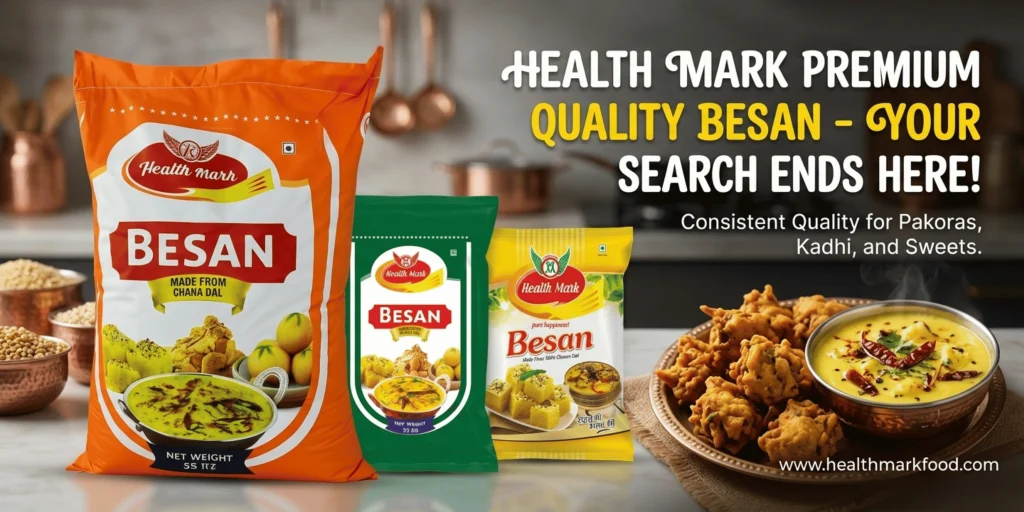
Health Mark’s besan is prepared from carefully selected chana dal and finely milled to preserve its natural nutty flavour and smooth texture you can see the full product details on the Besan product page.
How to Find the Best Besan Seller Near Me
A local search for besan usually returns a mix of kirana stores, wholesale mandis, D2C brands, and quick-commerce listings. Here’s how to filter through the noise and land on a seller you can actually trust.
Check Certifications and Hygiene Standards
A genuine seller or manufacturer should be operating under FSSAI licensing and following documented hygiene protocols during cleaning, grinding, and packaging. If a seller can’t tell you anything about how the product is processed, that’s a red flag.
Look at Reviews, Reputation, and Longevity
Brands that have been supplying besan for years and have a visible presence a website, product categories, social media, customer support numbers are generally more accountable than a nameless stall. Established players also tend to have more consistent batch quality because their processes are standardised.
Ask About the Source of the Chana Dal
Premium besan starts with premium dal. A trustworthy seller should be able to explain, even briefly, where their chana dal is sourced from and how fresh their stock rotation is.
Compare Prices Without Chasing the Cheapest Option
Besan price is a legitimate factor, but the cheapest packet in the market is very often the one cut with lower-grade dal or fillers. Aim for fair, mid-to-premium pricing from a seller who’s transparent about ingredients rather than the rock-bottom option.
Prefer Sellers With Direct Manufacturer Backing
When you buy from a besan manufacturer in India directly or a brand with its own manufacturing unit you cut out a layer of middlemen, which usually means fresher stock and better accountability if something’s wrong with a batch.
What Makes Besan “Premium Quality”? The Real Quality Markers
“Premium” gets used loosely in food marketing, so it helps to know the actual, checkable markers of quality besan. Here’s what to look for on the packet and in the flour itself:
| Quality Marker | What Premium Besan Looks Like | What Poor Quality Besan Looks Like |
| Colour | Even, natural pale yellow | Dull, greyish, or patchy |
| Texture | Smooth, fine, no visible lumps | Gritty, uneven, or coarse without reason |
| Aroma | Mild, natural, nutty smell | Musty, stale, or no smell at all |
| Moisture | Dry to the touch, free-flowing | Slightly damp, clumps together |
| Purity | 100% chana dal, no fillers | May contain maize, tapioca, or pea starch |
| Packaging | Sealed, hygienic, labelled with batch/date | Loose, unsealed, or unlabelled |
A simple home check: mix a spoon of besan into a little water. Premium quality besan dissolves into a smooth, lump-free batter fairly quickly. If it feels gritty or separates oddly, the grind quality or purity is likely compromised.
Top Qualities of the Best Besan Brand in India
With dozens of regional and national players in the market, here’s what genuinely separates the best besan brand in India from an average one:
Consistency batch after batch the besan you buy this month should taste and behave the same as the one you bought three months ago
Hygienic processing and packing, ideally in a facility that follows food-safety standards rather than open-air grinding
No artificial colour or bleaching agents used to make the flour look brighter than it naturally is
Natural nutty aroma retained through gentle processing rather than aggressive heat treatment
A range of grinds and variants fine besan for smooth batters, coarser “bareek” or “mota/motichur” besan for boondi and laddoos, and powdered besan for specific recipes
Transparent labelling, including manufacturing details and pack sizes
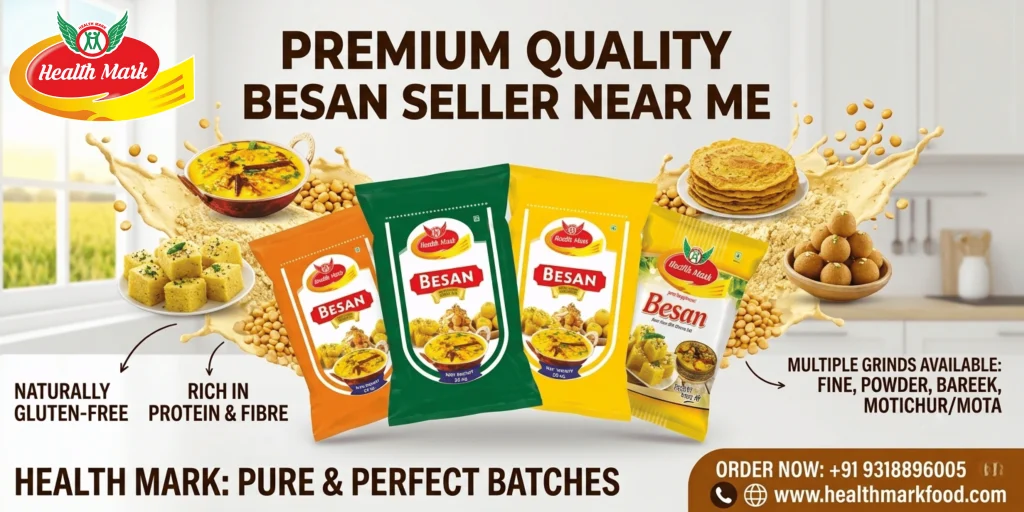
Health Mark, for instance, offers its besan across multiple pack sizes 55gm, 200gm, 500gm, and 1kg along with dedicated variants like Powder Besan, Bareek Besan, and Motichur/Mota Besan, so home cooks and sweet-makers can pick the exact grind their recipe needs. You can browse the full range on the Besan product category page.
Besan Manufacturer in India: How Premium Besan Is Actually Made
Understanding the manufacturing journey helps explain why prices and quality vary so widely between sellers. A responsible besan manufacturer in India generally follows a process like this:
1. Sourcing procuring good-quality chana dal from trusted grain suppliers, checked for moisture content and freedom from pests or foreign matter
2. Cleaning removing dust, husk, stones, and any impurities using mechanical cleaning and sieving equipment
3. Grading sorting the dal by size and quality before it goes to the mill
4. Grinding/Milling the dal is milled into flour at a controlled speed and temperature to protect flavour and nutrients, with the fineness adjusted depending on whether it’s regular, bareek, or powder besan
5. Sieving passing the ground flour through fine sieves to remove any residual husk or coarse particles
6. Quality Checks testing for colour, texture, moisture, and purity before packaging
7. Hygienic Packing sealing the besan in food-grade packaging to lock in freshness and prevent contamination during transport and storage
Every step in this chain affects the final product. A manufacturer that skips cleaning or uses old, low-grade dal can produce besan that looks fine on the shelf but underperforms in the kitchen which is exactly why sourcing matters as much as the seller you buy from.
Besan Price in India: What Really Affects the Cost
Besan price varies noticeably across the market, and it’s rarely random. Here are the main factors that push the cost of besan up or down:
Raw material cost chana dal prices fluctuate with the agricultural season and market demand, directly affecting besan price
Processing quality finer grinding, better cleaning, and stricter quality checks cost more to run but produce a noticeably better product
Brand reputation and consistency established best besan brand in India names typically price slightly higher because they invest in hygiene, testing, and packaging
Pack size smaller packs (like 55gm or 200gm) usually cost more per kilogram than bulk packs (500gm or 1kg)
Packaging and logistics sealed, food-grade packaging and transport add to the final price compared to loose, open besan sold by weight
| Besan Category | Typical Positioning | What You’re Really Paying For |
| Loose/unbranded besan | Lowest price point | No traceability, inconsistent quality, higher adulteration risk |
| Standard branded besan | Mid-range pricing | Basic quality checks, sealed packaging, brand accountability |
| Premium quality besan | Slightly higher pricing | Superior chana dal, finer grind, hygienic processing, consistent batches |
Because besan price changes with the market, the most reliable way to get the current besan price for Health Mark products is to check the Besan product page or contact the sales team directly at +91 93188 96005, +91 92185 87660, or +91 98828 96000.
How to Choose the Best Wholesale Besan Supplier
If you run a restaurant, sweet shop, snack unit, or retail store, your requirements go beyond a single packet. Here’s a checklist for evaluating the best wholesale besan supplier:
Valid FSSAI licensing and documentation for bulk food supply
Consistent supply capacity can the supplier reliably meet your monthly volume without quality dipping during peak demand?
Multiple pack size options, so you can order in bulk formats suited to your kitchen or retail shelf
Clear pricing for wholesale besan without hidden costs on logistics
Direct communication channel for reordering, complaints, or custom requirements look for sellers offering quick contact options like WhatsApp or a dedicated sales line
Track record with other B2B clients, even if it’s just word of mouth in your local trade circle
Health Benefits of Besan (Backed by Nutrition Data)
Besan isn’t just a cooking staple it’s genuinely nutrient-dense. According to widely cited nutrition data for gram flour, a 100g serving typically provides approximately:
~387 kcal of energy
~22g of protein notably higher than wheat flour (atta), making it a strong plant-based protein source
~10–11g of dietary fibre, which supports digestion and helps with satiety
~6g of fat, relatively low compared to many other flours
~57–58g of carbohydrates, with a comparatively low glycemic profile versus refined wheat or rice flour
Meaningful amounts of iron, calcium, magnesium, potassium, and folate
Because besan is milled from chickpeas rather than wheat, it’s also naturally gluten-free, which makes it a useful ingredient for people avoiding gluten. Its combination of protein and fibre is one reason besan-based dishes like chilla and dhokla tend to feel more filling than similarly sized wheat-based snacks.
For a general nutritional reference, see the Wikipedia entry on gram flour, which compiles standard nutrition data per 100g serving.
Culinary Uses: What You Can Make With Premium Besan
Good besan is versatile enough to carry an entire meal from starter to dessert. Here’s what premium quality besan is best suited for:
Pakoras and bhajiyas a fine, pure besan gives a crisp, golden coating without turning soggy
Dhokla and khaman quality besan ferments and steams evenly, giving that classic soft, spongy texture
Kadhi smooth besan blends into buttermilk without lumps, giving a silky, well-thickened gravy
Besan chilla and cheela a popular high-protein breakfast, especially for vegetarians
Laddoos and barfis coarser motichur or mota besan is preferred here for that classic grainy-yet-melting texture
Batter coatings for vegetables, paneer, and snacks across regional Indian cuisines
Thickening agent in certain curries and gravies
This is also why brands offer different besan variants fine besan, bareek besan, and motichur/mota besan aren’t just marketing labels; each grind genuinely performs better in specific recipes.
Common Mistakes to Avoid When Buying Besan
Buying loose besan from open sacks at unhygienic stalls without checking freshness or storage conditions
Ignoring the manufacturing or packing date, which can mean you’re buying stock that’s already lost freshness
Choosing purely on price and overlooking purity, texture, and hygiene
Using the wrong grind for the recipe for example, using coarse besan where a smooth batter is needed
Storing besan incorrectly at home, which lets even good-quality besan go stale or attract moisture and pests quickly
Not checking for a visible brand, FSSAI number, or contact details on the packaging before purchase
Why Health Mark Is Among the Best Besan Sellers Near You
Health Mark Besan is made from carefully selected chana dal, finely ground to deliver a smooth texture and rich, nutty flavour that works equally well in everyday cooking and festive preparations. A few reasons households and businesses keep coming back to it:
Made from premium quality Bengal gram (chana dal), finely milled for consistency
Hygienically processed and packed to preserve freshness and purity
Available across multiple pack sizes 55gm, 200gm, 500gm, and 1kg for both households and bulk needs
Multiple grind variants available: regular Besan, Powder Besan, Bareek Besan, and Motichur/Mota Besan
Backed by Health Mark’s broader food portfolio, including atta, pulses, spices, and dry fruits, reflecting an established, accountable supplier rather than a one-product seller
Easy enquiry and ordering via phone or WhatsApp, making it simple to place an order or ask about besan price and availability
To place an order or ask a question, you can view the product directly on the Health Mark Besan product page, explore the full Besan category, or reach the sales team directly at +91 93188 96005, +91 92185 87660, or +91 98828 96000.
Health Mark Besan vs. Typical Loose Market Besan
| Parameter | Health Mark Besan | Typical Loose Market Besan |
| Source dal | Selected premium chana dal | Often unspecified/mixed-grade dal |
| Processing | Hygienic, controlled milling | Frequently open, unregulated grinding |
| Packaging | Sealed, food-grade packs (55gm–1kg) | Loose, sold by weight, often unsealed |
| Variants available | Regular, Powder, Bareek, Motichur/Mota | Usually one generic grind only |
| Traceability | Branded, contactable seller | Little to no traceability |
| Consistency | Batch-to-batch consistency | Can vary significantly by purchase |
Expert Tips to Store Besan and Keep It Fresh Longer
Always store besan in an airtight container exposure to air is the fastest way to make it go stale
Keep it in a cool, dry place, away from direct sunlight and stovetop heat
In humid climates or during monsoon, refrigerate besan to prevent clumping and prolong shelf life
Use a clean, dry spoon every time moisture from a wet spoon is a common cause of early spoilage
Buy pack sizes that match your usage a 1kg pack sitting half-used for months won’t stay as fresh as smaller packs used up faster
Do a quick smell and texture check before use if a pack has been stored for a long time
FAQ
1. What is besan made of?
Besan is made by grinding dried, split, and dehusked chickpeas known as chana dal (Bengal gram) into a fine flour.
2. Is besan gluten-free?
Yes. Since besan is made from chickpeas rather than wheat, it is naturally gluten-free, making it suitable for people avoiding gluten.
3. How do I identify premium quality besan?
Look for an even pale-yellow colour, a smooth fine texture with no lumps, a mild natural nutty aroma, dry free-flowing consistency, and sealed, labelled packaging from a traceable brand.
4. What’s the difference between besan, motichur besan, and bareek besan?
Regular besan is the standard fine gram flour used for batters and curries. Bareek besan is a very finely milled version ideal for smooth textures. Motichur or mota besan is more coarsely ground and is preferred for boondi and laddoo-style sweets where a grainier texture is needed.
5. How long does besan stay fresh after opening?
Stored properly in an airtight container in a cool, dry place, besan generally stays fresh for several months; refrigeration extends this further, especially in humid weather.
6. Where can I buy the best besan online in India?
You can order Health Mark’s premium quality besan directly through the product page at healthmarkfood.com, or contact the sales team via call or WhatsApp for order assistance.
7. What is the besan price range in India?
Besan price depends on chana dal market rates, processing quality, brand, and pack size. Loose, unbranded besan is typically cheapest, while hygienically processed, branded premium besan is priced slightly higher to reflect better sourcing and quality control. For current besan price on specific pack sizes, check the product page or contact the seller directly.
8. Is Health Mark besan suitable for bulk or wholesale orders?
Yes. Health Mark caters to both individual household buyers and businesses looking for wholesale besan. Bulk enquiries can be made by phone or WhatsApp to the numbers listed on the website.
9. Can diabetics eat besan?
Besan has a comparatively lower glycemic profile than refined wheat or rice flour and is rich in fibre and protein, which many people find easier on blood sugar. That said, individuals managing diabetes should consult their doctor or dietitian for guidance specific to their condition.
10. How is besan different from regular wheat flour (atta)?
Besan is made from chickpeas and is naturally gluten-free with a higher protein content, while atta is made from wheat and contains gluten. They’re used differently in cooking besan for batters, sweets, and thickening, atta primarily for rotis and baked goods.
Conclusion: Choose Purity, Choose the Best Besan Seller
The next time you search for a “premium quality besan seller near me,” remember that the packet you choose affects everything downstream the crunch of your pakoras, the softness of your dhokla, the melt of your laddoos, and even the nutrition your family gets from a daily-use flour. Look past the price tag alone, and check for purity, hygiene, traceability, and consistency.
Health Mark Besan is built around exactly these principles premium chana dal, hygienic processing, multiple grinds to match different recipes, and pack sizes for both home kitchens and bulk business needs. Whether you’re a home cook looking for a reliable everyday besan or a business owner sourcing a wholesale besan supplier, it’s worth checking out the range and reaching out directly with any questions.