
Open almost any Indian kitchen and you’ll find a tin of besan sitting quietly next to the atta and rice until the day it lets you down. The pakoras don’t puff up the way they used to. The dhokla turns out dense. The kadhi tastes flat instead of nutty and rich. More often than not, the problem isn’t the recipe. It’s the besan.
Besan, or gram flour, is one of those ingredients people assume is “all the same.” It isn’t. The chana dal used, how finely it’s milled, how it’s stored before packing, and even how long it sits on a warehouse shelf all change the way it cooks, tastes, and keeps. And because besan is sold everywhere from the corner kirana store to large wholesale mandis quality can swing wildly between one packet and the next.
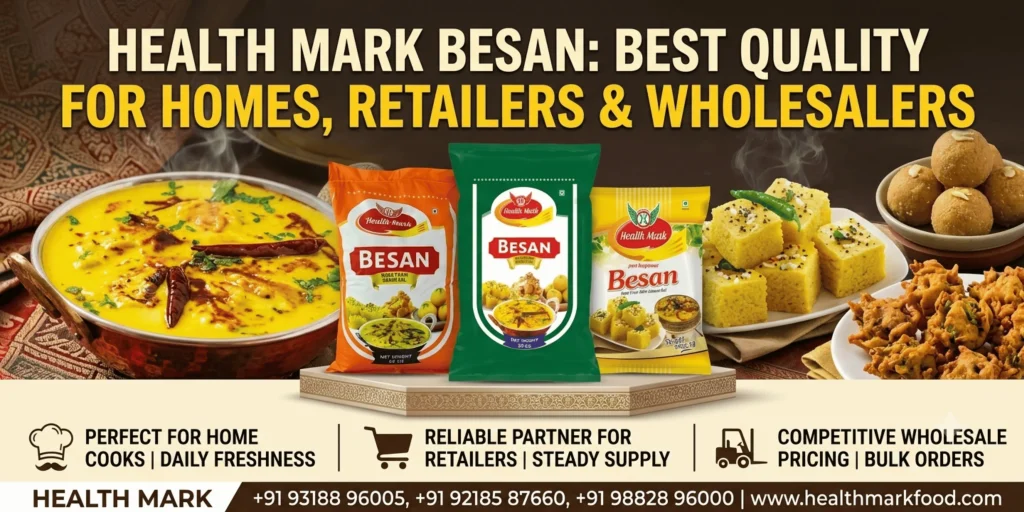
This guide is built for three different readers who all end up asking the same question in different words: home cooks wanting the best besan for daily cooking, retailers who need a reliable best besan seller they can stock with confidence, and wholesalers or distributors hunting for the best wholesale besan at a fair besan price. Whichever camp you’re in, you’ll find a practical, no-fluff answer here along with a look at how Health Mark, a besan manufacturer in India based out of Baddi, Himachal Pradesh, approaches quality at every stage.
What Is Besan? Understanding India’s Favourite Gram Flour
Besan is the flour milled from chana dal (split Bengal gram), one of India’s most widely grown pulses. It’s pale yellow, slightly grainy to the touch, and carries a distinct nutty aroma that becomes more pronounced once it hits hot oil or a warm pan. Outside India it’s often labelled “gram flour” or “chickpea flour,” though technically it comes from Bengal gram rather than the larger kabuli chana used in dishes like chole.
It’s genuinely one of the most versatile items in an Indian pantry. The same packet can go into crisp pakoras, a soft steamed dhokla, a tangy kadhi, festive laddus, or even a quick face pack few staples cross that many categories of cooking and home use in one bag.
Why Besan Quality Matters More Than You Think
Because besan looks fairly uniform on the shelf, it’s easy to assume price is the only real difference between one pack and another. In practice, quality gaps show up in ways that affect both your food and, over time, your health.
Adulteration Risks in the Market
Loose or unbranded besan sold in open markets is occasionally mixed with cheaper fillers such as ground yellow peas (matar) or, in poorly regulated supply chains, artificial colouring to fake a richer yellow shade. This isn’t true of every loose seller, but it’s common enough that food safety bodies routinely flag it. A simple household check dropping a pinch of besan into a glass of water and watching whether any colour bleeds out is a well-known first test, though it isn’t a substitute for buying from a traceable, tested source.
How Poor Quality Besan Affects Your Cooking
Pakoras and bhajiyas turn oily or fail to crisp up because the flour absorbs oil unevenly
Dhokla and khaman come out dense instead of light and spongy
Kadhi can taste raw or bitter if the besan wasn’t milled or roasted properly
Sweets like besan laddu lose their signature grainy-yet-smooth bite
None of this is about being fussy it’s simply what happens when the raw material varies. Consistent results start with consistent, well-sourced flour.
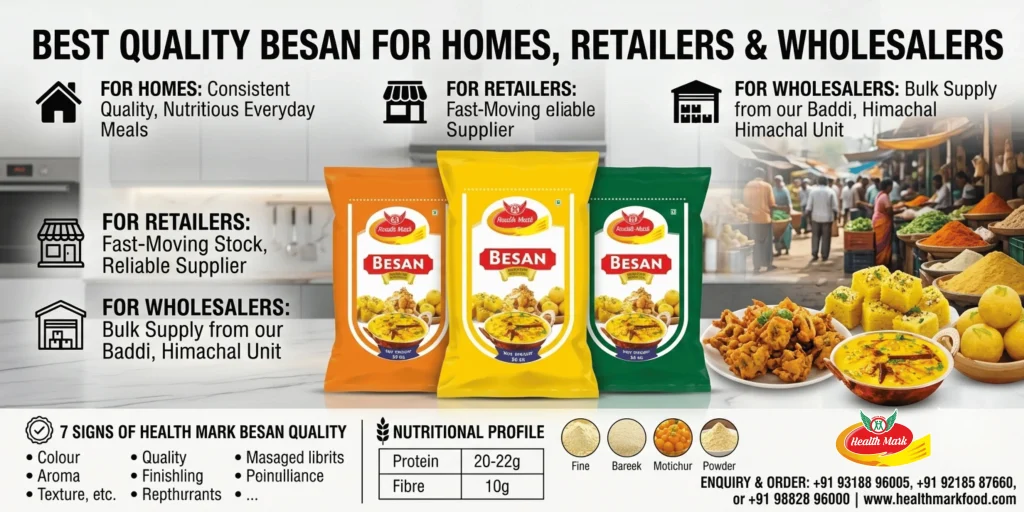
7 Signs of Best Quality Besan A Buyer’s Checklist
Whether you’re picking up a small pack for home or evaluating a supplier for your shop, these are the practical checks worth running:
Colour a soft, natural pale yellow, not an unnaturally bright or dull shade
Aroma a mild, nutty smell; any sour, musty, or “stale flour” odour is a red flag
Texture fine and even, without lumps, grit, or visible husk fragments
Water test a pinch in water should not release any colour or floating film
Packaging sealed, tamper-proof packs with a visible manufacturing and best-before date
Source transparency a named manufacturer with a traceable address, not an unlabelled loose sack
Behaviour on cooking good besan binds batter smoothly and fries or steams evenly, without a raw smell lingering after cooking
Nutritional Profile of Premium Besan
One reason besan has stayed a kitchen staple for generations is that it’s genuinely nutritious when made from good-quality chana dal. Figures vary slightly by source and testing method, so treat the numbers below as a general reference rather than a lab certificate:
| Nutrient | Approx. per 100g | Why It Matters |
| Protein | ~20–22g per 100g | One of the higher plant-protein flours used daily in Indian cooking |
| Dietary Fibre | ~10g per 100g | Supports digestion and helps with satiety |
| Fat | Low, mostly unsaturated | Naturally low-fat compared to refined flours |
| Carbohydrates | Moderate, complex carbs | Slower energy release than refined maida |
| Iron & Folate | Present in meaningful amounts | Common reasons besan is recommended in balanced diets |
Because besan is naturally gluten-free, it’s also a popular substitute for wheat-based binders in recipes for people managing gluten sensitivity though anyone with a diagnosed condition should always confirm suitability with a doctor or dietitian rather than relying on a food blog alone.
Besan Varieties Explained: Fine, Bareek, Motichur/Mota & Powder
Not all besan is milled to the same grade, and the right one depends on what you’re cooking. Health Mark besan range on the category page covers exactly these four grades:
| Variant | Best Used For | Texture Notes |
| Fine Besan (standard) | Everyday cooking kadhi, curries, batters | Smooth, all-purpose texture |
| Bareek Besan | Delicate items like dhokla, khaman, sweets | Extra-fine grind for a lighter finish |
| Motichur / Mota Besan | Motichur laddu and coarser sweet preparations | Slightly coarser grain for that classic pearl-like texture |
| Powder Besan | Bulk cooking, catering, thickening gravies | Very fine, consistent powder form |
Best Quality Besan for Home Kitchens
For everyday home cooking, most families need just one reliable pack of fine besan that performs consistently across pakoras, kadhi, and the occasional dhokla or laddu. What matters most at home is freshness (smaller pack sizes bought more often beat one giant sack that sits half-used for months), a clean ingredient list with nothing but chana dal, and a texture fine enough to blend into batter without lumps.
Health Mark’s standard Besan is milled from carefully selected chana dal and is available in 55gm, 200gm, 500gm, and 1kg packs sizes that suit both trial purchases and a full month’s stock for a household kitchen.
Best Besan for Retailers: What Shop Owners Should Check
If you run a kirana store, a general store, or a small supermarket counter, besan is a fast-moving, repeat-purchase item which means your customers will notice quality dips faster than they will with slower-moving goods. Before you commit shelf space to a besan seller near you, it’s worth checking a few things beyond just the wholesale rate:
Consistency between batches does pack #50 taste and cook the same as pack #1?
Shelf life and packaging durability during transport and storage
Availability of multiple pack sizes (small packs move faster at retail counters)
Reliable reordering and delivery timelines from the manufacturer
A recognisable brand name that builds repeat trust with your customers
A supplier who can answer all five confidently is generally a safer long-term bet than one offering only the lowest possible besan price with no consistency guarantee.
Best Wholesale Besan for Bulk Buyers & Distributors
Wholesalers and distributors are working with a different set of pressures volume, margin, and dependable supply chains matter as much as the product itself. When you’re comparing a besan manufacturer in India for a long-term bulk arrangement, the questions get more operational.
Questions to Ask Any Besan Manufacturer in India
What is your production capacity, and can you scale up during festive-season demand?
Do you offer flexible pack sizes for different retail and institutional customers?
What quality checks happen between raw chana dal intake and final packing?
What is your typical lead time from order confirmation to dispatch?
Can you support recurring, standing bulk orders rather than one-off purchases?
Health Mark works out of a dedicated manufacturing unit in the Industrial Township, Bhatoli Kalan, Baddi, and takes bulk and wholesale enquiries directly through its sales team a practical starting point for distributors evaluating a new supplier relationship.
How Health Mark Approaches Besan Manufacturing
Health Mark positions its besan around three simple commitments: sourcing quality chana dal, milling it to a smooth, consistent texture, and packing it hygienically to protect freshness until it reaches your kitchen or shop shelf.
From Dal to Flour
According to the brand’s own product description, Health Mark besan is prepared from premium quality Bengal gram and finely milled for a smooth consistency, designed to add depth, richness, and texture whether you’re making pakoras, dhokla, or kadhi.
Hygiene & Packing
The finished flour is hygienically processed and packed to lock in freshness and purity, then made available across four pack sizes 55gm, 200gm, 500gm, and 1kg so both individual households and small retail counters can order the quantity that suits them.
You can view full product details, pack sizes, and place an enquiry directly on the Health Mark Besan product page, or explore the complete range of variants on the
Besan Price: What Actually Affects the Cost
“What’s a fair besan price?” is one of the most common questions from both households and retailers. There’s no single right number it moves with a handful of real factors:
| Factor | How It Affects Price |
| Raw material cost | Chana dal prices fluctuate with the harvest and mandi rates each season |
| Milling grade | Finer grades (bareek, powder) typically involve more processing |
| Pack size | Smaller packs carry a higher per-kg packaging cost than bulk sacks |
| Brand & quality assurance | Traceable, tested, hygienically packed besan usually costs a little more than unbranded loose flour |
| Logistics & region | Freight and local taxes shift landed cost between cities and states |
As a buyer, the more useful question usually isn’t “what’s the cheapest besan?” but “what am I getting for this price?” A slightly higher-priced, consistently good besan often works out cheaper in practice you use less oil re-frying failed batches, waste less flour to lumps, and get repeat customers if you’re a retailer.
Common Mistakes to Avoid When Buying Besan
Buying only on price and ignoring the ingredient list or manufacturing details
Storing besan in humid kitchen corners near the stove, which speeds up spoilage
Purchasing large sacks for home use “to save money” and letting most of it go stale
Ignoring the best-before date on loose or unbranded packs that may not even carry one
Assuming all besan grades (fine, bareek, motichur, powder) are interchangeable in every recipe
Retailers restocking from inconsistent local suppliers purely to chase a lower quote
Loose vs Branded vs Health Mark Besan Comparison
Here’s a simple side-by-side to help you decide where to buy from, based on the priorities most buyers care about:
| Criteria | Loose / Local Besan | Generic Branded Besan | Health Mark Besan |
| Source transparency | Often none | Usually printed on pack | Chana dal, milling & pack details shared on product page |
| Adulteration risk | Higher, unregulated | Lower, generally tested | Positioned as hygienically processed & packed |
| Pack size options | Fixed bulk sacks only | Limited sizes | 55gm, 200gm, 500gm & 1kg |
| Consistency batch-to-batch | Variable | Generally stable | Aimed at consistent milling & texture |
| Best suited for | Very price-sensitive bulk use | General retail/home use | Homes, retail counters & wholesale/bulk buyers |
How to Store Besan for Maximum Freshness
Keep it in an airtight container moisture and open air are besan’s biggest enemies
Store in a cool, dry cabinet away from direct sunlight and stove heat
For hot, humid climates, refrigeration can meaningfully extend shelf life
Buy smaller packs more frequently rather than one large pack that sits open for months
Always check for a musty smell or clumping before use both signal it’s time to replace the batch
Everyday Ways to Use Besan in Cooking
Pakoras & Bhajiyas the classic besan batter for onions, potatoes, or paneer
Kadhi a tangy yogurt-and-besan curry that’s a staple across Indian households
Dhokla & Khaman steamed, spongy Gujarati snacks that rely entirely on fine besan
Besan Laddu / Motichur Laddu festive sweets built around roasted besan and ghee
Chilla / Besan Cheela a quick, protein-rich savoury pancake for breakfast
Thickening agent a spoonful of besan can bind and thicken gravies in a pinch
FAQ
1. What is the best quality besan for daily home cooking?
The best everyday besan is finely milled, made purely from chana dal with no fillers, has a mild nutty smell, and is packed in a sealed container with a visible date. Health Mark’s standard besan, available in 55gm to 1kg packs, is built for exactly this kind of daily use.
2. How can I tell if besan is adulterated or mixed with cheaper flour?
A simple home check is to mix a pinch of besan in water pure besan shouldn’t release colour. Also check for an unnatural bright-yellow shade, gritty texture, or a sour smell, all of which can indicate poor-quality or mixed flour.
3. Is besan the same as gram flour or chickpea flour?
Besan and gram flour refer to the same product in Indian usage flour milled from chana dal (split Bengal gram). It’s sometimes loosely called “chickpea flour” abroad, though it’s technically from Bengal gram rather than the larger kabuli chana.
4. Which besan variant should I use for dhokla versus pakoras?
Bareek (extra-fine) besan works best for delicate steamed items like dhokla and khaman, while standard fine besan is versatile enough for pakoras, kadhi, and most curries. Motichur or mota besan is specifically suited to laddus.
5. What determines besan price in the Indian market?
Besan price is shaped by chana dal costs, the milling grade, pack size, brand quality assurance, and regional logistics. Prices can shift seasonally as raw dal rates change at the mandi level.
6. Where can I buy the best quality besan online in India?
You can order Health Mark besan range directly through the Besan product page or browse all available variants on the
7. How long does besan stay fresh, and how should it be stored?
Properly packed besan typically stays fresh for several months when stored in an airtight container away from heat and humidity. Always check the best-before date on the pack and store smaller quantities you’ll use within a reasonable time.
8. Is besan healthy, and can it help with weight management goals?
Besan is naturally high in plant protein and dietary fibre and is low in fat compared to refined flours, which is why it’s often included in balanced-diet and weight-conscious meal plans. That said, individual dietary needs vary, so it’s worth checking with a doctor or nutritionist for guidance specific to you.
9. How do retailers and wholesalers place bulk besan orders with Health Mark?
Retailers and distributors can reach out directly via phone at +91 93188 96005, +91 92185 87660, or +91 98828 96000, or through the enquiry option on the besan product page, to discuss pack sizes, quantities, and recurring supply arrangements.
10. What makes Health Mark a reliable besan manufacturer in India?
Health Mark manufactures its besan from its facility in Bhatoli Kalan, Baddi, focusing on quality chana dal sourcing, fine and consistent milling, and hygienic packing across four pack sizes an approach aimed at serving home kitchens, retail counters, and wholesale buyers from the same trusted supply chain.
Conclusion & Next Steps
Besan might look like a simple pantry item, but the difference between an average pack and genuinely good quality besan shows up in every dish you make with it crispier pakoras, fluffier dhokla, richer Besan kadhi, and sweets that actually taste the way they’re supposed to. Whether you’re stocking your home kitchen, restocking a retail counter, or sourcing at scale as a wholesaler, the checklist in this guide colour, aroma, texture, transparency, and consistency will serve you well no matter which brand you finally choose.
If you’d like to see how Health Mark builds these standards into every pack, explore the full besan range on the category page, check specific pack sizes on the
Health Mark homepage. For bulk, wholesale, or retail inquiries, you can call the sales team directly at +91 93188 96005, +91 92185 87660, or +91 98828 96000.