
If you run a restaurant, a kirana store, a catering unit or a small food brand, you already know one thing: a bad batch of chilli powder can cost you customers faster than almost any other ingredient. The colour looks dull, the heat is uneven, or worse, someone finds a gritty, brick-like texture in the gravy.
That is why so many buyers type top red chilli powder wholesalers near me into Google. They are not only looking for a low rate. They want a supplier who delivers the same quality every time, answers the phone, and stands behind what is in the bag.
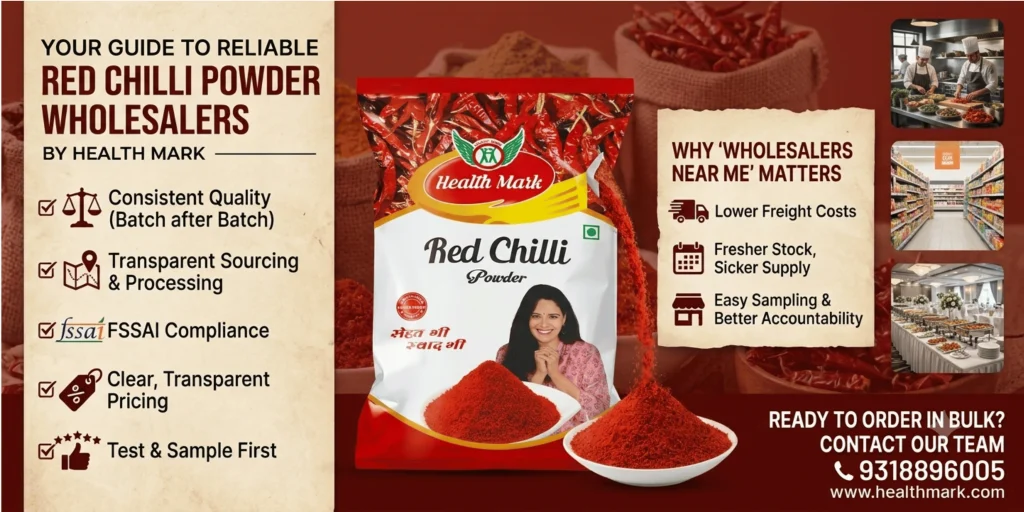
This guide walks you through exactly how to judge a wholesaler, what to test before placing a big order, and how to read pricing without getting caught out. It is written for real buyers, so you will find simple checks you can do at your counter, not lab jargon
A reliable chilli powder wholesaler shows consistent colour and heat across batches, is open about sourcing and processing, can supply food-safety paperwork, quotes clearly by pack size, and is easy to reach. Test a sample first, always.
Why wholesale buyers search “near me” for chilli powder
Spices look simple, but supply is not. Chilli powder is a fresh agricultural product. It loses aroma, colour and pungency with time and poor storage. Buying from a nearby supplier helps in several ways:
- Faster restocking. You can reorder before you run out, without waiting a week for transport.
- Fresher stock. Shorter supply chains usually mean less time sitting in warehouses.
- Easy sampling. You can visit, touch, smell and compare before committing.
- Lower freight cost. This matters when margins on spices are thin.
- Better accountability. If something goes wrong, you can walk in or call someone who knows your account.
For buyers in hill states and nearby plains, a regional FMCG supplier in Himachal also understands local demand: tourism-season restaurants, dhabas, mountain-town grocery chains and wedding catering, all of which need dependable monthly volumes.
What makes a wholesaler truly “top”
A famous name is not the same as a dependable partner. When we speak of top wholesalers, these are the traits that actually matter:
1. Consistent quality, batch after batch
Your customers notice when the dish tastes different. A good supplier standardises colour and heat so your food does not change every month.
2. Transparent sourcing and processing
They can tell you which chilli varieties go into the powder, whether it is cleaned, dried and ground in a hygienic unit, and how it is packed.
3. Food-safety compliance
In India, food businesses must follow FSSAI rules. Ask for the FSSAI licence number and check it on the FSSAI website. A genuine supplier will not hesitate.
4. Clear pricing
A clean quote lists rate per kg, pack size, GST and delivery terms. Vague “best rate” talk without numbers is a red flag.
5. Reachable support
If calls go unanswered before you buy, imagine after. Good wholesalers pick up, send samples and follow up.
6. Flexible order sizes
Starting with a trial order, then scaling to larger volumes, is a sign of a supplier who wants a long relationship.
Know your chilli: types, colour and heat
Before comparing suppliers, understand what you are comparing. Not all red chilli powder is the same. Heat is measured in Scoville Heat Units (SHU), and colour is often rated using ASTA colour value. The figures below are approximate ranges, as they vary by crop and region.
| Chilli type | Heat (approx. SHU) | Colour | Best for |
| Kashmiri | 1,000 to 2,000 | Deep, bright red | Rich colour in curries, tandoori marinades, gravies |
| Byadgi | 8,000 to 15,000 | Dark red, wrinkled skin | Colour with moderate heat |
| Guntur / Teja | 15,000 to 35,000 or more | Red, strong pungency | Pickles, street food, spicy dishes |
| Bird’s eye | 50,000 and above | Red-orange | Extra-hot sauces and specialty cooking |
What this means for you: A restaurant serving butter chicken needs colour without fire, so a Kashmiri-leaning blend works. A pickle maker needs sharp pungency. Many wholesalers sell blends, so ask what is inside.
If you are searching for the best spicy red chilli powder in India, remember that “spicy” depends on your customer base. North Indian households often prefer balanced heat with strong colour, while some southern and eastern markets want a harder bite.
How to test red chilli powder quality yourself
You do not need a laboratory to catch the most common problems. Try these five checks on every sample.
Check 1: Look at the colour
Good powder has a natural, even red. Unnaturally bright, almost glowing colour can suggest added dye. Very dull brown colour can mean old stock or poor-quality chillies.
Check 2: Smell it
Fresh powder has a clean, warm chilli aroma. A musty, damp or sour smell points to moisture or age.
Check 3: The water test
Sprinkle a small spoon of powder over a glass of still water.
- Natural powder floats first, then colour releases slowly.
- Coloured streaks racing down quickly may indicate artificial colour.
- A lot of grit sinking fast can suggest sand or brick powder.
Check 4: Rub between your fingers
Pure powder feels fine and slightly oily. A rough, sandy feel is a warning sign.
Check 5: The taste test
Taste a tiny pinch with plain rice or yoghurt. Heat should build clearly without a bitter or chemical aftertaste.
Important: These home tests are indicators, not proof. For large or regular orders, ask for a lab report. The food safety regulator FSSAI prohibits adulteration, and industrial dyes such as Sudan colours are banned in food. A reputable supplier should welcome questions about testing.
Common adulterants to watch for
- Brick powder or sand
- Sawdust or husk
- Artificial colours
- Excess starch fillers
- Old, re-ground stock
Understanding red chilli powder price
Every buyer asks about price first, and that is fair. But red chilli powder price is not a single number. It moves with the crop season, chilli variety, grinding quality and pack size.
What affects the rate
- Variety. Kashmiri and Byadgi usually cost more than hotter, lower-colour varieties.
- Crop and season. Harvest size changes raw chilli cost. Prices can swing during the year.
- Grade and cleaning. Stem-free, cleaned, sorted chillies cost more to process.
- Grind and moisture. Properly dried and ground powder keeps better and weighs honestly.
- Packaging. Branded retail packs cost more per kg than bulk sacks.
- Transport and GST. Always confirm these are included or extra.
The “too cheap” trap
If one quote is far below the market, ask why. In spices, an unusually low rate often means filler, old stock or short weight. Paying a little more for a clean, consistent product usually saves money through fewer complaints and wasted dishes.
How to compare quotes fairly
| Question | Why it matters |
| Is the rate per kg for the same variety? | Kashmiri and Guntur are not comparable |
| Is GST included? | Can change the total by 5% or more |
| Is delivery included? | Freight can be a hidden cost |
| What is the pack size? | Smaller packs raise cost per kg |
| What is the payment term? | Credit terms affect real cost |
For current rates, speak to the team directly rather than trusting a number copied online. Prices change, and an honest supplier will give you a fresh quote.
Bulk buying: pack sizes, MOQ, storage and shelf life
When you plan bulk red chilli powder purchases, think beyond the rate.
Minimum order quantity
Ask what the smallest order is. Some wholesalers start with a few kilograms for trial orders, others only deal in sacks.
Packaging
- Retail packs for shops and shelves
- Sealed bulk bags for restaurants and caterers
- Food-grade lined sacks for large kitchens and manufacturers
Check that bags are sealed, labelled and food-grade. Loose, open packing invites moisture and contamination.
Storage at your end
Even the best powder spoils if stored badly. Follow these rules:
- Keep it in airtight containers.
- Store in a cool, dry, dark place away from the stove.
- Never use a wet spoon.
- Use older stock first (first in, first out).
- Avoid opening large sacks repeatedly. Decant into smaller working containers.
Shelf life
Ground spices are best used within about six to twelve months of packing for peak colour and aroma, depending on storage. Always check the packing date, not just the expiry date.
Where Health Mark fits in
Health Mark Food offers a range of powdered spices under its Powder Masale category, and the brand’s Health Mark Red Chilli Powder is the product this guide is built around. If you want to see where it sits among other blended and ground spices, browse the full Powder Masale collection.
For wholesale buyers, the useful questions are the practical ones. Does the supplier handle regular volumes? Can you sample before ordering? Is there someone to speak to when stock runs low? These are things best confirmed by phone, so the team is reachable on 09318896005.
What to confirm when you call Health Mark:
- Available pack sizes for wholesale red chilli powder orders
- Current rate for your quantity
- Delivery area and expected timelines
- Sample availability
- Billing and GST details
If you are shortlisting a red chilli powder manufacturer or a brand to stock, ask each one the same questions, then compare answers side by side. That is the fairest way to choose.
Common buying mistakes
- Choosing on price alone. The cheapest quote often costs more in wasted food.
- Skipping the sample. Never place a large first order blind.
- Ignoring the packing date. Old stock looks fine but tastes flat.
- Not matching variety to use. A hot variety will ruin a delicate gravy; a mild one will disappoint pickle customers.
- Buying more than you can store. Spices degrade faster than many people expect.
- Relying on brand name only. Check the product itself, every time.
- Forgetting paperwork. Keep invoices and licence details on file for your own compliance.
Expert tips for repeat orders
- Standardise one blend. Once you find a colour and heat you like, record the specification and reorder the same.
- Keep a reference sample. Store a sealed 50 g sample from each good batch to compare against future deliveries.
- Order in a rhythm. Monthly or fortnightly smaller orders keep stock fresh.
- Blend smartly. Some kitchens mix a colour-rich chilli with a hotter one to control both independently.
- Taste before you scale. Always cook a test dish before changing suppliers across the entire menu.
- Build the relationship. Regular, honest buyers usually get better service during shortages.
Is it really worth chasing the best brand?
Buyers often ask for the best red chilli powder brand in India, and the honest answer is that no single brand wins for everyone. The right choice depends on your dish, your customer’s taste and your budget. What you can do is judge any brand on the same four things: purity, colour, heat consistency and service. If you want the best quality red chilli powder for your kitchen or store, use the tests above and let the sample decide.
In the same spirit, a top red chilli powder is simply one that behaves predictably. It looks the same, smells the same and heats the same, every time.
A short note on health
Red chillies contain capsaicin, which gives heat and has been studied for roles in metabolism and pain relief, mostly in research settings and often with topical or concentrated forms. Chillies also provide small amounts of vitamins such as A and C, though the amount you eat in a normal serving is modest. Chilli powder can irritate the stomach in some people, especially in large quantities, so moderation is sensible. Anyone with acid reflux, ulcers or a medical condition should follow their doctor’s advice.
Cooking with lal mirch powder is as much about balance as heat. A teaspoon in a family pot is very different from the same amount scaled up across a restaurant batch, so always adjust to taste.
Using red chilli powder in your kitchen or business
- Dal tadka and everyday sabzi
- Tandoori and tikka marinades
- Pickles and chutneys
- Street-food chaat and snack seasoning
- A ready spicy masala base for dry rubs
Whichever use you have, a well-ground, evenly coloured powder blends smoothly and avoids dark specks or lumps.
FAQ
1. How do I find the top red chilli powder wholesalers near me?
Search your area on Google Maps and local B2B directories, then shortlist three suppliers. Ask each for a sample, an FSSAI licence number and a written quote, then compare colour, aroma, heat and price on the same variety.
2. What is the difference between red chilli powder and lal mirch powder?
There is no difference in meaning. Lal mirch is the Hindi name for red chilli. Variation comes from the chilli variety and blend, not the name.
3. How can I check whether red chilli powder is pure?
Do a smell, touch and water test, and look for even colour and fine texture. For bulk or commercial orders, request a lab report, since home tests only give hints.
4. What factors change red chilli powder price?
Variety, crop season, cleaning grade, grind quality, pack size, GST and delivery. Always compare quotes for the same variety and terms.
5. Is Kashmiri chilli powder hotter than regular chilli powder?
No. Kashmiri is known for deep colour with mild heat. Guntur-type chillies are much hotter.
6. What is the minimum order for wholesale red chilli powder?
It varies by supplier. Some accept small trial orders; others sell in larger sacks. Call the supplier to confirm current terms.
7. How long does red chilli powder last?
Stored airtight in a cool, dry place, ground chilli keeps good colour and aroma for roughly six to twelve months from packing. It stays safe longer but loses quality.
8. Should I buy chilli powder in bulk for a small restaurant?
Yes, if you can use it within a few months and store it properly. Otherwise, order smaller quantities more often to keep it fresh.
9. What certifications should a spice wholesaler have?
At minimum, a valid FSSAI licence. Additional quality or export-related certifications are a plus, but should be verified directly.
10. How can I contact Health Mark for wholesale enquiries?
Call 09318896005, 9218587660 or 9882896000, or visit healthmarkfood.com.
Conclusion
Finding the right supplier is less about luck and more about method. Define what you need, test samples, compare quotes on equal terms, and check that the supplier answers questions openly. A good wholesaler becomes part of your business, not just a vendor.
If you are ready to explore options, take a look at Health Mark Red Chilli Powder and the wider Powder Masale range. Then pick up the phone and speak with the team on 09318896005, 9218587660 or 9882896000 to ask for a sample and a current quote. Your next batch of curries, pickles or packs will thank you.