Walk into any kirana store, sweet shop or supermarket in India and you will find besan on the shelf. It is one of those quiet staples that never goes out of season. Pakoras in monsoon, kadhi in winter, laddoos at Diwali, dhokla on Sunday mornings. Demand is steady all year, and that is exactly why retailers get complacent about it.
Here is the catch. Besan looks the same in every bag. Customers cannot judge it by looking at the pack, but they absolutely notice when their pakoras turn soggy or the flour smells stale. One bad batch and a regular customer quietly moves to another shop.
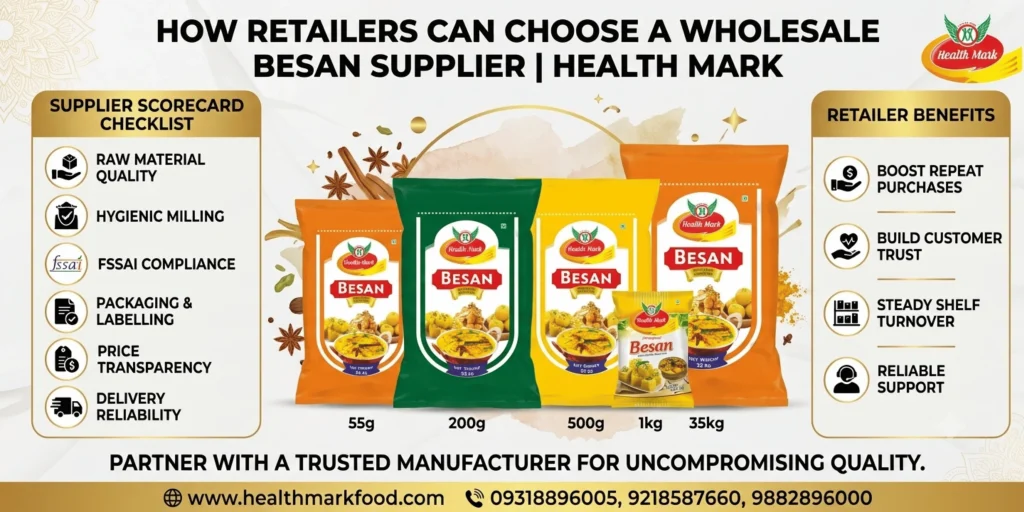
That is why how retailers can choose a wholesale besan supplier is not a small procurement question. It decides your repeat purchases, your returns, your shelf turnover and, in the end, your margin.
In this guide we break the decision into clear, practical steps. Whether you run a single store, a chain of outlets or a distribution business, you will leave with a checklist you can use on your very next supplier call.
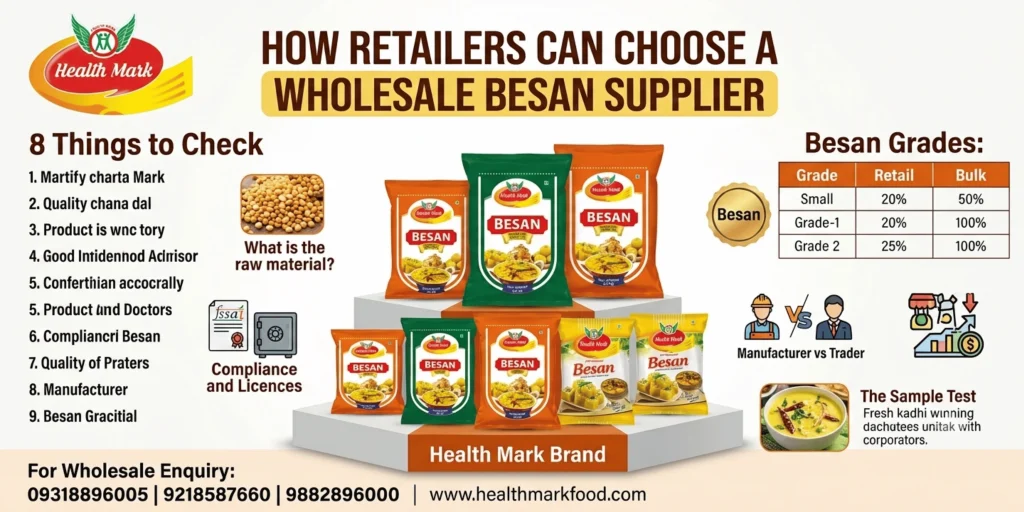
8 Things to Check Before You Order
If you only have two minutes, use this list. A reliable supplier should be able to answer every point clearly.
- Raw material: Is the besan made from selected chana dal (Bengal gram), and can they say so openly?
- Grades available: Do they offer fine, coarse and powder variants for different customers?
- Hygiene: Is milling and packing done in a clean, controlled facility?
- Licences: Do they hold a valid FSSAI licence and display it on the pack?
- Packaging: Are pack sizes practical, sealed well and printed with batch and date details?
- Samples: Will they give you a sample before you commit to bulk?
- Price transparency: Is the quote clear on GST, freight and minimum order quantity?
- Consistency and support: Can they deliver the same quality on the fifth order as on the first?
Know Your Besan Grades First
Before comparing suppliers, understand what you actually need to buy. Besan is not one single product. Different grinds suit different dishes, and your local customers decide which one moves fastest.
| Grade | Texture | Typical Use | Who Buys It |
| Fine / Bareek besan | Very smooth, silky | Pakoras, dhokla, kadhi, cheela, face packs | Households, restaurants |
| Coarse / Motichur (Mota) besan | Slightly grainy | Boondi, motichur laddoo, mithai | Sweet shops, halwais, caterers |
| Powder besan | Ultra-fine, free-flowing | Batters, snacks, quick everyday cooking | Households, snack makers |
| Regular besan | Balanced, all-purpose | Everyday cooking, sweets and savouries | General retail |
A good wholesale partner stocks more than one grade. It means you can serve a halwai and a home cook from the same supplier, with one invoice and one delivery. Health Mark, for example, lists regular, bareek, motichur and powder variants in its besan category, which is the kind of range a retailer should look for.
Check the Raw Material (Chana Dal)
Besan is simply ground chana dal, so the quality of the dal sets the ceiling for the flour. Everything the miller does afterwards can only protect that quality, not create it.
When you speak to a supplier, ask these questions directly:
- What is the source of the chana dal? A good supplier knows where it comes from and how it is selected.
- Is it cleaned and graded before milling? Stones, husk and broken pieces should be removed.
- Is the dal fresh? Old, poorly stored dal leads to flour with an off smell and shorter shelf life.
- Is anything added? Genuine besan has one ingredient. Anything else on the label deserves a question.
A supplier that is proud of their raw material will talk about it for ten minutes. One that dodges the question is telling you something too.
Why Nutrition Matters to Your Customers
Shoppers increasingly read labels. Chickpea flour is naturally gluten-free and, according to USDA FoodData Central, provides roughly 20 to 22 grams of protein and around 10 grams of fibre per 100 grams. That makes besan an easy story to tell to health-conscious buyers, and a strong reason to stock premium quality besan that actually delivers on taste and texture.
Look at Milling, Hygiene and Manufacturing
Two suppliers can start with the same dal and still deliver very different flour. The difference lies in the mill.
What good milling looks like
- Consistent particle size: A uniform grind means uniform batter. Uneven flour gives lumpy pakoras and dense dhokla.
- Heat control: Overheated grinding can dull aroma and flavour. Properly controlled milling keeps the nutty, fresh smell.
- Clean environment: Metal detection, sieving and dust control are signs of a serious facility.
- Hygienic handling: Processing and packing should happen with minimal manual contact.
Is the supplier a manufacturer or a middleman?
This is one of the most useful questions you can ask. A besan manufacturer in India who mills and packs in their own unit can control quality batch by batch and quote you a factory-level price. A trader, on the other hand, may change sources depending on what is cheapest that week, and your product quality changes with it.
Neither is automatically bad, but you deserve to know which one you are dealing with. If possible, ask for a plant visit or a short video walkthrough. Confident manufacturers usually say yes.
Packaging, Pack Sizes and Shelf Life
Besan is rich in natural oils, so it can turn rancid if it is packed badly or stored in humid conditions. Packaging is therefore a quality feature, not just a design choice.
What to look for:
- Strong, well-sealed packs that block moisture and pests
- Clear printing of batch number, manufacturing date, best-before date, MRP and FSSAI number
- Retail-friendly pack sizes: Health Mark Besan, for instance, is offered in 55 gm, 200 gm, 500 gm and 1 kg packs. Small trial packs help impulse buyers, while 500 gm and 1 kg packs suit family kitchens
- Bulk packing options if you sell loose or supply other businesses
- Carton quality, so packs reach you without tears or leaks
Compliance and Certifications
In India, any business making or selling packaged food must follow the Food Safety and Standards Act. For you as a retailer, this protects your shop as much as your customer.
Before signing on with a supplier, verify:
- A valid FSSAI licence number that appears on the pack and matches the invoice. You can learn about licensing and food safety rules on the official FSSAI website.
- Correct labelling: ingredients, net weight, nutrition information, vegetarian mark, date details and consumer care contact.
- GST invoicing with proper HSN details, so your input credit is clean.
- Quality accreditations that the supplier is willing to show. You can see how Health Mark presents its credentials on the Health Mark website.
If a supplier hesitates to share licence details, move on. Compliance gaps can turn into your problem during an inspection.
Understand Price Properly
Every retailer wants the best besan price, and that is fair. But price only makes sense when you compare like with like.
What to compare
| Price Factor | Why It Matters |
| Rate per kg (ex-GST) | The honest base for comparison |
| GST and freight | Hidden costs often reverse the winner |
| Minimum order quantity | A low rate with a high MOQ locks up your cash |
| Credit terms | Even 15 days of credit improves your working capital |
| Scheme and margin | A better trade margin can beat a lower rate |
| Wastage and returns policy | Bad batches cost more than a small price difference |
Supply, Logistics and Support
A wonderful sample means little if the second delivery arrives three weeks late. Retail runs on shelves that must never be empty, especially before festivals.
Ask your shortlisted suppliers:
- What is the usual delivery time to your city or district?
- Can they handle repeat orders and sudden festive spikes?
- Do they have stock in a warehouse or make to order?
- Who is your single point of contact if something goes wrong?
- How do they handle complaints and replacements?
Location also matters. A supplier based in the northern industrial belt can reach Punjab, Haryana, Himachal, Delhi NCR and Uttarakhand faster and cheaper than one sending trucks across the country. If you search for a besan seller near me, think of it as a search for a partner within a practical delivery radius, not just the nearest shop. Health Mark operates from Baddi in Himachal Pradesh, which gives it good road access to much of North India.
The Sample Test Every Retailer Should Run
Never place a large first order without testing a sample. It takes ten minutes and can save you months of regret. Here is a simple routine.
- Smell test: Open the pack. Fresh besan smells nutty and mildly sweet. A sour, musty or oily smell is a red flag.
- Colour check: Look for a natural pale yellow shade. Grey patches or dark specks suggest poor cleaning or old stock.
- Touch test: Rub a pinch between your fingers. It should feel smooth and even, not gritty, unless you ordered a coarse grade.
- Water test: Mix with water to form a batter. It should come together smoothly without excessive lumps.
- Cooking test: Make pakoras or cheela. Check crispness, colour, taste and whether the batter holds its shape.
- Shelf test: Keep a small portion sealed for a few weeks and check for smell changes.
If you want a second opinion on tricky cases, ask your supplier for a quality test report. A transparent supplier will share what they have.
Supplier Scorecard
Use this scorecard to compare two or three suppliers side by side. Give each criterion a score from 1 to 5.
| Criterion | Weight | Supplier A | Supplier B | Supplier C |
| Raw material quality | 20% | |||
| Hygiene and processing | 15% | |||
| Range of grades | 10% | |||
| Packaging and labelling | 10% | |||
| FSSAI and compliance | 15% | |||
| Total price and terms | 15% | |||
| Delivery reliability | 10% | |||
| After-sales support | 5% |
A supplier scoring above 80% overall is usually a safe long-term partner.
Common Mistakes Retailers Make
- Choosing on price alone. The lowest quote often hides weaker dal or poor storage.
- Skipping the sample. A brochure cannot tell you how the flour behaves in a kadhi.
- Ignoring the manufacturing date. Old stock hurts taste and trust.
- Buying only one grade. You lose sweet shops, caterers and snack makers.
- Overstocking in humid months. Besan absorbs moisture and spoils faster.
- Believing big claims. Every seller says they are the No 1 besan brand. Ask for proof, not slogans.
- Not checking the label. Missing FSSAI details or batch numbers are warning signs.
- Relying on a single supplier. Keep one backup so you are never out of stock.
Expert Tips to Sell More Besan
Choosing the right supplier is half the work. The other half is turning shelf space into sales.
- Match stock to the season. Keep more besan before Diwali, Holi, Navratri and the monsoon, when pakora and sweet demand peaks.
- Place it near complementary items. Keep besan close to spices, oil and snack ingredients. Cross-selling lifts basket size.
- Offer two sizes. A small pack for trial and a family pack for regular buyers. Watch which sells faster and learn what the top selling besan in India looks like in your own neighbourhood.
- Use recipe cards. A tiny QR code or card with a pakora or dhokla recipe turns a plain staple into a reason to buy.
- Train your staff. One line like “This one is smooth and fresh, perfect for kadhi” builds trust.
- Rotate stock first-in, first-out. Always sell older packs first.
- Collect feedback. Ask regular customers which brand they liked. It is the cheapest market research you will ever do.
Where Health Mark Besan Fits In
If you are building a shortlist, Health Mark deserves a look. The brand makes its besan from carefully selected chana dal, finely ground for smooth texture and a rich nutty flavour. It is hygienically processed and packed, and designed for pakoras, dhokla, kadhi and traditional sweets.
Why retailers consider Health Mark Besan:
- Made from premium quality chana dal
- Smooth, fine texture with a nutty aroma
- Suitable for both sweet and savoury recipes
- Multiple pack sizes: 55 gm, 200 gm, 500 gm and 1 kg
- Several variants including bareek, motichur and powder
- Direct enquiry through phone and WhatsApp
You can view the full range on the Health Mark Besan product page or explore the complete besan category. For bulk pricing and partnership details, speak to the sales team directly.
Contact Health Mark Sales: 09318896005 | 9218587660 | 9882896000
FAQ
1. How can retailers choose a wholesale besan supplier?
Check five things first: the quality of the chana dal, hygienic milling, a valid FSSAI licence, packaging with clear batch and date details, and transparent pricing. Then order a sample, test it in a real recipe and compare total landed cost, not just the rate per kg.
2. What is the best besan for retail shops?
The best besan is one that is made from selected chana dal, has a fresh nutty smell, a smooth even texture and consistent results in cooking. Stock fine (bareek) besan for households and coarse (motichur) for sweet makers.
3. How do I identify premium quality besan?
Look for a natural pale yellow colour, a clean fresh aroma, no lumps or gritty feel (unless coarse), and a clear label with batch and date information. Test it in pakoras or kadhi, because good flour gives a crisp, well-bound result.
4. Should I buy besan from a manufacturer or a trader?
A manufacturer generally gives better consistency and factory-level pricing because they control raw material and processing. A trader may offer variety but can change sourcing often. Ask directly, and request a plant visit if possible.
5. What pack sizes are best for retail besan sales?
A mix works best: small packs of 55 gm and 200 gm for trial and budget buyers, and 500 gm and 1 kg for regular family use. Health Mark Besan is available in all four sizes.
6. How long does besan stay fresh?
Sealed besan stays fresh for a few months when stored in a cool, dry place away from moisture and sunlight. Always follow the best-before date printed on the pack and sell older stock first.
7. Does the supplier need an FSSAI licence?
Yes. Any packaged food business in India must comply with FSSAI rules. Check that the licence number is printed on the pack and matches the invoice, and verify details on the official FSSAI portal.
8. How do I compare besan prices between suppliers?
Compare the rate per kg excluding GST, then add freight, minimum order quantity, credit terms, trade margin and return policy. The supplier with the best total value, not the lowest quote, usually wins.
9. How do I store besan in my shop?
Keep it on raised shelves, away from walls, moisture, direct sun and strong-smelling items. Close open loose stock tightly and avoid overstocking in humid seasons.
10. Where can I contact Health Mark for wholesale besan?
Call 09318896005, 9218587660 or 9882896000, or visit the Health Mark website to send a product enquiry.
Conclusion
Choosing a besan supplier is not about finding the loudest brand or the lowest number on a quotation. It is about finding a partner who gives you the same fresh, smooth, dependable flour every single time, packed cleanly, labelled properly and delivered when promised.
To recap, check the raw material, ask about milling and hygiene, verify FSSAI compliance, compare total price rather than just the rate, test a sample in your own kitchen and score each supplier honestly. Do that, and you will not just stock besan. You will build a shelf that customers trust.
Ready to stock besan that your customers will come back for? Explore Health Mark Besan, browse the besan range, or call 09318896005, 9218587660 or 9882896000 to request a sample and wholesale quote today.