
If you’ve typed “buy premium quality besan wholesale nearby” into Google, you already know the frustration: dozens of listings, vague promises of “pure” gram flour, and no real way to tell which supplier actually delivers on quality. Besan isn’t just another pantry staple in Indian households and food businesses it is the backbone of pakoras, dhokla, kadhi, laddus, and hundreds of regional recipes. When the besan is coarse, adulterated, or stale, every dish built on it suffers.
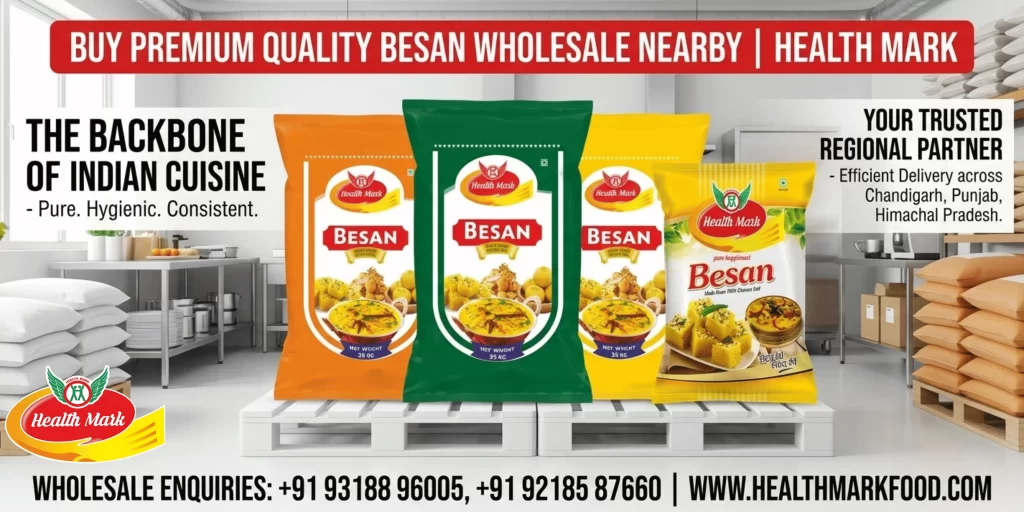
This guide breaks down exactly what separates the best besan from an average one, how wholesale pricing actually works, what to check before you commit to a besan manufacturer in India, and why sourcing from a nearby, quality-focused supplier like Health Mark makes a measurable difference to your kitchen or business. Whether you’re a home cook stocking up for festival season or a restaurant owner comparing besan suppliers in north India, you’ll find a clear, no-fluff framework here.
What Is Besan and Why Does Quality Matter So Much?
Besan, also called gram flour or chana flour, is made by milling dehusked and split Bengal gram (chana dal) into a fine powder. It’s naturally gluten-free, protein-rich, and has been a kitchen essential across Indian households for generations. But not all besan is created equal the milling process, the quality of the raw chana dal, moisture control, and packaging hygiene all directly affect taste, texture, shelf life, and even how a dish turns out.
Low-grade besan often has a gritty texture, a raw or bitter aftertaste, and inconsistent color. It absorbs oil unevenly when fried and can leave pakoras soggy or dhokla dense instead of fluffy. That’s exactly why more home cooks, sweet shops, and food manufacturers are now specifically searching for premium quality besan rather than settling for whatever is available at the nearest kirana store.
Understanding Gram Flour’s Role in the Kitchen
Because besan behaves differently from wheat-based flours it has no gluten to provide elasticity the quality of the raw material matters more, not less. A finely milled, properly dried besan binds better, fries crisper, and blends more smoothly into batters. This is the single biggest reason experienced cooks are willing to pay slightly more for a premium quality besan rather than a generic, unbranded packet.
How to Buy Premium Quality Besan Wholesale Nearby
Searching for a besan seller near me is only the first step. Buying in wholesale quantities means you’re committing to a supplier for weeks or months at a time, so the selection process deserves more scrutiny than a single retail purchase. Here’s a practical checklist to run through before you place a bulk order.
• Check the source of chana dal reputable manufacturers disclose sourcing practices and quality control steps.
• Look for consistent, fine, pale-yellow color without dark specks or visible impurities.
• Smell test: good besan has a mild, nutty aroma; any sour or musty smell signals poor storage or age.
• Ask for recent batch or manufacturing dates freshness impacts both flavor and shelf life.
• Confirm hygiene certifications (FSSAI registration is the minimum baseline in India).
• Compare best besan price across at least three verified sellers before committing to a bulk contract.
• Request a small trial pack before signing on for recurring wholesale supply.
If a supplier is unwilling to share this basic information, that’s usually a signal to move on. A genuine besan manufacturer in India that stands behind its product will happily answer sourcing and hygiene questions it’s part of building trust with wholesale buyers, retailers, and food businesses.
Signs You’re Looking at the Best Quality Besan
Beyond color and smell, premium quality besan should feel powdery-fine between your fingers, not grainy. When mixed with water, it should form a smooth, lump-free batter almost immediately. If you notice clumping, uneven texture, or a flour that resists absorbing water evenly, it’s likely been stored poorly or milled with outdated equipment.
Health Mark Besan: A Trusted Name Among Top Besan Suppliers
Health Mark is a Baddi (Himachal Pradesh)-based FMCG food company that has built its besan around a simple principle: start with carefully selected chana dal and mill it finely enough to deliver a smooth texture and rich, nutty flavor in every batch. The brand’s besan range is designed for both everyday home cooking and bulk food-service use, covering snacks, curries, sweets, and traditional recipes across North India.
What sets Health Mark Besan apart in a crowded market is its focus on hygienic processing and consistent packing, so buyers get the same quality whether they order a small 200gm pack or a wholesale consignment. The brand also maintains transparency about its sourcing and production practices a factor that matters increasingly to buyers who want a health mark of quality behind the products they cook with.
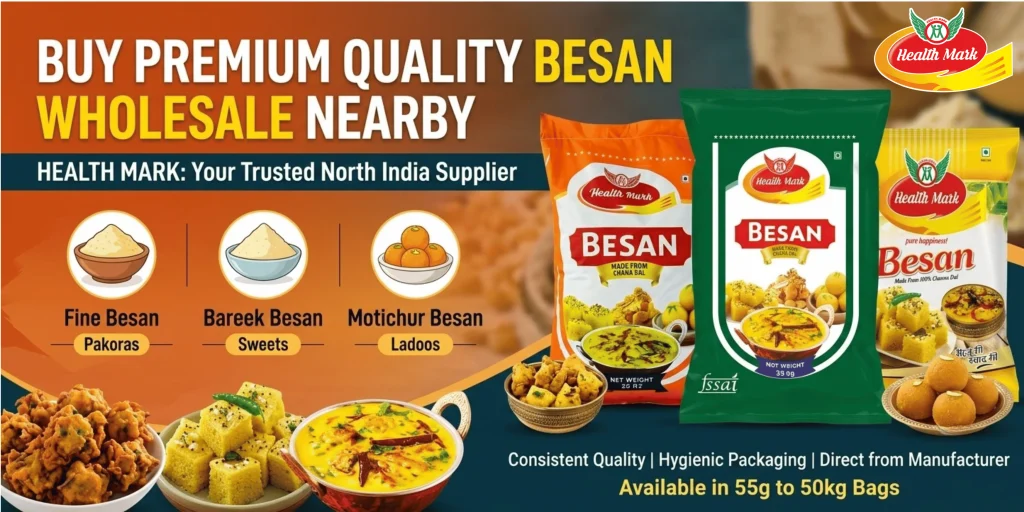
You can explore the full besan range, including fine, bareek, motichur, and powder variants, on the Health Mark Besan product category page.
Why Health Mark Is a Strong Contender for the No. 1 Besan Brand Title
There’s no shortage of besan brands in the market, but few combine all three pillars buyers actually care about: consistent milling quality, hygienic packaging, and responsive wholesale support. Health Mark besan checks each of these boxes, which is why it’s increasingly recommended as a best besan brand in India for both households and small-to-mid-size food businesses across Punjab, Haryana, Himachal Pradesh, and the wider North India belt.
Types of Besan Explained (With Comparison Table)
Not every recipe calls for the same grind. Understanding the different besan variants helps you order exactly what your kitchen or production line needs, rather than over-ordering a single type and compromising on results.
| Besan Type | Texture | Best Used For | Notes |
| Fine Besan (Standard) | Smooth, fine powder | Pakoras, kadhi, dhokla, everyday cooking | Most versatile all-purpose variant |
| Bareek Besan | Extra-fine, silky | Sweets, delicate batters, ladoo mixes | Preferred for smoother mouthfeel in desserts |
| Motichur / Mota Besan | Coarser granules | Motichur ladoo, boondi, traditional sweets | Gives the classic textured bite in festive sweets |
| Powder Besan | Ultra-fine, powdery | Industrial/bakery blending, instant mixes | Ideal for large-scale food manufacturing |
Health Mark stocks all four variants, so wholesale buyers with mixed production needs say, a sweet shop that also sells snacks can source everything from a single, reliable besan manufacturer instead of juggling multiple vendors.
Nutritional Benefits of Premium Quality Besan
Besan‘s popularity isn’t just about taste it’s genuinely one of the more nutritionally dense flours used in Indian cooking. Because it’s made from chana dal rather than refined wheat, it naturally carries a different nutrient profile.
• High in plant-based protein, making it a useful ingredient for vegetarian and vegan diets.
• Naturally gluten-free, suitable for people managing gluten sensitivity.
• Contains dietary fiber that supports digestion and helps with satiety.
• Lower glycemic impact compared to many refined flours, when used as part of a balanced diet.
• Provides essential minerals such as iron, magnesium, and folate.
According to nutrition guidance published by India’s National Institute of Nutrition, pulses and pulse-derived flours like besan are recommended as part of a balanced Indian diet because of their protein and micronutrient contribution. Premium quality besan, milled from clean, well-selected chana dal, retains more of these nutrients than poorly processed alternatives, which is one more reason quality sourcing genuinely matters not just for taste, but for the nutritional value on your plate.
Best Besan Price: What Determines Fair Wholesale Rates
Besan pricing fluctuates with chana dal commodity rates, but quality-focused buyers should understand that the cheapest option on paper isn’t always the best value. Several factors legitimately affect the best besan price you’ll be quoted:
1. Raw material quality: Chana dal sourced from better growing regions costs more but mills into a superior finished product.
2. Milling technology: Finer, more consistent grinding requires better equipment and adds to production cost.
3. Packaging format: Smaller retail packs (55gm–500gm) typically carry a higher per-kg cost than bulk 25kg or 50kg wholesale bags.
4. Order volume: Larger, recurring wholesale orders usually unlock better per-unit pricing from most suppliers.
5. Logistics and delivery distance: A besan seller near me search often surfaces better landed pricing simply because transport costs are lower.
When comparing quotes, always ask for price per kilogram at your specific order volume, not just a headline number. A supplier offering the lowest price on a small sample pack may price wholesale volumes very differently get the full breakdown before committing.
How to Choose the Best Besan Seller Near You
Proximity matters more than most buyers realize. A nearby besan supplier means fresher stock, lower freight costs, faster replenishment, and often the ability to visit the facility or request samples in person. Here’s a step-by-step approach to shortlisting the right seller.
Search specifically for wholesale besan suppliers in your region rather than general grocery listings.
Verify FSSAI license and any additional accreditation the supplier lists publicly.
Request product samples across the variants you need (fine, bareek, motichur, powder).
Compare minimum order quantities (MOQs) and delivery timelines against your business’s ordering cycle.
Ask about return or replacement policy for damaged or substandard stock.
Confirm direct contact channels for reordering a supplier that’s easy to reach saves you time on every future order.
For buyers based in and around Chandigarh, Punjab, Baddi, Panchkula, and Ludhiana, Health Mark operates from its Baddi facility and serves this belt directly, which shortens delivery timelines considerably compared to sourcing from distant states.
Common Mistakes to Avoid When You Buy Besan Wholesale
• Choosing solely on price without verifying hygiene certification or sourcing practices.
• Skipping a trial order and jumping straight into a large-volume wholesale commitment.
• Not checking packaging integrity torn or poorly sealed bags accelerate spoilage and pest risk.
• Ignoring batch/manufacturing dates, which can mean receiving older stock with reduced shelf life.
• Overlooking storage conditions at the supplier’s warehouse heat and humidity degrade besan quickly.
• Failing to confirm reorder lead times, leading to stock-outs during peak festive or wedding season demand.
Besan Supplier in North India: Why Location and Logistics Matter
North India particularly Punjab, Haryana, Himachal Pradesh, and Chandigarh has one of the highest per-capita consumption rates of besan-based dishes in the country, from kadhi-chawal to pakoras during monsoon season to festive ladoos. This regional demand makes local sourcing especially advantageous: shorter supply chains mean fresher product reaching your kitchen or store shelf faster.
Health Mark’s manufacturing base in Baddi, Himachal Pradesh puts it within efficient delivery range of Chandigarh, Panchkula, Mohali, Ludhiana, and surrounding Punjab markets making it a practical choice for buyers specifically searching for a besan supplier in north India or a best besan brand in Chandigarh. Working with a regionally based besan manufacturer also simplifies communication, sample requests, and after-sales support compared to coordinating with suppliers based far outside the region.
Top Culinary Uses of Besan in Indian Cooking
Premium quality besan earns its place in the pantry because of how versatile it is across both everyday meals and festive cooking.
• Pakoras and bhajiyas the classic monsoon snack, where a fine besan gives a crisp, non-greasy coating.
• Dhokla and khaman steamed Gujarati snacks that need a smooth, lump-free batter to rise properly.
• Kadhi a yogurt-and-besan curry where fine texture prevents graininess in the final gravy.
• Besan ladoo and mysore pak sweets where bareek or motichur besan directly affects mouthfeel.
• Cheela and besan roti protein-rich flatbreads popular as a light meal or breakfast option.
• Thickening agent used in small quantities to thicken curries and gravies.
Best Practices for Storing Besan to Preserve Freshness
• Store in an airtight container to prevent moisture absorption and pest contamination.
• Keep away from direct sunlight and heat sources, which accelerate rancidity.
• For wholesale/bulk stock, use a cool, dry storage room with good ventilation.
• Use older stock first (first-in, first-out) to avoid holding besan beyond its optimal freshness window.
• Avoid storing besan near strong-smelling spices, as it can absorb odors.
Health Mark Quality Assurance Process
Health Mark positions itself around hygienic processing, careful raw material selection, and consistent packing standards the same fundamentals that matter to any wholesale buyer evaluating a besan manufacturer in India. The brand also maintains an accreditation page detailing its compliance credentials, which buyers can review before placing a bulk order.
Buyers who want to verify certifications and compliance details can review the Health Mark accreditation page directly, or explore the complete Besan product page for specifications and available pack sizes.
For businesses that operate under India’s food safety framework, it’s worth cross-checking any packaged food supplier against the guidelines published by the Food Safety and Standards Authority of India (FSSAI), the national regulator responsible for food hygiene and labeling standards.
FAQ
1. What is the difference between besan and gram flour?
There isn’t one besan and gram flour refer to the same product. Besan is the Hindi/regional name; gram flour (or chana flour) is the common English term used in packaging and international recipes.
2. How do I know if besan is adulterated?
Adulterated besan often has an unusually bright yellow color, a chalky or gritty texture, or an unusual smell. A simple test is to mix a spoonful in water pure besan dissolves relatively smoothly without settling into a gritty residue at the bottom.
3. What is the shelf life of premium quality besan?
When stored in a cool, dry, airtight container, good-quality besan typically stays fresh for 4 to 6 months. Always check the manufacturing date and store as recommended on the packaging.
4. Is besan good for weight management?
Besan is higher in protein and fiber compared to many refined flours, which can support satiety as part of a balanced diet. It should still be consumed in moderation, especially in fried preparations like pakoras.
5. What quantities does Health Mark Besan come in for wholesale orders?
Health Mark offers besan in multiple pack sizes including 55gm, 200gm, 500gm, and 1kg, with wholesale and bulk enquiry options available directly through the company for larger orders.
6. Which besan variant is best for making pakoras?
Fine, standard besan works best for pakoras and bhajiyas it coats ingredients evenly and fries up crisp without becoming dense.
7. How can I place a wholesale enquiry with Health Mark?
You can reach the Health Mark sales team directly via phone or WhatsApp, or submit a product enquiry through the official website’s contact page for wholesale pricing and delivery details.
8. Does besan contain gluten?
No, besan is naturally gluten-free since it’s made purely from ground chana dal (Bengal gram), making it suitable for people avoiding gluten in their diet.
9. What should I look for in a besan manufacturer in India before signing a long-term supply contract?
Prioritize FSSAI registration, transparent sourcing practices, consistent batch quality, responsive customer support, and a willingness to provide trial samples before committing to recurring wholesale volumes.
10. Why does locally sourced besan often taste fresher?
Shorter transportation distances mean less time between milling and delivery, reducing exposure to heat, humidity, and handling that can degrade flavor and texture over long supply chains.
Conclusion: Choosing the Right Besan Partner for Your Kitchen or Business
Buying premium quality besan wholesale nearby comes down to three things: verifying real quality markers (texture, aroma, certification), comparing wholesale pricing transparently, and choosing a supplier close enough to guarantee freshness and reliable reordering. Whether you’re stocking a home pantry for festive cooking or sourcing for a restaurant, sweet shop, or food manufacturing unit, working with an established, regionally accessible besan manufacturer removes most of the guesswork.
Health Mark besan range spanning fine, bareek, motichur, and powder variants is built specifically for buyers across Chandigarh, Punjab, Himachal Pradesh, and the broader North India region who want consistent quality without long, unpredictable supply chains.
Ready to order? Explore the full besan range on the Health Mark Besan category page, or place a wholesale enquiry directly by calling +91 93188 96005, +91 92185 87660, or +91 98828 96000.