If you type “besan seller near me” or “best besan brand in India“ into Google right now, you’re probably not shopping for a single kilo bag for your kitchen. You’re a shopkeeper, a sweet shop owner, a snack manufacturer, a caterer, or a distributor trying to find a besan manufacturer in India you can depend on month after month, festival season after festival season. That search is really about three things: consistent quality, a fair and transparent best besan price, and a supplier who actually picks up the phone when you call.

This guide breaks down exactly what separates an average besan brand from a genuine No. 1 besan brand for wholesale and bulk buyers, and how Health Mark, a Baddi (Himachal Pradesh) based FMCG food manufacturer, fits into that picture for buyers across Chandigarh, Panchkula, Ludhiana, Punjab, and the wider North India belt.
What Is Besan and Why Quality Matters So Much
Besan, also called gram flour or chana flour, is made by grinding dehusked and split Bengal gram (chana dal) into a fine powder. It’s one of the most versatile ingredients in an Indian kitchen the base for pakora flour batters, dhokla flour steamed cakes, besan kadhi, Besan chilla, laddoos, and dozens of regional sweets and snacks.
For a home cook, a slightly inconsistent bag of besan is an inconvenience. For a wholesale buyer a sweet shop, a namkeen unit, a restaurant chain, or a retailer repacking under their own label inconsistent besan is a business problem. Texture, moisture content, colour, and grind size directly affect:
Oil absorption and crispiness in fried snacks like pakoras and bhajis
Binding and texture in dhokla, khaman, and steamed preparations
Shelf life once the product reaches store shelves or is repacked
Consistency of taste across every single batch you cook or sell
What Actually Makes a Besan Brand “No. 1” for Wholesale Buyers
There’s no single certificate that stamps a brand as the No 1 besan brand. In practice, wholesale and B2B buyers judge a besan manufacturer in India against a fairly consistent checklist:
1. Sourcing of Raw Chana Dal
Where the gram is sourced from, how it’s cleaned, and how consistently graded it is before milling.
2. Milling & Grind Consistency
A premium quality besan brand should be able to offer different grinds fine besan for batters, bareek besan for delicate sweets, and coarser motichur or mota besan for boondi and motichur laddoo.
3. Hygiene & Processing Standards
Dust-free, contamination-free processing and packing lines, ideally in a dedicated food manufacturing facility rather than a small unregulated mill.
4. Packaging Flexibility
Wholesale buyers need pack sizes that suit their business small retail packs for shelf sale, and larger bulk packs for kitchens, caterers, and manufacturing units.
5. Transparent, Fair Pricing
A best besan price isn’t necessarily the cheapest price it’s a price that reflects consistent quality and doesn’t fluctuate unpredictably from order to order.
6. Supply Reliability
Can the besan seller near me actually deliver the same order, at the same quality, next month and the month after including through festival-season demand spikes?
About Health Mark A Besan Manufacturer in India
Health Mark is an FMCG food brand manufacturing a wide range of everyday staples atta, besan, pulses, spices, rice, salt, sugar, dry fruits, sauces, pickles, and snacks from its facility at Plot No. 60, Industrial Township Bhatoli Kalan, Baddi, Himachal Pradesh (173205).
The brand positions itself around three pillars that matter directly to wholesale and bulk buyers: careful sourcing, hygienic processing, and traceability from raw material to finished pack. For a category like besan where the raw material (chana dal) quality decides almost everything downstream that sourcing discipline is what allows Health Mark to be considered among the top selling Besan in India within the markets it actively serves.
Health Mark Besan Product Range
Health Mark besan portfolio is built around Bengal gram (chana dal), milled to different fineness levels to suit different wholesale use-cases:
| Product | Description | Pack Sizes Available | Best Suited For |
| Besan (Classic) | Premium chana dal, finely milled for a smooth, consistent texture and rich nutty flavour. | 55g, 200g, 500g, 1kg | Pakoras, dhokla, kadhi, everyday cooking |
| Powder Besan | Extra-fine powder grind for smoother batters and delicate preparations. | Multiple retail & bulk packs | Sweets, baking, fine batters |
| Bareek Besan | Superfine texture besan milled for a silkier mouthfeel. | Multiple retail & bulk packs | Traditional sweets, festive cooking |
| Motichur / Mota Besan | Coarser grind besan suited for granular preparations. | Multiple retail & bulk packs | Motichur laddoo, boondi |
Why Health Mark Is a Strong Choice for Bulk & Wholesale Orders
Premium raw material: Made from carefully selected chana dal rather than mixed or lower-grade gram.
Consistent, smooth texture: Fine milling designed to behave predictably across large cooking batches.
Hygienically processed and packed: Processing is carried out to maintain freshness and purity through to the final pack.
Multiple grind types under one roof: Classic, powder, bareek, and motichur besan means wholesale buyers can consolidate more of their order with a single besan supplier.
Direct wholesale enquiry channel: Orders and bulk enquiries can be raised directly by phone or WhatsApp, which shortens the sourcing cycle for repeat B2B buyers.
Part of a wider FMCG catalogue: Buyers sourcing besan can also source atta, pulses, spices, rice, and other staples from the same manufacturer, simplifying vendor management.
Best Besan Price for Wholesale Buyers What Actually Affects It
Besan is fundamentally a commodity-linked product its price tracks the market rate of chana dal, which itself moves with the agricultural season, government policy, and mandi (wholesale grain market) trends. Because of this, no besan brand can responsibly publish a fixed “best besan price” that stays accurate for months. What a wholesale buyer should actually evaluate is how transparently a supplier prices, not a single static number.
Key factors that influence what you’ll pay for wholesale besan:
Current market price of raw chana dal
Order volume larger, recurring orders typically unlock better per-kg pricing
Pack size and packaging material requested
Delivery location and freight distance from the manufacturing unit in Baddi, Himachal Pradesh
Seasonal demand prices and lead times can shift around Diwali, wedding season, and other high-demand periods
Retail Purchase vs. Wholesale Purchase At a Glance
| Factor | Retail Purchase | Wholesale / Bulk Purchase |
| Typical Pack Size | 55g – 1kg | Bulk / multi-kg packs (confirm with supplier) |
| Pricing | Fixed shelf/MRP pricing | Volume-based, negotiated pricing |
| Best For | Home cooking, small kitchens | Sweet shops, snack units, caterers, retailers |
| Ordering Method | Retail store / e-commerce | Direct enquiry, phone, or WhatsApp |
| Delivery | Single delivery, small quantity | Scheduled / recurring bulk delivery |
Besan Manufacturing & Hygiene Standards Explained
Understanding the broad manufacturing journey helps wholesale buyers ask sharper questions of any besan manufacturer in India, including Health Mark:
1. Cleaning: Raw chana dal is cleaned to remove dust, husk, and foreign material.
2. Dehusking & splitting: Whole chana is dehusked and split before milling, where required.
3. Milling: The split dal is ground to the required fineness classic, powder, bareek, or mota/motichur grind.
4. Sieving & grading: The milled flour is sieved to achieve a uniform, consistent texture batch after batch.
5. Quality check: Colour, texture, and freshness are checked before the product moves to packing.
6. Hygienic packing: The final besan is packed to protect it from moisture and contamination and preserve shelf life.
India’s packaged food sector operates under the regulatory framework of the Food Safety and Standards Authority of India (FSSAI). Wholesale buyers should always ask any besan seller near me for their current FSSAI licence number and batch quality documentation as part of standard due diligence before placing a large order.
How to Find the Best Besan Seller / Supplier Near You (Step-by-Step)
7. Define your requirement: Estimate your monthly or seasonal volume, and the grind types (classic, bareek, motichur) your recipes need.
8. Shortlist manufacturers, not just traders: A besan manufacturer in India that mills and packs its own product typically offers more consistency than a reseller.
9. Ask for hygiene and compliance details: FSSAI registration, processing facility details, and packaging standards.
10. Request a sample: Test texture, colour, aroma, and cooking performance in your actual recipes before committing to volume.
11. Compare pricing across order sizes: Ask for a best besan price breakdown at two or three different order volumes.
12. Confirm supply reliability: Ask about lead times, minimum order quantity (MOQ), and capacity during peak festive demand.
13. Check delivery coverage: Confirm the supplier can reliably service your city or region for example, Chandigarh, Panchkula, Baddi, or Ludhiana.
14. Finalise through a direct enquiry: Call, WhatsApp, or use the supplier’s product enquiry page to lock in your first wholesale order.
Best Besan Brand in Chandigarh, Punjab & North India
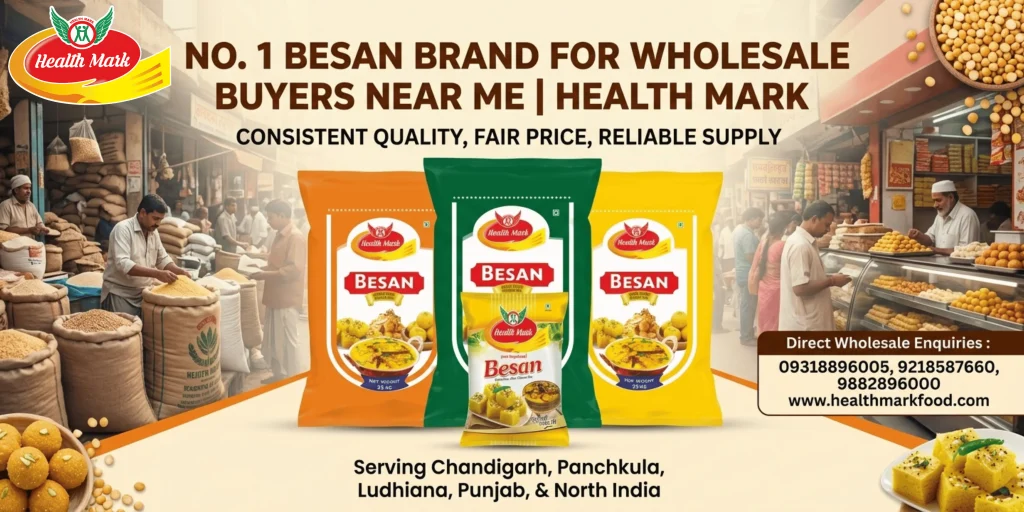
Health Mark’s manufacturing base sits in Baddi, Himachal Pradesh a well-connected industrial hub that puts it within practical delivery reach of Chandigarh, Panchkula, Mohali, Ludhiana, and the broader Punjab and North India market. For buyers specifically searching for a best besan brand Chandigarh option, or a besan supplier in north India who can service Punjab and Himachal together, this regional positioning is a meaningful advantage: shorter transit times, fresher stock on arrival, and a manufacturer that understands regional demand patterns around festivals and wedding season.
If your business is based in or around Chandigarh, Panchkula, Baddi, or Ludhiana, this regional proximity is worth factoring in alongside product quality and pricing when you’re comparing a top Besan supplier for your city.
Common Mistakes Wholesale Buyers Make When Sourcing Besan
Chasing the lowest price only: The cheapest quote per kilo often means lower-grade chana dal or inconsistent milling both of which cost you more in wastage and customer complaints later.
Skipping the sample stage: Committing to a bulk order before testing a sample batch in your own kitchen or production line is one of the most common and most expensive mistakes.
Ignoring packaging suitability: Packaging that isn’t designed for transport or storage conditions can lead to moisture damage before the besan even reaches your shelf.
Not confirming reorder lead time: A great first order means little if the supplier can’t reliably repeat it on your schedule.
Single-supplier dependency: Relying entirely on one besan seller near me without a backup plan is risky during festival-season demand spikes.
Not verifying hygiene credentials: Skipping the basic check of FSSAI compliance and facility hygiene standards before a bulk commitment.
Expert Tips & Best Practices for Wholesale Besan Buyers
Always request a fresh sample batch not an old reference sample before a large order.
Plan stock levels ahead of Diwali, Navratri, and wedding season, when besan-based sweets and snacks see a sharp demand spike.
Ask your supplier which grind (classic, bareek, or motichur) suits your specific recipe rather than defaulting to one type for everything.
Keep a direct communication channel like WhatsApp open with your supplier for faster reordering and query resolution.
Negotiate pricing and delivery terms for recurring orders rather than renegotiating from scratch every time.
Store besan in a cool, dry area away from moisture to protect shelf life once it reaches your premises.
How to Evaluate Any Besan Brand Before You Commit
Use this checklist to compare Health Mark or any other premium quality besan supplier before finalising a wholesale contract:
| Evaluation Criteria | What to Look For | Why It Matters |
| Sourcing of chana dal | Consistent grading, quality raw material | Directly decides taste, colour, and texture |
| Texture & fineness options | Classic, bareek, powder, and motichur grinds available | Different recipes need different grinds |
| Hygiene & packaging | Clean facility, protective packaging | Preserves freshness and shelf life |
| Price transparency | Clear per-kg pricing at your order volume | Avoids surprises on repeat orders |
| Pack size flexibility | Both retail and bulk pack options | Suits different resale or kitchen needs |
| Supply reliability | Realistic lead times, stated MOQ | Keeps your business running without gaps |
FAQ
1. What is besan made of?
Besan, or gram flour, is made by grinding dehusked, split Bengal gram (chana dal) into a fine powder. It’s a staple ingredient in Indian snacks, sweets, and savoury dishes.
2. Which is the best besan brand in India for wholesale buyers?
The best besan brand for a wholesale buyer is the one that consistently matches your quality, pricing, and supply-reliability needs. Health Mark, a besan manufacturer in India based in Baddi, Himachal Pradesh, is one option worth evaluating for buyers across Chandigarh, Panchkula, and North India, particularly if regional delivery speed matters to your business.
3. How is besan price decided for wholesale orders?
Wholesale besan pricing is influenced by the current market rate of chana dal, your order volume, pack size, delivery distance, and seasonal demand. It’s best to request current pricing directly from the supplier rather than relying on a fixed published rate.
4. What is the difference between besan, bareek besan, and motichur besan?
Classic besan is a standard fine grind used for everyday cooking. Bareek besan is milled to an even finer, silkier texture suited to delicate sweets. Motichur or mota besan has a coarser grind, ideal for motichur laddoo and boondi preparations.
5. Is Health Mark besan suitable for both sweets and snacks?
Yes. Health Mark besan range covers classic, powder, bareek, and motichur grinds, which together suit savoury preparations like pakoras and dhokla as well as traditional sweets like laddoo and barfi.
6. How can I place a bulk or wholesale besan order with Health Mark?
You can raise a wholesale enquiry directly by calling or messaging Health Mark on 09318896005, 9218587660, or 9882896000, or through the product enquiry option on the Besan product page.
7. What pack sizes does Health Mark besan come in?
Health Mark’s classic besan is available in 55gm, 200gm, 500gm, and 1kg packs, with the powder, bareek, and motichur variants available in additional retail and bulk pack options on enquiry.
8. Where is Health Mark besan manufactured?
Health Mark besan is manufactured at the company’s facility in Plot No. 60, Industrial Township Bhatoli Kalan, Baddi, Himachal Pradesh, 173205.
9. Do you supply besan near Chandigarh, Panchkula, and Ludhiana?
Health Mark’s Baddi-based facility is positioned to serve buyers across Chandigarh, Panchkula, Mohali, Ludhiana, and the wider Punjab and North India region. Confirm current delivery coverage and lead times directly with the sales team for your specific location.
10. How do I check besan quality before buying in bulk?
Request a fresh sample batch and test it in your actual recipe check colour, aroma, texture when mixed into batter, and how it fries or steams. Also verify the supplier’s FSSAI compliance and hygiene practices before placing a large order.
Conclusion: Choosing Ybour Besan Supplier With Confidence
There’s no shortcut to becoming a genuinely reliable No 1 besan brand for wholesale buyers it comes down to consistent sourcing, careful milling, hygienic processing, transparent pricing, and a supplier who’s easy to reach when you need to reorder. Whether you land on Health Mark or compare it against other options, run every besan supplier in North India through the same checklist: sample it, question it, and confirm it can actually scale with your business.
If you’d like to explore Health Mark Besan range or request wholesale pricing, you can browse the Besan product page and Besan category page, or reach the team directly at 09318896005, 9218587660, or 9882896000