
If you run a snack stall, a sweet shop, a restaurant kitchen, or a food processing unit anywhere in Rajasthan, chances are besan is already one of your highest-turnover ingredients. From crisp pakoras on a rainy evening to soft, steaming dhokla, besan quietly holds together a huge share of Indian food culture and Rajasthan, with its deep-rooted love for gram-flour dishes like gatte ki sabzi, besan chilla, and pyaaz kachori, consumes it in genuinely large quantities.

But here’s the catch: not all besan is created equal, and not every wholesale seller can be trusted with your business’s reputation. Buy the wrong batch one that’s gritty, adulterated, or past its prime and you’ll taste it in every dish that leaves your kitchen. This guide walks you through everything you need to know before you place your next bulk order: how to judge quality, what drives besan price up or down, which mistakes cost buyers the most money, and how to identify a genuinely reliable besan manufacturer in India.
What Is Besan and Why Does Quality Matter So Much?
Besan, also called gram flour or chana flour, is made by dry-milling chana dal (split Bengal gram) into a fine, pale-yellow powder. It’s one of the oldest and most versatile flours in Indian cooking equally at home in a savory kadhi, a crunchy pakora batter, a smooth dhokla, or a festive besan ladoo.
For home cooks, a stray bad batch might mean one disappointing meal. For a business a restaurant, sweet shop, snack manufacturer, or caterer it means something bigger:
- Consistency: Customers expect the same taste and texture every single time. Besan with inconsistent grain size ruins that consistency.
- Shelf stability: Poorly processed besan turns rancid faster, developing a bitter aftertaste that no amount of seasoning can hide.
- Food safety: Adulterated or improperly stored besan is a genuine health risk, and it’s the kind of thing that can quietly damage a food business’s reputation if a customer notices.
- Cost efficiency: Good besan performs better per kilogram it binds, fries, and sets the way it should, so you waste less.
This is exactly why the search for the best Besan seller matters more than it might seem at first glance. It isn’t just about price per kilo; it’s about protecting the quality of everything you cook with it.
Why Rajasthan Is a Major Hub for Besan Wholesale
Rajasthan’s cuisine leans heavily on besan-based dishes gatte ki sabzi, pakodi, besan gatta, mirchi bada, and countless sweets all depend on it. That deep culinary reliance has made the state one of the most active markets in the country for besan wholesale.
A few reasons Rajasthan stands out as a besan wholesale destination:
- High and steady demand from sweet shops, dhabas, hotels, caterers, and household kitchens alike.
- Strong distribution networks connecting mandis, wholesalers, and retailers across cities like Jaipur, Jodhpur, Udaipur, Kota, and Ajmer.
- Proximity to chana-growing belts in North India, which keeps raw material sourcing relatively efficient.
- A market that rewards quality because Rajasthani cooking uses besan so extensively, buyers here are unusually discerning about texture and taste.
If you’re searching for a top besan supplier serving Rajasthan, you’re really looking for two things at once: a seller who understands large-volume B2B supply, and a manufacturer whose besan meets the exacting standards Rajasthani kitchens are used to.
How to Identify the Best Besan Brand in India
Not every “premium” label on a besan packet is backed by an actual quality process. Here’s what genuinely separates the best besan brand in India from an average one.
Color and Texture
Good besan has a consistent pale-yellow color and a fine, uniform grain no lumps, no visible husk fragments, no dull grey undertones. Rub a pinch between your fingers; it should feel smooth, not gritty.
Aroma
Fresh besan has a mild, nutty smell. If a batch smells musty, sour, or “off” in any way, it’s either old stock or poorly stored stock and either way, it doesn’t belong in your kitchen.
Purity and Certification
The best besan seller will be transparent about sourcing and processing. Look for:
- FSSAI licensing
- Hygienic, dust-free milling and packaging facilities
- No added fillers, chalk powder, or synthetic colors
Packaging Integrity
Wholesale besan should arrive in moisture-resistant, properly sealed packaging. Torn or poorly sealed bags are one of the most common (and most avoidable) reasons besan spoils before it even reaches your kitchen shelf.
Milling Consistency
Different recipes need different grinds a dhokla batter wants a finer flour than a pakora batter, which can handle a slightly coarser grind. A manufacturer offering multiple grind types (fine, medium, coarse) signals that they actually understand culinary use-cases, not just bulk production.
Meet Health Mark: Premium Quality Besan You Can Rely On
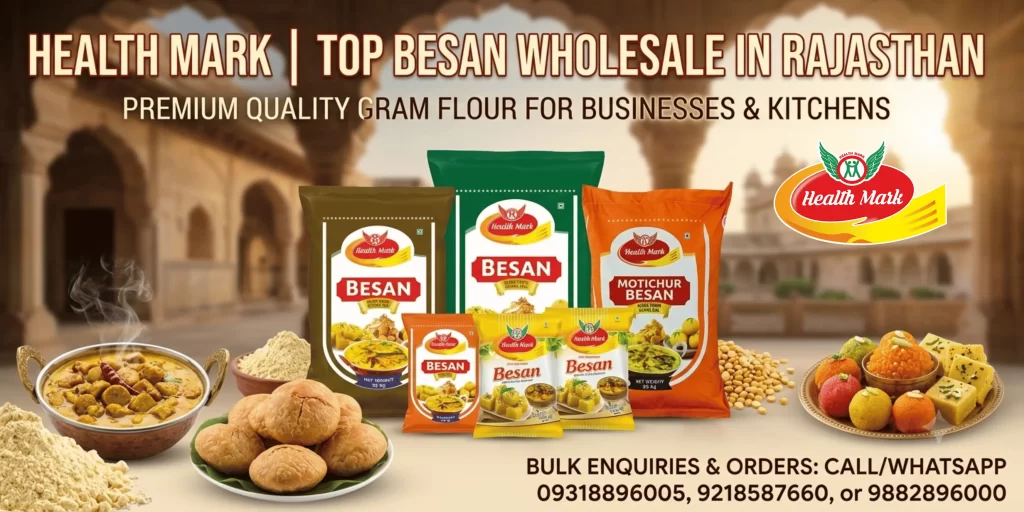
Health Mark has built its besan range around a simple idea: gram flour should taste the way it’s supposed to, every single batch. Their Besan is made from carefully selected chana dal, finely ground to deliver a smooth texture and a rich, nutty flavor that holds up whether you’re frying pakoras, steaming dhokla, or thickening a kadhi.
What makes Health Mark besan worth considering for wholesale buyers:
- Premium quality chana dal as the base ingredient no shortcuts on raw material.
- Smooth, fine texture suited to both sweet and savory preparations.
- Hygienic processing and packing, designed to preserve freshness during transit and storage.
- Multiple pack sizes 55gm, 200gm, 500gm, and 1kg giving retailers and bulk buyers flexibility depending on turnover.
Health Mark’s full besan lineup goes beyond a single standard product. Their Besan product category includes variants like Powder Besan, Motichur/Mota Besan, and Bareek Besan useful if your business needs different grind types for different recipes rather than a one-size-fits-all flour.
For businesses evaluating a best health mark Besan supply relationship, the brand’s positioning is built around consistency and hygiene rather than just competing on the lowest possible besan price which, for a food business protecting its own reputation, is usually the smarter long-term bet.
Best Besan Seller Checklist: What to Verify Before You Buy
Before signing off on a wholesale order especially a recurring one run through this checklist:
| What to Check | Why It Matters |
| FSSAI license and food safety compliance | Protects you legally and protects your customers |
| Sample testing before bulk order | Confirms texture, color, and taste match expectations |
| Minimum order quantity (MOQ) and pricing slabs | Helps you plan cash flow and storage |
| Packaging type (moisture-proof, sealed) | Directly affects shelf life |
| Delivery timelines and consistency | Prevents kitchen stock-outs |
| Batch-to-batch consistency | Keeps your recipes and customer experience stable |
| Availability of multiple besan types (fine/coarse/motichur) | Lets you match flour to specific recipes |
| Responsiveness to enquiries | A good indicator of how they’ll handle issues post-sale |
A seller who checks most of these boxes is generally a safer long-term partner than one offering the cheapest besan price with none of the above.
Besan Price in India: What Actually Drives the Cost
Besan price isn’t fixed it moves with several interconnected factors, and understanding them helps you negotiate smarter and avoid being blindsided by sudden price jumps.
- Raw material cost (chana dal): Since besan is milled directly from chana dal, any fluctuation in gram/chana prices driven by monsoon performance, government procurement, or export demand feeds directly into besan pricing.
- Seasonality: Demand spikes around festivals (Diwali, Holi, wedding season) when sweets and snacks are made in bulk, which can push prices up temporarily.
- Processing and milling quality: Finer grinding, better cleaning processes, and stricter quality control add to production cost but also to product performance.
- Packaging format: Smaller retail packs generally cost more per kilogram than bulk wholesale packaging, since packaging materials and labor are a bigger share of the cost.
- Order volume: Most manufacturers offer tiered wholesale pricing the larger and more consistent your order volume, the better your per-kilo rate.
- Transport and regional logistics: Delivery distance from the manufacturing unit to your city affects landed cost, which is one reason regional besan seller near me searches often turn up more competitive pricing than sourcing from far outside the state.
Practical tip: Rather than chasing the single lowest quoted price, compare cost-per-kilo alongside quality consistency and delivery reliability. A slightly higher besan price from a dependable top Besan supplier often works out cheaper overall once you account for wastage, spoilage, and recipe failures from inconsistent stock.
Top Selling Besan Types in India (And Which One You Need)
Not all besan is milled the same way, and using the wrong type for the wrong recipe is a common (and avoidable) inefficiency.
- Regular/Fine Besan – The everyday all-purpose gram flour, ideal for kadhi, chilla, dhokla batter, and general cooking.
- Bareek Besan – An extra-fine grind, well suited to delicate sweets and smooth batters where texture needs to be silky.
- Motichur/Mota Besan – A coarser grind traditionally used for motichur laddoo and other sweets that need a distinct, granular bite.
- Powder Besan – A finely powdered format often preferred for consistent binding in snack and namkeen manufacturing.
If your business handles multiple product lines say, a sweet counter and a snack counter sourcing from a supplier like Health Mark that stocks several besan variants under one roof simplifies procurement considerably, since you’re not juggling multiple vendors for a single ingredient category.
How to Find a Trustworthy Besan Manufacturer or Seller Near You
When you search for a besan seller near me or a besan manufacturer in India, here’s how to shortlist genuinely reliable options rather than just the first few search results:
- Check for a real, verifiable manufacturing address not just a marketplace listing.
- Look for product-level detail on their website (ingredients, pack sizes, processing method) rather than vague marketing claims.
- Read what other B2B buyers say, where available, about consistency and delivery reliability.
- Ask for a sample batch before committing to a large order any confident manufacturer will offer this.
- Confirm they handle wholesale/bulk enquiries directly, rather than only retail-sized orders.
Health Mark, for instance, operates from Plot No. 60, Industrial Township, Bhatoli Kalan, Baddi, India, and accepts direct product enquiries a straightforward way to test responsiveness before placing a bulk order.
Step-by-Step: Placing a Bulk Besan Wholesale Order
- Identify your requirement pack size, besan type (fine, coarse, motichur, powder), and estimated monthly volume.
- Request a sample to test texture, color, and taste against your current benchmark.
- Confirm pricing slabs for your expected order volume and delivery frequency.
- Verify packaging and shelf-life details so you can plan storage accordingly.
- Place your enquiry for Health Mark, this can be done via the Product Enquiry page or directly on WhatsApp.
- Set up a recurring order cycle once you’re satisfied with quality, so your kitchen never runs short.
Common Mistakes Buyers Make When Sourcing Besan Wholesale
- Chasing only the lowest besan price without checking quality this almost always costs more later in wastage and customer complaints.
- Skipping the sample-testing step and ordering bulk stock sight unseen.
- Overstocking besan beyond what can reasonably be used before quality starts to decline.
- Ignoring packaging quality, which directly determines how well besan resists moisture and pests during storage.
- Sticking with one supplier out of habit, even after repeated inconsistency in batch quality.
- Not confirming FSSAI compliance, which can create real legal and safety exposure for a food business.
Expert Tips for Storing and Handling Bulk Besan
- Store besan in a cool, dry place away from direct sunlight and moisture.
- Use airtight containers once a bulk bag is opened, rather than leaving it in the original packaging.
- Rotate stock on a first-in, first-out basis so older batches are used before newer ones.
- Keep besan away from strong-smelling ingredients, since it can absorb odors easily.
- Check for weevils or moisture damage periodically if storing in large quantities for extended periods.
- Avoid buying more than a 2–3 month supply unless your storage conditions are genuinely well-controlled.
Local Mandi Besan vs. Branded Wholesale Besan A Comparison
| Factor | Local Mandi Besan | Branded Wholesale Besan (e.g., Health Mark) |
| Quality Consistency | Varies batch to batch | Standardized processing and quality checks |
| Hygiene Standards | Often unregulated | Hygienically processed and packed |
| Packaging | Frequently loose or basic | Moisture-resistant, sealed packaging |
| Traceability | Limited to none | Clear manufacturer and sourcing details |
| Pack Size Flexibility | Usually fixed bulk sizes only | Multiple sizes (55gm to 1kg and bulk) |
| Certification | Rarely verifiable | FSSAI-compliant processing |
| Best Suited For | Very price-sensitive, low-volume buyers | Businesses prioritizing consistency and brand trust |
FAQ
1. What is the best besan for wholesale food business use?
The best besan for wholesale use is one milled from premium chana dal, with a fine and consistent texture, hygienic processing, and reliable packaging like Health Mark’s besan range, which is designed specifically for both everyday cooking and bulk food-business needs.
2. How do I find the top besan wholesale in Rajasthan?
Look for manufacturers with verifiable addresses, product-level transparency, sample availability, and direct B2B enquiry channels. Comparing a few shortlisted suppliers on quality, pricing, and delivery reliability is the safest approach.
3. What factors affect besan price the most?
Chana dal raw material cost, seasonal demand (especially around festivals), processing quality, packaging format, and order volume are the biggest drivers of besan price fluctuations.
4. Is branded besan better than loose mandi besan?
Generally yes, for consistency and hygiene. Branded besan typically goes through standardized milling and quality checks, while loose mandi besan quality can vary significantly between batches.
5. What is the difference between fine besan and motichur besan?
Fine besan has a smooth, powdery texture suited to batters and everyday cooking, while motichur (mota) besan has a coarser grind traditionally used for motichur laddoo and similar sweets.
6. How should I store bulk besan to keep it fresh longer?
Keep it in a cool, dry, airtight container away from sunlight and strong odors, and use it on a first-in, first-out basis to avoid quality decline over time.
7. Can I request a sample before placing a bulk besan order?
Yes any reliable besan manufacturer, including Health Mark, should be willing to provide a sample so you can verify quality before committing to a larger wholesale order.
8. What certifications should a good besan manufacturer in India have?
At a minimum, look for FSSAI licensing along with clear evidence of hygienic processing and packaging practices.
9. How do I contact Health Mark for besan wholesale enquiries?
You can reach out via their Besan product page or call/WhatsApp 09318896005, 9218587660, or 9882896000.
10. Does besan have a long shelf life?
Properly processed and stored besan typically stays fresh for several months, though exact shelf life depends on packaging, storage conditions, and grind type always check the manufacturer’s recommended shelf-life on the pack.
Final Thoughts
Sourcing besan wholesale isn’t just a procurement task for any food business in Rajasthan, it’s a decision that touches taste, consistency, and customer trust every single day. The best approach isn’t necessarily the cheapest one; it’s finding a top besan supplier who combines premium quality Besan, transparent sourcing, and dependable service.
If you’re ready to move beyond guesswork, explore Health Mark’s Besan range and reach out for a bulk quote or sample. Their team can be contacted directly at 09318896005, 9218587660, or 9882896000 a straightforward first step toward a more reliable besan supply for your business.