
Walk into any commercial kitchen in Punjab, Haryana, Himachal Pradesh or Delhi NCR and you’ll find one ingredient sitting quietly in every corner besan. It goes into pakoras, dhokla, kadhi, laddoos, and dozens of snacks that never go out of fashion. But here’s the catch: not all besan is created equal, and buying it wholesale is a completely different game from picking up a small pack at your local kirana store.
If you run a sweet shop, a snack manufacturing unit, a restaurant chain, or a retail store, the besan you choose directly affects your product’s taste, texture, shelf life, and ultimately, your customer’s trust. A slightly rancid batch, inconsistent grinding, or poor packaging can ruin an entire production run and your reputation along with it.
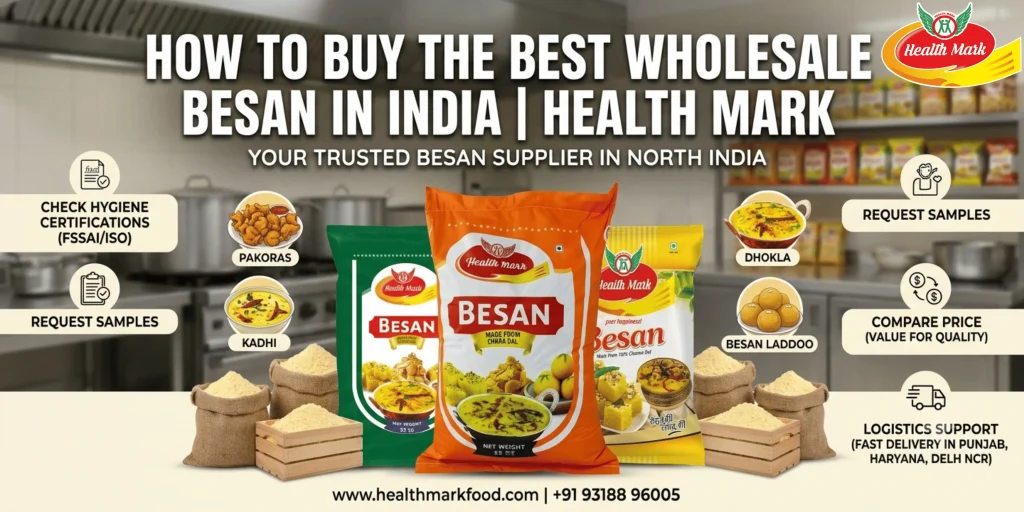
This guide breaks down exactly how to buy the best wholesale besan in India what to check before placing a bulk order, how besan price is actually determined, which quality markers separate premium gram flour from average stock, and how to identify a besan manufacturer in India you can rely on year after year. Whether you’re searching for a besan seller near me or comparing the top Besan supplier in north India, this is the buyer’s checklist you need.
What Is Besan and Why It Matters for Businesses and Homes
Besan, also called gram flour or chana flour, is made by finely milling chana dal (split Bengal gram). It’s naturally protein-rich, gluten-free, and carries a mild nutty flavour that forms the base of countless Indian dishes from crispy pakoras and soft dhokla to festive laddoos and everyday kadhi.
For households, besan is a pantry essential. For businesses sweet shops, restaurants, caterers, and packaged snack brands it’s a raw material that needs to perform consistently, batch after batch. That’s exactly why buying besan wholesale requires a more careful approach than a one-off retail purchase.
Why Wholesale Buyers Need to Be Extra Careful While Buying Besan
When you’re buying a 500-gram pack for home use, a minor quality slip is easy to overlook. But when you’re placing a bulk order of 50 kg, 500 kg, or several tonnes, even a small inconsistency multiplies across your entire stock. A few reasons wholesale buyers need to slow down and evaluate carefully:
One bad batch can affect an entire month’s production line.
Moisture content issues in bulk besan lead to faster spoilage and lumping.
Inconsistent grinding (coarse vs fine) changes texture in recipes like dhokla and laddoo.
Adulteration or mixing with cheaper flours is more common with unverified sellers.
Price negotiated in bulk should still reflect genuine premium quality Besan, not just a lower rate.
How to Buy the Best Wholesale Besan: A Step-by-Step Guide
Here’s a practical, field-tested process to follow before you finalise any bulk besan order.
Step 1: Verify the Source of Raw Material
Ask the supplier where their chana dal is sourced from. Best Besan is made from clean, well-graded Bengal gram free from stones, husk, or foreign matter. A besan manufacturer in India that mills its own dal in-house (rather than outsourcing to unknown third parties) generally offers better traceability and consistency.
Step 2: Check Hygiene Certifications
Look for FSSAI registration, ISO certification, and, ideally, a facility that follows HACCP-based food safety practices. These certifications aren’t just paperwork they indicate the plant is regularly audited for cleanliness, pest control, and safe handling.
Step 3: Request a Sample and Test It Yourself
Before signing a bulk order, get a sample pack. Check the colour (should be a bright, even yellow), the smell (fresh and nutty, never musty or sour), and the texture (fine and free-flowing, no lumps). Mix a small quantity in water genuine besan blends smoothly without any grainy residue.
Step 4: Compare Besan Price Across Multiple Suppliers
Don’t chase the lowest besan price in the market it’s often a red flag for compromised quality or lower dal content. Instead, request quotes from three to four suppliers, compare what’s included (packaging, delivery, minimum order quantity), and evaluate price against quality, not price in isolation.
Step 5: Assess Manufacturing Capacity and Consistency
A top selling Besan in India brand should be able to fulfil your recurring order volumes without delays. Ask about their monthly production capacity, average dispatch time, and whether they can maintain consistent quality across repeat orders this matters far more than a one-time attractive quote.
Step 6: Check Packaging Options for Bulk Orders
Wholesale besan should come in food-grade, moisture-resistant packaging suited to your storage and usage whether that’s 1kg retail-ready pouches for a store shelf or larger sacks for a production unit. Ask if the best Besan seller you’re considering offers customised packaging sizes.
Step 7: Look at Reputation, Reviews and Track Record
A best Besan brand in India will have a visible track record years in business, client testimonials, and a presence across multiple states. Don’t hesitate to ask for references from other bulk buyers, especially those in your own industry (bakery, restaurant, or snack manufacturing).
Step 8: Confirm Delivery and Logistics Support
If you’re based in Punjab, Haryana, Himachal Pradesh, Chandigarh, Panchkula or anywhere nearby, working with a besan supplier in north India cuts down transit time and keeps freight costs predictable. Confirm delivery timelines, minimum order quantities, and whether the supplier can commit to scheduled recurring deliveries.
Key Quality Markers of Premium Quality Besan
Use this checklist every time you inspect a batch, whether it’s your first order or your fiftieth.
Colour: A consistent, natural bright yellow not dull, greyish, or overly pale.
Aroma: Fresh, nutty, and mild any sour or musty smell signals spoilage or poor storage.
Texture: Fine, smooth, and free-flowing with no clumping or coarse grit.
Moisture Content: Low and controlled, to prevent lumping and extend shelf life.
Purity: No visible foreign particles, husk, or mixing with cheaper flours.
Taste: A subtle nutty flavour when tasted raw, without bitterness.
Shelf Life: Should be clearly mentioned, typically several months when stored correctly.
Besan Price in India: What Actually Affects Wholesale Rates
Besan price fluctuates through the year, and understanding why helps you negotiate smarter and time your bulk purchases better. Key factors include:
● Chana dal (raw material) prices, which shift with the agricultural harvest cycle.
● Order volume larger, recurring wholesale orders typically unlock better per-kg pricing.
● Packaging type and size (loose bulk sacks vs branded retail-ready pouches).
● Transportation distance and logistics costs, especially for pan-India delivery.
● Processing quality finely milled, well-tested besan generally costs a little more than unverified stock, and rightly so.
● Seasonal demand spikes around festivals like Diwali and Navratri, when besan-based sweets and snacks see higher consumption.
What Makes a Reliable Besan Manufacturer in India
Not every seller marketing itself as a ‘top Besan supplier‘ actually has the infrastructure to back that claim. Here’s what separates a genuinely dependable besan manufacturer in India from the rest:
In-house milling and quality control, rather than outsourced or unverified stock.
Consistent grinding standards across every batch and every order.
Proper hygiene protocols covered storage, pest-free units, and trained staff.
Transparent communication about sourcing, certifications, and pricing.
A track record of serving repeat wholesale clients, not just one-off retail buyers.
The ability to offer multiple besan variants (fine, coarse/motichur, and standard) for different culinary needs.
Comparing Wholesale Besan Suppliers: A Quick Reference Table
Use this simple comparison framework when you’re shortlisting suppliers for a bulk order.
| Evaluation Factor | What to Look For | Why It Matters |
| Raw Material Source | In-house or verified chana dal sourcing | Ensures consistent purity and taste |
| Certifications | FSSAI, ISO, hygiene audits | Confirms food safety compliance |
| Sample Availability | Willing to provide test samples | Lets you verify quality before bulk commitment |
| Pricing Transparency | Clear, itemised besan price quotes | Avoids hidden costs on large orders |
| Production Capacity | Can fulfil recurring bulk volumes | Prevents stock-outs in your business |
| Packaging Flexibility | Multiple sizes, food-grade material | Matches your storage and retail needs |
| Delivery Reach | Serves your region reliably (e.g. north India) | Reduces transit time and freight cost |
| Reputation | Reviews, testimonials, years in business | Indicates long-term reliability |
Common Mistakes Buyers Make While Ordering Besan in Bulk
● Choosing the cheapest quote without checking quality or certifications first.
● Skipping the sample-testing step to save time.
● Not confirming the minimum order quantity (MOQ) before negotiating price.
● Ignoring packaging suitability for their specific storage conditions.
● Failing to ask about consistency across repeat batches.
● Overlooking delivery timelines, leading to production delays.
● Not verifying whether the seller is an actual manufacturer or simply a reseller.
Why Health Mark Is Regarded as One of the Best Besan Brands in India
Based out of Baddi, Himachal Pradesh, Health Mark has built its besan range around one simple principle: the flour should perform exactly the same way, batch after batch, whether you’re making a small tray of dhokla or running a full day’s production of pakoras. Their besan is prepared from carefully selected chana dal, finely milled for a smooth, consistent texture and a rich, nutty flavour that holds up in both savoury and sweet preparations.
What makes it a practical choice for wholesale buyers is the range of variants available under one roof:
Besan the everyday, fine gram flour suited for pakoras, kadhi, and general cooking.
Bareek Besan an extra-fine variant for smoother batters and delicate preparations.
Motichur / Mota Besan a coarser grind, ideal for motichur laddoos and boondi.
Powder Besan finely powdered for consistent blending in bulk recipes.
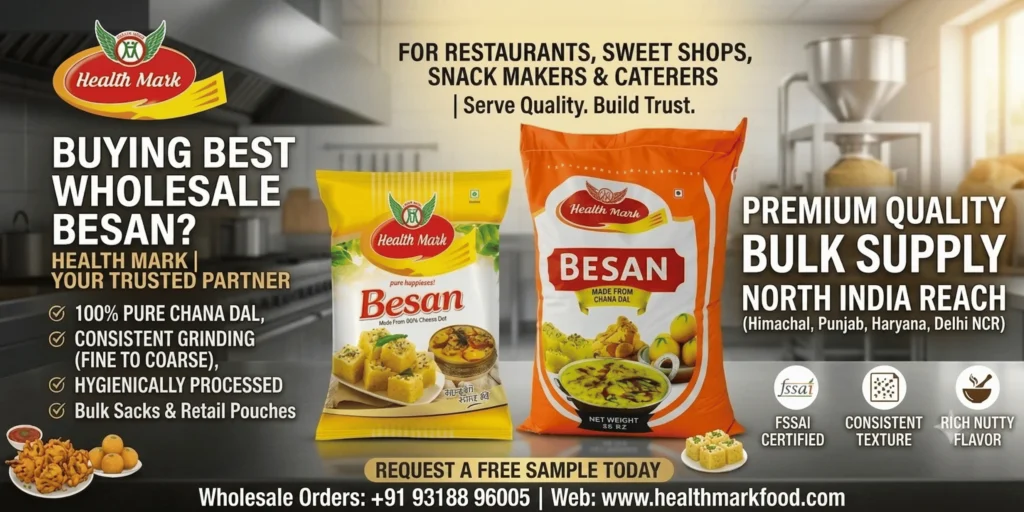
Every batch is hygienically processed and packed to lock in freshness, with pack sizes ranging from 55gm retail packs to 1kg, making it workable for both small retailers and larger bulk buyers. If you’re comparing options for the best health mark Besan range, browsing their besan product page and category page is a good place to start.
Finding a Trustworthy Besan Seller Near Me or in North India
If you’re searching for a besan seller near me or specifically a besan supplier in north India, prioritise suppliers with an established production base in the region it usually means shorter delivery times, fresher stock (less time in transit or storage), and easier communication for recurring orders or urgent top-ups.
Health Mark’s manufacturing unit is located in Baddi, Himachal Pradesh, placing it within easy reach of Punjab, Haryana, Chandigarh, Panchkula, Ludhiana, and the wider Delhi NCR belt making it a practical option for buyers across north India looking for consistent, regionally-sourced besan supply.
Best Uses of Besan for Restaurants, Sweet Shops and Snack Makers
Restaurants & QSRs: Pakoras, bhajiyas, besan chilla, and batter-coated fried items that need consistent crisping.
Sweet Shops: Besan laddoo, mysore pak, and boondi, where a coarser Motichur-style grind gives the right texture.
Snack Manufacturers: Namkeen, sev, and fried mixtures that rely on fine, uniform flour for even frying.
Caterers & Home-Style Kitchens: Kadhi Pakoda, dhokla, and thepla, where a smooth, lump-free blend is essential.
Expert Tips to Store Wholesale Besan Without Losing Freshness
Store in a cool, dry place away from direct sunlight and moisture.
Use airtight containers once bulk sacks are opened to prevent humidity absorption.
Avoid storing besan near strong-smelling spices, as gram flour can absorb odours easily.
Rotate stock using a first-in, first-out (FIFO) system for large inventories.
Check periodically for any change in smell, colour, or the presence of small pests, especially during humid months.
Keep bulk storage areas pest-controlled and well-ventilated.
FAQ
1. What is the best way to buy wholesale besan in India?
The best approach is to verify the supplier’s raw material sourcing and certifications, request a sample before committing, compare besan price across a few suppliers, and confirm delivery and packaging options suited to your business.
2. How can I check if besan is of premium quality?
Check for a bright, even yellow colour, a fresh nutty aroma, fine and lump-free texture, low moisture content, and the absence of any foreign particles or sour smell.
3. What factors affect besan price in the wholesale market?
Besan price is influenced by chana dal costs, order volume, packaging type, transportation distance, processing quality, and seasonal demand around festivals.
4. Is besan the same as gram flour or chana flour?
Yes, besan, gram flour, and chana flour all refer to the same product finely milled Bengal gram (chana dal).
5. How do I find a reliable besan manufacturer in India?
Look for FSSAI and ISO certifications, in-house milling, transparent pricing, a strong track record with repeat wholesale clients, and the willingness to provide test samples before bulk orders.
6. What is the minimum order quantity for wholesale besan?
Minimum order quantities vary by supplier and are usually based on your business size and delivery region. It’s best to confirm this directly with the besan manufacturer or supplier you’re considering.
7. How should I store bulk besan to keep it fresh for longer?
Store it in a cool, dry, airtight environment away from moisture and strong odours, and follow a first-in, first-out (FIFO) system to use older stock before newer batches.
8. Which type of besan is best for laddoos versus pakoras?
A coarser grind like Motichur or Mota Besan works best for laddoos and boondi, while a fine besan or Bareek Besan is better suited for pakoras, kadhi, and smooth batters.
9. How do I find a besan supplier in north India?
Search for manufacturers with a production base in or near your region for example, suppliers operating out of Himachal Pradesh, Punjab, or Haryana typically offer faster delivery across Chandigarh, Panchkula, Ludhiana, and Delhi NCR.
10. Can I request a sample before placing a bulk besan order?
Yes, and you should always do this. A genuine besan manufacturer or top-selling brand should be willing to provide a sample batch so you can verify quality before committing to a wholesale order.
Conclusion
Buying besan wholesale isn’t just about finding the lowest besan price it’s about finding a supplier who can consistently deliver premium high-quality Besan, order after order, without compromising on hygiene, taste, or texture. Whether you run a restaurant, a sweet shop, or a snack manufacturing unit, the checklist in this guide from checking raw material sourcing to comparing packaging and delivery options will help you make a confident, informed decision.
If you’re looking for a dependable besan manufacturer in India with a strong presence across north India, Health Mark’s range of Besan, Bareek Besan, Motichur/Mota Besan, and Powder Besan is worth exploring. Each variant is milled to suit a specific culinary need, hygienically processed, and packed to retain freshness from the factory to your kitchen.
Ready to place a bulk order? Explore the full besan range at healthmarkfood.com/product-category/besan, or reach out directly to the sales team at +91 93188 96005, +91 92185 87660, or +91 98828 96000 for wholesale pricing and delivery details.