
If you’ve typed “best spice brand in North India” into Google, you’re probably tired of guesswork powders that fade in colour after a month, chilli that’s more filler than flavour, or “pure” masala that smells like cardboard. North Indian cooking lives and dies by its spice box, and the difference between an average meal and a restaurant-style one usually comes down to one thing: the quality of the spice powder you started with.
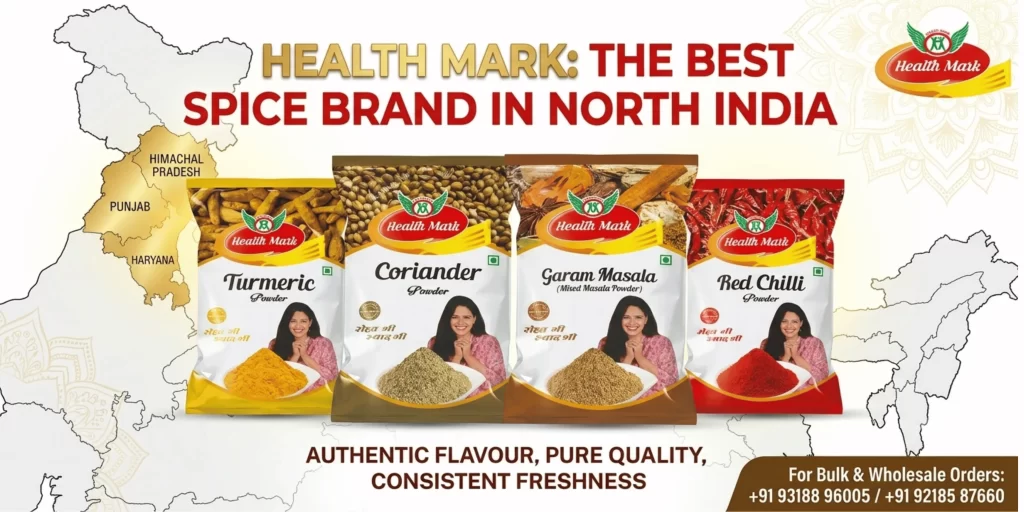
In this guide, we’ll break down exactly what separates a genuinely high quality spice brand from a mass-market one, why Health Mark manufactured out of the industrial hub of Baddi, Himachal Pradesh has become one of the most searched names among home cooks, restaurants and retailers across Punjab, Haryana, Chandigarh, Himachal Pradesh and Delhi-NCR, and how to buy spices powder in wholesale/bulk quantities without compromising on purity.
What Really Makes a Spice Brand the “Best” in North India?
Before comparing brands, it helps to understand the criteria that actually matter. Most people judge spices only by price and colour, but the real markers of quality sit further back in the supply chain.
1. Sourcing & Farm-Level Quality
The flavour of turmeric, red chilli or coriander is decided long before it reaches a packet at the farm. Spices sourced from certified, pesticide-conscious farms retain more natural oils, colour and aroma than mass-bought commodity stock.
2. Processing, Cleaning & Hygiene Standards
Cleaning, grinding, sieving and packaging all affect purity. A best spices manufacturing unit will follow food-safety protocols in line with FSSAI norms, avoid cross-contamination, and test batches rather than relying on visual checks alone.
3. Packaging That Locks In Freshness
Spice powders lose their volatile oils quickly when exposed to air, light and moisture. Brands that use proper multi-layer, food-grade packaging protect aroma for far longer than loose-sold or thin poly-packed spices.
4. Batch-to-Batch Consistency
A brand you can trust delivers the same colour, grind size and pungency every single time you buy whether it’s your 1st packet or your 100th bulk order.
Why Health Mark Is Recognized as a Best Spices Manufacturer in North India
Health Mark operates from Plot No. 60, Industrial Township Bhatoli Kalan, Baddi, Himachal Pradesh 173205 one of North India’s largest FMCG and food manufacturing belts, strategically positioned near Chandigarh, Panchkula, Ludhiana and the greater Punjab-Haryana-Himachal corridor. This location isn’t incidental; it’s a genuine sourcing and logistics advantage that lets the brand move fresh stock quickly across North India.
Organic-First, GMO-Free Philosophy
Health Mark positions its spice range within a wider organic food portfolio that also includes atta, besan, pulses, dry fruits, pickles and sugar. The brand’s stated commitment is to source from certified organic farms and keep products free from synthetic pesticides, herbicides and GMOs an approach that directly benefits spice quality, since spices absorb and reflect whatever chemical residue exists at the farm level.
Farm-to-Pack Traceability
Transparency across the supply chain means Health Mark can trace a packet of turmeric or garam masala back toward its source rather than relying on blended, anonymous commodity stock a key differentiator buyers increasingly look for when searching for the best spices seller rather than the cheapest one.
A Full FMCG Portfolio, Not Just Spices
Because Health Mark also manufactures atta, besan, pulses and dry fruits under one roof, retailers and distributors can consolidate orders with a single trusted supplier instead of managing five different vendors a practical reason many buyers searching for the best Health Mark spices end up staying for the full product range.
Health Mark’s Best-Selling Spice Powders
Health Mark’s core spices range covers the six staples every North Indian kitchen reaches for daily. Here’s how they stack up:
| Product | Best Used For | Flavour Profile | Buying Format |
| Turmeric Powder | Curries, dal, milk (haldi doodh), marination | Earthy, warm, mildly bitter | Retail pack / bulk sack |
| Red Chilli Powder | Curries, tandoori marinades, pickles | Deep red colour, adjustable heat | Retail pack / bulk sack |
| Coriander Powder | Base masala for almost every North Indian sabzi | Citrusy, nutty, mild | Retail pack / bulk sack |
| Garam Masala | Finishing spice for curries, biryani, dal tadka | Warm, aromatic blend | Retail pack / bulk sack |
| Carom Seeds (Ajwain) | Parathas, pakoras, digestive tea | Sharp, thyme-like, pungent | Retail pack |
| Fennel Seeds (Saunf) | Mouth freshener, tea, tempering | Sweet, aromatic, cooling | Retail pack |
Each of these is engineered for one job: to behave predictably in your kitchen, every single time. That consistency is exactly what people mean when they search for top selling spices in India rather than just the cheapest ones on a shelf.
Buy Spices Powder Online vs Wholesale Spices in India Which Should You Choose?
Not every buyer has the same need. Here’s how to decide the right purchase route:
For Home Kitchens Buy Spices Powder Online
• Small, resealable packs (100g–500g) that stay fresh through daily use
• Doorstep delivery, ideal for regular home cooking needs
• Lets you sample quality before committing to bulk
For Restaurants, Hotels, Caterers & Cloud Kitchens Wholesale Spices in India
• Larger pack sizes at wholesale spice prices in India, reducing per-kg cost
• Predictable supply schedules for high-volume kitchens
• Consistent grind and heat level across every order, which matters for recipe standardisation
For Retailers, Distributors & Traders Bulk Spice Distributor Baddi
• Direct-from-manufacturer sourcing cuts out middle-layer markups
• Private-label / bulk-sack options for regional distribution
• Being based in Baddi gives distributors quick access to Punjab, Haryana, Himachal Pradesh, Chandigarh and Delhi-NCR markets
If your requirement falls into the wholesale or bulk category, Health Mark’s team can be reached directly at +91 93188 96005, +91 92185 87660, or +91 98828 96000 to discuss minimum order quantities, pricing slabs and delivery timelines, or via the Product Enquiry page.
How to Identify High Quality Spices A Buyer’s Checklist
Whether you’re buying one packet or a full pallet, run through this checklist before you commit:
• Colour test: Turmeric should be a deep golden-yellow, not pale or overly bright (which can indicate added colour). Red chilli should look brick-red, not dull brown.
• Aroma check: Fresh, high quality spices release a strong smell the moment the pack is opened. Faint or musty smell old stock or poor storage.
• Texture: Powder should be fine and uniform, not clumpy or gritty (grit can indicate adulteration with sand or husk).
• FSSAI license number: Every legitimate packaged spice sold in India should display a valid FSSAI license number on the pack.
• Packaging date & shelf life: Always check manufacturing date; spice powders are best used within 6–9 months of packing for peak flavour.
• Water test for adulteration: A pinch of turmeric or chilli powder in a glass of water should not immediately release synthetic colour that streaks unnaturally natural pigment disperses more gradually.
• Source transparency: A best spices manufacturing brand will be upfront about sourcing and certifications rather than vague packaging claims.
Everyday Health Benefits of Common Indian Spices
Beyond flavour, the spices in a typical North Indian kitchen carry generations of culinary wisdom around wellness. A few widely recognised, general highlights:
• Turmeric: Contains curcumin, commonly associated with its warm colour and traditional use in immunity-supporting recipes like haldi doodh.
• Red Chilli: Contains capsaicin, which gives chillies their heat and is often linked to metabolism-boosting properties in traditional use.
• Coriander Powder: Traditionally used to aid digestion and add a cooling, citrusy balance to spicy dishes.
• Ajwain (Carom Seeds): A staple home remedy ingredient, often brewed as tea for digestive comfort.
• Saunf (Fennel Seeds): Commonly chewed after meals as a natural mouth freshener and digestive aid.
• Garam Masala: A blend that brings together warming spices like cloves, cinnamon and black pepper, valued as much for aroma as for its traditional warming qualities.
Note: These are general, traditional food-use observations and not medical claims. Consult a qualified healthcare professional for advice specific to any health condition.
Common Mistakes to Avoid When Buying Spices
Buying purely on price and ignoring the manufacturing/packaging date.
Choosing loose, open-sold spices from unhygienic storage over sealed, FSSAI-labelled packs.
Storing spice powders near the stove, where heat and steam quietly degrade them.
Buying oversized packs for occasional-use spices (like garam masala) that then sit and lose potency.
Assuming all “organic” labels are equal without checking the brand’s sourcing transparency.
Overlooking bulk/wholesale options when the actual usage volume (restaurant, catering, retail) clearly justifies it.
Health Mark vs Loose Market Spices vs Generic Packaged Brands
| Criteria | Health Mark | Loose Market Spices | Generic Packaged Brands |
| Sourcing transparency | Traceable, organic-focused sourcing | Rarely disclosed | Often not disclosed |
| Packaging & shelf life | Sealed, food-grade packaging | Exposed to air, dust, moisture | Varies by brand |
| Wholesale / bulk supply | Direct-from-manufacturer, Baddi-based | Informal, inconsistent supply | Limited or through distributors only |
| Product range under one supplier | Spices + atta, besan, pulses, dry fruits, pickle & more | Spices only | Spices only (usually) |
| Consistency across batches | High | Low | Medium |
| Ideal buyer | Home cooks, restaurants, retailers, distributors | Occasional, price-first buyers | Retail-only buyers |
How to Store Spices the Right Way
Keep powders in airtight glass or food-grade containers, away from direct sunlight.
Store away from the stove and any heat source steam and heat both accelerate flavour loss.
Use a dry spoon every time; moisture is the fastest way to spoil a spice powder.
Buy fast-used spices (chilli, turmeric, coriander) in slightly larger packs, but keep low-turnover spices in smaller quantities.
For bulk/wholesale stock, store bulk sacks in a cool, dry, pest-free storage area and rotate stock (first-in, first-out).

How to Order From Health Mark Retail, Wholesale & Bulk
Getting started with Health Mark is straightforward, whether you’re a home cook or a distributor:
Browse the Spices category page to view Turmeric Powder, Red Chilli Powder, Coriander Powder, Garam Masala, Carom Seeds and Fennel Seeds.
For retail quantities, click through to the individual product page and place your order.
For wholesale or bulk requirements (restaurants, retailers, distributors), submit a request via the Product Enquiry form or contact the sales team directly.
Call or WhatsApp the sales team at +91 93188 96005 / +91 92185 87660 / +91 98828 96000 for pricing, MOQs and delivery timelines.
Visit the About Us page or Accreditation page to review certifications before large-volume orders.
FAQ
1. Which is the best spice brand in North India?
Health Mark, manufactured out of Baddi, Himachal Pradesh, is widely searched as a leading spice brand in North India due to its organic-focused sourcing, GMO-free commitment, and its ability to serve both retail and wholesale/bulk buyers across Punjab, Haryana, Chandigarh and Delhi-NCR.
2. Where can I buy spices powder online in India?
You can order Health Mark’s spice powders directly from its official Spices category page, which includes turmeric, red chilli, coriander, garam masala, carom seeds and fennel seeds.
3. Does Health Mark supply spices for wholesale or bulk requirements?
Yes. Health Mark caters to restaurants, hotels, retailers and distributors with wholesale and bulk spice supply directly from its Baddi manufacturing facility. Reach out via the Product Enquiry page or the sales contact numbers for pricing and minimum order quantities.
4. Is Health Mark a bulk spice distributor in Baddi?
Health Mark manufactures and supplies spices from its facility in Industrial Township Bhatoli Kalan, Baddi, Himachal Pradesh, making it a practical bulk sourcing point for distributors and retailers across the North Indian belt.
5. What makes a spice “high quality”?
High quality spices show consistent colour, strong natural aroma, fine uniform texture, a valid FSSAI license number on the packaging, and a clear manufacturing/packaging date. Transparent sourcing from certified farms further supports quality and purity.
6. Are Health Mark’s spices organic and chemical-free?
Health Mark’s stated brand philosophy centres on sourcing from certified organic farms and avoiding synthetic pesticides, herbicides and GMOs across its food portfolio, including its spice range.
7. What other products does Health Mark manufacture besides spices?
Alongside spices, Health Mark manufactures atta, besan, pulses, dry fruits, pickles, protein-rich foods, snacks, sugar, and Italian range products.
8. How long do spice powders stay fresh after opening?
Most spice powders retain peak flavour for 6–9 months from the packaging date if stored in an airtight container away from heat, sunlight and moisture. Beyond that, they don’t spoil unsafely but do lose potency and aroma.
9. How can I verify Health Mark’s certifications before placing a bulk order?
You can review Health Mark’s certifications and standards on its Accreditation page before committing to a large wholesale or bulk order.
10. How do I contact Health Mark for spice orders or business enquiries?
You can reach the Health Mark sales team at +91 93188 96005, +91 92185 87660, or +91 98828 96000, or submit a request through the Product Enquiry page. The manufacturing facility is located at Plot No. 60, Industrial Township Bhatoli Kalan, Baddi, Himachal Pradesh 173205.
Conclusion
Choosing the best spice brand in North India isn’t about picking the loudest packaging on a shelf it’s about sourcing transparency, hygienic processing, freshness-first packaging and consistency you can rely on meal after meal. Health Mark checks each of these boxes with an organic-first philosophy, a strategically located Baddi manufacturing base, and the flexibility to serve everyone from a home cook buying a single 200g pack of turmeric to a distributor placing a bulk order for an entire region.
Ready to taste the difference? Explore Health Mark’s full spice range online, or for wholesale and bulk enquiries, call +91 93188 96005 / +91 92185 87660 / +91 98828 96000 today, or submit your requirement via the Product Enquiry page.