Type “which company besan is best“ into Google and you’ll get dozens of opinions, a handful of paid ads, and almost no explanation of why one besan brand is actually better than another. That’s a problem, because besan (gram flour) isn’t a throwaway pantry item in an Indian kitchen it’s the base of your pakoras, your dhoklas, your kadhi, your laddoos, and half the snacks your family expects to taste a certain way, every single time.
This guide breaks the question down properly. Instead of just naming a brand and asking you to trust it, we’ll walk through the exact quality markers sourcing, milling, hygiene, certification, freshness, and consistency that separate a premium quality besan from an average one. Along the way, we’ll use Health Mark Besan as a working example of a brand that checks these boxes, so you can apply the same checklist to any packet sitting on a store shelf or listed online.
By the end, you’ll be able to answer “which company besan is best“ for your own kitchen or business not because someone told you to, but because you’ll know exactly what to look for.
What Is Besan and Why the Brand You Choose Matters
Besan, also called gram flour or chickpea flour, is made by grinding chana dal (split Bengal gram) into a fine powder. It’s naturally gluten-free, has a distinctive nutty aroma, and behaves very differently in cooking depending on how it was milled, how fresh the chana dal was, and how it was stored before it reached your kitchen.
Nutritionally, besan punches well above most flours. According to USDA FoodData Central figures, a 100-gram serving of gram flour delivers roughly 387 kcal, about 22 grams of protein, and close to 10–11 grams of dietary fiber noticeably higher in both protein and fiber than refined wheat flour, while remaining naturally cholesterol-free and gluten-free.
That nutrition profile is exactly why quality control matters so much. Two packets labelled “besan” can taste, cook, and even digest completely differently depending on:
● The quality of chana dal used as raw material (broken, dusty grain vs. clean, sorted grain)
● Milling technique stone-ground vs. high-heat industrial grinding, which affects flavor and nutrient retention
● Hygiene standards during processing and packing
● Moisture control, which determines shelf life and resistance to weevils or clumping
● How recently it was milled before reaching the shelf
This is the real reason which company besan is best is a legitimate question not a trivial one. The brand behind the pack determines almost everything about how your dish turns out.
Which Company Besan Is Best? 8 Factors That Actually Matter
Rather than chasing marketing claims, judge any besan brand including the one you’re currently using against these eight practical criteria.
| Factor | What to Check |
| 1. Raw Material Sourcing | Is the besan made from clean, well-sorted chana dal, or a mix of low-grade grain and husk? Premium brands specify chana dal / Bengal gram as the sole raw material. |
| 2. Milling Consistency | A best besan brand delivers a uniform grind batch after batch no lumps, no gritty patches, no unexplained colour variation. |
| 3. Hygiene & Food Safety Certification | Look for FSSAI compliance and process certifications such as ISO, GMP, or HACCP. These aren’t just logos they indicate documented hygiene and quality-control systems in the factory. |
| 4. Texture Options | The best besan sellers usually offer more than one grind fine besan for batters, coarse/bareek besan for certain sweets, and motichur-grade for boondi and laddoo. |
| 5. Aroma & Colour | Fresh, quality besan has a light nutty smell and a pale yellow colour. A stale, dull, or greyish tone usually signals old stock or poor storage. |
| 6. Packaging & Shelf Life | Moisture-proof, sealed packaging in multiple pack sizes (so you’re not stuck buying more than you need) is a strong signal of a brand that understands both retail and bulk buyers. |
| 7. Price Transparency | A best besan price should reflect the quality tier honestly neither suspiciously cheap (often a red flag for adulteration) nor inflated without justification. |
| 8. Availability & Supply Reliability | A top besan supplier should be able to fulfil small retail orders and bulk besan requirements alike, with responsive customer support for enquiries. |
Run any packet whether it’s a hyper-local mill or a national FMCG name through this eight-point checklist, and you’ll have a far more reliable answer than any single review or ad claim.
Types of Besan Explained: Fine, Bareek, Motichur & Powder
Not all besan is meant for the same dish. A brand that offers multiple grind types signals that it understands Indian cooking beyond a one-size-fits-all product. Here’s a quick breakdown:
| Besan Type | Texture | Best Used For |
| Fine Besan | Standard everyday gram flour, smooth and finely milled | Pakoras, kadhi, cheela, dhokla, gatte ki sabzi |
| Bareek Besan | Extra-fine textured besan for smoother batters and sweets | Delicate sweets, thin coatings, smooth batters |
| Motichur / Mota Besan | Slightly coarser grind, ideal for boondi-style droplets | Motichur laddoo, boondi, festive sweets |
| Powder Besan | Ultra-fine powdered besan | Instant mixes, quick batters, fine-textured recipes |
Health Mark, for example, sells besan across all four grind profiles Besan, Bareek Besan, Motichur / Mota Besan, and Powder Besan which is a practical way to judge range and specialisation when you’re comparing suppliers.
How to Spot Premium Quality Besan Before You Buy
Whether you’re shopping in-store or scrolling an online listing, use this quick sensory and label checklist:
Visual Check
● Even, pale-yellow colour with no dark specks or visible husk
● Fine, uniform particle size (no gritty patches unless it’s meant to be coarse-grind besan)
● No visible moisture, clumping, or signs of pest activity
Smell Check
● A light, nutty aroma not sour, musty, or rancid
Label Check
● FSSAI license number printed on the pack
● Clear ingredient statement ideally just chana dal / Bengal gram
● Manufacturing and best-before dates that are recent and clearly legible
● Net weight, batch number, and manufacturer address/contact details
Texture Check (After Opening)
● Should feel powdery and flow freely, not sticky or damp
● A pinch rubbed between fingers should feel smooth, not sandy, unless it’s a coarse variant
Health Mark Besan: A Closer Look at a Trusted Indian Besan Brand
Health Mark is an FMCG food brand headquartered at Plot No. 60, Industrial Township Bhatoli Kalan, Baddi, Himachal Pradesh, operating since 2014. Its besan range is positioned around three things that map directly onto the buying checklist above: consistent raw material sourcing, hygienic processing, and product variety.
What Health Mark States About Its Besan
● Made from carefully selected chana dal, finely ground for a smooth texture and rich, nutty flavour
● Positioned for both everyday cooking and festive preparations pakoras, dhokla, kadhi, and sweets
● Hygienically processed and packed to help preserve freshness and purity
● Available in multiple pack sizes 55g, 200g, 500g, and 1kg suiting single-use trial packs through to full-size kitchen packs
● Sold across four grind variants: Besan, Bareek Besan, Motichur/Mota Besan, and Powder Besan
Certifications the Brand Cites
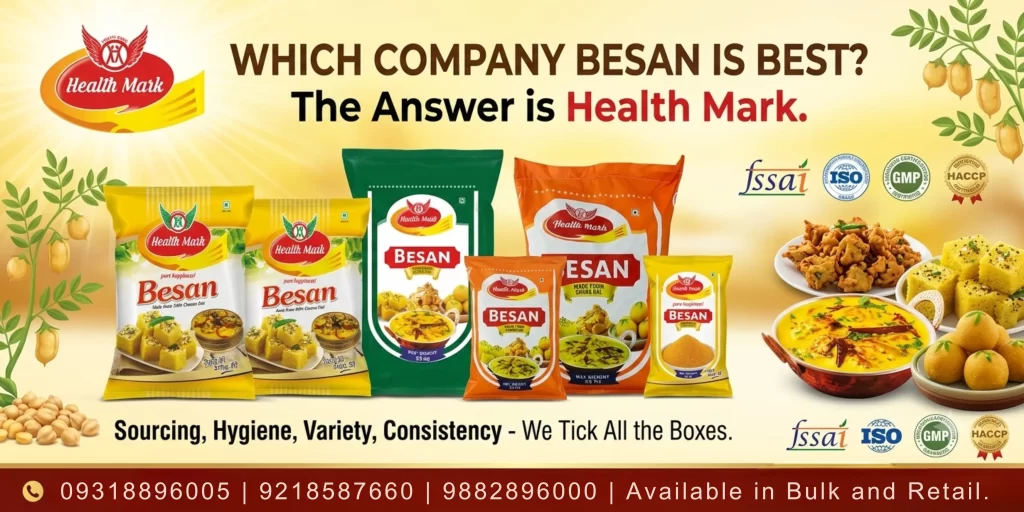
On its Accreditation page, Health Mark states that it follows FSSAI guidelines and works to ISO-certified, GMP, and HACCP-aligned processes for hygiene, nutrition, and product safety. If certification and traceability are high on your list when deciding “which company besan is best,” these are the exact documents worth asking any supplier to show you Health Mark included.
Where This Fits in the Best Besan Brand in India Conversation
No single guide can objectively crown one best besan brand in India for every reader, because “best” depends on your recipe, your city, your budget, and whether you’re buying a single 200g pack or bulk besan for a restaurant. What we can say is that Health Mark meets the practical criteria laid out earlier in this guide sourcing, hygiene claims, texture variety, and flexible pack sizing which makes it a reasonable brand to shortlist and compare against whatever you’re currently buying.
Best Besan Brand Comparison Checklist
Use this side-by-side worksheet to compare Health Mark Besan (or any brand) against alternatives you’re considering. Fill in the right-hand columns yourself as you compare packets.
| Quality Checkpoint | Health Mark Besan | Brand You’re Comparing |
| Raw material | Chana dal / Bengal gram (as stated by brand) | |
| FSSAI compliance stated | Yes (per Accreditation page) | |
| ISO / GMP / HACCP claims | Yes (per Accreditation page) | |
| Grind variety | Fine, Bareek, Motichur, Powder | |
| Pack sizes | 55g / 200g / 500g / 1kg | |
| Bulk ordering option | Available via product enquiry / WhatsApp | |
| Direct contact for orders | +91 93188 96005 |
Best Uses of Besan in Everyday and Festive Cooking
A genuinely good besan should perform reliably across this entire range of Indian recipes:
● Pakoras & bhajiyas needs a fine besan that fries crisp without turning dense
● Dhokla & khaman depends on a fresh, well-fermenting besan for the right rise
● Kadhi a smooth-mixing besan prevents lumps in the yogurt-based gravy
● Chilla / besan cheela a popular high-protein breakfast option
● Gatte ki sabzi needs besan that binds well into firm dumplings
● Motichur laddoo & boondi requires a coarser, motichur-grade besan for the classic droplet texture
● Face packs & natural skincare besan is also a traditional ingredient in homemade ubtan and face masks
Buying Besan in Bulk: A Guide for Retailers, Caterers & Food Businesses
If you run a restaurant, sweet shop, catering business, or retail store, the questions you ask change. You’re no longer just looking for best besan price on a single pack you need a reliable top besan supplier who can maintain consistent quality across large, repeat orders. When evaluating a best besan manufacturing partner or a bulk besan source, check for:
● Consistent batch-to-batch quality, not just a good first sample
● Documented hygiene certifications you can request in writing
● Ability to scale order volumes without long lead times
● Clear, direct communication channels for order enquiries
● Competitive bulk pricing without compromising on raw material quality
Health Mark accepts bulk and business enquiries directly through its Product Enquiry page or by phone/WhatsApp at +91 93188 96005, +91 92185 87660, or +91 98828 96000. If you’re sourcing for a business, it’s worth reaching out directly to discuss volume pricing and delivery timelines rather than relying on retail pack prices alone.
Best Besan Price: What Affects the Cost You Pay
Besan pricing in India isn’t fixed it moves with a few clear variables. Understanding them helps you judge whether a price is fair or a red flag.
● Chana dal (raw material) prices: Besan cost tracks the wholesale price of chana dal, which fluctuates with the pulses harvest and mandi rates.
● Grind type: Specialised grinds like motichur or bareek besan can carry a slightly different price than standard fine besan.
● Pack size: Smaller trial packs (like 55g or 200g) usually have a higher per-kg cost than 1kg or bulk packs.
● Certification & processing standards: Brands investing in ISO/GMP/HACCP-aligned hygiene processes may price slightly above unbranded, loose besan but that premium buys traceability and consistency.
● Region and logistics: Freight and local distribution costs can shift retail pricing city to city.
As a rule of thumb: don’t chase the absolute lowest price per kilogram without checking the raw material and hygiene claims first. A slightly higher, transparent best besan price is usually a better long-term value than the cheapest unbranded option.
Common Mistakes People Make When Buying Besan
● Buying loose, unlabelled besan purely on price. You lose all traceability no batch number, no FSSAI details, no way to verify freshness.
● Ignoring the manufacturing date. Besan can turn rancid faster than you’d expect, especially in humid climates.
● Assuming all besan is interchangeable. Using coarse motichur-grade besan for pakoras (or vice versa) changes your results significantly.
● Overbuying large packs you can’t use before they turn stale. Match pack size to how quickly your household or kitchen actually uses besan.
● Storing it incorrectly after opening. Even the best besan brand’s product will spoil early if left in humid, open conditions.
Expert Tips to Store Besan and Keep It Fresh Longer
● Transfer besan to an airtight container immediately after opening the pack
● Store in a cool, dry place away from direct sunlight and stovetop heat
● Always use a dry spoon moisture is the fastest way to trigger clumping and spoilage
● In humid seasons, consider refrigerating besan in a sealed container to extend shelf life
● Buy pack sizes that match your usage a 1kg pack sitting half-used for months loses freshness faster than a 200g pack used up quickly
● Do a quick smell-and-look check before each use, especially with packs older than a few months
FAQ
1. Which company besan is best in India?
There isn’t one universal answer, because “best” depends on the grind type, pack size, and price point you need. Judge any brand including Health Mark against practical factors like raw material sourcing (chana dal quality), FSSAI and ISO/GMP/HACCP certification claims, texture consistency, and freshness, rather than relying on marketing alone.
2. What is the best besan brand in India for daily cooking?
For everyday cooking, look for a brand offering fine-grind besan with hygienic processing and clear labelling. Health Mark’s standard Besan variant, made from chana dal and finely milled for smooth texture, is designed for daily dishes like pakoras, kadhi, and cheela.
3. How can I tell if besan is premium quality before opening the pack?
Check the label for an FSSAI license number, a recent manufacturing date, clear ingredient listing (ideally just chana dal), and the manufacturer’s contact details. These label details are usually a reliable proxy for quality even before you open the pack.
4. Where can I buy besan online?
You can buy Health Mark Besan directly through its product page, or reach the brand via WhatsApp or phone for enquiries and orders. Many general grocery and quick-commerce platforms also stock branded besan.
5. What is the best besan price per kilogram?
Besan price fluctuates with chana dal (raw material) rates, grind type, and pack size, so there’s no single fixed “best” price. Compare per-kg cost across pack sizes and prioritise brands that are transparent about sourcing and certification over the cheapest unbranded option.
6. Is besan good for health?
Yes. Gram flour is naturally gluten-free and, per USDA nutrition data, provides roughly 22 grams of protein and around 10–11 grams of fiber per 100 grams notably higher in both than refined wheat flour along with minerals like iron, magnesium, and folate.
7. What is the difference between besan and bareek besan?
Standard besan is a regular fine grind suited to most everyday recipes, while bareek besan is milled to an even finer, smoother texture, often preferred for delicate batters and certain sweets.
8. Which besan is best for making pakoras?
A standard fine-grind besan works best for pakoras, since it fries up light and crisp rather than dense. Coarser motichur-grade besan is better suited to boondi and laddoo, not pakoras.
9. How do I find a reliable bulk besan supplier for my business?
Look for a manufacturer that can show certification documentation (FSSAI, ISO, GMP, HACCP), has a track record of consistent batch quality, and offers direct communication for bulk pricing. Health Mark accepts business and bulk enquiries through its Product Enquiry page and via phone/WhatsApp.
10. How long does besan stay fresh after opening?
Properly stored in an airtight container away from moisture and heat, besan generally stays fresh for several months, though this varies by climate and storage conditions. Always check the manufacturing date and do a smell-and-look check before use.
Conclusion & Next Steps
So, “which company besan is best?“ The honest answer is: the one that can show you clean raw material sourcing, real hygiene certification, consistent milling, and packaging suited to how you actually cook not just the loudest ad. Run every brand you’re considering through the eight-point checklist in this guide, and you’ll make a far more confident choice than any single review could give you.
If you’d like to see how Health Mark Besan measures up in your own kitchen, explore the full Besan product range including Besan, Bareek Besan, Motichur/Mota Besan, and Powder Besan. For bulk orders or business enquiries, contact the Health Mark team directly at +91 93188 96005, +91 92185 87660, or +91 98828 96000, or visit the Health Mark homepage to browse the complete product catalogue.