
Walk into any dhaba in Zirakpur, any sweet shop in Chandigarh, or any kitchen in Mohali, and you will find one jar that never runs empty: lal mirch powder. It colours the dal, enhances the flavour of paneer tikka, and adds the perfect touch of spice to everyday Indian dishes.
For a retailer, restaurant owner, or caterer in the Chandigarh–Mohali–Panchkula region, the question is rarely “Should I stock chilli powder?” Instead, it is “Who can supply consistent colour, flavour, and heat in every order?”
Finding a reliable supplier can be challenging. Two packets of red chilli powder may look similar but deliver very different results in cooking. One gives curries a rich red colour and a fresh, spicy aroma, while another may produce dull colour, uneven heat, or a less appealing flavour.
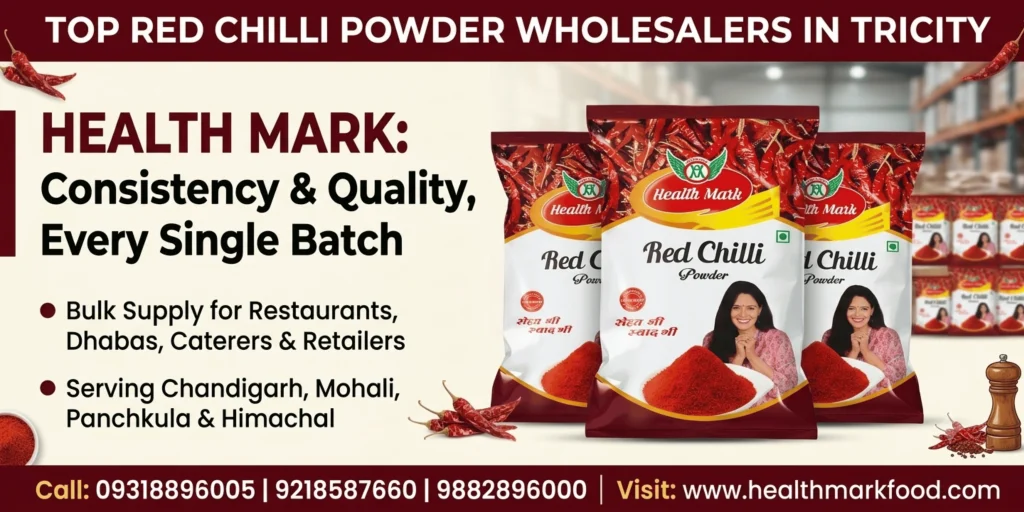
This guide will help bulk buyers understand what to look for when choosing the top red chilli powder wholesalers in Tricity, how to evaluate product quality, which factors influence wholesale prices, and how to select a dependable supplier. Whether you run a restaurant, retail store, catering business, or food distribution company, making the right purchasing decision can help you maintain consistent quality and customer satisfaction.
Why Tricity Is a Serious Market for Wholesale Spices
Tricity is one of North India’s busiest consumption zones. A few things keep demand high all year:
- A dense food-service sector. Restaurants, cloud kitchens, dhabas, banquet halls and street-food vendors use chilli powder daily.
- Strong retail networks. Kirana stores, supermarkets and Mohali’s growing residential communities all need steady stock.
- Festival and wedding seasons. Punjab and Haryana’s catering demand spikes sharply, and so does the need for large, dependable quantities.
- A gateway to the hills. Tricity is a natural supply point for traders serving Himachal and nearby towns.
India is among the world’s largest producers and consumers of chillies, according to the Spices Board of India, and the powder you buy in Tricity is usually the end product of a long chain: farm, drying yard, cold store, grinding unit, packing line and finally your shelf. The more of that chain a supplier controls, the easier it is to keep quality steady.
Know Your Chillies: Kashmiri, Guntur, Byadgi and Teja
Before comparing suppliers, know what you are actually buying. “Red chilli powder” is a category, not a single product.
| Variety | Typical Colour | Heat Level (approximate) | Best For |
| Kashmiri | Bright, deep red | Mild (roughly 1,000–2,000 SHU) | Tandoori dishes, rogan josh, colour-led gravies |
| Byadgi | Rich red | Mild to medium | South Indian and coastal curries, colour with moderate heat |
| Guntur (S4 type) | Red | Medium to hot (roughly 30,000–50,000 SHU) | Everyday North Indian cooking, pickles, spice blends |
| Teja | Dark red | Very hot (often 75,000+ SHU) | Extra-spicy dishes, commercial heat-driven products |
Colour and Heat Are Not the Same Thing
When choosing red chilli powder, it is important to understand that colour and spiciness are two different qualities. Some chilli varieties, such as Kashmiri red chilli, are known for their rich red colour and relatively mild heat. Others, such as Teja chilli, generally offer a stronger, spicier taste.
Many red chilli powder suppliers combine different chilli varieties to achieve a balance of colour, flavour, and heat according to customer requirements.
Practical Example: Restaurants preparing paneer tikka often prefer red chilli powder that gives the marinade an attractive red colour without making the dish excessively spicy. On the other hand, pickle manufacturers and street-food businesses may prefer stronger chilli powder for a more intense flavour.
For businesses purchasing in bulk, selecting the right chilli powder helps maintain consistent taste, appearance, and customer satisfaction.
What Makes a Wholesaler One of the Best
A large godown and a loud promise are not credentials. When evaluating the leading names in the market, check these points:
The essentials
- A valid FSSAI licence that the supplier is willing to show you. The FSSAI is India’s food safety regulator.
- Clearly stated variety and grade. “Mix chilli” with no explanation is a warning sign.
- Batch consistency. The 10th bag should look, smell and taste like the first.
- Sealed, labelled packaging with batch number, date of packing and best-before date.
- Transparent pricing that can be explained by grade, packing size and quantity.
- Reliable delivery across Tricity and, if you need it, beyond.
The extras that signal a serious supplier
- Willingness to send a sample before a bulk order
- Test reports or quality-control practices they can describe in plain language
- A range of pack sizes for retail and for institutional use
- A real contact person who answers calls, not just a web form
- A broader product range (powders, masalas, pulses) so you can consolidate purchases
Key point: The best wholesaler is not the cheapest or the biggest. It is the one whose product performs the same way in your kitchen or on your shelf, month after month.
Quality Parameters That Actually Matter
You do not need a laboratory to ask smart questions. Here is what quality means in practice.
Colour
Good powder has an even, natural red. Be careful with colour that looks too bright or glossy for the variety. Artificial colouring is an adulteration risk, and it is illegal.
Pungency (heat)
Ask what heat level the product is designed for. A reputable supplier can tell you whether it is mild, medium or hot, and will keep that level steady across batches.
Moisture
High moisture shortens shelf life and invites mould. FSSAI sets standards for ground chilli, including limits on moisture and ash content, so it is fair to ask a supplier how they stay within them.
Aroma and flavour
Fresh powder smells sharp and slightly fruity. A musty, flat or oily smell suggests old stock or poor storage.
Texture
Fine, free-flowing powder with uniform particle size mixes evenly in gravies. Clumping usually points to moisture.
Purity
This is the big one. Common adulterants reported in spice trade discussions include added colours, brick powder, sawdust and cheap fillers. Buy only from sources you can hold accountable.
Simple Home Tests for Chilli Powder Purity
These are rough field checks, not lab-grade proof, but they help you spot obvious problems when you receive a sample.
- Water test for added colour. Sprinkle half a teaspoon of powder on the surface of a glass of water. Pure chilli powder tends to float for a while and releases colour slowly. Streaks of intense colour spreading quickly can suggest added dye.
- Rub test. Rub a pinch between your fingers. A gritty, sandy feel may point to brick powder or similar fillers.
- Smell test. Smell a fresh sample, then a sample you trust. Differences are often easy to notice.
- Oil on paper. Place a little powder on white tissue. A heavy, bright stain can indicate added oil or colour.
- Cooking test. Always cook a small batch of your standard dish. This is the test that matters most for a kitchen.
If a sample fails any of these checks, do not simply argue with the supplier. Ask for batch details and a replacement sample, and compare again. If you suspect adulteration, you can report it to the food safety authorities.
Red Chilli Powder Price: What Drives the Rate
Buyers often ask for a single rate per kilo. The honest answer is that rates move with several factors, and a quote means little without knowing what is behind it.
| Factor | How It Affects the Rate |
| Chilli variety | Kashmiri and premium grades usually cost more than standard grades |
| Crop year and season | A poor harvest or strong export demand pushes rates up |
| Grade and stalk content | Stem-free, cleaner grades cost more to produce |
| Pack size | Large institutional packs usually lower the per-kg cost |
| Order quantity | Bigger orders can unlock better rates |
| Transport and handling | Distance and logistics add to the final landed cost |
| Processing method | Cleaning, sterilisation and quality control add cost |
How to compare quotes fairly
- Compare the same variety and grade across suppliers.
- Ask whether the quoted rate includes GST and delivery.
- Calculate cost per kg, not cost per pack.
- Remember that a very low quote often hides a compromise somewhere: weaker colour, higher moisture or lower purity.
Packaging, Storage and Shelf Life
The best powder in the world can be ruined in a damp store room. Treat storage as part of your buying decision.
Packaging formats you will commonly see
Small retail pouches for kirana and supermarket shelves
Medium packs for homes and small eateries
Large sacks and institutional packs for restaurants, caterers and traders
Storage best practices
Keep stock in a cool, dry, dark place
Store sacks off the floor on pallets, away from walls
Reseal opened packs tightly or transfer to airtight containers
Use first in, first out so older stock goes first
Avoid placing spice sacks near strong-smelling goods
Packaged ground spices typically keep best within the best-before period printed on the label. Colour and aroma fade gradually with time, so very old stock is rarely worth the saving.
Wholesaler, Manufacturer or Local Mandi?
Each channel has its place. Here is how they compare.
| Factor | Local Mandi / Loose Trader | Wholesaler / Distributor | Direct Manufacturer |
| Traceability | Often limited | Moderate to good | Usually strongest |
| Branded, sealed packs | Rare | Common | Common |
| Batch consistency | Variable | Good | Usually best |
| Bulk pricing | Competitive but uneven | Competitive | Often best at volume |
| Credit / flexible terms | Informal | Sometimes | Varies |
| Custom blends or pack sizes | Rare | Limited | More likely |
If you want clear accountability and consistent output, working with a red chilli powder manufacturer or a distributor directly connected to one tends to give you more control than buying loose from an unnamed source.
Health Mark Red Chilli Powder: What Buyers Can Expect
Health Mark is a Himachal-based food brand with a range of powder masale and everyday kitchen staples listed on its website. For buyers shortlisting suppliers, the brand’s Red Chilli Powder product page is a good place to start, and the wider Powder Masale category shows the other spices available alongside it.
Why does this matter to a bulk buyer? Because Health Mark Red Chilli Powder sits within a broader masala range, which means a restaurant, retailer or caterer can often consolidate several spice requirements with one supplier instead of juggling many.
What to ask Health Mark (or any supplier) before ordering
- Which chilli variety and heat level does this pack use?
- What pack sizes are available for retail and for bulk?
- What is the best-before period and how is the product packed?
- What is the rate per kg at my order quantity, and does it include GST and delivery?
- Can you send a sample before I place a larger order?
Choosing a brand with a clear head
People search for the best red chilli powder brand in India hoping to find one winner. In reality, the right brand depends on your need. A tandoori-focused restaurant, a pickle maker and a family kitchen will each pick differently. Judge brands on consistency, transparency and support, not on advertising volume.
Supply Reach: Tricity and Himachal
Geography matters in the spice trade because freshness and delivery time matter. A supplier rooted in the northern hill belt and serving the plains has a natural advantage for traders who cover both.
If your business serves towns across Himachal as well as Chandigarh, Mohali and Panchkula, look for a dependable FMCG supplier in Himachal who can handle mixed loads (spices, pulses and staples) in a single dispatch. Fewer deliveries mean lower freight costs and fewer chances of stock-outs.
Questions worth asking about logistics:
- What is the usual delivery time to my location?
- Is there a minimum order quantity?
- How are damaged or short deliveries handled?
- Can I schedule repeat monthly orders?
Common Mistakes Bulk Buyers Make
- Buying on price alone. The cheapest rate is often the most expensive mistake.
- Skipping the sample. Never place a large order without testing a sample in your own recipe.
- Ignoring the variety. “Chilli powder” without a named type can mean anything.
- Not checking the packing date. Old stock loses colour and aroma.
- Confusing colour with heat. A red powder is not necessarily a hot one.
- Poor storage after delivery. Damp storage can ruin good powder within weeks.
- Buying loose from unknown sources. No batch information means no accountability.
- Not comparing the landed cost. Freight and GST change the real price.
- Overstocking in slow seasons. Buy to your turnover, not to a discount.
- Never revisiting the supplier. Review quality every few months and keep a back-up supplier.
Expert Tips for a Smoother Purchase
- Run a side-by-side trial. Cook the same dish with two or three samples and let your team vote.
- Match the grade to the job. Use milder, colour-rich grades for gravies and tandoori; reserve hotter grades for dishes that need a kick.
- Ask for a spice range, not just chilli. Combining chilli, turmeric and coriander with one supplier can improve your terms. If you are building a spicy masala range for your shop or kitchen, this also keeps flavour profiles consistent across products.
- Plan around the season. Chilli rates often shift after harvest, so talk to your supplier about when to lock in volume.
- Keep a quality log. Note the batch number, date and your impression of each delivery.
- Build a relationship. Suppliers who know your volumes and standards tend to look after you when stock is tight.
How to Place a Bulk Order, Step by Step
- Define your need. Decide the variety, heat level and monthly quantity.
- Shortlist two or three suppliers. Verify FSSAI details and product range.
- Request samples. Ask for the same grade from each supplier.
- Test and compare. Check colour, aroma, texture and cooking performance.
- Get written quotes. Include rate per kg, GST, delivery and payment terms.
- Start with a trial order. A smaller first order reduces risk.
- Inspect on delivery. Check seals, batch numbers, dates and weight.
- Store properly. Move stock to a dry, cool place immediately.
- Review and repeat. If quality holds, move to regular or scheduled orders.
Quick Comparison: Choosing Between Spice Strengths
| If your customers want… | Consider |
| Bright red colour with mild heat | Kashmiri-type or Byadgi-type powder |
| A balanced everyday flavour | Medium-heat Guntur-type or a blend |
| A strong, fiery kick | Hot Guntur or Teja-type grades |
| One product that does everything | A tested blend, confirmed by cooking trials |
For shoppers who specifically hunt for the best spicy red chilli powder in India, remember that “spicy” is subjective. Define the heat you want in plain words (mild, medium, hot, extra hot) and test before you stock.
FAQ
1. Who are the top red chilli powder wholesalers in Tricity?
There is no single official ranking. Strong wholesalers share common traits: a valid FSSAI licence, named chilli varieties, consistent batches, sealed labelled packaging, transparent rates and reliable delivery. Compare two or three suppliers on these points and test samples before you decide. Health Mark is one option you can evaluate through its Red Chilli Powder page.
2. How can I identify the best quality red chilli powder?
Look for natural, even colour, a fresh sharp aroma, fine free-flowing texture and clear labelling with batch and date details. Do a cooking test with a sample. Genuine best quality red chilli powder performs consistently across batches, not just in the first sample.
3. What is the difference between Kashmiri and regular red chilli powder?
Kashmiri chilli is prized for deep red colour and mild heat. Regular grades such as Guntur-type chilli are usually hotter and less intensely coloured. Many cooks blend the two to balance colour and heat.
4. How much does red chilli powder cost per kg in bulk?
Rates vary by variety, grade, season, pack size and order quantity, so a fixed number would mislead you. Request a written quote for your exact grade and quantity, and ask whether GST and delivery are included.
5. What is the minimum order for wholesale purchases?
Minimum order quantities differ between suppliers and between pack sizes. Call the supplier directly. For Health Mark, you can reach the team on 09318896005, 9218587660 or 9882896000.
6. How can I check if chilli powder is adulterated?
Simple checks include the water test, rub test and smell comparison, but these are only indicators. For certainty, buy from licensed suppliers who provide batch details, and consider lab testing for large or regular purchases.
7. How long does red chilli powder last?
Unopened, properly packed powder lasts through its printed best-before period if stored in a cool, dry, dark place. Once opened, keep it airtight. Colour and aroma fade gradually with time.
8. Is a wholesaler better than a manufacturer?
Neither is automatically better. Manufacturers often offer stronger traceability and customised packs, while wholesalers and distributors can offer convenience and mixed-product loads. Choose the one that gives you consistency and clear accountability.
9. Which red chilli powder is best for restaurants?
It depends on the menu. Colour-focused dishes such as tandoori and butter gravies suit milder, colour-rich powder, while spicy street-food and dhaba-style dishes suit hotter grades. Many restaurants use a blend for balance.
10. Can I buy other masalas along with red chilli powder?
Many suppliers, including Health Mark, list multiple powder masalas. Browse the Powder Masale category to see what is available and ask about combined orders.
Conclusion
Choosing among the top red chilli powder wholesalers in Tricity is not about the loudest brand or the lowest rate. It is about finding a supplier whose product behaves the same way in your kitchen or on your shelf, delivery after delivery.
Start with the basics: know your variety, insist on a sample, check the licence, compare the landed cost per kilo and store your stock well. Review quality regularly, and keep a back-up supplier in mind.
If you are looking for wholesale red chilli powder and a wider range of everyday masalas, explore the Health Mark website, view the Red Chilli Powder product page and speak to the team about samples, rates and delivery.