
If you run a restaurant, catering business, kirana store, or food-processing unit anywhere near Panchkula, you already know that the spice you buy can make or break your dish, your margins, and your reputation. The search for the right spices wholesalers in Panchkula usually starts the same way: too many local traders, inconsistent quality, and no clear way to compare who is genuinely reliable.
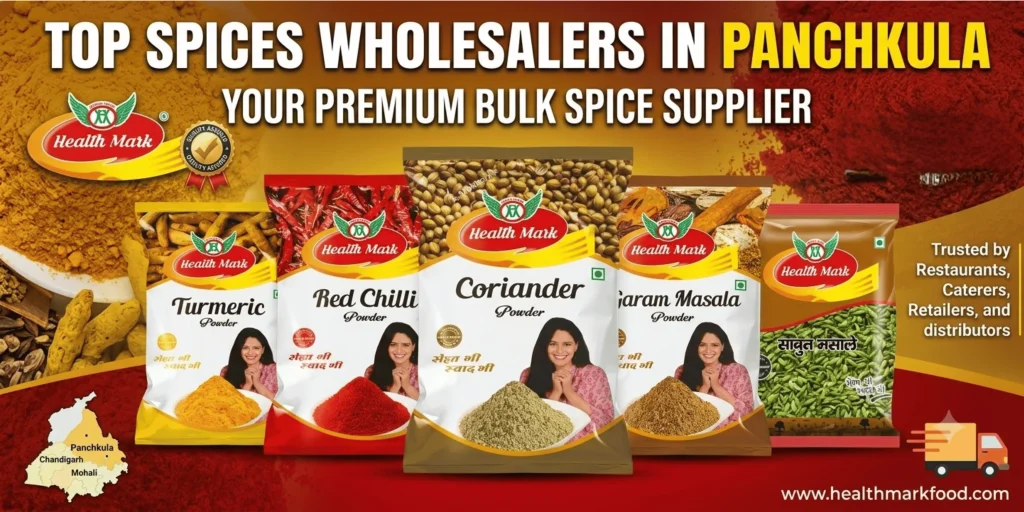
This guide breaks that confusion down. We’ll walk through what actually separates a dependable wholesale spice supplier from an average one, look at the certifications and practices that signal genuine quality, and introduce you to Health Mark, a Tricity-area FMCG brand supplying turmeric, chilli powder, garam masala, and other everyday masalas to retailers, distributors, and bulk buyers. By the end, you’ll have a practical framework for choosing a spices seller near me whether that’s Health Mark or anyone else and know exactly what questions to ask before you place your next bulk order.
Why Panchkula Is Emerging as a Key Spice Trading Hub
Panchkula sits right at the edge of the Chandigarh Tricity region, within easy reach of Mohali, Chandigarh, and the industrial belt around Baddi in Himachal Pradesh. That geography matters. It puts the city close to major grain and spice processing units, well-connected highways for last-mile distribution, and a fast-growing base of hotels, cloud kitchens, caterers, and modern retail outlets that all need a steady, trustworthy supply of masalas.
As more households and businesses move away from loose, unbranded spices bought at random and toward sealed, lab-tested, branded alternatives, organized FMCG suppliers are filling that gap. This shift is exactly why searches for wholesale spices in India, and specifically for a dependable spices wholesaler in Panchkula, have grown so quickly over the last few years.
What Actually Makes a Spices Wholesaler “The Best”?
Almost every trader will claim to sell “the best spices” or call themselves a “No.1 spices brand.” The real question is what you should be checking before you believe that claim. Here’s what genuinely separates a best spices seller from an average one.
1. Sourcing and Purity
A serious best spices manufacturer controls its raw material sourcing closely knowing which region the turmeric, chilli, or coriander is grown in, and testing it for moisture, adulteration, and pesticide residue before it ever reaches the grinding unit.
2. Certifications and Food Safety Compliance
Look for ISO 9001 (quality management), ISO 22000 (food safety management), HACCP (hazard analysis), GMP (good manufacturing practice), and GHP (good hygiene practice). These aren’t just logos on a website they represent audited processes covering everything from raw material intake to final packaging.
3. Pricing Transparency for Bulk Orders
A genuine wholesale spices supplier in India will have clear pricing slabs for different order volumes, rather than vague “call for price” answers with no consistency.
4. Packaging and Shelf Life
Premium high quality spices are packed in moisture-resistant, food-grade material that protects aroma and colour, with visible batch numbers and manufacturing dates.
5. Consistency of Supply
For a restaurant or retailer, an occasional great batch followed by an inconsistent one is worse than steady, dependable average quality. Reliability matters as much as peak quality.
6. Customer Support and After-Sales Service
A best spices seller responds quickly to bulk enquiries, handles complaints professionally, and is transparent about lead times and delivery.
Meet Health Mark: A Trusted Name Among Spices Wholesalers Near Panchkula
Health Mark is a North India-based FMCG company built around quality and innovation in everyday food essentials. You can read more about the company on the Health Mark homepage, where the brand positions itself as one of North India’s leading names in wholesale and retail consumer packaged goods.
The company’s manufacturing base is located in the Baddi industrial township in Himachal Pradesh, an area known for large-scale FMCG and pharma production, and its distribution network extends across the Chandigarh Tricity belt Panchkula, Chandigarh, and Mohali as well as Baddi and Ludhiana.
Rather than being a single-product trader, Health Mark operates across a wide catalogue: atta, besan, pulses, rice, salt, sugar, dry fruits, pickles, sauces, snacks, and spices, all under one roof. For a retailer or distributor, that breadth means fewer supplier relationships to manage and one point of contact for multiple category needs including your spice and masala requirement.
Health Mark’s Spice Range: From Everyday Masalas to Kitchen Staples
Health Mark core spice lineup, all listed on the Spices product category page, currently covers six high-demand essentials that any kitchen, restaurant, or retail shelf needs on a recurring basis:
• Turmeric Powder the everyday base spice used in nearly every Indian curry, prized for colour, mild bitterness, and its long-standing place in home remedies.
• Red Chilli Powder a top-selling spice across India, driving both colour and heat in gravies, marinades, and snacks.
• Coriander Powder a mild, aromatic base spice used to thicken and flavour curries and dry preparations alike.
• Garam Masala a blended spice mix used at the finishing stage of cooking to round out flavour in North Indian dishes.
• Fennel Seeds (Saunf) used both as a cooking spice and as an after-meal digestive, popular in retail and HORECA channels alike.
• Carom Seeds (Ajwain) a strong, aromatic seed spice widely used in snacks, parathas, and traditional home remedies.
Because these six products cover the bulk of everyday Indian cooking, a distributor or retailer stocking Health Mark spices can meet most of a typical customer’s masala basket from a single supplier, rather than juggling multiple small-batch traders.
Quality You Can Trust: Certifications That Matter
Health Mark’s accreditation page highlights ISO 22000, ISO 9001, GMP, GHP, and HACCP certification a combination that, together, is meant to cover food safety management, quality management, hygienic manufacturing practice, and hazard control at the production stage.
For a buyer, these certifications matter for a very practical reason: they are usually the first thing a retail chain, hotel procurement team, or export buyer will ask to see before signing on with a new spices manufacturer. If you’re evaluating any wholesale spices in India supplier, always ask for current certificates, not just logos on a website.
For context on what these standards generally represent, national food regulators such as the Food Safety and Standards Authority of India and industry bodies like the Spices Board of India publish detailed guidance on hygienic processing and quality benchmarks for spice manufacturers.
Wholesale vs Retail Spices: Why Bulk Buying Makes Sense
If you’re buying for a business rather than a single household, understanding the practical difference between retail and wholesale spice purchasing helps you plan budgets and storage correctly.
| Factor | Retail Buying | Wholesale / Bulk Buying |
| Unit cost | Higher per kg, small packs | Lower per kg, volume-based slabs |
| Packaging | Consumer-facing, small SKUs | Bulk packs, often customizable |
| Order frequency | Frequent, small top-ups | Planned, scheduled restocking |
| Best suited for | Individual households | Restaurants, caterers, retailers, distributors |
| Supplier relationship | One-off, transactional | Ongoing, relationship-based with support |
| Price predictability | Can fluctuate order to order | More stable with agreed terms |
This is precisely why hotels, catering businesses, kirana stores, and regional distributors around Panchkula increasingly look for a dedicated wholesale spices supplier rather than buying retail packs in bulk the cost, packaging, and support structure are built for business use.
How to Choose the Best Spices Seller or Manufacturer (Step-by-Step)
1. Verify certifications first. Ask for current ISO, HACCP, GMP, and FSSAI licence numbers, not just marketing claims.
2. Request a sample batch. A genuine best spices manufacturer will happily send a small trial quantity before you commit to a bulk order.
3. Check minimum order quantities (MOQ) and pricing slabs. Clear, tiered pricing is a sign of an organized wholesale spices in India supplier.
4. Inspect packaging quality. Look for moisture-proof sealing, visible batch codes, and manufacturing/expiry dates.
5. Ask about delivery timelines and coverage. Confirm whether the supplier regularly services your area for Panchkula-based buyers, ask specifically about Tricity delivery routes.
6. Read how the company presents itself. A transparent “About Us” page, visible address, and accessible contact numbers are simple but meaningful trust signals.
Health Mark vs Typical Local Spice Traders: A Quick Comparison
| Parameter | Typical Unbranded Local Trader | Health Mark (Organized FMCG Supplier) |
| Certifications | Often undocumented | ISO 22000, ISO 9001, GMP, GHP, HACCP |
| Product range | Usually single-category | Spices plus atta, besan, pulses, rice, and more |
| Packaging | Variable, often unsealed | Standardized, sealed, dated packaging |
| Traceability | Limited | Batch-coded manufacturing |
| Business support | Informal | Dedicated sales contacts and enquiry channel |
| Delivery coverage | Localized only | Tricity region and pan-India dispatch |
This comparison isn’t meant to dismiss every local trader many run honest, careful operations. But when you’re sourcing at scale, the documentation, consistency, and support structure of an organized supplier reduce risk in ways an informal setup usually can’t.
Top-Selling Spices in India Right Now
Across most Indian kitchens and food businesses, a handful of spices consistently top the reorder list. Understanding these trends helps you plan your own stocking priorities:
• Turmeric powder a staple with year-round, stable demand.
• Red chilli powder one of the highest-volume spices in India due to its role in both colour and flavour.
• Coriander powder used across both vegetarian and non-vegetarian cooking as a base spice.
• Garam masala demand rises further during festive and wedding seasons.
• Cumin and fennel seeds popular both as whole spices and as tempering ingredients.
• Ajwain (carom seeds) steady demand from both snack manufacturers and households for its digestive use.
Common Mistakes to Avoid When Buying Bulk Spices
• Choosing the lowest price without checking certification or freshness the cheapest option often means compromised quality or short shelf life.
• Not asking for a sample before committing to a large order.
• Ignoring packaging quality, which directly affects how long the aroma and potency last.
• Overstocking beyond realistic usage, leading to spices losing potency before they’re used.
• Skipping a check on the supplier’s delivery reliability for your specific location.
• Assuming brand-name recognition alone guarantees freshness always check manufacturing dates regardless of the brand.
Expert Tips for Storing and Preserving Spice Freshness
• Store spice powders in airtight, opaque containers away from direct sunlight and heat.
• Keep bulk stock in a cool, dry storage area humidity is the fastest way to degrade colour and aroma.
• Use a first-in-first-out (FIFO) system for bulk inventory so older stock is used before newer batches.
• Avoid storing spices directly above stoves or ovens, where heat accelerates flavour loss.
• Buy in quantities aligned with your actual usage cycle rather than the deepest bulk discount available.

Why Health Mark Is a Strong Choice for Bulk Spices in Panchkula
Bringing it all together: Health Mark combines a wide, everyday-essential spice range (turmeric, red chilli, coriander, garam masala, fennel, and ajwain) with documented food-safety certifications, a manufacturing base close to the Chandigarh Tricity region, and a broader FMCG catalogue that lets business buyers consolidate multiple grocery categories with one supplier.
For businesses in and around Panchkula specifically searching for wholesale spices in India, or simply typing “spices seller near me” into a search bar, that combination of documented quality, category breadth, and regional reach is exactly what a bulk buyer should be screening for and you can explore the current spice catalogue directly on the Spices category page.
FAQ
1. What should I look for in a spices wholesaler in Panchkula?
Check for valid food safety certifications (FSSAI, ISO, HACCP, GMP), transparent bulk pricing, sample availability, and confirmed delivery coverage for your specific location before placing a large order.
2. Is buying spices in bulk actually cheaper than retail packs?
Generally yes, because wholesale pricing is structured around volume slabs rather than individual consumer-pack margins. Savings depend on order size, so always ask your supplier for their specific bulk pricing tiers.
3. What spices does Health Mark currently offer?
Health Mark’s current spice range includes turmeric powder, red chilli powder, coriander powder, garam masala, fennel seeds (saunf), and carom seeds (ajwain), all listed on its spices category page.
4. Where is Health Mark’s manufacturing facility located?
Health Mark’s production unit is located at Plot No. 60, Industrial Township Bhatoli Kalan, Baddi, Himachal Pradesh, with distribution reaching the Chandigarh Tricity region, including Panchkula.
5. Does Health Mark supply to restaurants, caterers, and retail stores, not just individual buyers?
Health Mark operates as a wholesale and retail FMCG supplier, meaning its catalogue and pricing structure are built to serve both individual consumers and business buyers such as retailers, distributors, and food service operations.
6. What certifications does Health Mark hold?
According to its accreditation page, Health Mark holds ISO 22000, ISO 9001, GMP, GHP, and HACCP certifications, covering food safety management, quality management, and hygienic manufacturing practice.
7. How can I place a bulk or wholesale enquiry with Health Mark?
You can reach out through the Product inquiry page on the Health Mark website, or contact the sales team directly by phone for bulk pricing and order details.
8. Are Health Mark spices suitable for both home use and commercial use?
Yes. The everyday-essential nature of the range turmeric, chilli powder, coriander powder, and garam masala makes it suitable for household kitchens as well as commercial kitchens, catering units, and retail resale.
9. How do I know if a spice supplier’s quality claims are genuine?
Ask for current certification numbers rather than logos alone, request a trial sample before a bulk order, and check whether batch numbers and manufacturing dates are visible on the packaging.
10. What makes Health Mark different from other wholesale spice suppliers in North India?
Health Mark combines a documented food-safety certification stack with a broad FMCG catalogue spanning spices, atta, besan, pulses, rice, and more allowing bulk buyers to source multiple grocery categories from a single, organized supplier rather than several unregistered local traders.
Conclusion & Next Steps
Choosing the right spices wholesaler in Panchkula comes down to a few non-negotiables: verified certifications, transparent bulk pricing, consistent packaging, and a supplier who can reliably service your location. Health Mark certified manufacturing process, its everyday-essential spice range, and its base near the Chandigarh Tricity region make it a strong option worth evaluating for your next bulk order.
To explore the current spice catalogue, visit the Health Mark Spices category page, or learn more about the company on the
For bulk pricing, samples, or wholesale inquiries, you can reach the Health Mark sales team directly at +91 93188 96005, +91 92185 87660, or +91 98828 96000.